

Reduce hiring costs in public safety: smart strategies
TL;DR:
- Public safety agencies face staffing shortages and rising costs in recruitment efforts.
- Streamlining processes and adopting technology can reduce hiring expenses without sacrificing candidate quality.
- Effective strategies include early screening, process automation, targeted outreach, and continuous process evaluation.
Public safety agencies across the country are facing a staffing crisis that shows no signs of easing. Over 70% of agencies report that recruitment has become significantly more difficult, with average staffing sitting at just 91% of authorized capacity. Budget constraints compound the pressure, forcing agency leaders to scrutinize every dollar spent on hiring. But here is the critical insight many overlook: reducing hiring costs does not require sacrificing background rigor or candidate quality. This guide breaks down where costs actually originate, how strategic process improvements protect both budgets and standards, and what actionable steps your agency can take today.
Table of Contents
- The true cost of hiring in public safety
- Why reducing hiring costs does not mean cutting corners
- Actionable strategies to lower hiring costs and increase efficiency
- Balancing cost, compliance, and candidate quality
- A new mindset for public safety recruitment: efficiency is not the enemy of rigor
- Streamline your hiring process with expert support
- Frequently asked questions
Key Takeaways
| Point | Details |
|---|---|
| Hidden hiring costs | Many costs in public safety hiring are indirect, from overtime to turnover, not just training. |
| Efficiency enables rigor | Streamlining recruitment frees up resources so agencies can perform deeper background checks. |
| Strategic cost savings | Hiring for potential and investing in retention-focused practices keep costs down long term. |
| No shortcuts on compliance | Effective cost reduction in hiring does not require waiving vital compliance or vetting standards. |
The true cost of hiring in public safety
Understanding what drives hiring costs is the first step toward controlling them. Most agency leaders focus on the obvious line items, but the real financial burden runs much deeper than a job posting fee or a background check invoice.
Direct costs are the most visible. These include advertising and job board fees, physical and psychological testing, polygraph examinations, onboarding administration, uniforms, and equipment. For a single law enforcement hire, these expenses can easily reach several thousand dollars before the recruit ever steps into training. The law enforcement hiring costs picture becomes even more complex when academy training, field training officer time, and benefits enrollment are factored in.
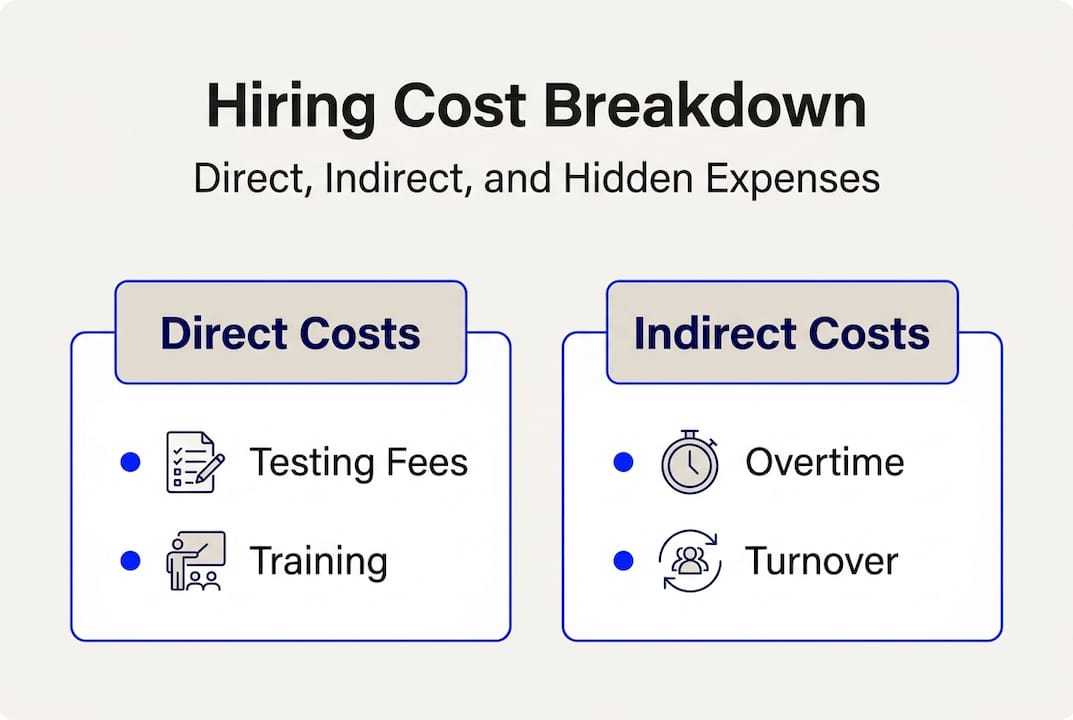
Indirect costs are where agencies often lose the most ground. Every open position generates overtime for existing staff, accelerating burnout and increasing the likelihood of additional departures. Reduced unit coverage affects response times, community trust, and officer safety. These consequences are difficult to quantify on a spreadsheet, but they are very real.
Hidden long-term costs represent the most damaging category. High turnover forces agencies to restart the entire public safety recruitment process repeatedly, multiplying costs with each cycle. Delayed hiring stretches vacancy periods, deepening the overtime spiral.
The contrast between career and volunteer staffing models illustrates just how steep these costs can become. Transitioning from volunteer to career fire departments can cost over $1 million per engine annually, a figure that underscores why facilities investment and retention strategies are far more economical than reactive hiring.
Certification requirements add another layer of expense. High entry barriers like certifications drive up firefighter and paramedic recruitment costs significantly, narrowing the qualified applicant pool and extending time-to-hire.
| Cost category | Examples | Impact level |
|---|---|---|
| Direct | Advertising, testing, equipment | Moderate |
| Indirect | Overtime, burnout, coverage gaps | High |
| Long-term/hidden | Turnover, repeated hiring cycles | Very high |
| Certification-related | Training, exam fees, prerequisites | Moderate to high |
Key cost drivers to monitor closely:
- Prolonged vacancy periods that generate compounding overtime
- Redundant or poorly sequenced screening steps
- Lack of applicant tracking technology leading to manual rework
- Insufficient employer branding resulting in low-quality applicant pools
- Inadequate onboarding that increases early attrition
Why reducing hiring costs does not mean cutting corners
Once you see where costs come from, it is easy to worry that spending less means sacrificing quality. That concern is understandable, but it reflects a false choice. The agencies that successfully reduce hiring costs do so by eliminating waste, not by weakening standards.

Recruitment is more difficult than ever, yet maintaining rigorous standards remains non-negotiable for public safety roles. The good news is that process inefficiency, not thoroughness, is what inflates costs. Redundant data entry, poorly timed screening steps, and siloed communication between HR and background investigators all add time and money without adding value.
Technology solutions, particularly applicant tracking systems and automated scheduling tools, streamline administrative tasks without bypassing critical investigator-driven checks. Automation handles the logistics; trained investigators handle the judgment calls. These are not competing priorities.
Strategic cost reductions that preserve due diligence include:
- Consolidating vendor relationships to reduce administrative overhead and negotiate volume pricing on screening services
- Standardizing application materials to reduce processing time and ensure consistent data collection from every candidate
- Implementing digital document management to eliminate paper-based bottlenecks and reduce manual filing errors
- Using structured interview frameworks to reduce the time each interviewer spends preparing, while improving consistency and defensibility
- Scheduling physical and psychological testing in cohorts rather than individually, reducing per-candidate testing costs substantially
Reducing hiring risks is also a cost-reduction strategy in its own right. A single bad hire in a public safety role can generate liability exposure, internal investigations, and reputational damage that far exceeds the cost of a thorough pre-employment background investigation.
“Efficiency in hiring is not about doing less. It is about doing the right things in the right order, so that every dollar spent on vetting actually protects the agency.”
Pro Tip: Integrate background investigations as early as the conditional offer stage rather than waiting until the final steps. Catching disqualifying information earlier prevents agencies from investing additional resources in candidates who will ultimately be eliminated.
Reviewing background vetting best practices specific to your agency type is a practical starting point for identifying where your current process wastes time and money without adding protective value.
Actionable strategies to lower hiring costs and increase efficiency
With confidence that standards can be maintained, here is how agencies can put cost-saving strategies into action.
The contrast between traditional and streamlined hiring models is striking:
| Model | Time to hire | Cost per hire | Screening quality |
|---|---|---|---|
| Traditional sequential | 6 to 12 months | Very high | Variable |
| Streamlined parallel | 3 to 6 months | Reduced | Consistent |
Parallel processing, where multiple screening steps run simultaneously rather than one after another, is one of the highest-impact changes an agency can make. Background investigation, psychological evaluation scheduling, and reference outreach do not all need to wait for the prior step to fully close.
Hiring for potential and training on the job reduces entry barriers and turnover for firefighters and paramedics, a principle that applies broadly across public safety roles. Agencies that require every certification upfront eliminate a large portion of otherwise qualified candidates, extending vacancy periods and driving up costs.
A practical roadmap for implementing cost reduction strategies:
- Audit your current hiring timeline step by step, identifying every handoff, delay, and redundancy
- Map screening steps to candidate stages so that low-cost filters (application review, basic eligibility checks) occur before high-cost steps (polygraph, full background investigation)
- Deploy an applicant tracking system integrated with your background screening provider to eliminate duplicate data entry
- Develop targeted outreach campaigns focused on qualified candidate pools, including veterans, community college programs, and lateral transfers
- Track cost-per-hire and time-to-hire metrics quarterly to identify where your process is improving and where bottlenecks persist
Following evidence-based recruitment steps gives agencies a structured framework for this audit process, reducing the guesswork involved in process redesign.
Pro Tip: Invest in employer branding before you have an open position. Agencies with strong community visibility and a clear value proposition attract more qualified applicants organically, reducing paid advertising spend and shortening time-to-fill.
Improving recruitment cycle efficiency is not a one-time project. It requires ongoing measurement and adjustment, particularly as labor market conditions and candidate expectations continue to shift.
Balancing cost, compliance, and candidate quality
Finally, maintaining the right balance is crucial for ongoing success. Cost-saving initiatives that create compliance gaps are not savings at all. They are deferred liabilities.
Key compliance risks to monitor when reducing hiring costs include:
- FCRA (Fair Credit Reporting Act) compliance requirements for any consumer report used in hiring decisions
- State-specific background check disclosure and authorization rules that vary significantly by jurisdiction
- Equal Employment Opportunity Commission (EEOC) guidance on using criminal history in public safety hiring
- POST (Peace Officer Standards and Training) minimum background investigation requirements for law enforcement
- Documentation retention obligations that protect the agency in the event of a hiring decision challenge
Quality benchmarks matter just as much as compliance checkpoints. Agencies should track offer acceptance rates, early attrition rates (departures within the first 12 months), and candidate satisfaction with the hiring process. These metrics reveal whether cost reductions are creating unintended friction that drives away qualified candidates.
Proven practices to maintain quality while lowering costs:
- Use structured, scored interview rubrics to reduce interviewer bias and improve defensibility
- Require consistent documentation at every screening stage to support audit readiness
- Conduct periodic reviews of disqualification rates by screening stage to identify bottlenecks
- Partner with a background screening provider that specializes in public safety to avoid generic, incomplete vetting
Modern station investments improve recruitment and retention, offsetting higher upfront hiring costs over the long term. The same principle applies to process investments: spending thoughtfully on the right tools and workflows reduces the total cost of hiring across multiple cycles, not just the next one.
Reviewing recruitment best practices alongside your compliance obligations gives agency leaders a complete picture of where efficiency gains are safe and where caution is warranted. For agencies also managing EMS recruitment, the compliance landscape includes additional credentialing and licensure verification requirements that must be preserved regardless of cost pressures.
A new mindset for public safety recruitment: efficiency is not the enemy of rigor
Here is an observation worth sitting with: many agencies that resist process modernization do so out of a genuine commitment to thoroughness. That instinct is admirable. But clinging to outdated, sequential hiring models does not make background investigations more rigorous. It just makes them slower and more expensive.
Agencies that have invested in streamlined workflows consistently report that the time and resources saved on administrative tasks get redirected toward deeper candidate assessment, more thorough reference interviews, and more careful review of investigative findings. Efficiency creates capacity. Capacity enables rigor.
The agencies that struggle most are those that treat every process change as a potential compromise. The leaders who succeed approach their recruitment guide as a living document, one that evolves with technology, labor markets, and community expectations. Intentional, evidence-based hiring refinement is not a threat to public safety standards. It is what those standards actually require.
Streamline your hiring process with expert support
If your agency is ready to reduce hiring costs without sacrificing the investigative depth that public safety roles demand, specialized tools and expert support make the difference between incremental improvement and transformational change.

OMNI Intel’s pre-employment screening services are purpose-built for public safety agencies, combining investigator-driven background checks for agencies with AI-assisted applicant management tools that accelerate your recruitment cycle. From law enforcement to fire, EMS, and dispatch, our pre-employment investigations are designed to protect your agency, your community, and your budget. Contact OMNI Intel to learn how your agency can achieve faster, smarter, and more cost-effective hiring without compromising the integrity your community depends on.
Frequently asked questions
How can agencies reduce hiring costs without compromising background checks?
Streamlining processes, implementing technology, and shifting more screening earlier in recruitment can reduce costs while preserving thoroughness. Hiring for potential and early screening cuts costs and supports compliance simultaneously.
What is the biggest driver of hiring costs in public safety?
The main drivers are overtime coverage, high turnover, prolonged vacancy periods, and upfront costs like training and equipment. Facilities investment offsets higher hiring costs over time, but unmanaged turnover compounds expenses rapidly.
Do background check automation tools really save hiring costs?
Yes, automation speeds up the recruitment process and cuts manual errors, reducing total hiring costs. Technology solutions can streamline background checks and lower overall recruitment spend without reducing investigative quality.
Is it more cost-effective to hire experienced recruits or train new hires?
Hiring for potential and providing agency-supported training can lower long-term costs and improve retention compared to only recruiting experienced candidates. Agencies hiring for potential and investing in training consistently see lower turnover rates.