

Law enforcement screening: Ensuring integrity in public safety hiring
TL;DR:
- Law enforcement screening involves comprehensive background checks focusing on integrity, character, and community trust.
- The process includes criminal, financial, employment, social media, psychological, and reference evaluations.
- Adhering to structured, documented, and empirically supported standards reduces hiring risks and builds community confidence.
Research consistently shows that prehire misbehavior indicators such as prior reprimands and bad credit can sharply predict later on-the-job misconduct, yet many public safety agencies still treat these signals as minor footnotes. Law enforcement screening is not simply a formality. It is the foundational safeguard that separates trustworthy public servants from candidates who pose long-term risks to communities and agency credibility. For HR managers and hiring decision-makers, understanding the full scope of this process, and applying it with rigor and consistency, is one of the most consequential responsibilities in public safety leadership.
Table of Contents
- Defining law enforcement screening: More than a background check
- Core components of the screening process
- Disqualifiers: What eliminates candidates and what the public supports
- Challenges and limitations: Polygraph, bias, and subjectivity in screening
- Best practices for HR managers: Building safer hiring programs
- Our take: What most agencies still get wrong about screening
- Enhance your screening process with proven solutions
- Frequently asked questions
Key Takeaways
| Point | Details |
|---|---|
| Screening predicts integrity | Empirical evidence links prehire behavior to future officer misconduct. |
| Go beyond basics | Law enforcement screening is more rigorous than traditional background checks, using multiple methods and benchmarks. |
| Watch for overlooked risks | Financial, social, or employment red flags often go undetected but strongly forecast later issues. |
| Use polygraphs with caution | Polygraphs can increase disclosures but have high false positive rates and potential for bias. |
| Best practices save costs | Smart, thorough screening prevents lawsuits, turnover, and protects public safety agency credibility. |
Defining law enforcement screening: More than a background check
With the need for public safety agencies to go beyond standard checks, it is vital to define exactly what law enforcement screening covers and why it matters.
Law enforcement screening is a comprehensive pre-employment background investigation process used by police departments and public safety agencies to verify candidates’ integrity, character, and suitability for roles involving authority and public trust. This definition alone signals the difference from a standard employment background check. Where a typical corporate check might confirm employment history and scan for felony convictions, law enforcement screening reaches into a candidate’s financial habits, personal associations, online behavior, and psychological fitness.
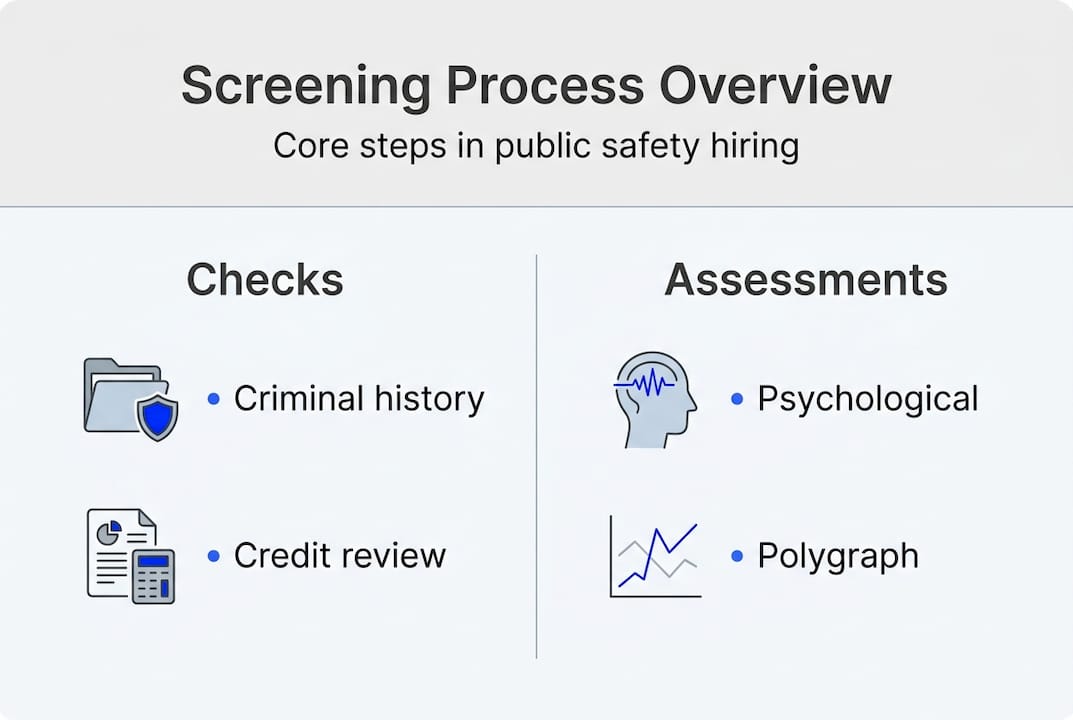
The pre-employment screening overview for public safety roles reflects a fundamentally different standard. Officers, dispatchers, and first responders carry legal authority, access sensitive data, and make life-or-death decisions. That level of responsibility demands a level of vetting that goes far beyond ticking boxes.
Key distinctions between law enforcement screening and standard background checks include:
- Integrity verification: Assessing honesty and ethical consistency across multiple sources, not just official records
- Character investigation: Interviewing neighbors, former colleagues, and personal references to build a behavioral profile
- Public trust assessment: Evaluating whether a candidate’s history supports the community-facing nature of the role
- Multi-layer documentation: Maintaining consistent, auditable records throughout each phase of investigation
- Compliance standards: Aligning with POST, CJIS, and FCRA requirements at every step
“The vetting process for law enforcement is not about finding perfect candidates. It is about identifying those whose history, character, and judgment make them suitable to carry public trust.”
The FBI screening guidelines reinforce that agencies must treat each investigation as a structured, evidence-based process rather than an administrative task. Consistency and documentation are not optional. They are the backbone of defensible hiring decisions.
Pro Tip: Build a standardized investigation checklist aligned with your state’s POST requirements before you begin any candidate review. This protects your agency legally and ensures no critical step is skipped under time pressure.
Core components of the screening process
With the definition clear, let’s examine which methods and steps are central to thorough screening.
A complete law enforcement screening process typically follows a structured sequence. Core methodologies include criminal history checks at the local, state, and federal levels, credit and financial reviews, employment and education verification, driving records, interviews with references, family members, and neighbors, social media review, polygraph or voice stress analysis where permitted, and psychological and medical evaluations.
Here is how a thorough process typically unfolds:
- Application and consent: Candidates provide written consent and biometric data, including fingerprints, before any investigation begins
- Criminal history review: Searches span local, state, and federal databases to identify any disqualifying offenses or patterns
- Financial and credit review: Financial irresponsibility is a recognized predictor of corruption risk and is reviewed carefully
- Employment and education verification: Every claim on the application is independently confirmed, including gaps in employment
- Reference and neighborhood interviews: Investigators speak directly with people who know the candidate outside of professional settings
- Social media and digital footprint review: Online behavior is increasingly central to character assessment
- Polygraph or voice stress analysis: Used in many jurisdictions to encourage fuller disclosure, though not without limitations
- Psychological and medical evaluation: Conducted by licensed professionals to assess fitness for duty
The public safety screening steps outlined by leading agencies reflect the time this process demands. Investigations can take weeks to more than a year depending on the depth required and the candidate’s history.
| Screening component | Standard employment check | Law enforcement screening |
|---|---|---|
| Criminal history | Yes | Yes, multi-jurisdiction |
| Credit and financial review | Sometimes | Always |
| Reference interviews | Basic | In-depth, including neighbors |
| Social media review | Rarely | Standard practice |
| Psychological evaluation | No | Required |
| Polygraph/voice stress | No | Common where permitted |
The FBI screening process underscores that the screening workflow must be both thorough and legally defensible, with written consent obtained before each phase.
Pro Tip: Document every step of your investigation with timestamps and source notes. If a hiring decision is ever challenged, your records are your strongest defense.
Disqualifiers: What eliminates candidates and what the public supports
Knowing the screening process, it is crucial to understand what reasons lead to rejections and how these standards align with the community’s expectations.
Automatic disqualifiers typically include felony convictions, recent or sustained drug use, dishonorable military discharge, falsification of the application, and patterns of dishonesty or irresponsibility. These are non-negotiable across most agencies.
Beyond automatic disqualifiers, agencies also apply discretionary standards. Common red flags that warrant serious review include:
- Repeated minor criminal offenses showing a pattern of poor judgment
- Significant unexplained financial debt or bankruptcy without mitigating context
- History of workplace complaints or terminations for cause
- Inconsistencies between self-reported history and verified records
- Social media content reflecting bias, dishonesty, or conduct unbecoming of a public servant
Research adds a critical layer to this picture. Prehire misbehavior indicators such as prior reprimands and bad credit predict later misconduct with hazard ratios as high as 14.59, yet agencies often reduce a candidate’s hiring chances by only about 5% for these factors. That gap between predictive data and actual hiring decisions is where risk accumulates.
| Disqualifier category | Public support level | Agency standard |
|---|---|---|
| Serious drug use history | High | Automatic disqualifier |
| Felony conviction | High | Automatic disqualifier |
| Mental illness (unmanaged) | High | Case-by-case review |
| Marijuana use (minor/past) | Low to moderate | Often discretionary |
| College education requirement | Moderate | Increasingly preferred |
Agencies that want to avoid hiring risks must align their disqualifier standards with both empirical research findings and community expectations, not just administrative tradition.
Integrating empirically based benchmarks into your disqualifier framework is not just best practice. It is the clearest path to defensible, community-supported hiring decisions.
Challenges and limitations: Polygraph, bias, and subjectivity in screening
Even with robust processes and clear disqualifiers, certain screening methods introduce their own risks and debates.
The polygraph is one of the most debated tools in law enforcement screening. As a disclosure tool, it can encourage candidates to reveal information they might otherwise withhold. However, its accuracy in screening contexts is widely questioned, with some estimates placing accuracy for screening polygraphs at around 80%, compared to higher rates for single-issue examinations. False positives are a real concern, and research suggests the tool can produce biased outcomes for minority candidates and those who are neurodiverse.
Key challenges agencies face with screening methods include:
- Polygraph inaccuracy: Screening polygraphs carry a meaningful false positive rate, which can unfairly eliminate qualified candidates
- Bias in subjective review: Without empirical benchmarks, investigators may unconsciously favor or penalize candidates based on irrelevant factors
- Neurodiversity considerations: Standard physiological and behavioral assessments may not account for candidates with conditions that affect stress responses
- Legal compliance: The Fair Chance Act and related regulations impose strict timing restrictions on when criminal history can be reviewed in the hiring process
- Inconsistent standards: Agencies that rely on gut instinct rather than structured criteria expose themselves to legal challenge and poor outcomes
Empirical insights reinforce that polygraph use should be cautious, applied as part of a multi-method screening approach for disclosure purposes, not as a standalone determinant. Subjective screening fails precisely because it lacks the structured benchmarks needed to consistently predict officer behavior.
The background check guide for public safety professionals addresses these limitations directly, recommending structured, documented processes that reduce reliance on any single method.
The polygraph debate in law enforcement hiring is unlikely to be resolved soon, but agencies that treat it as one tool among many, rather than a definitive verdict, are better positioned to make fair and accurate decisions.
Pro Tip: If your agency uses polygraph testing, pair it with structured behavioral interviews and documented reference checks. No single method should carry disproportionate weight in a hiring decision.
Best practices for HR managers: Building safer hiring programs
Given these challenges and opportunities, how should HR managers approach law enforcement screening differently going forward?
Building a safer, more defensible hiring program requires moving beyond checklists toward a structured, technology-supported, and empirically grounded approach. Here are the most impactful steps HR leaders in public safety should prioritize:
- Implement digital tracking systems: Software that logs every step of the investigation creates an auditable record and catches red flags such as social media activity or unexplained employment gaps that manual processes miss
- Use behavior-specific benchmarks: Replace subjective judgment with documented criteria tied to empirically validated predictors of misconduct, such as prior reprimands, financial irresponsibility, and dishonesty patterns
- Verify military and employment records thoroughly: POST standards require deep verification of service records and employment history, including direct contact with former supervisors
- Comply with Fair Chance Act timing: Criminal history review must occur at the right stage of the hiring process to remain legally compliant
- Require structured ride-alongs or scenario assessments: Direct observation of candidate behavior in relevant contexts adds a layer of evaluation that records alone cannot provide
- Align with CJIS standards: The CJIS security standards set the baseline for data handling and background check integrity in law enforcement contexts
Thorough investigations also produce measurable financial benefits. Avoiding a single bad hire can save an agency hundreds of thousands of dollars in litigation, retraining, and reputational damage. The investigation principles that guide effective screening programs share a common thread: consistency, documentation, and evidence-based decision-making.
Pro Tip: Schedule annual reviews of your disqualifier benchmarks against current research. Standards that made sense five years ago may no longer reflect the best predictors of officer conduct or align with evolving community expectations.
Our take: What most agencies still get wrong about screening
While best practices offer a roadmap, real insight comes from understanding where agencies most commonly fall short.
The most persistent mistake is treating screening as a compliance exercise rather than a predictive one. Agencies invest significant resources in process, checklists, and documentation, but fail to ask the more important question: does this investigation actually predict how this person will behave on the job? The answer, too often, is no.
Reliance on the polygraph is a prime example. When agencies treat a passed polygraph as a green light, they may be masking gaps in reference verification, financial review, or behavioral history. The polygraph can encourage disclosure, but it cannot substitute for the cross-referencing of multiple data sources that genuine predictive screening requires.
The path forward for ensuring safe hires runs through three commitments: investing in cross-reference checks that connect behavioral signals across multiple sources, maintaining digital recordkeeping that enables pattern recognition over time, and conducting regular benchmark reviews to ensure your standards reflect current empirical evidence. Agencies that make these investments do not just reduce risk. They build the kind of institutional credibility that communities and oversight bodies increasingly demand.
Enhance your screening process with proven solutions
If you are ready to move beyond common pitfalls and put evidence-based best practices into action, OMNI Intel offers the tools to make that transition structured and defensible.

OMNI Intel’s pre-employment screening services are purpose-built for public safety agencies, designed to meet POST, CJIS, and Fair Chance Act standards without sacrificing speed or accuracy. From investigator-driven background checks for public safety to AI-assisted candidate tracking, the platform gives HR managers the visibility and documentation they need to make defensible hiring decisions. Explore how pre-employment investigations through OMNI Intel can reduce your agency’s legal exposure, accelerate recruitment cycles, and ensure that every hire reflects the integrity your community expects.
Frequently asked questions
What is included in a law enforcement screening process?
Law enforcement screening covers criminal history checks at local, state, and federal levels, financial and credit reviews, employment and education verification, reference and neighbor interviews, social media review, psychological and medical evaluations, and polygraph testing where permitted.
How long does the law enforcement screening process take?
The process duration ranges from several weeks to more than a year, depending on the agency’s requirements, the depth of investigation, and the complexity of the candidate’s history.
What will disqualify a law enforcement candidate?
Automatic disqualifiers typically include felony convictions, sustained drug use, dishonorable military discharge, falsification of application materials, and documented patterns of dishonesty or financial irresponsibility.
Is the polygraph required for law enforcement screening?
The polygraph’s role varies by jurisdiction. Many agencies use it to encourage fuller disclosure, but its accuracy in screening contexts is frequently questioned, and it is rarely used as the sole basis for a hiring decision.
Why is screening so important in public safety hiring?
Thorough investigations protect agencies from the legal and reputational costs of bad hires, ensure that personnel in positions of authority meet the highest standards of integrity, and reinforce public trust in the institutions responsible for community safety.