

Pre-Employment Background Check Guide for Public Safety Hiring
Building a trustworthy public safety workforce starts long before uniforms and badges. For Human Resources professionals across the United States, crafting robust pre-employment background check policies is vital for protecting communities and sustaining professional standards. Comprehensive policy documents and thorough screening criteria help agencies objectively filter candidates for integrity, reliability, and legal compliance. This guide breaks down every step, from policy development to final candidate eligibility, giving hiring teams a clear roadmap to effective, defensible background investigations.
Table of Contents
- Step 1: Prepare Agency Policies And Screening Criteria
- Step 2: Collect Candidate Information And Consent
- Step 3: Conduct Comprehensive Records And Reference Checks
- Step 4: Verify Employment History And Credentials
- Step 5: Review Results And Ensure Compliance Standards
- Step 6: Document Findings And Finalize Eligibility
Quick Summary
| Key Point | Explanation |
|---|---|
| 1. Develop Clear Screening Policies | Create comprehensive pre-employment guidelines that comply with legal standards and promote fairness in candidate evaluations. |
| 2. Collect Candidate Consent | Ensure explicit written consent before collecting personal background information, while adhering to privacy regulations. |
| 3. Conduct Thorough Background Checks | Verify all candidate information through national databases and reference checks to ensure integrity and suitability. |
| 4. Standardize Employment Verification | Document employment and credentials meticulously to confirm qualifications and assess potential risks in candidates. |
| 5. Systematically Document Findings | Maintain detailed records of background investigations to support hiring decisions and facilitate transparency in the process. |
Step 1: Prepare agency policies and screening criteria
Developing comprehensive pre-employment screening policies represents the foundational cornerstone of building a reliable public safety workforce. Agencies must craft detailed guidelines that systematically evaluate candidate qualifications while adhering to legal and professional standards. The goal is creating a transparent, fair screening process that identifies candidates with the highest potential for professional integrity and community service.
To develop effective screening criteria, start by establishing clear minimum qualifications aligned with evidence-based hiring strategies. This involves defining specific educational requirements, professional certifications, physical fitness standards, and background investigation parameters. Your policy should outline comprehensive background check protocols that examine criminal records, employment history, personal references, financial responsibility, and psychological fitness. Agencies must document specific consent procedures, ensuring applicants understand and agree to thorough investigations.
Agency screening policies must balance rigorous evaluation with legal compliance and workforce diversity goals. Incorporate standardized assessment tools that reduce unconscious bias while maintaining high selection standards. By developing clear, objective screening criteria, public safety organizations can build teams characterized by professionalism, diversity, and unwavering commitment to community protection.
Pro Tip: Regularly review and update your screening policies to reflect evolving professional standards, technological capabilities, and legal requirements in public safety recruitment.
The following table compares common assessment tools used during public safety candidate evaluation:
| Assessment Tool | How It Works | Impact on Hiring Decision |
|---|---|---|
| Structured Interviews | Standardized questions | Reduces bias, improves fairness |
| Written Exams | Cognitive assessment | Identifies skills and knowledge |
| Physical Fitness Tests | Measures physical ability | Ensures job-readiness |
| Psychological Screening | Evaluates stability | Screens for suitability |
Step 2: Collect candidate information and consent
Collecting comprehensive candidate information represents a critical phase in public safety hiring where precision and legal compliance converge. Your goal is gathering detailed personal and professional background data while maintaining strict adherence to privacy regulations and ethical standards.
Begin by developing a standardized personal history statement process that comprehensively captures candidate background. This documentation should include educational records, employment history, professional certifications, military service, and comprehensive contact information. Critically, agencies must obtain explicit written consent from applicants before conducting any background investigations. The consent form should clearly outline the scope of information being collected, potential investigation methods, and the candidate’s rights. Transparency is key your forms must explicitly state which records will be reviewed including criminal databases, employment verification, credit history, and personal references.
Effective information collection requires creating a structured yet candidate friendly approach. Design user friendly forms that are clear, concise, and provide ample space for detailed responses. Ensure digital and paper versions are equally accessible, allowing candidates multiple submission options. Remember that the quality of information collected directly impacts your ability to make informed hiring decisions in public safety roles.
Pro Tip: Develop a standardized checklist to ensure every candidate receives identical documentation and understands the complete information collection process.
Step 3: Conduct comprehensive records and reference checks
Conducting comprehensive records and reference checks represents the most critical phase of public safety hiring, where meticulous investigation transforms candidate information into actionable insights. Your objective is to systematically verify every aspect of a candidate’s professional and personal background to ensure they meet the highest standards of integrity and performance.

Begin by accessing comprehensive national background databases that provide a holistic view of candidate history. These investigations should cover multiple dimensions including criminal records, employment verification, driving history, financial responsibility, and professional certifications. Pay special attention to national resources like the National Crime Information Center and the National Decertification Index. Contact previous employers, academic institutions, and professional references to validate the candidate’s claims and uncover potential performance patterns or red flags that might not appear in written documentation.
Professional background checks require a balanced approach that respects candidate privacy while maintaining rigorous screening standards. Develop a systematic process that cross references information from multiple sources, allowing you to build a comprehensive profile of each candidate’s professional capabilities and potential risks. Ensure your investigation methods comply with federal and state regulations, protecting both the agency’s interests and the candidate’s legal rights.
Pro Tip: Create a standardized scoring matrix that objectively evaluates reference check results to minimize subjective interpretation and ensure consistent candidate assessment.
Here’s a quick summary of essential background investigation components and what they assess in candidate screening:
| Investigation Component | Purpose | Typical Data Sources |
|---|---|---|
| Criminal Records | Identify past legal issues | National databases, police |
| Employment Verification | Confirm work experience | Former employers, HR departments |
| Professional Certifications | Validate claimed credentials | Licensing agencies, institutions |
| Financial Responsibility | Assess reliability and risk | Credit bureaus, records |
| Personal References | Reveal behavioral patterns | Colleagues, supervisors |
| Psychological Fitness | Ensure emotional suitability | Licensed evaluators, reports |
Step 4: Verify employment history and credentials
Employment history verification forms the cornerstone of comprehensive background investigations for public safety professionals. Your goal is to transform candidate claimed experiences into independently confirmed professional profiles that reveal genuine capabilities and potential risks.
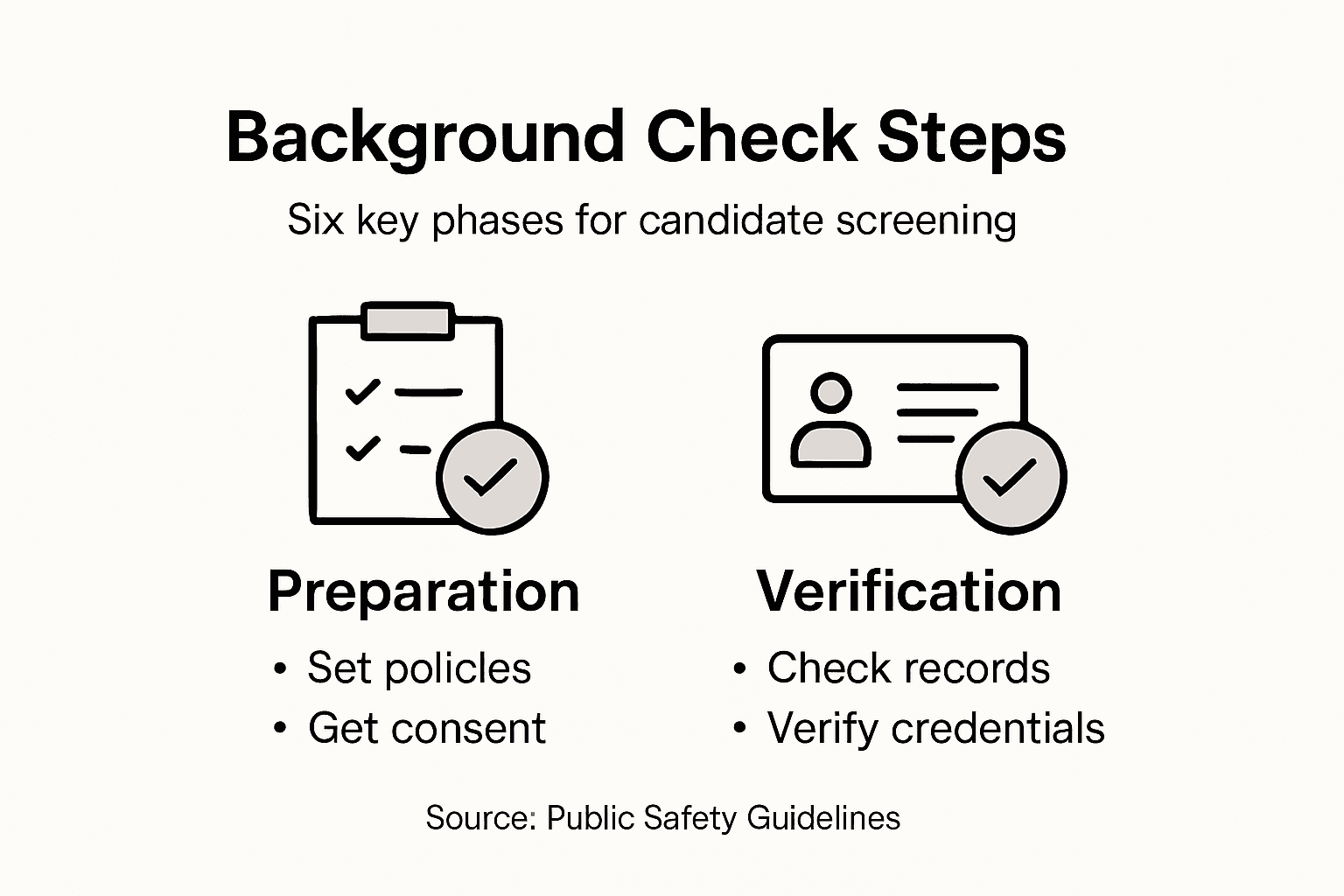
Initiate the verification process by systematically documenting employment credentials through direct communication with previous employers. Develop a structured approach that goes beyond basic employment confirmation by requesting detailed information about job responsibilities, performance evaluations, conduct records, and reasons for separation. Contact human resources departments, supervisors, and professional references to validate every aspect of the candidate’s claimed professional history. Pay special attention to any gaps in employment, discrepancies in job titles or dates of service, and patterns of workplace conduct that might indicate potential performance concerns.
Credential verification requires meticulous attention to detail and a comprehensive cross referencing strategy. Validate professional certifications, training records, educational degrees, and specialized qualifications through direct communication with issuing institutions. Implement a robust verification protocol that includes checking license status, confirming training program completions, and ensuring compliance with industry specific professional standards. Remember that each verification step builds a more complete picture of the candidate potential fitness for critical public safety roles.
Pro Tip: Develop a standardized verification tracking system that documents every communication attempt and verification result to ensure thorough and consistent background investigation processes.
Step 5: Review results and ensure compliance standards
The final stage of background investigation requires a comprehensive and systematic review that transforms raw data into actionable insights for public safety hiring decisions. Your primary objective is to analyze background check results through a lens of legal compliance, organizational standards, and professional integrity.
Begin by developing standardized review procedures that create a consistent evaluation framework for all candidate background information. This process demands a meticulous approach that cross references findings against multiple compliance standards including federal employment laws, nondiscrimination statutes, and agency specific requirements. Carefully examine each background check component looking for potential disqualifying factors red flags or patterns that might indicate unsuitability for public safety roles. Pay special attention to criminal record details, employment history discrepancies, professional credential validations, and any information that could compromise the candidate potential performance or organizational safety.
Your review must balance rigorous screening with legal protections and fairness. Implement a multi tier evaluation process that involves multiple reviewers to reduce individual bias and ensure objective decision making. Document every step of your review process creating a transparent record that demonstrates compliance with legal and ethical standards. Establish clear decision making criteria that provide consistent guidelines for accepting or rejecting candidates based on background investigation results.
Pro Tip: Create a structured decision matrix that assigns weighted scores to different background check components enabling more nuanced and objective candidate evaluation.
Step 6: Document findings and finalize eligibility
The documentation and eligibility finalization stage represents the culmination of your comprehensive background investigation process. Your primary objective is to transform detailed background check insights into a clear systematic record that supports transparent and defensible hiring decisions for public safety roles.
Begin by meticulously documenting investigation findings in a standardized format that captures every aspect of the candidate background check. Create a comprehensive report that includes detailed verification sources, specific findings, and clear annotations about each investigated element. Your documentation should provide a transparent narrative that allows reviewers to understand how specific eligibility determinations were reached. Include precise references to policy standards used for evaluation ensuring that each decision can be traced back to objective organizational criteria.
The final eligibility determination requires a holistic review that balances legal compliance professional standards and organizational needs. Develop a structured decision making framework that assigns clear weight to different background investigation components. This approach enables consistent objective evaluations that protect both the agency and potential candidates. Ensure your documentation includes specific rationales for acceptance or rejection maintaining a professional neutral tone that focuses on verifiable qualifications and potential risks.
Pro Tip: Implement a digital documentation system that allows secure storage and easy retrieval of background investigation records to support future audits and review processes.
Enhance Your Public Safety Hiring with OMNI Intel Solutions
Building a trustworthy public safety workforce starts with a thorough and compliant pre-employment background check process. As outlined in the guide, challenges such as developing clear screening policies, collecting detailed candidate information, and verifying employment history require precision and legal adherence. OMNI Intel understands these critical pain points—especially the need for comprehensive investigations that emphasize integrity, accuracy, and transparency.
Our platform offers tailored screening solutions designed specifically for public safety agencies. By leveraging AI-driven tools and law enforcement principles, OMNI Intel accelerates recruitment cycles while ensuring compliance and reducing risk. Whether you need to improve candidate vetting or streamline your hiring process, our technology supports your goal of building a professional team committed to community safety.
Discover how our specialized approach can transform your hiring strategy by exploring Hiring Best Practices | OMNI Intel.
Take control of your hiring process today and ensure every candidate meets the highest standards required for public safety roles. Visit OMNI Intel now to learn how our platform can help you implement evidence-based hiring decisions that protect your agency and community.
Frequently Asked Questions
What is the purpose of pre-employment background checks in public safety hiring?
Pre-employment background checks in public safety hiring aim to verify candidates’ qualifications and assess their suitability for roles that require high integrity and community commitment. To ensure a reliable hiring process, agencies should establish clear policies that outline the qualifications and screening methods used.
How can agencies develop effective screening criteria for public safety candidates?
Agencies can develop effective screening criteria by defining minimum qualifications related to education, certifications, and physical fitness standards. Start by aligning these criteria with evidence-based hiring strategies and documenting comprehensive background check protocols.
What types of information should be included in a candidate’s personal history statement?
A candidate’s personal history statement should include educational records, employment history, professional certifications, military service, and comprehensive contact information. Create a standardized form that captures this data clearly and concisely for easier evaluation.
How can I ensure thorough verification of a candidate’s employment history and credentials?
To verify a candidate’s employment history and credentials, contact previous employers directly and request detailed information about job responsibilities and performance. Implement a structured approach to ensure all components are validated, from job titles to professional certifications.
What steps should be taken to review background check results effectively?
Agencies should develop standardized review procedures to evaluate background check results consistently. Examine each component for potential red flags or disqualifying factors, ensuring that legal compliance and organizational standards are upheld during the decision-making process.
How should findings from background investigations be documented?
Documenting findings should involve creating a comprehensive report capturing every aspect of the background investigation. Ensure that the documentation clearly outlines the sources and rationale behind eligibility determinations to maintain transparency and support future audits.
Recommended
- Avoid Hiring Risks: Master Pre-Employment Background Investigations for Public Safety Professionals • OMNI Intel
- Background Investigation Insights | OMNI Intel
- Why Employment Screening for Government Employees Is Crucial Now • OMNI Intel
- Struggling with Post Employment Background Verification? Here’s the Fix • OMNI Intel