

Why County IT Employees Need Background Checks
County IT employees who access Criminal Justice Information (CJI) are required by federal policy to pass fingerprint-based background checks before receiving system access. This requirement stems directly from CJIS Security Policy 6.0, the FBI’s governing framework for all agencies that handle criminal justice data. The policy covers not just sworn officers but every person with logical, physical, or support access to CJI, including network administrators, help desk staff, and contracted IT vendors. Understanding why county IT employees need background checks is the first step toward building a hiring program that protects both your agency and the public it serves.
Why county IT employees need background checks: the regulatory foundation
The legal basis for background screening county IT staff is not discretionary. CJIS Security Policy 6.0 mandates state and national fingerprint-based criminal history checks for any individual with logical, physical, or support access to CJI. That definition is broad by design. It captures the IT contractor who patches your records management system just as firmly as it captures the detective who queries the database.
Three prerequisites must be satisfied before any employee or contractor receives CJI access:
- Fingerprint-based criminal history check. The check must run through both state repositories and the FBI’s national database. A commercial background check alone does not satisfy this requirement.
- Security awareness training. Personnel must complete CJIS-approved training before access is granted, not during onboarding or afterward as a formality.
- Security Addendum execution. Every individual with CJI access must sign the CJIS Security Addendum, a binding agreement that outlines acceptable use and personal accountability.
Audit obligations accompany these prerequisites. Agencies must maintain current, retrievable documentation for every person with CJI access. A lapse in any one of the three areas, even for a single employee, constitutes a compliance failure during a CJIS audit.
Pro Tip: Treat the Security Addendum as a living document. Re-execute it whenever an employee changes roles, gains elevated system privileges, or moves from on-site to remote access.
The scope of CJIS requirements also extends to Managed Service Providers (MSPs) serving county networks. Agencies must sign CJIS Security Addenda with their MSPs and verify that all vendor staff with CJI access have completed fingerprint-based screening and security awareness training. Outsourcing IT functions does not transfer compliance responsibility. It multiplies it.
What security risks come from inadequate screening of county IT staff?
The most direct risk is what security professionals call “security asymmetry.” Non-cleared IT and support staff present a significantly weaker identity verification profile than cleared personnel, creating exploitable gaps that adversaries can target. A county network administrator with unverified credentials and broad system access is a single point of failure for the entire agency.

Small municipalities face a compounded version of this problem. When one IT employee manages multiple environment layers, including firewalls, servers, and user accounts, the consequences of a bad hire extend across every system that person touches. Small municipal IT teams face higher risk precisely because a single employee often controls the full technology stack, with no redundant oversight to catch misuse.
The risks county officials must account for include:
- Insider threats from trusted access. An employee with legitimate credentials who misuses them is harder to detect than an external attacker. Insider threats often go undetected for months.
- Fraudulent credentials and synthetic identities. Without fingerprint-based verification, an applicant can present fabricated education, employment history, or even a false identity that a commercial database check will not catch.
- Identity verification gaps for remote staff. Remote IT contractors present the highest identity risk. Physical presence at least allows visual verification. Remote access grants system privileges without that baseline check.
- Vendor and MSP exposure. Third-party staff who access county systems under a service contract carry the same risk profile as direct employees. Agencies that screen their own staff but not their vendors create an obvious gap.
“Background checks are not a complete prevention plan. Many malicious insiders do not have prior convictions. Layered safeguards and training on suspicious behavior are vital components of any effective risk strategy.”
That insight reframes the purpose of background checks. They are a necessary filter, not a complete solution. Agencies that treat a passed background check as the end of their security obligation leave themselves exposed to the full range of insider threats that emerge after hire.
How should county officials implement an effective background check program for IT staff?
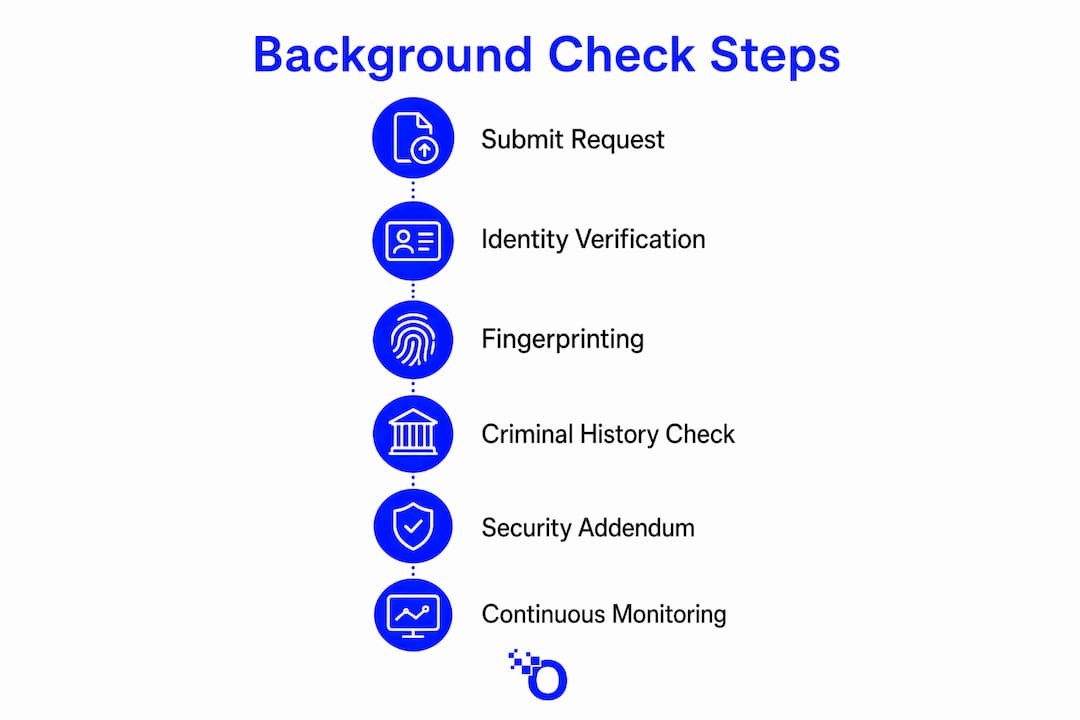
Implementation requires coordination between HR, IT leadership, and legal counsel. The most common failure point is timing. Compliance responsibility is often fragmented among HR, IT, and leadership, leading to gaps where employees receive system access before their background check or security training is complete. Closing that gap requires a structured, sequenced process.
- Start background checks before the offer. Beginning background screening early in recruitment, prior to offer acceptance, reduces hiring delays and prevents unauthorized access during the onboarding window. Treat compliance as a pre-recruiting function, not a post-offer formality.
- Align system access timing with verification completion. No employee or contractor should receive CJI system credentials until fingerprint results are returned, the Security Addendum is signed, and security awareness training is documented as complete. Build this sequence into your HR onboarding checklist.
- Mandate security awareness training as a hard gate. Training is not an orientation module. Under CJIS Security Policy 6.0, it is a prerequisite for access. Schedule it before the employee’s first day of system use, and track completion in your HR system.
- Implement continuous monitoring and periodic re-screening. Periodic re-screening every 2–3 years, or whenever a role’s sensitivity changes, is required to maintain compliance under evolving security policies. An employee who passed a check three years ago may have a disqualifying event in their recent history.
- Extend requirements to all vendors and MSPs. Draft vendor contracts to require CJIS-compliant screening for all staff with CJI access. Require documentation of their compliance before granting network access, and audit vendor records on the same cycle as your own staff.
Pro Tip: Create a single compliance tracker that HR and IT both update in real time. When the tracker shows all three prerequisites complete, IT activates access. When any item lapses, access is suspended automatically.
Identity verification for remote IT staff deserves special attention. Remote contractors who access county systems from outside the network perimeter require the same fingerprint-based screening as on-site employees. The physical distance does not reduce the risk. It increases it. Agencies should also consult legal guidance on layered safeguards when building vendor oversight policies, particularly when MSP contracts cross jurisdictional lines.
The investigation timeline matters for workforce planning. Tier 1 investigations take 2–4 weeks. Tier 2 moderate-risk investigations take 4–8 weeks. High-risk investigations may extend to 4–12 months. County HR departments that wait until a position is vacant to begin screening will face extended gaps in IT coverage. Build the screening timeline into your workforce planning calendar.
How does documentation support audits and ongoing security for county IT departments?
Documentation is the evidence that compliance happened. CJIS audits focus heavily on whether agencies can produce fingerprint-based background check results, signed Security Addenda, and training completion records for every person with CJI access. An agency whose employees are technically cleared but whose records are incomplete will fail the audit. The technical fact of compliance is not enough. The paper trail must confirm it.
The table below outlines the core documentation categories, what each must contain, and the common failure mode for each.
| Documentation Type | Required Content | Common Failure Mode |
|---|---|---|
| Fingerprint-based check results | State and FBI national results, date of completion | Using commercial check results in place of fingerprint-based results |
| Signed Security Addendum | Individual signature, date, role at time of signing | Addendum not re-executed after role change or access expansion |
| Security awareness training records | Completion date, training provider, employee name | Training completed after system access was granted |
| Vendor and MSP compliance records | Screening results and addenda for all vendor staff with CJI access | Vendor staff screened by vendor but records not shared with the agency |
| Periodic re-screening records | Date of re-screen, updated results, role at time of re-screen | Re-screening not triggered when employee changes roles |
Fragmented responsibility is the root cause of most documentation failures. When HR owns the background check, IT owns the access log, and no one owns the Security Addendum, records end up in three separate systems with no single source of truth. The background check documentation process works best when one designated compliance owner maintains a master file for every person with CJI access.
Continuous monitoring reinforces documentation discipline. When agencies track employee status in real time, they catch lapses before auditors do. A re-screening cycle tied to calendar reminders, role change notifications, and contract renewal dates keeps records current without requiring manual audits of the full employee roster every year.
Key Takeaways
Thorough background screening for county IT employees is the single most effective control for protecting CJI access, maintaining CJIS compliance, and reducing insider threat exposure across government networks.
| Point | Details |
|---|---|
| CJIS Policy 6.0 is mandatory | All personnel with CJI access must complete fingerprint checks, training, and sign the Security Addendum before access is granted. |
| Timing prevents unauthorized access | Starting background checks before offer acceptance closes the gap where employees receive system access before verification is complete. |
| Vendors carry the same risk as employees | MSPs and contractors with CJI access must meet identical screening requirements, with documentation held by the agency. |
| Documentation determines audit outcomes | Agencies that cannot produce fingerprint results, signed addenda, and training records will fail CJIS audits regardless of actual compliance. |
| Re-screening sustains long-term compliance | Periodic re-screening every 2–3 years, or at role change, catches disqualifying events that occurred after the initial hire. |
What county HR leaders consistently underestimate about IT background checks
County HR leaders consistently underestimate the scope of who qualifies as a CJI-access employee. The assumption is that background check requirements apply to law enforcement personnel and stop there. They do not. Every IT employee, contractor, and MSP technician who touches a system containing criminal justice data falls under CJIS Security Policy 6.0. I have seen agencies with fully compliant sworn officer screening programs that had never run a single fingerprint check on their network administrator.
The second underestimation is the gap between a passed background check and a secure employee. Background checks verify history. They do not predict future behavior. An employee who passes a check on day one can become an insider threat on day 365. That is why continuous monitoring, clear reporting channels, and a leadership culture that takes boundary violations seriously are not optional additions to a background check program. They are the program’s second half.
The jurisdictional complexity of county government makes this harder than it sounds. A county IT department may serve multiple agencies, each with different access levels and different compliance obligations. The HR team managing those hires may not have deep familiarity with CJIS requirements. The IT director may not know what documentation HR is keeping. That fragmentation is where compliance failures are born.
The fix is not complicated. Assign one compliance owner. Build a shared tracker. Sequence access behind verification. Audit vendor records on the same cycle as your own staff. These are not sophisticated controls. They are disciplined ones. The agencies that fail CJIS audits almost never fail because they lacked the right technology. They fail because no one owned the process.
— Matt
OMNI Intel’s screening services for county IT compliance
County government HR teams face a specific challenge: screening IT employees to CJIS standards while managing the full scope of public sector hiring. OMNI Intel’s pre-employment screening services are built for exactly this environment, combining investigator-driven background investigations with compliance documentation support tailored to government agencies.

OMNI Intel’s platform supports fingerprint-based criminal history checks, Security Addendum tracking, and continuous post-hire monitoring, giving HR and IT leadership a single source of truth for every employee with CJI access. Whether your county is onboarding a new network administrator or auditing vendor compliance across an MSP contract, OMNI Intel’s background investigations are designed to meet the evidentiary standards CJIS auditors require. Contact OMNI Intel to build a screening program that keeps your county IT department compliant and your community’s data secure.
FAQ
What does CJIS Security Policy 6.0 require for county IT employees?
CJIS Security Policy 6.0 requires fingerprint-based state and national criminal history checks, completion of security awareness training, and execution of the CJIS Security Addendum before any employee or contractor receives access to Criminal Justice Information.
Do background check requirements apply to IT contractors and MSP staff?
Yes. Any contractor or MSP technician with logical, physical, or support access to CJI must meet the same fingerprint-based screening and training requirements as direct county employees, and the agency must hold documentation of their compliance.
How often should county IT employees be re-screened?
Re-screening every 2–3 years is the standard practice, with additional re-screening required whenever an employee changes roles or gains elevated system access. This cycle catches disqualifying events that occur after the initial hire.
What happens if an agency fails a CJIS compliance audit?
Agencies that cannot produce fingerprint check results, signed Security Addenda, and training completion records for all CJI-access personnel will fail the audit, even if employees are technically cleared. Incomplete documentation is treated as a compliance failure.
Why are background checks alone not enough for county IT security?
Background checks verify an employee’s history at the time of hire. They do not prevent insider threats that develop after employment begins. Layered safeguards including multifactor authentication, continuous monitoring, and clear reporting channels are required to address risks that emerge post-hire.