

The Role of Watch List Screening in Security Firms
Watch list screening is the process by which security firms verify individuals against authorized sanctions lists, politically exposed persons (PEP) databases, adverse media reports, and internal watchlists to identify potential security risks and meet regulatory standards. The role of watch list screening in security firms extends beyond a simple database query. It is a foundational control that shapes hiring decisions, protects agency reputation, and satisfies legal obligations under frameworks like the Fair Credit Reporting Act (FCRA). Whether you are a compliance officer at a private security company or a public safety HR director, understanding how this process works and where it can break down is the difference between a defensible program and a liability.
What Is the Role of Watch List Screening in Security Firms?
Watch list screening, also called sanctions screening or compliance screening in formal regulatory contexts, is the systematic comparison of an individual’s identity against curated databases of known or suspected threats. These databases include Office of Foreign Assets Control (OFAC) sanctions lists, Interpol notices, PEP registries, adverse media archives, and agency-specific internal watchlists. Each list serves a distinct purpose, and together they create a layered picture of risk.
For security firms, this process is not optional. Regulators and contracting agencies expect documented evidence that personnel have been checked against relevant lists before they are placed in sensitive roles. A security officer with access to a federal facility, a financial institution, or a school campus carries a level of trust that demands verification beyond a standard criminal background check.
The distinction between a watch list check and a criminal record check matters. Criminal records reflect past convictions. Watch lists capture current designations, including individuals under active investigation, those subject to financial sanctions, and persons flagged for association with terrorist organizations or organized crime. A candidate may have a clean criminal record and still appear on an OFAC sanctions list. That gap is exactly what watch list compliance is designed to close.
Adverse media screening adds another layer. Automated tools scan news sources, court filings, and regulatory announcements for negative coverage tied to a candidate’s name. This catches reputational risks that formal databases may not yet reflect, particularly in cases where investigations are ongoing but no formal charge has been filed.
How Do Security Firms Use Watch List Screening in Their Process?
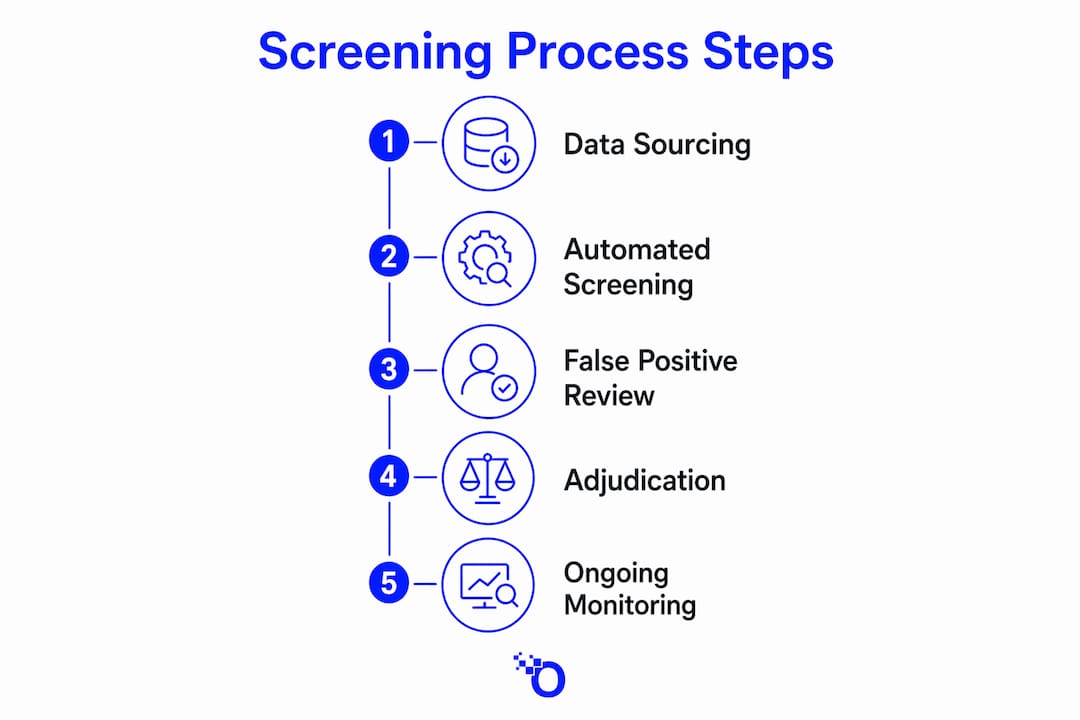
The operational mechanics of a security firm’s screening process begin with data sourcing. A comprehensive global watchlist search scans more than 1,800 international enforcement databases across 190+ countries. That scale means a single candidate check touches sanctions lists from the European Union, the United Nations, the U.S. Treasury, and dozens of national law enforcement agencies simultaneously.

Turnaround time varies significantly by platform and configuration. Some systems return results in under one second. Others, particularly those requiring manual verification or cross-referencing with restricted government databases, may take up to seven days. Security firms with high-volume hiring pipelines need to account for this variability when building their screening timelines.
The core workflow typically follows this sequence:
- Identity capture: Collect full legal name, date of birth, government-issued ID number, and any known aliases. Incomplete identity data is the most common cause of inconclusive results.
- Automated matching: The platform compares the candidate’s identity against all configured databases using fuzzy logic and phonetic matching to account for name variations and transliteration differences.
- Alert generation: Any potential match triggers an alert for human review. The alert includes the source list, the matched name, and a confidence score.
- Human adjudication: A trained reviewer assesses whether the alert represents a true match or a false positive. This step requires documented reasoning and a clear decision trail.
- Integration with broader checks: Combining watchlist screening with identity verification, criminal background checks, and employment history checks produces a complete risk profile rather than an isolated data point.
Pro Tip: Configure your watchlist platform to flag aliases and name variants automatically. Many high-risk individuals operate under multiple identities, and a search limited to a single legal name will miss them entirely.
Experts confirm that watchlist screening tools function as risk identification signals, not definitive guilt markers. A hit on a watchlist prompts further due diligence. It does not automatically disqualify a candidate. That distinction protects both the firm and the applicant.
What Are the Regulatory Requirements for Watch List Compliance?
Security firms operate under a web of federal, state, and sector-specific regulations that govern how screening must be conducted, documented, and communicated. The FCRA is the primary federal statute. Under FCRA, security firms must provide candidates a copy of the screening report, a summary of their rights, and an opportunity to dispute findings before taking any adverse employment action. This pre-adverse action process applies when a watchlist result contributes to a hiring denial or termination.
Failure to follow FCRA’s pre-adverse action steps exposes firms to individual lawsuits and class action claims. The adverse action process is not a formality. It is a legally required sequence with specific timing requirements that compliance officers must track for every affected candidate.
Beyond FCRA, sector-specific mandates add further obligations:
- Armed security roles: Personnel with access to weapons, explosives, or high-security facilities face enhanced scrutiny. Certain high-risk roles require personnel reliability screening every three years to maintain job authorization. This interval is not a suggestion. It is a condition of continued employment in those positions.
- Federal facility access: Programs like the Transportation Security Administration (TSA) and the Private Security Officer Employment Authorization Act (PSOEAA) require biometric fingerprints and signed consent for personnel background screening. Without these exact inputs, state agencies may refuse to process the check entirely.
- Documentation standards: Regulators expect an audit trail for every screening decision. This includes the date of the check, the databases queried, the results returned, the adjudication rationale, and the final employment decision. Verbal approvals and informal notes do not satisfy this standard.
The FCRA compliance requirements for public safety HR teams are detailed and non-negotiable. Security firms that treat compliance as an afterthought rather than a program design principle consistently face the highest regulatory exposure.
What Are the Biggest Challenges in Managing Watch List Screening?
False positives are the dominant operational challenge in watch list compliance. Most watchlist alerts are false positives caused by common names or transliteration differences. For a security firm processing hundreds of applications per month, this creates a significant workload that can delay hiring and frustrate candidates who have done nothing wrong.
The instinct to solve this problem by adding more reviewers is understandable but inefficient. Managing false positives efficiently requires fine-tuning matching algorithms to reduce workload without compromising legally required audit trails. Hiring more staff addresses the symptom, not the cause.
The table below compares reactive and proactive approaches to managing screening challenges:
| Challenge | Reactive Approach | Proactive Approach |
|---|---|---|
| High false positive volume | Add more manual reviewers | Fine-tune algorithm confidence thresholds |
| Missed post-hire risks | Wait for incident reports | Schedule periodic re-screening by risk tier |
| Inconsistent adjudication | Rely on reviewer judgment | Implement documented decision frameworks |
| Regulatory audit gaps | Reconstruct records after the fact | Maintain real-time audit logs per check |
Pro Tip: Set confidence score thresholds that match your risk tolerance. A threshold set too low floods reviewers with noise. A threshold set too high misses genuine matches. Calibrate quarterly based on your false positive rate.
Ongoing screening is the second major challenge. Risk profiles change post-hire, and a one-time pre-employment check cannot capture those changes. Compliance programs must maintain documented, repeatable re-screening processes on intervals of one to three years, depending on role risk tier. A security officer who clears screening at hire may appear on a sanctions list eighteen months later. Without a periodic re-screening schedule, that change goes undetected.
The importance of watch list checks extends into the employment lifecycle, not just the hiring decision. Firms that treat screening as a one-time event create blind spots that regulators and contracting clients will eventually find.
How to Implement a Watch List Screening Program in a Security Firm
Building a watch list screening program that holds up under regulatory scrutiny requires structure, not improvisation. The following steps reflect current best practices for both public safety agencies and private security firms:
-
Define your risk tiers. Not every role carries the same risk. Classify positions by access level, sensitivity, and regulatory requirement. Armed officers, facility access personnel, and those handling sensitive data belong in a higher tier with more frequent and more extensive screening.
-
Select and configure your screening platform. Choose a platform that covers the databases relevant to your risk tiers. Confirm it supports international background checks if your workforce includes candidates with foreign histories. Verify that the platform generates audit-ready records automatically.
-
Integrate watchlist checks with your full screening package. A watchlist check run in isolation delivers partial value. Integrated screening packages that combine watchlist results with criminal records, identity verification, and employment history checks give compliance officers a complete picture of candidate suitability. This is the standard that regulators and high-value clients expect.
-
Establish your adjudication framework. Document the criteria reviewers use to distinguish true matches from false positives. Define escalation paths for confirmed hits. Specify who has authority to make the final employment decision and what documentation that decision requires.
-
Build your re-screening schedule. Map each risk tier to a re-screening interval. High-risk roles warrant annual checks. Standard roles may qualify for a two-year or three-year cycle. Automate reminders so re-screening does not depend on a reviewer remembering to initiate it.
-
Train your team. Reviewers who do not understand the legal weight of their adjudication decisions create compliance exposure. Training should cover FCRA pre-adverse action requirements, the difference between a watchlist hit and a disqualifying finding, and the documentation standards your program requires.
-
Audit your program annually. Pull a sample of screening records and verify that every step was completed, documented, and timed correctly. Identify gaps before a regulator or contracting client does. Use audit findings to update your adjudication framework and platform configuration.
Public safety agencies face an additional consideration. Whether you screen law enforcement candidates or private security officers, the program structure is the same. The specific databases and regulatory mandates differ, but the underlying logic of risk-tiered, documented, and repeatable screening applies universally.
Understanding whether certain legal records, such as pretrial diversion outcomes, appear in screening results is also part of building a complete adjudication framework. Compliance officers need to know what each check captures and what it does not.
Key Takeaways
Watch list screening is a legally required, operationally complex control that security firms must treat as a program, not a single transaction.
| Point | Details |
|---|---|
| Screening scope | A global watchlist search covers 1,800+ databases across 190+ countries, requiring platform configuration to match your risk tiers. |
| FCRA compliance | Pre-adverse action disclosures are legally mandatory before any hiring denial based on screening results. |
| False positive management | Algorithm tuning, not additional headcount, is the most effective way to reduce false positive workload. |
| Ongoing re-screening | Risk profiles change post-hire; re-screening intervals of one to three years are required for a defensible compliance program. |
| Integrated approach | Watchlist checks deliver the highest value when combined with criminal, identity, and employment history verification. |
Why Watch List Screening Deserves a Permanent Seat at the Table
I have reviewed enough compliance programs to recognize a pattern. Organizations that treat watch list screening as a checkbox exercise tend to discover its importance only after something goes wrong. A contractor placed in a sensitive facility turns out to be on an OFAC list. A security officer hired without a re-screening protocol is later flagged in an adverse media search. The cost of those discoveries, measured in legal exposure, contract loss, and reputational damage, always exceeds the cost of a properly structured screening program.
What I find most underappreciated is the adjudication layer. Compliance officers invest heavily in selecting the right platform and configuring the right databases. They invest far less in building the decision framework that governs what happens when a hit comes back. That gap is where programs fail. A watchlist hit is a signal, not a verdict. The reviewer who cannot articulate why a hit was dismissed or acted upon creates a record that will not survive regulatory scrutiny.
The shift toward continuous monitoring is the most significant operational change I have seen in this space. Pre-employment screening was once considered sufficient. The current regulatory expectation, particularly for armed and high-risk roles, is that screening continues throughout employment. Firms that have not yet built a post-hire monitoring workflow are operating behind the standard, even if their pre-employment process is strong.
The technology exists to automate most of this. The discipline required to configure it correctly, audit it regularly, and train reviewers to use it well is the harder part. That discipline is what separates a program that protects the organization from one that merely creates the appearance of compliance.
— Matt
OMNI Intel’s Approach to Security Firm Screening
Security firms and public safety agencies need a screening partner that understands both the regulatory weight and the operational demands of watch list compliance. OMNI Intel builds its pre-employment screening services around the investigator-driven principles that public safety hiring requires, combining watchlist checks, criminal record searches, identity verification, and employment history review into a single, FCRA-compliant workflow.

OMNI Intel’s security company background checks are designed for both armed and unarmed officer roles, with configurable screening packages that match your risk tiers and re-screening schedules. The platform maintains audit-ready records at every step, so your compliance documentation is always current. If your agency is ready to build a screening program that holds up under scrutiny, OMNI Intel provides the structure and the expertise to get there.
FAQ
What is watch list screening in the context of security firms?
Watch list screening is the process of checking candidates and employees against sanctions lists, PEP databases, adverse media sources, and internal watchlists to identify security risks. Security firms use it to meet regulatory requirements and protect clients from placing high-risk personnel in sensitive roles.
How often should security firms re-screen employees?
Re-screening intervals depend on role risk tier. High-risk roles, particularly those involving arms or access to secure facilities, require re-screening every three years at minimum, and annual checks are considered best practice for the highest-sensitivity positions.
What happens when a watchlist hit is returned?
A watchlist hit triggers human review to determine whether the alert is a true match or a false positive. If confirmed, the firm must follow FCRA pre-adverse action procedures before taking any employment action, including providing the candidate a copy of the report and an opportunity to dispute the finding.
Why are false positives such a significant problem in watch list compliance?
Common names and transliteration differences cause most watchlist alerts to be false positives. This creates a high volume of manual review work. Fine-tuning the platform’s matching algorithm and confidence score thresholds is the most effective way to reduce that burden without creating gaps in the audit trail.
What federal programs govern watch list screening for private security officers?
The PSOEAA and TSA programs set specific requirements for private security personnel, including mandatory biometric fingerprints and signed consent forms. Without these exact inputs, state agencies may decline to process the background check, leaving the firm without a completed screening record.