

Why compliance matters in public safety hiring: A guide
TL;DR:
- Compliance in public safety hiring involves adhering to federal laws like Title VII, FCRA, and EEOC guidelines.
- A structured process includes validated selection tools, individualized criminal reviews, and proper recordkeeping.
- Proper compliance can be a recruitment advantage, enhancing transparency, diversity, and workforce integrity.
Compliance in public safety hiring is far more than a procedural formality. One misstep, such as skipping a pre-adverse action notice or applying a blanket criminal record ban, can halt your entire hiring cycle, expose your agency to costly litigation, or jeopardize federal funding. For HR professionals and hiring managers in law enforcement, fire, EMS, and dispatch, understanding the legal framework governing your selection process is not optional. It is the foundation of every defensible hiring decision you make. This guide breaks down the essential compliance requirements, shows how they shape your screening process, and explains how to navigate the gray areas that trip up even experienced agencies.
Table of Contents
- What compliance means in public safety hiring
- Essential compliance requirements: Standards and laws
- How compliance shapes the screening process
- Navigating edge cases and gray areas
- A fresh take: Compliance as a recruitment advantage, not a burden
- Get help streamlining compliance and safer hiring
- Frequently asked questions
Key Takeaways
| Point | Details |
|---|---|
| Legal compliance is essential | Following EEOC, FCRA, and other laws is required to prevent lawsuits and lost hires. |
| Validated, job-related screening | Use assessments tied to job duties to ensure fairness and defend your process. |
| Handle gray areas carefully | Edge cases like criminal records and polygraphs need individualized attention to avoid risk. |
| Compliance boosts recruitment | Getting compliance right widens your applicant pool and supports agency credibility. |
What compliance means in public safety hiring
In the context of public safety hiring, compliance refers to adherence to a layered set of federal laws, regulatory guidance, and validation standards that govern how agencies select, screen, and onboard personnel. It is not simply about avoiding lawsuits. It is about building a hiring process that is legally defensible, job-related, and consistent across all applicants.
The core legal sources shaping public safety hiring best practices include:
- Title VII of the Civil Rights Act (1964): Prohibits employment discrimination based on race, color, religion, sex, or national origin, and applies directly to selection procedures.
- Uniform Guidelines on Employee Selection Procedures (UGESP): Federal standards requiring that any selection tool, whether a written exam, physical test, or background check, be validated as job-related if it produces adverse impact.
- Fair Credit Reporting Act (FCRA): Governs how consumer reports, including background checks, are obtained and used in hiring, with strict notice and authorization requirements.
- EEOC Guidance on Background Checks: Clarifies how criminal history information may be used without violating Title VII.
- I-9 Employment Eligibility Verification: Mandatory documentation confirming every new hire’s legal authorization to work in the United States.
As one legal analysis notes, compliance in public safety hiring “primarily ensures adherence to federal laws like Title VII via UGESP, requiring selection procedures to be validated and job-related.”
The stakes are real. Non-compliant agencies face discrimination charges, stalled hiring pipelines, and reputational damage that erodes public trust. Proper data privacy obligations and background check requirements are not bureaucratic overhead. They are your agency’s first line of defense against legal exposure and the foundation of fair, evidence-based hiring.
With this foundation, let’s explore the essential compliance requirements in hiring.
Essential compliance requirements: Standards and laws
Understanding the legal landscape is one thing. Translating it into daily hiring actions is another. Each major regulation carries specific procedural obligations that must be embedded into your workflow.
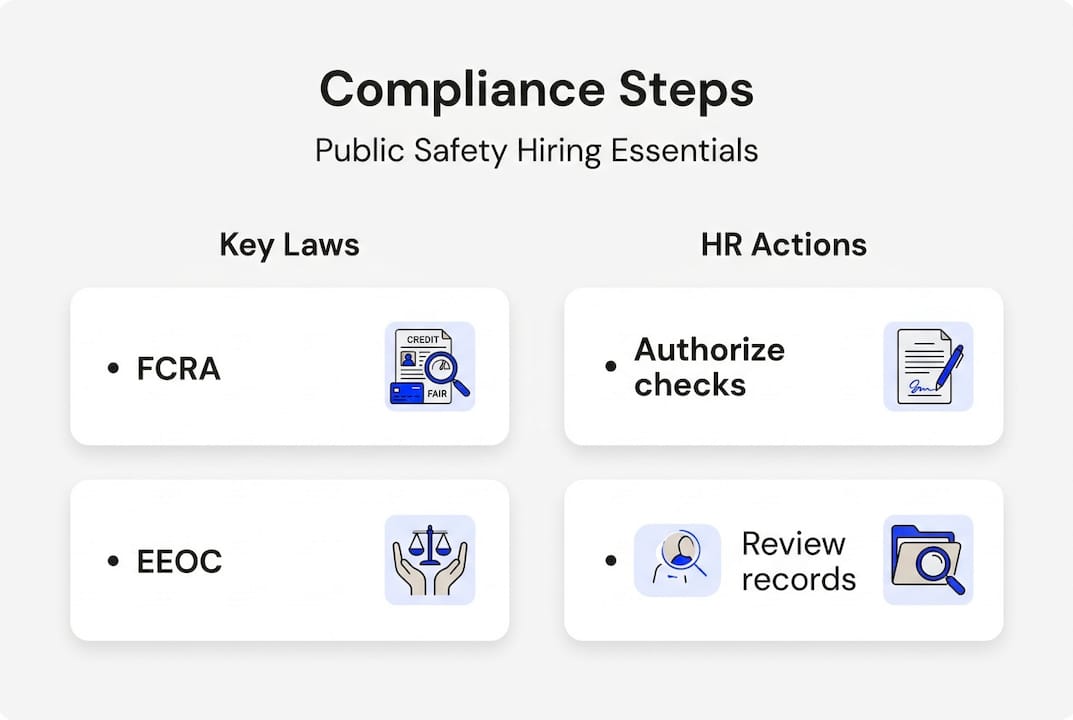
The EEOC background check guidance and related federal rules require agencies to move through several distinct compliance layers. Here is how the core requirements break down:
| Regulation | What it covers | Required HR action |
|---|---|---|
| FCRA | Background check authorization and adverse action | Obtain written consent; send pre-adverse and adverse action notices |
| I-9 | Work eligibility verification | Complete Form I-9 for every hire within 3 days of start date |
| EEOC Guidance | Non-discriminatory use of criminal history | Conduct individualized assessments; avoid blanket exclusions |
| OFCCP (federal contractors) | Affirmative action and adverse impact analysis | Maintain records; analyze selection rates by demographic group |
A critical point on FCRA compliance basics: FCRA-compliant background checks require candidate authorization, a pre-adverse action notice, and a waiting period before any final adverse decision is made. Skipping any one of these steps creates immediate legal exposure.
The scale of enforcement is significant. 81,055 discrimination charges were filed with the EEOC in fiscal year 2023 alone, a number that underscores how frequently agencies and employers fall short of their legal obligations.
Common compliance pitfalls include failing to provide individualized criminal history reviews, using unvalidated selection tests that produce disparate impact, and neglecting proper recordkeeping for I-9 documentation. Each of these errors can trigger audits, complaints, or litigation that stalls your step-by-step hiring process for months.
Pro Tip: Always provide an individualized review of criminal histories before making an adverse decision. Document your reasoning, the nature of the offense, time elapsed, and its direct relevance to the position. This single practice significantly reduces your exposure to blanket exclusion lawsuits.
Understanding compliance standards, the next step is knowing how these rules become embedded in day-to-day hiring.
How compliance shapes the screening process
Compliance is not a checklist you complete at the end of hiring. It is woven into every step of your public safety background check guide, from the moment an application is submitted to the day a conditional offer is extended.
A compliant public safety hiring process typically follows this sequence:
- Application and job posting: Selection criteria must be validated and directly job-related before the position is advertised.
- Written consent: Obtain signed FCRA authorization before initiating any background investigation.
- Assessment and testing: Administer only validated selection tools, including physical ability tests, written exams, or psychological evaluations.
- Background investigation: Conduct a thorough review of employment history, finances, criminal history, and references under FCRA guidelines.
- Polygraph examination (where applicable): Administer only in compliance with the Employee Polygraph Protection Act (EPPA), ADA, and EEOC rules.
- Conditional offer and pre-adverse action: Issue a conditional offer, then follow FCRA’s adverse action process if disqualifying information is found.
According to the Havre de Grace Police recruitment policy, background investigations are comprehensive, covering employment history, finances, and criminal history under FCRA, and must verify integrity, with polygraph screening used as a decision-support tool compliant with EPPA, ADA, and EEOC.
| Feature | Compliant process | Non-compliant process |
|---|---|---|
| Criminal history review | Individualized, job-related assessment | Blanket exclusion of all records |
| Background check consent | Written authorization obtained first | Check run without candidate knowledge |
| Polygraph use | Follows EPPA and EEOC guidelines | Used as sole disqualifier without legal basis |
| Recordkeeping | Documented and retained per law | Incomplete or missing records |
Agencies that miss these steps face consequences that go beyond fines. Loss of accreditation, inability to hire under federal grants, and civil litigation are all documented outcomes. Reviewing verifying applicant credentials procedures regularly helps agencies catch gaps before they become liabilities. The comprehensive screening benefits of a structured process extend to faster onboarding and fewer post-hire misconduct incidents.

Pro Tip: Validate every selection procedure, including physical fitness standards and written tests, by documenting their connection to actual job duties. This validation record is your primary defense if a disparate impact claim is filed.
Knowing how compliance is applied, let’s look at handling complex or controversial areas.
Navigating edge cases and gray areas
Even well-structured hiring programs encounter situations where the rules are less clear. These edge cases require careful judgment, documented reasoning, and a firm grasp of both federal law and agency-specific policy.
Common edge cases in public safety hiring include:
- Polygraph use: Permitted for law enforcement and national security roles under EPPA exemptions, but must not be used as the sole basis for rejection.
- Individualized criminal record reviews: Required by EEOC guidance before any adverse action based on criminal history.
- Adverse impact analysis for federal contractors: Federal contractors over $10,000 must conduct adverse impact analyses under OFCCP, with timing restrictions on criminal inquiries and no disparate treatment in security checks.
- Disparate treatment vs. disparate impact: Disparate treatment means intentional discrimination. Disparate impact means a neutral policy disproportionately excludes a protected group. Both are actionable.
Examples of improper exclusions that agencies sometimes apply without realizing the legal risk include:
- Blanket bans on applicants with any tattoos, regardless of content or visibility
- Automatic disqualification for minor, decades-old offenses with no direct job relevance
- Requiring credit checks for roles where financial history has no demonstrated connection to job duties
- Excluding candidates based on arrest records alone, without a conviction
The EEOC’s best practice standard is clear: individualized assessments for criminal records must consider the nature of the offense, time elapsed, and job relevance to meet the “business necessity” standard. Agencies that skip this step are not just at legal risk. They are also shrinking their candidate pools unnecessarily, which compounds recruiting challenges in an already tight labor market.
For recruiting qualified public safety candidates, diversifying candidate pools while maintaining rigorous standards is achievable when selection criteria are validated, documented, and applied consistently. Reviewing your public safety screening steps against current EEOC and OFCCP guidance at least annually is a straightforward way to stay ahead of legal exposure.
With technical processes and gray areas covered, let’s discuss the compliance role in recruiting success.
A fresh take: Compliance as a recruitment advantage, not a burden
Most agencies treat compliance as a defensive posture. They build processes around avoiding lawsuits rather than around attracting the best candidates. That framing is worth challenging.
Agencies that invest in validated, well-documented hiring processes consistently report fewer hiring disputes, faster onboarding timelines, and stronger workforce diversity. When your selection criteria are job-related and clearly communicated, candidates trust the process. That trust translates into higher offer acceptance rates and lower early attrition.
Arbitrarily rigid criteria, such as blanket tattoo bans or automatic disqualification for minor offenses, do not make agencies safer. They make agencies smaller. The agencies succeeding in today’s recruiting environment are the ones using compliance as a tool to build better pipelines, not just as a shield against litigation.
The comprehensive screening value of a structured, validated process extends well beyond legal protection. It creates a hiring program that is transparent, defensible, and genuinely effective at identifying candidates who will serve with integrity. Compliance, done right, is your strongest recruiting asset.
Get help streamlining compliance and safer hiring
Building a compliant, efficient hiring process for public safety roles requires more than policy documents. It requires the right tools, the right expertise, and a platform built specifically for the demands of law enforcement, fire, EMS, and dispatch hiring.

OMNI Intel’s pre-employment screening services are designed to help agencies meet FCRA, EEOC, and UGESP requirements without slowing down your recruiting pipeline. From pre-employment investigations that cover criminal history, employment verification, and financial background, to a fully structured vetting process for public safety that integrates with your existing hiring workflow, OMNI Intel gives you the infrastructure to hire with confidence. Reduce legal risk, speed up onboarding, and build the reliable, integrity-driven workforce your community depends on.
Frequently asked questions
What are the legal risks of non-compliance in public safety hiring?
Non-compliance risks include EEOC discrimination charges, civil lawsuits, hiring delays, and potential loss of federal funding. The EEOC received 81,055 discrimination charges in fiscal year 2023, reflecting how frequently these issues arise across employers of all sizes.
Can agencies exclude all applicants with criminal records?
Blanket exclusions typically violate EEOC guidance and expose agencies to disparate impact claims. Individualized assessments that weigh the nature of the offense, time elapsed, and direct job relevance are required to establish business necessity.
Is polygraph use allowed for public safety hiring?
Polygraph screening is permitted for public safety roles under EPPA exemptions, provided it is used in compliance with EPPA, ADA, and EEOC rules, and is not the sole basis for an adverse hiring decision.
What laws shape public safety hiring compliance?
The primary legal framework includes Title VII via UGESP, FCRA, I-9 verification requirements, EEOC guidance on criminal history and background checks, and OFCCP regulations for agencies operating as federal contractors.