

Nonprofit screening guide: safety and compliance in 2026
TL;DR:
- Proper screening protects vulnerable populations, staff, and organizational reputation, reducing legal and financial risks.
- Compliance with laws like FCRA and state-specific regulations is essential for lawful background checks.
- A tiered, ongoing, and fair screening approach balances safety with equitable opportunity.
Nonprofits often operate on the assumption that shared values and good intentions are enough to keep their communities safe. That assumption carries real risk. Whether you lead a youth mentoring program, a homeless shelter, or a disaster relief organization, the people you bring on, whether paid staff or volunteers, can expose your organization to serious legal, financial, and reputational harm. A single inadequate screening decision can result in harm to a vulnerable individual, a costly lawsuit, or the loss of donor trust. This guide walks nonprofit leaders through the legal standards, practical frameworks, and strategic considerations needed to build a screening program that is both protective and fair.
Table of Contents
- Why screening matters for nonprofits
- Legal requirements for nonprofit screenings
- Tiered screening: Matching checks to risk levels
- Balancing safety and fair hiring practices
- Our take: What most nonprofits miss about screening
- Take action: Expert screening solutions for nonprofits
- Frequently asked questions
Key Takeaways
| Point | Details |
|---|---|
| Legal compliance is essential | Nonprofits must adhere to FCRA, ban-the-box laws, and robust documentation to avoid liability. |
| Risk-based screening | Tailor screening intensity to the risk level of each role, with frequent re-checks for high-risk staff and volunteers. |
| Balance safety and fairness | Rigorous screening should not block opportunities; use references and consider fair chance hiring for inclusion. |
| Screening is ongoing | Background checks start the process, but vigilance through periodic re-screening ensures ongoing safety. |
Why screening matters for nonprofits
Nonprofits exist to serve people, often the most vulnerable members of society: children, the elderly, individuals experiencing homelessness, and those recovering from trauma. That mission creates a heightened duty of care that many organizations underestimate until something goes wrong. Screening is not a bureaucratic formality. It is a foundational layer of protection for the people you serve, the staff and volunteers who serve alongside you, and the organization itself.
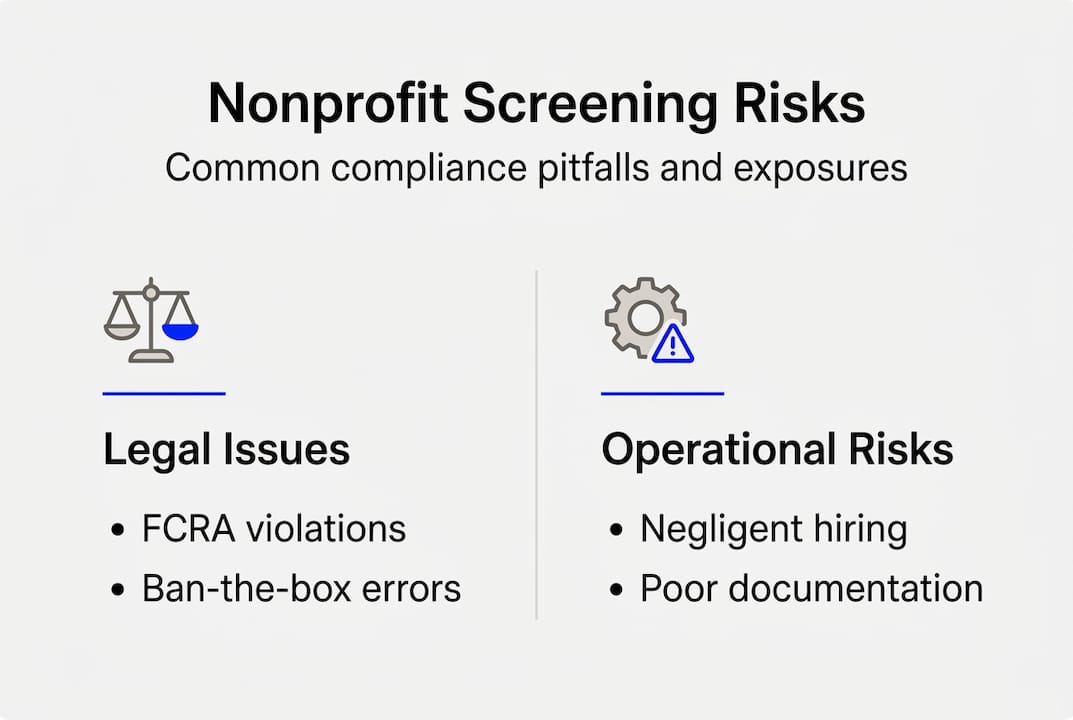
The legal exposure alone is significant. Negligent hiring claims arise when an organization fails to conduct reasonable due diligence before placing someone in a position of trust. Courts have consistently held organizations liable when a foreseeable harm occurs and the employer failed to identify warning signs that a proper background investigation would have revealed. For nonprofits working with children or other vulnerable groups, this exposure is even more acute.
Beyond legal liability, there is the matter of organizational reputation. A single incident involving an unvetted volunteer can generate media coverage that takes years to recover from, and in the nonprofit sector, reputation is directly tied to funding. Donors, grantors, and government partners all evaluate organizational integrity before committing resources.
At the same time, the screening conversation is not one-sided. As volunteer screening improvements become more sophisticated, nonprofits must also grapple with the tension between rigorous vetting and equitable access to opportunity. Strict screening is essential for safety and liability, especially in roles involving youth or vulnerable populations, but fair chance hiring principles caution against policies that create disparate impact on historically marginalized communities.
Key considerations for nonprofit leaders include:
- Liability exposure increases significantly when organizations skip checks for roles involving direct care or access to sensitive information
- Reputational damage from a single incident can affect donor confidence, grant eligibility, and community trust
- Equitable screening requires balancing safety requirements with policies that do not systematically exclude qualified candidates based on past records unrelated to the role
- Volunteer-specific risks are often underestimated because volunteers are not employees, but they carry the same potential for harm
“The stakes in nonprofit screening are not abstract. They are measured in the safety of real people, the sustainability of your mission, and the integrity of your organization.”
Understanding why screening matters is the starting point. The next step is understanding what the law actually requires.
Legal requirements for nonprofit screenings
Many nonprofit leaders assume that legal compliance is primarily a concern for large corporations or government agencies. In reality, the legal framework governing background checks applies broadly, and nonprofits are not exempt. Failing to comply can result in regulatory penalties, civil litigation, and damaged relationships with the communities you serve.
The Fair Credit Reporting Act (FCRA) is the primary federal law governing background checks conducted by third-party consumer reporting agencies. When a nonprofit uses an outside vendor to run a background check, FCRA compliance is mandatory. This means the FCRA screening compliance process must include a standalone written disclosure to the applicant, a signed authorization before the check is run, and a formal adverse action process if the results are used to deny a position.
The adverse action process has two steps. First, you must provide the applicant with a pre-adverse action notice, a copy of the report, and a summary of their rights. Then, after a reasonable waiting period, typically five business days, you must issue a final adverse action notice. Skipping either step is a common and costly mistake.
Beyond FCRA, background check legal standards vary significantly by state. Ban-the-box laws now exist in over half of U.S. states, delaying criminal history inquiries until after a conditional offer of employment has been made. Some jurisdictions extend these protections to volunteers as well.
Record retention is another overlooked obligation. Organizations should retain screening records for a minimum of five years, though state laws may require longer periods. Proper data privacy in screening protocols also require secure storage and restricted access to applicant records.
Here is a step-by-step overview of a compliant screening process:
- Develop a written screening policy that specifies which roles require which types of checks
- Provide standalone FCRA disclosure to the applicant before initiating any third-party check
- Obtain signed authorization from the applicant prior to running the check
- Conduct the background investigation through a compliant consumer reporting agency
- Review results and apply your policy consistently across all candidates
- Issue pre-adverse action notice if results may disqualify the applicant, including a copy of the report
- Allow a response period before issuing a final adverse action decision
- Retain all records securely in accordance with applicable state and federal requirements
Pro Tip: Do not rely on a single background check vendor without verifying their FCRA compliance certifications. Ask specifically whether they conduct multi-jurisdictional criminal searches and whether their adverse action process is built into their platform workflow.
Tiered screening: Matching checks to risk levels
Not every role in a nonprofit carries the same level of risk, and applying the same screening intensity across all positions is neither practical nor strategically sound. A tiered screening approach allows organizations to allocate resources efficiently while ensuring that the highest-risk roles receive the most thorough vetting.

Risk-tiered screening is the recommended standard: comprehensive checks including multi-jurisdictional criminal searches and sex offender registry verification for high-risk roles involving vulnerable populations, and basic checks for low-risk positions. Re-screening every one to two years, or annually for seasonal roles, is also advised.
| Role type | Risk level | Recommended checks | Re-screen frequency |
|---|---|---|---|
| Youth program staff | High | Multi-jurisdictional criminal, sex offender registry, reference verification | Annually |
| Financial administrator | High | Criminal, credit history, employment verification | Every 1 to 2 years |
| Event volunteer (supervised) | Low | Basic criminal, identity verification | Every 2 years |
| Remote administrative volunteer | Low | Identity verification, basic criminal | Every 2 years |
| Seasonal camp counselor | High | Comprehensive criminal, sex offender, references | Annually |
For organizations like fire and rescue departments that also rely on volunteers, volunteer background checks for fire and rescue organizations follow a similar tiered logic, with role-specific risk assessments driving the depth of investigation.
Practical considerations for implementing a tiered system include:
- Document your risk classifications in writing so decisions are consistent and defensible
- Apply tiers uniformly across comparable roles to avoid claims of selective enforcement
- Build re-screening into your calendar rather than treating it as an ad hoc process
- Review your tier structure annually as roles evolve and organizational risk profiles change
For a broader view of how public safety screening frameworks translate across sectors, the underlying principles of risk classification remain consistent: the greater the access to vulnerable individuals or sensitive resources, the more thorough the investigation must be.
Balancing safety and fair hiring practices
One of the most challenging aspects of nonprofit screening is navigating the genuine tension between protecting the people you serve and maintaining hiring practices that do not unfairly exclude qualified candidates. This is not a theoretical concern. It has real consequences for organizational culture, community relationships, and legal exposure.
Criminal history screening, in particular, can create disparate impact on communities of color, who are statistically more likely to have prior records due to systemic inequities in the criminal justice system. A blanket policy that disqualifies anyone with a criminal record may feel like a safety measure, but it can function as a barrier that undermines your mission if your organization serves those very communities.
| Approach | Benefit | Risk |
|---|---|---|
| Blanket criminal disqualification | Simple to administer | High disparate impact risk, may exclude qualified candidates |
| Role-specific criminal review | Targeted and defensible | Requires individualized assessment capacity |
| Reference-based screening | Surfaces behavioral patterns | Less objective, harder to standardize |
| Combination approach | Balanced and thorough | Requires clear policy documentation |
Fair chance hiring principles recommend using references and character assessments alongside or instead of criminal checks when the nature of the role permits. For positions that do not involve direct access to vulnerable populations or financial assets, a prior record may simply not be relevant to the candidate’s ability to perform the role safely and effectively.
The types of checks used in public safety hiring offer a useful model: not every check is appropriate for every role, and the selection of screening tools should be driven by a documented, individualized assessment of what each position actually requires.
Pro Tip: When reviewing a candidate with a criminal record, apply an individualized assessment that considers the nature of the offense, the time elapsed, evidence of rehabilitation, and the specific duties of the role. Document your reasoning. Consistency and documentation are your best legal defenses.
The goal is not to eliminate all risk, which is impossible, but to make informed, defensible decisions that protect both the people you serve and the integrity of your organization.
Our take: What most nonprofits miss about screening
Here is the uncomfortable truth: most nonprofits treat background screening as a one-time event rather than an ongoing organizational discipline. A candidate passes a check, joins the team, and is never screened again, sometimes for years. That approach creates a false sense of security.
People change. Circumstances change. A volunteer who was a model contributor three years ago may have experienced significant life events since their initial screening. Continuous monitoring and periodic re-screening are not signs of distrust. They are signs of organizational maturity.
More importantly, screening is only as effective as the culture surrounding it. If your organization does not have clear reporting channels, a written code of conduct, and supervisory structures that make misconduct visible, even a perfect background check cannot protect you. The check is the beginning of your due diligence, not the end.
We also see organizations focus exclusively on criminal history while ignoring reference checks, employment verification, and behavioral interviews, tools that often reveal far more about how a person will actually perform in a role. Building volunteer screening strategies that incorporate multiple data points produces a far more accurate picture than any single database search.
Screening is a culture, not a checkbox.
Take action: Expert screening solutions for nonprofits
If your organization is ready to move beyond one-size-fits-all screening and build a program that is legally sound, risk-calibrated, and fair, OMNI Intel is built for exactly that.

Our pre-employment screening services are designed with the rigor of law enforcement investigation principles, adapted for the specific needs of nonprofits and mission-driven organizations. From safe hire investigations that go beyond surface-level database checks to purpose-built volunteer screening solutions, OMNI Intel gives nonprofit leaders the tools to make confident, compliant, and defensible hiring decisions. Your mission depends on the people behind it. Make sure those people are thoroughly vetted.
Frequently asked questions
What types of background checks are required for nonprofit volunteers?
Comprehensive checks including multi-jurisdictional criminal and sex offender registry searches are recommended for high-risk roles, while basic criminal and identity checks are generally sufficient for low-risk volunteer positions.
Are nonprofits legally required to comply with FCRA in screenings?
Yes. When using a third-party provider, nonprofits must follow FCRA requirements for disclosure, written authorization, and formal adverse action procedures before making a disqualifying decision.
How often should nonprofit staff and volunteers be re-screened?
Re-screening every one to two years is the general standard, with annual re-screening recommended for seasonal roles and high-risk positions involving vulnerable populations.
Can screening policies unintentionally discriminate against certain groups?
Yes. Overly broad criminal disqualification policies can create disparate impact on marginalized communities, and fair chance hiring practices, including individualized assessments and reference-based screening, help reduce that risk.