
Why Responsible Recruitment Matters for Public Safety
Public safety agencies face a recruitment crisis few anticipated. Only 7% of officers recommend policing careers to friends or family, revealing deep challenges in attracting talent. Responsible recruitment practices offer a proven path to rebuild trust, improve employee integrity, and create sustainable hiring pipelines. This approach transforms how agencies attract, vet, and retain qualified candidates while strengthening community relationships.
Table of Contents
- Understanding The Recruitment Challenges In Public Safety Agencies
- Why Responsible Recruitment Matters: Enhancing Trust And Integrity
- Implementing Responsible Recruitment: Key Components And Compliance
- Best Practices For Sustaining Responsible Recruitment And Retention
- Enhance Your Responsible Recruitment With OMNI Intel Solutions
Key takeaways
| Point | Details |
|---|---|
| Responsible recruitment reduces misconduct | Robust vetting and transparent hiring practices decrease misconduct incidents by 20-30% while building public confidence. |
| Strong leadership drives recruitment success | Visible, caring leadership correlates directly with improved staffing levels and positive employee recommendations. |
| Legal compliance protects agencies | Job-related, validated selection procedures meet federal requirements and reduce liability risks. |
| Retention matters more than recruitment | Addressing retention issues provides greater impact on staffing stability than recruitment efforts alone. |
Understanding the recruitment challenges in public safety agencies
Public safety recruitment faces obstacles most agencies underestimate. The 7% recommendation rate among current officers signals a credibility crisis that traditional recruitment methods cannot solve. When your own workforce won’t advocate for careers within your agency, external marketing efforts face an uphill battle.
The real challenge isn’t recruitment but retention driving staffing shortages. Agencies lose experienced personnel faster than they can hire replacements. Exit interviews reveal dissatisfaction with leadership, organizational culture, and career development opportunities. Fixing these retention drivers creates sustainable staffing solutions.
Many agencies respond with financial incentives that fail to address core attrition issues. Signing bonuses and salary increases provide temporary relief but don’t resolve underlying morale problems. Worse, these incentives can attract candidates motivated by money rather than service, creating future retention challenges.
Modern recruitment requires strategic approaches:
- Transform every employee into an active recruiter with structured support
- Build authentic organizational culture that current staff proudly promote
- Maintain constant recruitment messaging across all communication channels
- Address leadership and workplace issues driving voluntary departures
Agencies implementing public safety recruitment best practices see measurable improvements in both application quality and quantity. This strategic shift moves beyond reactive hiring toward proactive talent pipeline development.
“Recruitment success depends on creating workplaces current employees genuinely recommend to others, not just marketing campaigns targeting external candidates.”
Why responsible recruitment matters: enhancing trust and integrity
Responsible recruitment practices deliver measurable benefits extending far beyond filling vacant positions. Rigorous vetting reduces misconduct by 20-30%, protecting both agency reputation and community safety. Every misconduct incident erodes public trust built over years, making prevention through careful selection essential.

Transparent hiring processes create accountability that communities notice and value. Background checks boost positive perception by 15-25% when agencies communicate their commitment to thorough vetting. This transparency demonstrates that agencies prioritize public safety over filling positions quickly.
Community involvement in recruitment yields surprising results. Agencies engaging the public see 15-20% trust increases as residents recognize their voice in hiring decisions. Advisory boards, community forums, and public feedback sessions build legitimacy that traditional closed-door hiring cannot achieve.
The transparency in hiring benefits extend internally as well. Current employees trust organizations with clear, consistent selection standards. This internal confidence translates into the employee advocacy agencies desperately need for successful recruitment.
Responsible recruitment practices include:
- Publishing clear hiring standards and disqualification criteria
- Conducting comprehensive background investigations on all finalists
- Involving diverse stakeholders in selection processes
- Documenting all screening decisions with job-related justifications
- Communicating hiring outcomes appropriately to maintain transparency
“Agencies demonstrating commitment to responsible recruitment through transparent practices build community trust that enhances both recruitment success and operational effectiveness.”
Implementing responsible recruitment: key components and compliance
Legal compliance forms the foundation of responsible recruitment. Selection devices must be job-related and validated to meet Uniform Guidelines on Employee Selection Procedures standards. Agencies using unvalidated tests, interviews, or screening criteria face significant liability under Title VII, ADA, and state employment laws.
Validation failures create legal exposure as demonstrated in multiple NYPD cases where courts found screening procedures lacked job-relatedness. The financial and reputational costs of discrimination lawsuits far exceed investment in proper validation studies. Every selection tool requires documented evidence connecting it to actual job performance.
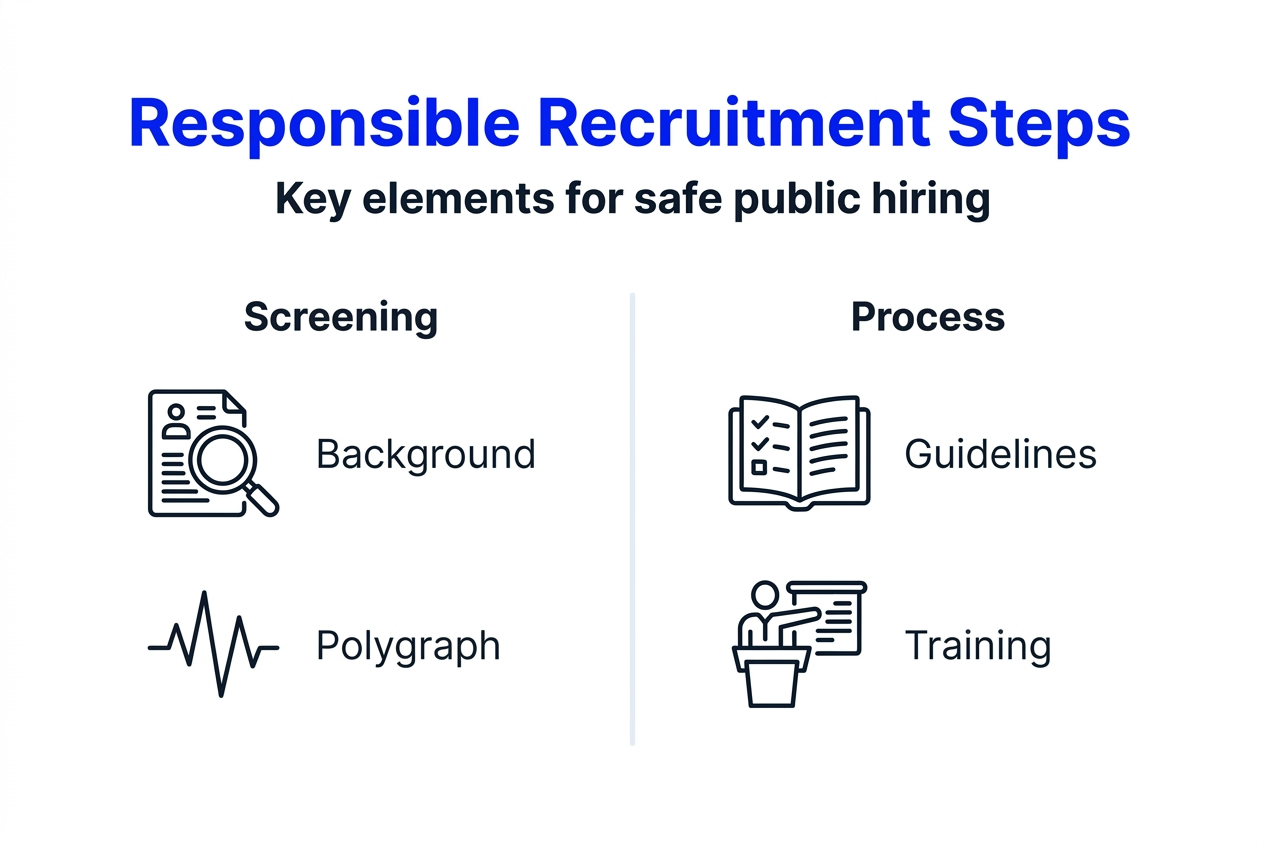
Comprehensive screening identifies risks traditional interviews miss. Polygraph test failures predict unethical behavior at three times the rate of those passing, while psychological evaluations detect personality traits incompatible with public safety roles. These tools, properly administered, prevent costly hiring mistakes.
Essential responsible recruitment components:
| Component | Purpose | Validation Requirement |
|---|---|---|
| Background investigations | Verify employment, criminal history, financial responsibility | Job-related criteria documented |
| Psychological evaluations | Assess emotional stability, decision-making, stress tolerance | Professional administration, validated instruments |
| Polygraph examinations | Detect deception regarding application information | State-compliant protocols, trained examiners |
| Reference checks | Gather performance insights from previous supervisors | Structured questions, consistent evaluation |
| Social media screening | Identify public behavior inconsistent with agency values | Clear policies, job-related standards |
Developing clear guidelines for edge cases prevents inconsistent decisions that create legal vulnerability. Candidates with prior minor infractions, employment gaps, or credit issues require case-by-case evaluation balancing rehabilitation evidence against risk factors. Documented decision criteria ensure fair treatment while protecting agency interests.
Pro Tip: Maintain detailed records of validation studies, adverse impact analyses, and selection decisions. These documents prove essential during Equal Employment Opportunity Commission investigations or litigation.
Continuous training reduces bias in recruitment processes. Hiring panels need regular education on unconscious bias, legal compliance, and diversity best practices. This training improves both decision quality and defensibility.
Ongoing monitoring extends responsible hiring beyond initial selection. Safe hiring investigations continue through probationary periods and employment tenure. Post-hire screening detects changes in criminal history, financial stability, or other risk factors requiring intervention.
Agencies should master background investigations by developing standardized procedures, training investigators thoroughly, and maintaining consistent documentation. This expertise prevents gaps that create future liability.

Best practices for sustaining responsible recruitment and retention
Transforming every employee into an active recruiter multiplies recruitment capacity exponentially. Provide structured talking points, referral incentives, and recognition programs that empower staff to represent your agency authentically. The most credible recruiters are current employees sharing genuine experiences with potential candidates.
Leadership presence correlates with strong staffing because visible, accessible leaders demonstrate organizational health. Chiefs and commanders who regularly interact with line staff, attend community events, and communicate transparently create cultures people want to join. This visibility signals stability and care that applicants value.
Constant recruitment messaging across channels maintains pipeline flow during both high and low application periods. Integrate recruitment content into staff meetings, community presentations, social media, and local media coverage. Consistency builds brand recognition that attracts candidates when they’re ready to apply.
Data-driven recruitment strategies replace guesswork with evidence. Track key performance indicators including:
- Application-to-hire conversion rates by recruitment source
- Time-to-fill metrics for different position types
- Demographic data showing recruitment reach and diversity
- Cost-per-hire calculations guiding budget allocation
- First-year retention rates indicating selection quality
Recruitment requires specialized expertise beyond general HR knowledge. Successful programs employ professionals who understand public safety culture, legal compliance, modern marketing techniques, and applicant tracking systems. Investing in expert recruiters yields better results than assigning recruitment as a collateral duty.
Pro Tip: Analyze which recruitment sources produce candidates who pass screening and succeed long-term. Double down on high-quality sources rather than spreading efforts across many low-yield channels.
Addressing retention complements recruitment for sustainable staffing. Exit interview data reveals fixable problems driving departures:
- Inadequate career development and promotion opportunities
- Poor supervision and leadership development
- Work-life balance issues and scheduling inflexibility
- Insufficient recognition and appreciation programs
- Limited input in operational decisions
Agencies recruiting qualified public safety candidates while simultaneously improving retention achieve staffing stability competitors cannot match. This dual focus creates competitive advantage in tight labor markets.
Enhance your responsible recruitment with OMNI Intel solutions
Implementing responsible recruitment requires tools designed specifically for public safety hiring challenges. Many agencies struggle with fragmented systems that create gaps in screening coverage or compliance documentation.

OMNI Intel provides public safety pre-employment screening tailored to law enforcement, fire, EMS, and related agencies. The platform streamlines comprehensive background checks for public safety roles while maintaining the thoroughness these positions demand. Integration capabilities connect screening processes with existing recruitment workflows through applicant screening integration, reducing administrative burden while improving compliance documentation. These solutions help agencies implement the responsible recruitment practices that build community trust and employee integrity.
Frequently asked questions
What is responsible recruitment in public safety?
Responsible recruitment encompasses ethical, legal, and transparent hiring practices that prioritize candidate quality and community trust over filling positions quickly. It includes validated selection procedures, comprehensive background investigations, psychological evaluations, and community involvement in hiring processes. These practices ensure agencies hire individuals with integrity, competence, and alignment with organizational values while meeting legal requirements.
How does responsible recruitment improve community trust?
Transparent vetting processes demonstrate agency commitment to accountability and public safety. When communities see rigorous screening standards applied consistently, they gain confidence that personnel meet high integrity standards. Public involvement in hiring decisions through advisory boards and feedback mechanisms increases legitimacy. Agencies communicating their thorough selection processes build trust that survives individual misconduct incidents because the community recognizes systemic commitment to quality.
What are the legal requirements for recruitment selection tools?
Federal law requires all selection devices to be job-related, valid, and free from discriminatory impact on protected classes. Agencies must conduct validation studies demonstrating that tests, interviews, background checks, and other screening tools predict actual job performance. Non-compliance creates liability under Title VII, Americans with Disabilities Act, Age Discrimination in Employment Act, and state fair employment laws. Documentation proving job-relatedness and validation is essential for legal defense.
How can agencies handle candidates with prior disciplinary issues?
Develop clear, written guidelines assessing severity, context, time elapsed, and rehabilitation evidence for prior infractions. Consider whether the issue relates to essential job functions and public safety risks. Case-by-case evaluations balance fairness with agency protection, examining remorse, corrective actions taken, and subsequent behavior. Document decision rationale thoroughly to demonstrate consistent application of standards and legal defensibility.
What role does leadership play in responsible recruitment?
Leadership visibility and genuine care for employee wellbeing directly correlate with recruitment success and retention rates. Leaders who communicate transparently, address workplace issues promptly, and demonstrate commitment to staff development create cultures current employees recommend to others. This internal advocacy proves more effective than external marketing. Leaders also set ethical tone for recruitment practices, ensuring compliance and integrity throughout hiring processes.