

Streamline your Employee Vetting Workflow in Public Safety
Public safety agencies face a critical challenge: lengthy vetting processes leave positions unfilled for weeks, compromising community safety and straining existing staff. A structured employee vetting workflow can cut recruitment time by 25-30% while maintaining compliance and reducing hiring risks by up to 40%. This guide walks you through building an efficient, compliant vetting system tailored to law enforcement, fire, EMS, and related agencies.
Table of Contents
- Prerequisites: What You Need Before Starting
- Designing An Employee Vetting Workflow
- Integrating Technology And Tools
- Common Mistakes And How To Avoid Them
- Continuous Monitoring And Risk Mitigation
- Alternative Approaches And Tradeoffs
- Expected Results And Outcomes
- Explore OMNI Intel’s Vetting Solutions To Optimize Your Workflow
- Frequently Asked Questions About Public Safety Employee Vetting
Key takeaways
| Point | Details |
|---|---|
| Risk reduction | Structured workflows reduce hiring risks by up to 40% through comprehensive multi-step screening. |
| Speed gains | AI and automation cut recruitment time by 25-30% compared to manual processes. |
| Post-hire protection | Continuous monitoring detects 50% more risk events after hiring than pre-hire checks alone. |
| Legal compliance | FCRA and state law adherence is mandatory to avoid violations and candidate challenges. |
| Balanced approach | Hybrid technology-manual workflows optimize speed, accuracy, and cost-effectiveness. |
Prerequisites: what you need before starting
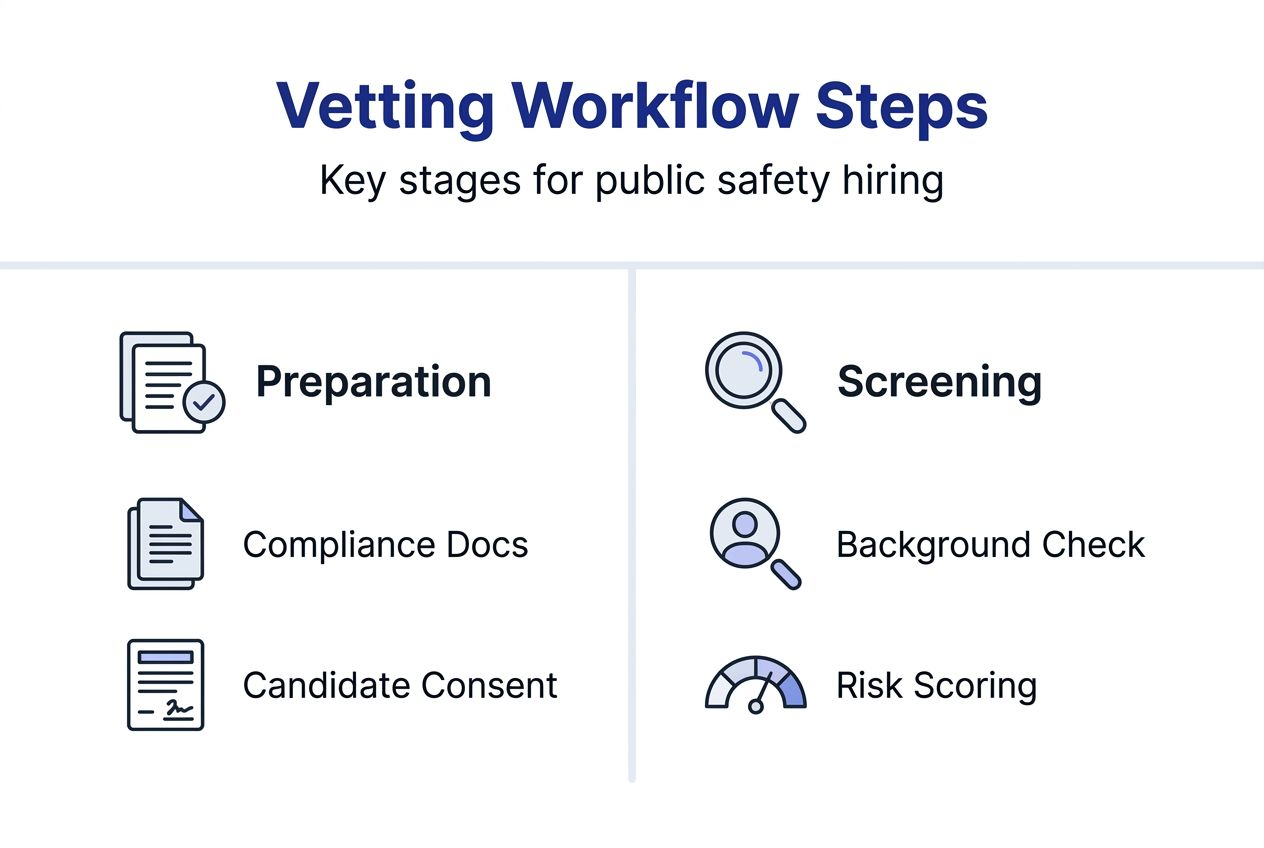
Before implementing a vetting workflow, gather essential resources and establish legal compliance foundations. You need government-issued IDs to verify candidate identity, signed consent forms compliant with FCRA and applicable state regulations, and access to comprehensive background screening databases with multi-jurisdictional data.
Understand relevant public safety hiring laws at federal and state levels. Different states impose varying requirements for criminal history checks, reference verification timelines, and candidate notification procedures. Technology tools including AI screening platforms and database integrations streamline the pre-employment screening workflow significantly.
Essential prerequisites checklist:
- Candidate consent forms meeting FCRA standards
- Multi-jurisdictional criminal database access
- Identity verification protocols and document requirements
- Compliance documentation for federal and state hiring laws
- AI screening tools integrated with applicant tracking systems
- Training materials for recruiters on legal requirements
Pro Tip: Create a compliance checklist template that recruiters complete before initiating any background check. This reduces legal violations by ensuring every vetting process starts with proper consent and documentation.
Smaller agencies often lack dedicated compliance staff. Partner with background screening providers who maintain current knowledge of evolving regulations. This outsourcing strategy protects your agency from inadvertent violations while freeing recruiters to focus on candidate evaluation rather than legal research.
Designing an employee vetting workflow
A structured multi-step vetting process reduces hiring risks and improves compliance in public safety agencies. Your workflow should include six distinct phases, each addressing specific risk factors and legal requirements.
The six-phase vetting workflow:
- Application and eligibility check: Verify minimum qualifications, certifications, and legal eligibility to work.
- Identity verification and consent: Confirm candidate identity with government IDs and obtain FCRA-compliant written consent.
- Comprehensive background checks: Conduct multi-jurisdictional criminal history, employment verification, education confirmation, and social media screening.
- Interviews and references: Perform structured interviews and contact professional references to assess character and fit.
- Final decision with conditional offer: Review all data, make hiring decision, and extend conditional job offer pending final clearances.
- Continuous post-hire monitoring: Implement ongoing monitoring to detect emerging risks after employment begins.
Each phase serves a specific purpose in risk mitigation. Multi-jurisdictional criminal checks catch offenses committed in other states that local checks miss. Social media screenings reveal behavioral patterns and judgment issues not visible in formal records. Reference contacts provide insight into work ethic and interpersonal skills critical for public safety teamwork.
| Workflow Phase | Primary Risk Addressed | Typical Duration |
|---|---|---|
| Application screening | Unqualified candidates | 1-2 days |
| Identity and consent | Fraud, legal violations | 1 day |
| Background checks | Criminal history, credential fraud | 7-14 days |
| Interviews and references | Character, fit issues | 3-5 days |
| Final decision | Overall risk assessment | 2-3 days |
| Post-hire monitoring | Emerging behavioral risks | Ongoing |
Pro Tip: Build decision matrices that assign risk scores to different background check findings. This standardizes hiring decisions and reduces bias while ensuring consistent application of your agency’s risk tolerance across all candidates.
Embed legal requirements into each workflow step rather than treating compliance as a separate checklist. For example, the screening process for public safety hiring should automatically generate FCRA-required adverse action notices when background findings may lead to rejection, giving candidates statutory time to dispute inaccuracies.
Integrating technology and tools
AI tools automate candidate screening and flag risks faster than manual review. AI screening can reduce recruitment timelines by 25-30% and increase the detection of discriminatory risk factors by up to 20% through pattern recognition across large datasets.
Integration with multiple background check databases enables cross-jurisdictional data retrieval in minutes rather than weeks. When your screening platform connects to state criminal repositories, federal databases, and employment verification services simultaneously, you eliminate the sequential delays that plague manual processes.
Technology integration benefits:
- Automated risk flagging based on customizable criteria
- Real-time status updates visible to hiring managers
- Standardized data formatting for consistent evaluation
- Audit trails documenting every screening decision
- Integration with applicant tracking systems for seamless workflow
Balance AI screening with expert manual review for legal and ethical compliance. Algorithms can misinterpret context or perpetuate historical biases in training data. Human oversight catches these errors and ensures fair treatment of candidates with complex backgrounds that deserve nuanced consideration.
Proven technology tools designed for public safety include AI recruitment platforms with built-in compliance features and pre-employment screening systems offering one-click access to dozens of data sources. Choose vendors who understand public safety hiring requirements and provide ongoing compliance updates as laws change.
Pro Tip: Start technology adoption with pilot programs testing AI screening on 20-30 candidates while maintaining your existing manual process in parallel. Compare results to identify where automation adds value and where human judgment remains essential.
Maximize efficiency through comprehensive recruiter training on new tools. Technology only delivers promised benefits when users understand its capabilities and limitations. Invest in hands-on training sessions and create quick-reference guides addressing common platform questions.

Common mistakes and how to avoid them
Skipping multi-jurisdictional checks occurs in 35% of vetting cases, causing significant risk exposure. Candidates may have clean records in your state but serious offenses elsewhere. Always conduct national criminal database searches supplemented by direct county courthouse checks in all jurisdictions where candidates lived or worked.
Manual processing delays background data by over 40%, extending recruitment cycles and losing top candidates to faster-moving agencies. Automation eliminates data entry errors and accelerates turnaround from weeks to days. Ignoring social media screenings misses key behavioral risks in 20% of hires, as candidates may display concerning judgment or associations online that never appear in formal records.
Critical errors to avoid:
- Relying solely on candidate self-reported criminal history
- Failing to verify employment dates and reasons for leaving prior positions
- Skipping education credential verification for degree requirements
- Using generic consent forms not tailored to public safety screening scope
- Neglecting to provide adverse action notices before rejection
- Conducting inconsistent screening depths across similar positions
Failing to obtain proper FCRA-compliant consent risks legal violations, financial penalties, and successful candidate challenges that can overturn hiring decisions and expose your agency to discrimination lawsuits.
Solutions include automation through integrated screening platforms, standardized checklists ensuring every step gets completed, and ongoing recruiter compliance training covering FCRA updates and state law changes. Implement hiring process best practices that build compliance into workflow design rather than relying on individual recruiter memory.
Document every screening decision with clear rationale. When candidates challenge adverse actions, detailed records demonstrating consistent, job-related evaluation criteria provide legal protection and help agencies prevail in disputes.
Continuous monitoring and risk mitigation
Automated alerts for behavioral or legal risk indicators enable real-time response to emerging threats. Continuous post-hire monitoring detects 50% more risk events and reduces compliance violations by over 30% compared to one-time pre-hire screening alone.
Periodic reinvestigation practices update background data post-hire, catching criminal charges, license suspensions, or financial distress that develop after employment begins. Many agencies reinvestigate every 3-5 years, but continuous monitoring provides daily updates rather than leaving multi-year gaps where risks accumulate undetected.
Effective monitoring methods:
- Daily criminal record database checks for new arrests or charges
- License and certification status verification for required credentials
- Social media monitoring for policy violations or concerning behavior
- Credit monitoring for financial distress indicators in positions handling money
- Professional reference periodic check-ins for performance concerns
Integration of monitoring with hiring platforms creates seamless workflow from initial vetting through entire employment lifecycle. When the same system manages pre-hire screening and post-hire monitoring, data flows automatically without redundant manual entry. This integration enables employee monitoring processes that protect agencies while respecting employee privacy through transparent, policy-based oversight.
| Metric | Pre-Hire Vetting Only | With Continuous Monitoring |
|---|---|---|
| Risk events detected | Baseline | 50% increase |
| Compliance violations | Baseline | 30% reduction |
| Early intervention rate | Not applicable | 65% of incidents |
| Termination for cause | Higher baseline | 25% reduction |
| Agency reputation incidents | Higher baseline | 40% reduction |
Reduced compliance violations stem from catching policy breaches early before they escalate into serious misconduct. Enhanced workforce integrity results from employees knowing ongoing monitoring creates accountability, which deters risky behavior and reinforces professional standards.
Pro Tip: Communicate monitoring policies clearly during onboarding. Transparency about what you monitor and why builds trust while establishing accountability expectations from day one.

Alternative approaches and tradeoffs
Manual vetting requires minimal technology investment but suffers from slower timelines and higher error risk. Recruiters manually request records from multiple sources, wait for responses, and compile data into evaluation packages. This approach works for very small agencies with low hiring volume but becomes unsustainable as recruitment needs grow.
Hybrid workflows combine AI screening with manual review for compliance and efficiency. AI handles initial candidate screening, database searches, and risk flagging while human experts review flagged cases, make final decisions, and ensure fair treatment of complex situations. This balanced model delivers 70-80% of full automation speed while maintaining the judgment quality of manual processes.
Fully automated workflows offer fastest turnaround but may miss nuanced risk factors requiring contextual interpretation. These systems work best for high-volume, lower-sensitivity positions where standardized criteria apply consistently. Public safety agencies rarely use full automation for sworn positions but may deploy it for administrative or support roles.
| Approach | Speed | Accuracy | Cost | Best For |
|---|---|---|---|---|
| Manual | Slowest (20-30 days) | Moderate | Low upfront, high labor | Very small agencies, low volume |
| Hybrid | Fast (10-14 days) | Highest | Moderate | Most public safety agencies |
| Fully Automated | Fastest (5-7 days) | Good | High upfront, low labor | Large agencies, non-sworn roles |
Cost versus thoroughness tradeoff affects agencies differently based on size and budget. Small agencies prioritize cost control and may accept longer timelines, while large metropolitan departments need speed to fill dozens of positions simultaneously and can justify technology investments through volume efficiencies.
Situational recommendations: Hybrid workflows suit most small to mid-sized agencies balancing budget constraints with quality requirements. Fully automated approaches benefit large agencies with dedicated IT staff and high-volume hiring. Manual processes remain viable only for agencies hiring fewer than 10 people annually where technology costs exceed labor savings.
Expected results and outcomes
Typical vetting timelines range from 10 to 28 days depending on workflow complexity and technology adoption. Hybrid workflows using AI screening average 12-15 days, while manual processes often exceed 25 days. Delays occur when candidates have lived in multiple jurisdictions requiring sequential record requests.
Risk incident reduction up to 40% with comprehensive vetting procedures stems from catching disqualifying factors before hire rather than discovering them post-employment through misconduct. Structured vetting workflows reduce hiring risks by up to 40% and shorten recruitment cycles by 25-30% through standardized processes eliminating redundant steps.
Measurable benchmarks to expect:
- Pre-hire screening completion: 10-14 days with technology integration
- Cost per hire reduction: 20-25% through automation efficiency
- Candidate experience improvement: 35% fewer complaints about process clarity
- Legal compliance rate: 95%+ with built-in consent and notification workflows
- Quality of hire metrics: 30% reduction in first-year terminations for cause
Recruitment cycle times cut by 25-30% through AI and technology integration free recruiters to focus on candidate engagement rather than administrative tasks. Faster hiring means securing top candidates before competing agencies make offers and reducing overtime costs from understaffing.
Continuous monitoring reduces compliance violations by over 30% by catching policy breaches early and enabling corrective action before minor issues escalate into serious misconduct requiring termination. Improved hire quality positively impacts agency safety and reputation as better-vetted employees demonstrate higher performance, lower turnover, and fewer disciplinary incidents.
Agencies implementing structured workflows report higher candidate satisfaction despite more thorough screening. Clear communication about process steps and timelines reduces applicant anxiety and demonstrates organizational professionalism that attracts quality candidates.
Explore OMNI Intel’s vetting solutions to optimize your workflow
OMNI Intel offers comprehensive public safety pre-employment screening tailored to law enforcement, fire, EMS, and related agencies. Their AI-powered applicant screening integrations accelerate vetting workflows while maintaining compliance with federal and state requirements.

OMNIScreen™ provides in-depth background investigations supporting risk mitigation through multi-jurisdictional criminal checks, employment verification, education confirmation, and ongoing monitoring. Their platform reduces recruitment timelines by up to 30% while improving hire quality through comprehensive data analysis and expert review.
Visit OMNI Intel to implement efficient, law-compliant employee vetting processes that protect your agency and community.
Frequently asked questions about public safety employee vetting
What is the typical timeframe for completing employee vetting in public safety agencies?
Vetting typically takes 10 to 28 days depending on workflow complexity, technology use, and candidate background factors. AI integration can reduce this time by up to 30% compared to manual processes. Delays often occur when candidates have complex multi-state residence histories requiring sequential record requests from multiple jurisdictions.
How does continuous post-hire monitoring improve workforce integrity?
Post-hire monitoring detects 50% more risk events than pre-hire checks alone by catching criminal charges, license issues, or policy violations that develop after employment begins. It reduces compliance violations by over 30%, protecting agency reputation through early intervention before minor issues escalate. Daily automated alerts enable real-time response rather than waiting years between periodic reinvestigations.
What are the legal requirements recruiters must follow during employee vetting?
Recruiters must obtain FCRA-compliant consent forms before initiating background checks and provide adverse action notices when findings may lead to rejection. They must conduct multi-jurisdictional background checks appropriate to position sensitivity and follow federal and state-specific public safety hiring laws. Documentation of screening decisions with job-related justifications protects against discrimination challenges.
Which technology tools best support a compliant vetting workflow?
AI screening platforms and multi-database integrations enhance risk detection while accelerating timelines through automated data retrieval and analysis. Hybrid models combining AI with expert review ensure compliance and accuracy by leveraging technology speed while maintaining human judgment for complex cases. Choose vendors offering built-in FCRA compliance features and regular legal updates.
How can agencies balance speed and thoroughness in public safety hiring?
Hybrid vetting workflows leverage AI for initial screening speed and manual review for thorough evaluation of flagged cases. Agencies should customize workflows based on size, budget, and risk tolerance. Standardized decision matrices and compliance checklists ensure consistent thoroughness while automation handles routine tasks, freeing recruiters to focus on complex candidate assessments requiring judgment.