
What is Integrity Screening: A Public Safety Hiring Guide
Public safety agencies that implement continuous integrity screening report up to 25% fewer misconduct incidents compared to those relying solely on traditional background checks. Yet many HR professionals still confuse integrity screening with basic criminal record searches. This comprehensive guide clarifies what integrity screening truly involves, why it matters for public safety recruitment, and how to implement it effectively while maintaining legal compliance and operational efficiency.
Table of Contents
- Introduction To Integrity Screening In Public Safety
- Core Components And Techniques Of Integrity Screening
- Legal And Compliance Considerations For Public Safety Agencies
- Common Misconceptions About Integrity Screening
- Comparing Integrity Screening To Standard Background Checks
- Practical Implementation For Public Safety Hr Professionals
- Case Studies Demonstrating Integrity Screening Benefits
- Conclusion: Enhancing Public Safety Through Integrity Screening
- Enhance Your Hiring With Omni Intel’s Public Safety Screening Solutions
- Frequently Asked Questions About Integrity Screening
Key takeaways
| Point | Details |
|---|---|
| Definition and scope | Integrity screening is a continuous, multi-dimensional vetting process that extends beyond criminal history to include behavioral assessments, social media monitoring, and financial reviews. |
| Legal compliance | FCRA and EEOC regulations mandate fair, transparent screening practices to avoid discriminatory hiring and reduce agency liability. |
| Beyond background checks | Traditional background checks provide a one-time snapshot, while integrity screening offers ongoing risk assessment throughout employment. |
| Implementation strategy | Successful programs combine AI-enhanced platforms, multiple data sources, and continuous monitoring protocols integrated into existing recruitment workflows. |
| Measurable outcomes | Agencies using comprehensive integrity screening experience faster hiring cycles, reduced misconduct rates, and improved community trust. |
Introduction to integrity screening in public safety
Integrity screening represents a fundamental shift from traditional hiring practices. Unlike standard background checks that examine only criminal records and employment history at a single point in time, integrity screening is a continuous process that evaluates candidates and employees across multiple risk dimensions throughout their entire tenure.
For public safety agencies, this comprehensive approach addresses unique challenges. Officers, firefighters, dispatchers, and emergency responders hold positions of extraordinary public trust. A single integrity failure can compromise investigations, endanger lives, or erode community confidence that takes years to rebuild.
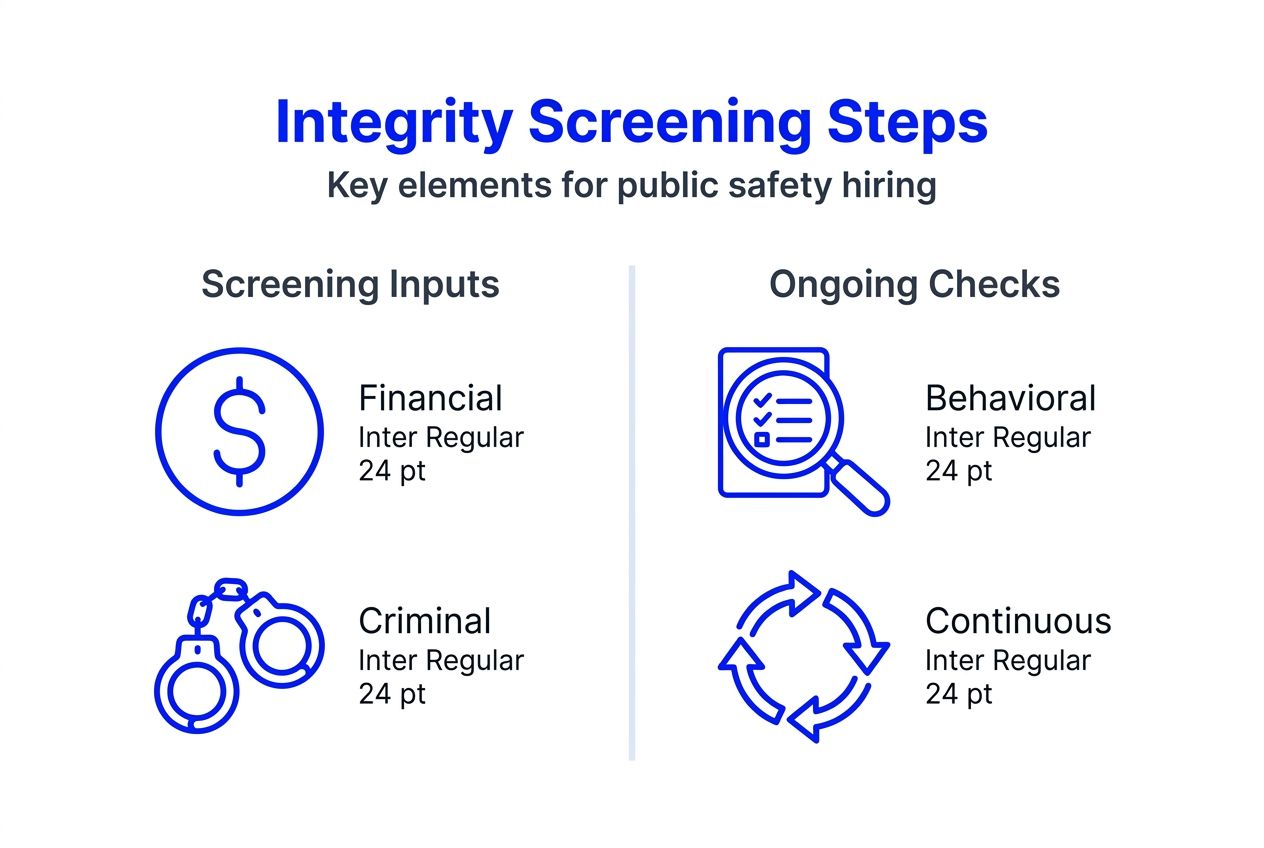
Public safety screening encompasses four critical layers:
- Pre-employment vetting that examines criminal history, credit reports, social media activity, and behavioral indicators
- Behavioral assessments that identify personality traits and decision-making patterns relevant to high-stress roles
- Continuous post-hire monitoring that flags emerging risks like financial distress or concerning online behavior
- Periodic re-evaluations that ensure ongoing suitability for sensitive positions
This multi-layered approach serves dual purposes. First, it helps identify candidates who demonstrate the character, judgment, and reliability essential for public safety work. Second, it provides ongoing assurance that personnel continue to meet integrity standards throughout their careers.
The distinction matters because public safety roles involve unique vulnerabilities. Access to confidential information, authority over vulnerable populations, and life-or-death decision-making require personnel who consistently demonstrate ethical behavior under pressure.
Core components and techniques of integrity screening
Effective integrity screening synthesizes data from multiple domains to create a comprehensive risk profile. Financial records reveal patterns of fiscal responsibility or distress that might create vulnerability to corruption. Social media monitoring identifies concerning associations, extremist viewpoints, or behavior inconsistent with professional standards. Behavioral assessments measure traits like impulse control, integrity, and stress tolerance.

AI-enhanced platforms transform how agencies process this information. Machine learning algorithms analyze vast datasets to identify patterns human reviewers might miss, flagging anomalies for further investigation. Natural language processing evaluates social media posts for concerning themes or language. Predictive analytics assess risk likelihood based on historical patterns.
These technological capabilities deliver practical benefits:
- Faster processing times that reduce hiring delays without sacrificing thoroughness
- Consistent evaluation criteria that minimize subjective bias
- Early detection of emerging risks through automated monitoring alerts
- Integration with existing applicant tracking systems for streamlined workflows
Continuous monitoring represents perhaps the most significant advancement. Rather than assuming integrity remains static after hire, modern systems track ongoing indicators. Financial monitoring alerts agencies to sudden debt accumulation or bankruptcy. Social media surveillance identifies problematic posts or associations. Court record monitoring catches new arrests or civil judgments.
Pro Tip: Implement AI-driven screening platforms that offer real-time alerts for post-hire risk indicators, enabling proactive intervention before minor concerns escalate into serious integrity breaches.
The integration of diverse data sources creates a more complete picture than any single check provides. Criminal records show past legal issues. Credit reports reveal financial stability. Social media offers insight into personal values and associations. Behavioral assessments predict future conduct under stress. Together, these elements form a robust foundation for hiring decisions.
Legal and compliance considerations for public safety agencies
Public safety agencies must navigate complex legal frameworks when implementing integrity screening. FCRA and EEOC compliance forms the foundation of lawful screening practices. The Fair Credit Reporting Act requires specific disclosures before obtaining consumer reports, written authorization from candidates, and pre-adverse action procedures if screening results in negative hiring decisions.
EEOC regulations prohibit discrimination based on protected characteristics. Screening criteria must relate directly to job requirements and apply consistently across all candidates. Policies that disproportionately exclude protected groups require business necessity justification and demonstration that no less discriminatory alternative exists.
Key compliance requirements include:
- Written disclosure and authorization forms before conducting checks
- Pre-adverse action notices giving candidates opportunity to dispute findings
- Individualized assessment of criminal history considering nature, recency, and job relevance
- Documentation of screening criteria, decision rationale, and consistent application
- Regular audits ensuring third-party vendors maintain compliance standards
Legal risks of non-compliance extend beyond regulatory penalties. Discrimination lawsuits can result in substantial damages, settlements, and legal fees. Consent decree violations may trigger federal oversight. Reputational damage from publicized legal battles undermines community trust and complicates future recruitment.
HR professionals must ensure staff understand legal boundaries. Training should cover permissible screening elements, prohibited inquiries, documentation requirements, and escalation procedures for borderline cases. Third-party screening vendors require careful vetting to confirm they maintain current compliance certifications and follow best practices.
Proactive compliance enhances agency credibility. Transparent policies demonstrate commitment to fair hiring. Thorough documentation provides defensible evidence of non-discriminatory practices. Regular legal review keeps policies aligned with evolving regulations and case law.
Common misconceptions about integrity screening
Many HR professionals hold outdated or incomplete understandings of integrity screening that limit its effectiveness. The most prevalent misconception equates integrity screening with criminal background checks. While criminal history remains important, comprehensive screening examines behavioral patterns, financial stability, social media presence, and ongoing conduct throughout employment.
Another common error treats screening as a one-time event. Traditional hiring models conduct background checks before employment begins, then assume integrity remains constant. Modern integrity screening recognizes that circumstances change. Financial pressure, personal crises, or gradual attitude shifts can compromise integrity years after hire.
Key misconceptions to avoid:
- Believing criminal records alone reveal integrity risks while ignoring financial distress or concerning online behavior
- Assuming initial screening suffices without ongoing monitoring for emerging issues
- Treating all background elements equally rather than weighting factors by relevance to specific roles
- Overlooking behavioral assessments that predict conduct under stress or temptation
- Neglecting social media monitoring that reveals associations or viewpoints inconsistent with professional standards
Recognizing these misconceptions helps agencies broaden their screening approach. Comprehensive programs incorporate multiple data sources, apply role-specific criteria, and maintain ongoing vigilance throughout employment. This fuller picture reduces blind spots that single-dimension checks create.
The shift from transactional to continuous screening requires cultural change. Agencies must view integrity assessment not as a hiring hurdle but as an ongoing professional development component. Regular re-evaluations normalize the process while catching issues before they escalate.

Comparing integrity screening to standard background checks
Standard background checks differ fundamentally from comprehensive integrity screening in scope, timing, and depth. Background checks typically examine criminal records, employment history, education credentials, and sometimes credit reports at a single point before hire. Integrity screening adds behavioral assessments, social media monitoring, reference interviews, and continuous post-hire surveillance.
| Feature | Standard Background Check | Integrity Screening |
|---|---|---|
| Timing | One-time pre-employment | Continuous throughout employment |
| Scope | Criminal, employment, education | Criminal, financial, behavioral, social media, ongoing conduct |
| Technology | Database queries | AI-enhanced analysis, predictive modeling, automated alerts |
| Depth | Surface-level verification | Multi-dimensional risk assessment |
| Outcome | Pass/fail hiring decision | Ongoing risk management and intervention |
The comparison reveals why integrity screening delivers superior risk mitigation for public safety roles. Background checks answer whether a candidate has disqualifying history. Integrity screening assesses whether someone demonstrates the character, judgment, and stability these positions demand.
Timing differences matter significantly. A background check conducted in January reveals nothing about a DUI arrest in March or financial crisis in June. Continuous monitoring catches these developments immediately, enabling proactive intervention.
Many agencies combine both approaches strategically:
- Initial background checks verify basic qualifications and identify disqualifying factors
- Comprehensive integrity screening during final candidate evaluation assesses suitability
- Ongoing monitoring throughout employment maintains awareness of changing risk factors
- Periodic re-evaluations for promotions or role changes ensure continued fitness
This layered strategy balances thoroughness with efficiency. Basic checks eliminate clearly unsuitable candidates quickly. Deeper screening focuses resources on serious contenders. Continuous monitoring protects long-term integrity without requiring full re-investigations.
Practical implementation for public safety HR professionals
Successful integrity screening implementation requires systematic planning and execution. Following established best practices helps agencies maximize benefits while maintaining compliance and efficiency.
- Define screening objectives aligned with agency mission and role-specific risks. Patrol officers require different assessments than dispatchers or administrative staff.
- Select comprehensive data sources relevant to identified risks. High-stress positions benefit from behavioral assessments. Roles with financial authority require credit monitoring. Public-facing positions need social media screening.
- Implement AI-enhanced platforms that accelerate processing without sacrificing accuracy. Modern screening technology delivers results in days rather than weeks while maintaining thorough analysis.
- Integrate screening workflows with existing recruitment software. Seamless data flow between applicant tracking systems and screening platforms eliminates manual data entry and reduces errors.
- Establish continuous monitoring protocols with clear escalation procedures. Define which alerts require immediate action, which need routine review, and how to document responses.
- Train hiring managers and HR staff on legal requirements, evaluation criteria, and documentation standards. Consistent application across all candidates ensures fairness and defensibility.
- Maintain detailed records of screening policies, individual assessments, and decision rationale. Thorough documentation supports compliance audits and defends against discrimination claims.
Pro Tip: Choose screening platforms that guarantee FCRA compliance, offer seamless ATS integration, and provide dedicated support for public safety-specific requirements rather than generic corporate solutions.
Implementation timelines vary based on agency size and existing systems. Smaller departments can deploy basic programs within weeks. Larger organizations require months for vendor selection, system integration, process development, and staff training.
Change management proves critical. Existing employees may view new monitoring as distrust. Clear communication about program goals, privacy protections, and fairness safeguards builds acceptance. Emphasizing how screening protects both agency reputation and individual officers helps frame monitoring positively.
Pre-employment workflows should integrate screening at optimal decision points. Conduct basic checks early to eliminate clearly unsuitable candidates. Reserve comprehensive assessments for finalists to focus resources efficiently. Complete all screening before extending final offers to avoid awkward withdrawals.
Case studies demonstrating integrity screening benefits
Real-world implementation data validates integrity screening’s value for public safety agencies. A mid-sized police department that adopted comprehensive screening reported a 25% reduction in internal affairs investigations during the first two years. The decrease reflected better initial hiring decisions and early intervention when monitoring flagged concerning behavior.
A regional fire service implementing continuous monitoring identified financial distress among several veteran firefighters before it escalated to policy violations. Early counseling and assistance prevented potential integrity breaches while supporting employee wellbeing. The proactive approach strengthened trust rather than creating an adversarial environment.
Measurable benefits documented across multiple agencies include:
- Hiring cycle reductions of 30-40% through AI-accelerated screening processes
- Decreased background investigation costs averaging $1,200 per hire
- Internal misconduct incident reductions ranging from 20-30% within two years
- Improved community satisfaction scores linked to greater confidence in personnel integrity
- Reduced legal exposure from discrimination claims through consistent, documented processes
A large sheriff’s office combining behavioral assessments with traditional checks found candidates who passed criminal and credit checks but showed concerning patterns in personality testing. Follow-up reference interviews confirmed judgment issues that disqualified them. Without comprehensive screening, these individuals would have received badges and firearms.
The community trust dimension proves equally important. Agencies with robust screening programs report easier recruitment, better public cooperation, and stronger support during budget deliberations. Residents who trust that personnel meet high integrity standards show greater willingness to engage with public safety services.
These outcomes justify the investment in comprehensive screening technology and processes. While implementation requires upfront costs and effort, the long-term benefits in reduced liability, improved hiring quality, and enhanced community relations deliver substantial returns.
Conclusion: enhancing public safety through integrity screening
Integrity screening represents an essential evolution in public safety hiring practices. The comprehensive, continuous approach addresses unique challenges these roles present while delivering measurable improvements in personnel quality, operational efficiency, and community trust.
Success requires recognizing that integrity screening extends far beyond traditional background checks. Multi-dimensional assessment combining criminal history, financial stability, behavioral evaluation, and social media monitoring creates a complete risk profile. Ongoing monitoring throughout employment catches emerging issues that point-in-time checks miss entirely.
Balancing speed, accuracy, and legal compliance remains achievable with proper tools and processes. AI-enhanced platforms accelerate analysis without sacrificing thoroughness. Systematic workflows integrated with existing recruitment systems maintain efficiency. Regular training and documentation ensure consistent, defensible practices.
Public safety agencies that embrace comprehensive integrity screening gain competitive advantages. Better hiring decisions reduce costly turnover and misconduct incidents. Faster processing shortens vacancy periods that strain operations. Enhanced community confidence strengthens public support and cooperation.
HR professionals should view integrity screening not as administrative burden but as strategic investment in agency excellence and public trust.
Enhance your hiring with OMNI Intel’s public safety screening solutions
Implementing the comprehensive integrity screening this guide describes requires specialized tools designed for public safety’s unique requirements. OMNI Intel delivers pre-employment screening solutions specifically tailored for law enforcement, fire services, dispatch centers, and related agencies.

Our AI-enhanced platforms accelerate background checks while maintaining the thoroughness public safety roles demand. Continuous monitoring capabilities catch emerging risks before they escalate. Seamless applicant screening integration with your existing recruitment systems eliminates workflow disruptions. Every solution maintains strict FCRA compliance and incorporates law enforcement investigation principles to ensure accuracy and defensibility. Discover how OMNI Intel can strengthen your hiring integrity while reducing timelines and costs.
Frequently asked questions about integrity screening
How does integrity screening differ from a criminal background check?
Integrity screening encompasses criminal history plus financial records, behavioral assessments, social media monitoring, and continuous post-hire surveillance. Criminal checks provide only a snapshot of legal history at one point in time, missing financial distress, concerning associations, or behavioral patterns that indicate integrity risks.
Is continuous employee monitoring legal under privacy laws?
Yes, when properly disclosed and consented to during hiring. Employers may monitor publicly available information and conduct periodic re-screenings with appropriate notice. FCRA requires disclosure and authorization for consumer reports, while monitoring must avoid protected activities like union organizing or legally protected speech.
How long does comprehensive integrity screening take?
AI-enhanced platforms typically complete initial screening within 3-7 business days, significantly faster than traditional methods requiring 2-3 weeks. Timeframes vary based on scope, with international checks or detailed financial analysis potentially extending timelines. Continuous monitoring operates in real-time with automated alerts.
What happens if screening reveals negative information after hire?
Agencies should conduct individualized assessments considering the nature, timing, and relevance of findings to job duties. Minor issues may warrant counseling or monitoring rather than termination. Serious concerns like criminal activity or policy violations follow standard disciplinary procedures. Documentation of assessment rationale protects against discrimination claims.
Can integrity screening reduce hiring discrimination risks?
Properly implemented programs actually reduce discrimination by applying consistent, job-related criteria across all candidates. Objective assessments minimize subjective bias. Thorough documentation demonstrates non-discriminatory decision-making. However, agencies must ensure criteria relate to legitimate job requirements and avoid disparate impact on protected groups.
How much does comprehensive integrity screening cost?
Costs range from $150-500 per candidate depending on scope and services. Basic criminal and employment checks cost $75-150. Adding behavioral assessments, social media monitoring, and financial reviews increases investment. Continuous monitoring subscriptions typically run $50-100 annually per employee. These costs prove minimal compared to expenses from bad hires or misconduct incidents.