
Step-by-Step Hiring Workflow Guide for Public Safety
Public safety agencies face mounting pressure to fill critical positions while maintaining rigorous vetting standards. The typical hiring process extends from 90 days to over a year, creating operational gaps that compromise community safety. This comprehensive guide breaks down each stage of an efficient hiring workflow, offering HR professionals and hiring managers proven strategies to reduce time-to-hire while ensuring candidate quality and integrity remain uncompromised.
Table of Contents
- Understanding The Public Safety Hiring Challenge
- Preparing For An Effective Hiring Workflow
- Executing The Step-By-Step Hiring Workflow
- Verifying And Optimizing Your Hiring Workflow
- Streamline Your Public Safety Hiring With OMNI Intel Solutions
- Frequently Asked Questions
Key takeaways
| Point | Details |
|---|---|
| Standardized multi-stage processes | Structured workflows improve fairness and candidate quality through consistent evaluation criteria. |
| Technology reduces hiring time | Automation and digital tools streamline scheduling, communication, and candidate tracking. |
| Lateral hiring accelerates onboarding | Experienced officers can complete hiring in 6 weeks versus traditional 12-month timelines. |
| Low conversion rates demand efficiency | Only 1.3% of applicants graduate in some agencies, requiring optimized screening at each stage. |
| Background checks protect integrity | Comprehensive vetting safeguards agency reputation and community trust. |
Understanding the public safety hiring challenge
The hiring workflow for public safety positions involves numerous sequential stages. Each stage serves as a quality filter, but the cumulative effect creates extended timelines. The POSS process typically takes a year, including application review, written assessments, physical fitness tests, oral board interviews, background investigations, medical examinations, and academy training.
Success rates reveal the challenge’s magnitude. Fewer than 5% of applicants make it from application to graduation in San Francisco’s police department. The San Francisco Police Department received 3,145 applications between 2020 and 2023, yet only 42 candidates graduated, a 1.3% conversion rate. These numbers highlight how competitive and rigorous public safety hiring has become.
National staffing shortages compound the problem. Agencies compete for a shrinking candidate pool while maintaining high standards. The extended timeline affects operational readiness:
- Patrol units operate below minimum staffing levels
- Overtime costs escalate as existing officers fill gaps
- Response times increase during staffing shortages
- Burnout rates rise among overworked personnel
“The complexity of public safety hiring demands systematic approaches. Every stage must balance speed with thorough evaluation to protect both agency and community.”
Understanding these challenges helps agencies design step by step hiring process public safety workflows that address bottlenecks systematically. The goal isn’t cutting corners but identifying efficiency opportunities within each stage while preserving vetting integrity.
Preparing for an effective hiring workflow
Foundational preparation determines hiring success before you post a single job announcement. Start by reviewing job requirements critically. Many agencies maintain outdated educational prerequisites that unnecessarily shrink applicant pools without improving candidate quality.
Standardized assessments form the backbone of fair evaluation. National Testing Network offers validated written and video-based assessments designed specifically for public safety roles. Structured interviews and standardized assessments reduce bias and increase hiring decision validity by 10-15%. These tools provide objective comparison points across candidates.
Implement preliminary screening questionnaires early in the workflow. Personal history questionnaires gather comprehensive background information upfront, allowing investigators to identify potential issues before investing significant resources. This front-loading saves time by eliminating unsuitable candidates before expensive stages.

Pro Tip: Create detailed applicant profiles during initial screening. Comprehensive early data collection reduces back-and-forth communication later and accelerates background investigations by 20-30%.
Reconsider lateral hiring as a strategic priority. Experienced officers from other agencies bring:
- Proven performance records
- Completed basic training and certifications
- Immediate operational readiness
- Reduced training costs and timeline
Structured interview protocols ensure consistency across hiring panels. Develop standardized question sets with scoring rubrics that align with job competencies. Train interviewers on proper techniques and legal compliance. This structure improves prediction accuracy while defending against discrimination claims.
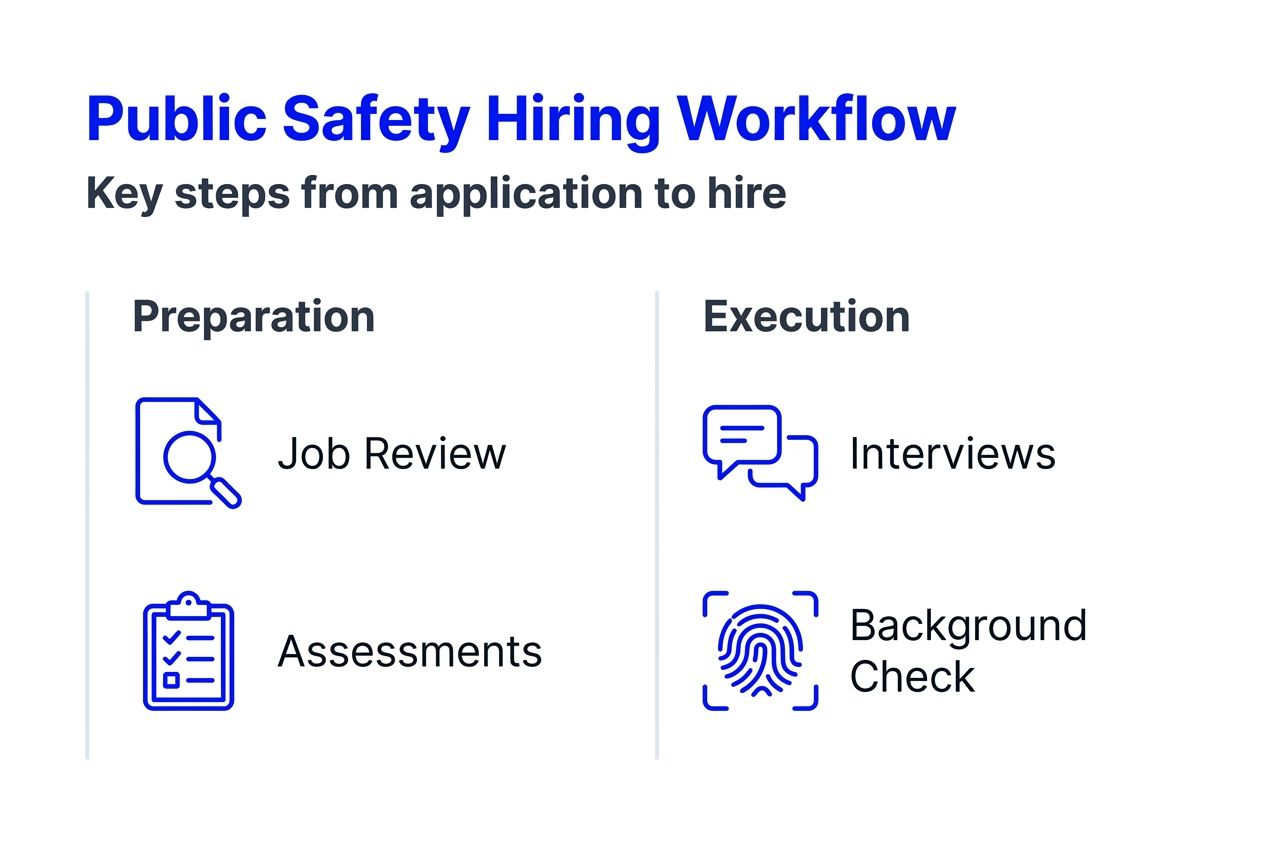
Document every decision point and evaluation criterion. Clear documentation supports both process improvement and legal defensibility. Following hiring process best practices public safety agencies establishes credibility and protects your agency from challenges.
Executing the step-by-step hiring workflow
The operational workflow begins when candidates submit applications. Here’s how leading agencies structure their sequential stages:
- Application review and screening occurs within 2-3 weeks. HR staff verify minimum qualifications and eliminate incomplete submissions. Automated systems flag disqualifying factors immediately.
- Written assessments and testing happen 3-4 weeks after application. City of Powell completes multi-stage selection in about 90 days using standardized written tests, physical agility assessments, and oral boards sequentially.
- Physical fitness evaluation tests candidates on job-specific physical demands. Schedule these within one week of written test results to maintain momentum.
- Oral board interviews involve panel assessments using structured questions. Complete within 2 weeks of physical testing while candidate motivation remains high.
- Background investigation represents the most time-intensive stage. Investigators verify employment history, conduct neighborhood interviews, review financial records, and check criminal history. This stage typically requires 60-90 days.
- Medical and psychological evaluation ensures fitness for duty. Schedule immediately after background clearance to avoid delays.
- Final job offer and academy assignment conclude the process, with academy start dates determining final timeline.
Lateral hiring offers compressed timelines. Experienced officers may skip written tests and basic training. Some agencies complete lateral hiring in 6 weeks versus 12 months for entry-level recruits. The expedited process focuses on:
- Credential verification from previous agency
- Targeted background update since last employment
- Department-specific orientation and policy training
- Immediate field training officer assignment
Pro Tip: Use digital workflow automation for candidate notifications and interview scheduling. This reduces administrative burden by 40% while improving candidate experience through timely communication.
Green Bay Police Department is reducing hiring time by eliminating in-person interviews for initial screening and modifying education requirements. They now accept relevant experience in place of college degrees, broadening their applicant pool without sacrificing quality.
Here’s how workflow duration varies by approach:
| Agency Approach | Timeline | Key Features | Success Rate |
|---|---|---|---|
| Traditional FBI POSS | 12 months | All stages, full academy | 5% application to graduation |
| City of Powell streamlined | 90 days | Efficient sequencing, clear milestones | 8-10% conversion |
| Lateral hire expedited | 6 weeks | Skip redundant training, focus verification | 15-20% acceptance |
| Modified requirements (Green Bay) | 75 days | Reduced barriers, maintained standards | 12% projected |
Maintain consistent candidate engagement throughout. Applicants who wait weeks without communication often accept other offers. Implement automated status updates at each stage transition. Personal outreach from hiring managers at critical decision points reinforces candidate interest and improves acceptance rates.
Follow the comprehensive public safety recruitment process guide to ensure no critical steps get overlooked during execution.

Verifying and optimizing your hiring workflow
Continuous monitoring separates high-performing hiring operations from mediocre ones. Track these metrics monthly:
- Time-to-hire from application to academy start
- Stage-by-stage conversion rates
- Offer acceptance rates
- First-year retention of new hires
- Cost per hire including overtime backfill
Data reveals bottlenecks requiring attention. If background investigations consistently exceed 90 days, consider adding investigative staff or implementing preliminary screening tools that identify issues earlier.
Technology delivers measurable improvements. Anaheim Police Department reduced scheduling time by 96.87% and returned 32.25% of staff time to operational duties through automation. Their scheduling software eliminated manual phone calls, email chains, and calendar conflicts. Similar tools exist for subpoena management, candidate tracking, and interview coordination.
Avoid common optimization mistakes:
- Rushing background investigations to meet hiring quotas
- Eliminating assessment stages without data supporting the change
- Focusing solely on speed without monitoring quality outcomes
- Neglecting candidate experience improvements
- Failing to benchmark against comparable agencies
“The balance between thorough vetting and efficient processing determines long-term hiring success. Agencies that optimize for speed alone often face higher turnover and integrity issues.”
Candidate feedback provides actionable insights. Survey applicants at multiple touchpoints about communication clarity, process transparency, and timeline expectations. Exit interviews with candidates who decline offers reveal competitive disadvantages requiring attention.
Refinement opportunities include:
- Recruitment incentives like signing bonuses and relocation assistance
- Emphasis on lateral hiring with expedited credentialing
- Partnership with local colleges for pre-academy preparation programs
- Enhanced benefits communication during offer stage
- Mentorship programs connecting candidates with current officers
Maintain vetting rigor while improving efficiency. Comprehensive background checks protect agency integrity and community safety. The step by step screening process public safety hiring ensures nothing critical gets missed despite timeline pressure.
Regularly audit your workflow against industry standards. Annual reviews should assess whether each stage still serves its intended purpose or represents legacy process that adds time without value.
Streamline your public safety hiring with OMNI Intel solutions
Managing complex hiring workflows demands specialized tools designed for public safety’s unique requirements. OMNI Intel offers pre-employment screening services that integrate seamlessly with your existing workflow, reducing administrative burden while improving vetting accuracy.

Our background checks public safety solutions leverage law enforcement investigation principles to deliver thorough, compliant candidate vetting. You’ll reduce time spent on manual verification while maintaining the integrity standards your agency demands. Applicant screening integration connects directly with your hiring platform, automating data transfer and eliminating duplicate entry.
These tools help agencies achieve faster time-to-hire without compromising candidate quality. Your HR team focuses on candidate engagement and decision-making while our platform handles verification logistics.
Frequently asked questions
How long does the typical public safety hiring workflow take?
Timelines vary significantly by agency and position type. Traditional entry-level hiring ranges from 90 days to 12 months depending on process complexity and staffing resources. The City of Powell completes their streamlined process in approximately 90 days while FBI’s comprehensive POSS requires a full year. Lateral hires often complete in 6 weeks since they skip basic training.
What causes the low success rate from application to graduation?
Multiple factors contribute to the 1.3-5% conversion rate. Many applicants fail to meet minimum qualifications but apply anyway. Others withdraw when learning about salary, schedule demands, or relocation requirements. The rigorous vetting process eliminates candidates with disqualifying background issues, failed assessments, or inadequate physical fitness. Each stage intentionally filters for the highest quality candidates.
Can agencies reduce hiring time without compromising candidate quality?
Yes, through strategic optimization rather than corner-cutting. Technology automates administrative tasks like scheduling and communication. Modified requirements focused on relevant experience versus arbitrary credentials broaden applicant pools. Lateral hiring emphasizes experienced officers who need less training. Efficient sequencing of stages maintains rigor while eliminating unnecessary delays between steps.
What role does technology play in streamlining hiring workflows?
Digital tools deliver significant time savings across multiple stages. Automated applicant tracking systems manage candidate flow and communication. Online assessment platforms enable remote testing, expanding geographic reach. Background investigation software accelerates records requests and verification. Scheduling automation eliminates phone tag and calendar conflicts. Agencies report 30-40% time savings when implementing comprehensive workflow automation.
How do structured interviews improve hiring outcomes?
Standardized questions with scoring rubrics ensure consistent evaluation across all candidates. This reduces unconscious bias and improves legal defensibility. Structured formats also increase predictive validity, helping identify candidates who will succeed long-term. Training interviewers on proper techniques further enhances reliability. Research shows structured approaches improve hiring decision accuracy by 10-15% compared to unstructured conversations.
Should agencies prioritize lateral hiring over entry-level recruitment?
A balanced approach works best. Lateral hires offer immediate operational readiness and proven performance, filling critical gaps quickly. However, entry-level recruits bring fresh perspectives and can be developed according to agency culture. The optimal mix depends on your staffing needs, budget constraints, and long-term succession planning. Many agencies target 30-40% lateral hires while maintaining robust entry-level pipelines.