

The Importance of Workforce Integrity in Public Safety
Workforce integrity is not a soft value reserved for annual ethics training. It is the operational foundation that determines whether a public safety agency can maintain community trust, retain qualified personnel, and function at the level its mission demands. The importance of workforce integrity becomes especially clear when you examine what its absence costs: misconduct incidents, officer decertification, wrongful hiring decisions, and the slow collapse of public confidence. This article provides a practical, evidence-grounded framework for public safety officials, HR professionals, and organizational leaders who need to move beyond compliance theater and build integrity into how their agencies actually operate.
Table of Contents
- Key Takeaways
- The importance of workforce integrity on trust, safety, and performance
- Common challenges in maintaining workforce integrity
- Best practices for embedding integrity into workforce culture
- Measuring and sustaining workforce integrity programs
- My perspective on workforce integrity in public safety
- How Omniintel supports public safety integrity from day one
- FAQ
Key Takeaways
| Point | Details |
|---|---|
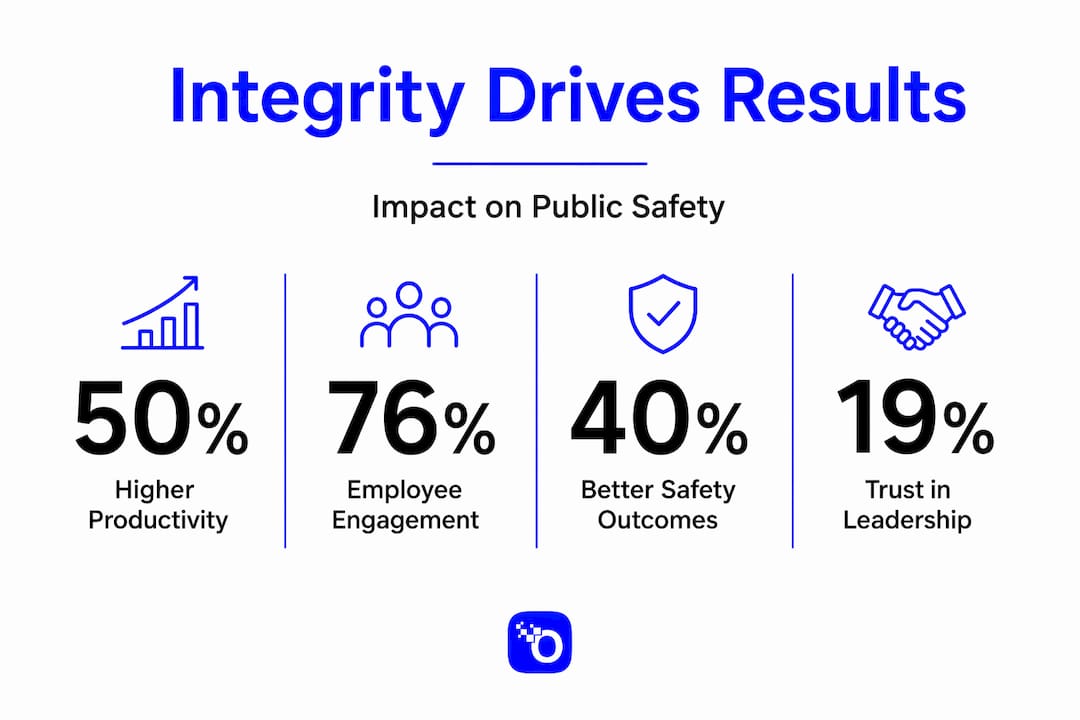
| Integrity drives performance | High-trust organizations report 50% higher productivity and 76% greater employee engagement than their peers. |
| Leadership trust is critically low | Only 19% of employees strongly trust their leaders, making structural reform more urgent than character coaching alone. |
| Retaliation fear silences misconduct reporting | One in three employees fears retaliation for reporting misconduct, which means most ethical failures go unreported until they become agency-wide crises. |
| The four E’s framework embeds integrity | Expression, Engagement, Empowerment, and Evaluation transform ethics from policy language into daily operational practice. |
| Measurement must go beyond compliance | Tracking training completions tells you almost nothing. Trust perception, fear of retaliation, and reporting confidence reveal your actual ethical climate. |
The importance of workforce integrity on trust, safety, and performance
Workforce integrity shapes every operational outcome a public safety agency cares about. It determines how officers interact with the public, how dispatchers handle sensitive information, how supervisors respond to complaints, and whether personnel feel safe raising concerns about misconduct. These are not abstract values. They are measurable performance variables.
The data is unambiguous. High-trust organizations outperform peers with 50% higher productivity and 76% greater employee engagement. Companies with demonstrated trustworthiness carry market value four times higher than their peers, and high-trust firms report 35% greater returns. For public safety agencies, the equivalent currency is not stock price. It is community confidence, officer retention, and the ability to recruit qualified candidates in a competitive labor market.
The table below illustrates the direct connection between integrity-related organizational factors and measurable outcomes:
| Integrity Factor | Observable Impact | Measurable Outcome |
|---|---|---|
| High leadership trust | Greater retention and commitment | 61% more likely to stay with the organization |
| Ethical hiring practices | Reduced misconduct incidents | Lower decertification rates and liability exposure |
| Transparent reporting channels | Earlier identification of problems | Fewer systemic failures reaching public scrutiny |
| Consistent accountability structures | Stronger team cohesion | Higher morale and operational reliability |
Beyond performance metrics, integrity directly affects safety outcomes in high-stakes environments. When employees’ ethical behavior is consistent and observable, supervisors can identify anomalies early. When integrity in teams is treated as a shared standard rather than an individual character trait, peer accountability becomes a natural check on misconduct. Agencies that have embedded integrity into their organizational culture report fewer use-of-force complaints, lower rates of administrative investigations, and stronger relationships with the communities they serve.
The relationship between integrity and public confidence is not incidental. It is structural. When an agency’s hiring and conduct standards are visibly rigorous, the public develops a baseline assumption of trustworthiness. When those standards erode or are perceived to be inconsistent, trust collapses faster than any public affairs effort can repair it. Rebuilding agency reputation after a high-profile integrity failure typically takes years. Preventing that failure through deliberate integrity practices costs a fraction of the recovery effort.
Common challenges in maintaining workforce integrity
Understanding why workforce integrity programs fail is just as important as knowing what they should include. Most agencies do not lack ethics policies. What they lack is the infrastructure to make those policies real in daily operations. Several persistent barriers stand between written standards and actual ethical behavior.
The retaliation problem is systemic. One-third of American employees fear retaliation for reporting misconduct, and 22% have personally witnessed unethical conduct at work. In public safety environments, where rank structure and loyalty culture are deeply embedded, those numbers likely understate the actual risk. When personnel believe that speaking up will damage their career or their relationships with colleagues, misconduct goes unreported until it escalates into something that cannot be ignored.
The monitoring paradox is real. Excessive oversight and surveillance create a paradox where employees spend more time documenting their compliance than actually performing their duties. This performative compliance undermines the genuine accountability that integrity programs are supposed to produce. Personnel learn to look compliant rather than act with integrity. The distinction matters enormously in public safety roles where autonomous judgment under pressure is the job.
Common misconceptions that derail integrity programs include:
- Integrity equals compliance. Ethics training completion does not indicate ethical behavior. Personnel who score 100% on annual modules and still engage in misconduct are not outliers. They are the expected result of treating integrity as a checkbox.
- Integrity is a hiring filter only. Many agencies invest in pre-employment screening and assume the work is done. Post-hire integrity erosion, driven by poor supervision, peer pressure, or leadership dissonance, is where most problems originate.
- Character is fixed at hire. Research on trust erosion shows that employees stop trusting their workplace gradually and often without warning. The conditions an agency creates after hiring matter as much as the character of the individual hired.
- More monitoring equals more integrity. This is perhaps the most dangerous misconception. Surveillance without trust infrastructure produces documentation, not accountability.
Pro Tip: Before implementing any new monitoring or reporting system, survey your personnel anonymously on their current perceptions of psychological safety and retaliation risk. The results will tell you whether your agency has the trust foundation required for the new system to work as intended.
Additionally, over 40% of employees are unaware of the protections available for confidential reporting, which renders even well-designed whistleblower programs largely ineffective. In public safety agencies, where the consequences of misconduct are community-facing, this awareness gap is a critical vulnerability that HR professionals must address proactively.
Best practices for embedding integrity into workforce culture
The importance of organizational integrity is not realized through policy documents. It is realized through deliberate structural choices about how agencies hire, supervise, evaluate, and respond to misconduct. The following framework provides a sequence for agencies ready to move from compliance-focused programs to integrity-centered operations.
The four E’s of ethical leadership
Deloitte’s framework for embedding integrity describes four interconnected functions that leaders must perform consistently:
-
Expression. Leaders articulate values clearly and repeatedly. Not in mission statements. In daily operational decisions, in how they respond to errors, and in what they reward and what they tolerate. An agency commander who publicly acknowledges when a personnel decision was wrong models the transparency that integrity programs depend on.
-
Engagement. Ethics is discussed as a normal part of operational conversations, not reserved for quarterly training sessions. Briefings, debriefs, and supervisory check-ins become opportunities to reinforce behavioral expectations and discuss real scenarios without punishing candor.
-
Empowerment. Personnel at every level are given clear, protected channels to raise concerns. This means safe speak-up mechanisms that are genuinely confidential, actively promoted, and demonstrably free from retaliation consequences. Empowerment also means supervisors have the authority to act on what they observe without requiring command-level approval for every integrity intervention.
-
Evaluation. Ethical culture is measured through trust indicators, not just training completions. Leaders receive feedback on their own conduct, not only the conduct of personnel they supervise. Performance reviews include behavioral dimensions, not just operational metrics.
Integrity in the hiring process
Fostering integrity at work begins before day one. Agencies that treat pre-employment background investigations as a compliance step rather than an investigative function miss the most consequential opportunity to protect their agency. Behavioral event interviewing, in which candidates are asked to describe specific past situations rather than hypothetical responses, surfaces patterns that credential reviews and standard reference checks cannot detect.
Embedding integrity checks into daily workflows extends this logic post-hire. Digital red flag monitoring, structured supervisor observation, and periodic integrity reviews tied to role responsibilities create a continuous signal rather than a one-time gate. The goal is early detection, not post-incident investigation.
The following comparison illustrates the difference between reactive and proactive integrity models:
| Approach | Trigger Point | Limitation |
|---|---|---|
| Reactive integrity management | Misconduct incident or complaint | Damage already done; agency reputation at risk |
| Proactive integrity integration | Ongoing hiring, monitoring, and feedback | Identifies risk early; prevents escalation |
| Compliance-only framework | Annual training completion | Creates documentation, not behavior change |
| Investigator-driven integrity model | Embedded in hiring and daily operations | Catches behavioral drift before it becomes misconduct |
Pro Tip: When conducting integrity-related investigations in multi-site or staffing environments, define investigation ownership, record control, and corrective authority before an incident occurs. Ambiguity about who owns the process is one of the most common reasons investigations produce inconclusive findings.
Workforce accountability is strengthened when every member of the organization understands not only what the standards are but how they are enforced and by whom. Clear investigation protocols, published response timelines, and consistent outcomes for similar violations signal that standards are real. Inconsistency in consequence, more than anything else, erodes the credibility of integrity programs.

Measuring and sustaining workforce integrity programs
Most agencies measure integrity program success by counting things that are easy to count: training hours completed, policies reviewed, investigations closed. These metrics are administratively useful and operationally meaningless when it comes to understanding whether your agency has actually built an ethical culture.
The indicators that reveal genuine ethical climate are harder to quantify but far more revealing:
- Employee confidence in the reporting process. Do personnel believe that raising a concern will be taken seriously and handled without retaliation? If they do not, your speak-up program is decorative.
- Perception of leadership consistency. Do personnel observe that leaders are held to the same standards as rank-and-file members? Leadership communication dissonance, where stated values and visible actions diverge, is the single most reliable predictor of trust collapse.
- Fear of retaliation trends. Tracking whether perceived retaliation risk is rising or falling over time tells you whether your culture is improving or deteriorating. Culture-focused indicators reveal ethical climate far better than compliance tracking alone.
- Voluntary reporting rates. An increase in internal reporting, before incidents escalate, suggests personnel trust the system. A decline suggests the opposite.
The following measurement framework provides a starting structure for agencies building integrity program dashboards:
| Indicator | Measurement Method | Review Frequency |
|---|---|---|
| Leadership trust score | Anonymous pulse survey | Quarterly |
| Retaliation perception rate | Annual ethics climate survey | Annually |
| Voluntary reporting volume | Incident reporting system data | Monthly |
| Post-hire integrity review completions | HR tracking system | Per review cycle |
| Personnel retention in integrity-sensitive roles | Workforce analytics | Semi-annually |
Sustaining these programs over time requires leadership alignment at every level, not just executive commitment. Middle managers and frontline supervisors are the daily face of your agency’s integrity standards. Building a culture of trust requires daily value demonstration, transparency in decision-making, and genuine engagement with personnel concerns rather than one-time perks or symbolic gestures. Agencies that incorporate diversity, equity, and inclusion principles into their integrity frameworks report stronger internal trust scores and lower rates of misconduct complaints across demographic groups.
My perspective on workforce integrity in public safety
I have spent considerable time examining how public safety agencies approach integrity, and the pattern I see most consistently is this: agencies invest in policies when they should be investing in behavior. They write codes of conduct when what they need is leadership that models the code publicly and consistently every day.
The finding that only 19% of employees strongly trust their leaders is not a character indictment of leaders. It is a structural indictment of how most organizations are designed. When there is no mechanism for leaders to receive honest feedback, when accountability flows in only one direction, and when personnel who raise concerns routinely experience professional consequences, the trust deficit is the predictable result. It is not a surprise. It is the designed outcome of a permission architecture that does not actually permit candor.
What I find most telling is the monitoring paradox. Agencies respond to integrity failures by adding oversight layers: more dashboards, more sign-offs, more documentation requirements. Then they wonder why personnel feel disengaged. The oversight communicates distrust. Distrust produces compliance theater. Compliance theater produces the next integrity failure.
The agencies that genuinely get this right treat integrity as an operational asset, not an administrative function. Their leaders are visibly held accountable. Their integrity verification process starts at recruitment and continues through every stage of employment. Their personnel understand the reporting system and believe it works. That belief, not the system itself, is what actually drives ethical behavior.
The hardest truth I have observed is that integrity programs almost never fail because of a bad policy. They fail because someone in leadership tolerated something they should not have, once, and then that tolerance became the unwritten standard. Culture is set at the top, but it lives in the middle. Fix the middle first.
— Matt
How Omniintel supports public safety integrity from day one

For public safety agencies, HR professionals, and organizational leaders, the work of building workforce integrity does not start with policy revision. It starts with knowing who you are hiring, understanding what your workforce looks like post-hire, and having the investigative infrastructure to act when red flags appear. Omniintel’s OMNIScreen™ background investigation platform delivers investigator-driven, FCRA-compliant background checks built specifically for the standards that law enforcement, fire, EMS, dispatch, and private security roles demand.
From pre-employment screening services that go beyond basic database queries to continuous post-hire monitoring that catches behavioral drift before it becomes misconduct, Omniintel provides the integrity infrastructure that serious agencies require. If your agency is ready to move from compliance theater to genuine workforce accountability, Omniintel’s platform and investigative expertise are built for exactly that mission.
FAQ
What is workforce integrity and why does it matter?
Workforce integrity refers to the consistent alignment between an organization’s stated values and the actual behavior of its personnel at every level. It matters because high-trust organizations report 50% higher productivity, 76% greater engagement, and significantly stronger retention rates compared to their peers.
How can public safety agencies ensure workforce integrity?
Agencies can ensure workforce integrity by combining rigorous pre-employment background investigations with post-hire behavioral monitoring, establishing protected speak-up channels, and holding leaders visibly accountable to the same standards applied to all personnel.
What are the biggest barriers to fostering integrity at work?
The most significant barriers are fear of retaliation for reporting misconduct, the trust-eroding effects of excessive surveillance, and treating integrity as a compliance checkbox rather than an ongoing operational practice embedded in daily decision-making.
How should agencies measure the success of an integrity program?
Effective measurement relies on culture-based indicators such as employee trust scores, retaliation perception rates, and voluntary reporting volumes rather than training completion statistics, which reveal administrative activity but not actual ethical climate.
How does leadership behavior affect workforce integrity?
Leadership behavior is the single most powerful driver of organizational integrity because only 19% of employees strongly trust their leaders, and those who do are 61% more likely to remain with their organization. When leaders model accountability publicly, trust scales across the entire workforce.