

How to Recruit Qualified Candidates for Public Safety Roles
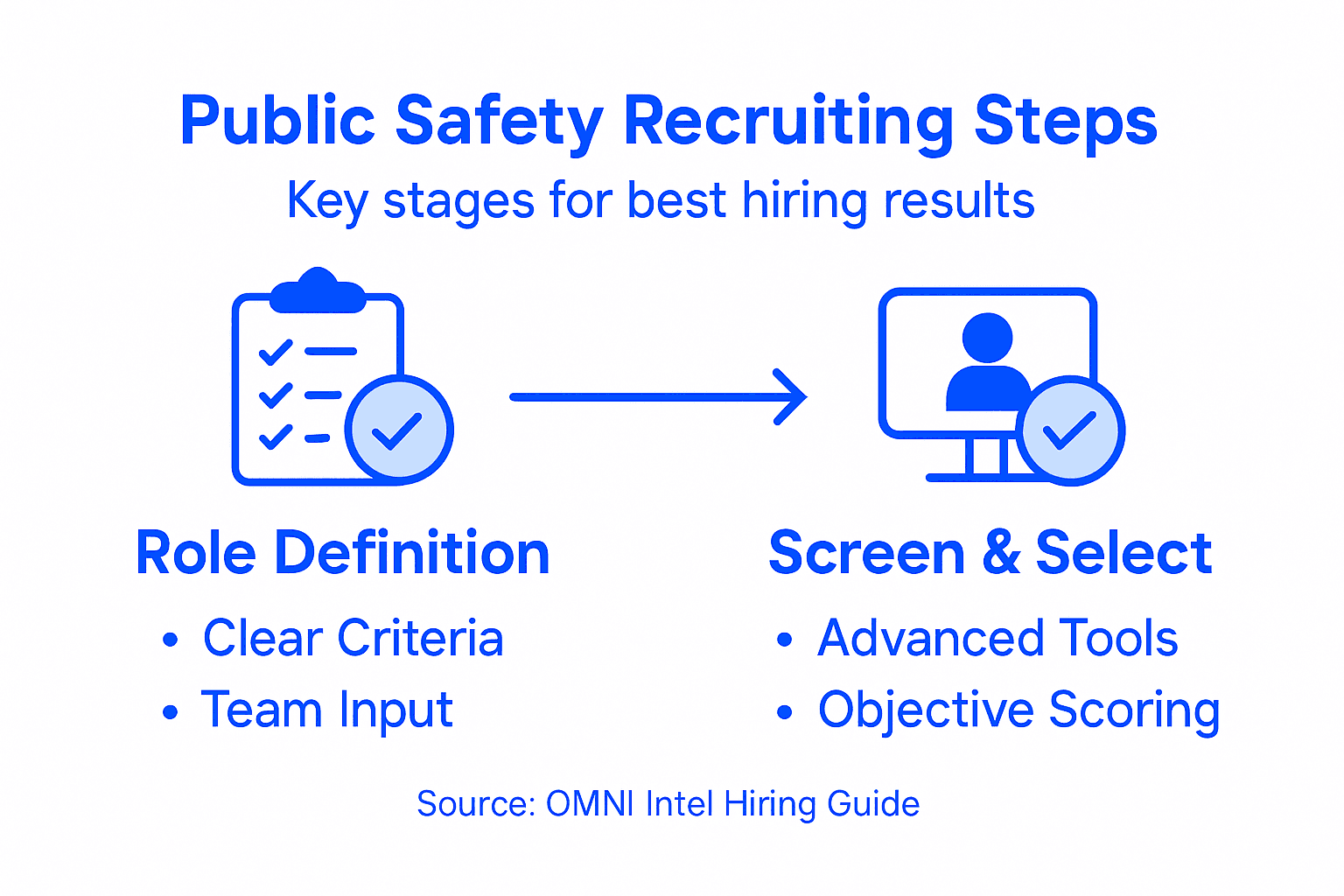
Hiring for public safety roles means more than filling vacancies—it is about ensuring your agency is built on trust, competence, and community alignment. Defining role requirements and selection criteria lays the groundwork for attracting qualified talent while reducing risk and bias during the hiring process. By focusing on clear job descriptions and objective standards, your agency can set the stage for a recruitment process that consistently brings in professionals equipped to enhance safety and compliance.
Table of Contents
- Step 1: Define Role Requirements And Selection Criteria
- Step 2: Develop Targeted Recruitment Strategies
- Step 3: Utilize Advanced Screening And Assessment Tools
- Step 4: Conduct Evidence-Based Candidate Evaluations
- Step 5: Confirm Qualifications And Ensure Compliance
- Step 6: Integrate And Monitor Successful New Hires
Quick Summary
| Key Point | Explanation |
|---|---|
| 1. Define Clear Role Requirements | Craft precise job descriptions based on thorough job analysis to attract top candidates tailored to public safety roles. |
| 2. Implement Targeted Recruitment Strategies | Use multi-channel approaches, including community events and social media, to effectively reach diverse public safety talent. |
| 3. Utilize Advanced Screening Tools | Employ cognitive tests, psychological assessments, and scenario simulations to evaluate candidates’ abilities beyond traditional methods. |
| 4. Conduct Evidence-Based Evaluations | Use quantitative metrics and competency assessments to identify the best candidates, reducing subjective biases in hiring. |
| 5. Ensure Comprehensive Compliance Checks | Systematically verify qualifications and regulatory compliance to protect agency integrity and ensure safe hiring processes. |
Step 1: Define role requirements and selection criteria
Defining precise role requirements and selection criteria forms the critical foundation for recruiting exceptional public safety professionals. By crafting clear job descriptions, your organization can attract and identify top-tier candidates who align perfectly with your agency’s needs.
To develop comprehensive role requirements, start by conducting a thorough job analysis that maps out the essential responsibilities, skills, and qualifications specific to the public safety position. This process involves breaking down the role into key components:
- Technical competencies required for the position
- Physical and mental performance standards
- Educational background and certification requirements
- Specific experience levels and professional credentials
- Personal attributes critical for success in public safety roles
When establishing selection criteria, focus on creating objective and job-related standards that enable fair and consistent candidate evaluation. These criteria should provide clear guidelines for assessing applicants and help minimize potential bias in the recruitment process.
Effective selection criteria transform recruitment from a subjective exercise into a strategic, data-driven approach to talent acquisition.
The most successful organizations develop multi-dimensional selection criteria that consider not just professional qualifications, but also psychological readiness, ethical standards, and cultural alignment with public safety missions.
Pro tip: Collaborate with current high-performing team members to validate and refine role requirements, ensuring your selection criteria reflect real-world job demands and organizational needs.
Step 2: Develop targeted recruitment strategies
Crafting targeted recruitment strategies is essential for attracting top-tier public safety talent that aligns with your agency’s unique needs and community demographics. Strategic recruitment approaches can significantly enhance the quality and diversity of your candidate pool.
To develop an effective recruitment strategy, consider a multi-channel approach that combines traditional and modern outreach methods:
- Community engagement through local events and career fairs
- Active social media recruitment targeting potential candidates
- Partnerships with educational institutions and professional organizations
- Targeted advertising in specialized platforms and industry channels
- Diversity and inclusion focused recruitment initiatives
Successful public safety recruitment demands a nuanced understanding of different recruiting methods and their potential impacts. Each strategy offers unique advantages, from expanding candidate reach to ensuring high-quality applicant pools.
Effective recruitment strategies transform your hiring process from passive selection to proactive talent acquisition.
Organizations must continuously evaluate and adapt their recruitment approaches, leveraging data-driven insights to refine targeting and improve candidate quality. This might involve analyzing past recruitment metrics, understanding demographic trends, and staying responsive to evolving workforce expectations.
Here’s a comparison of traditional versus modern recruitment approaches in public safety:
| Approach Type | Candidate Reach | Assessment Depth | Bias Reduction Potential |
|---|---|---|---|
| Traditional | Limited, local only | Basic screening, resumes | Low, subjective reviews |
| Modern, Data-Driven | Broad, national/global | Multi-dimensional testing | High, structured metrics |
Pro tip: Develop a comprehensive candidate persona that details the ideal professional profile, enabling more precise and effective recruitment targeting.
Step 3: Utilize advanced screening and assessment tools
Advanced screening and assessment tools represent the cutting edge of public safety recruitment, enabling agencies to identify candidates with exceptional potential beyond traditional evaluation methods. Modern screening approaches go far beyond simple background checks to evaluate comprehensive candidate capabilities.
Effective assessment strategies typically incorporate multiple evaluation dimensions:
- Cognitive ability testing to measure critical thinking skills
- Psychological assessments gauging emotional intelligence and stress management
- Physical fitness evaluations confirming operational readiness
- Scenario-based simulations testing real-world decision making
- Structured behavioral interviews revealing candidate motivations
The most sophisticated recruitment processes mirror comprehensive testing methodologies used by premier public safety organizations. These multi-phase assessments provide deeper insights into candidate potential by examining not just qualifications, but core competencies critical for high-stakes professional environments.
Advanced screening tools transform recruitment from a passive selection process into a strategic talent identification system.
Successful implementation requires a holistic approach that balances technological tools with human judgment. Agencies must continuously refine their assessment protocols, integrating data-driven insights with nuanced understanding of individual candidate strengths.

Pro tip: Design assessment tools that simulate actual job challenges, providing the most authentic evaluation of candidate capabilities.
Step 4: Conduct evidence-based candidate evaluations
Evidence-based candidate evaluations represent a sophisticated approach to public safety recruitment, transforming traditional hiring practices into data-driven, strategic selection processes. Systematic evaluation strategies enable agencies to move beyond subjective assessments and identify candidates with the highest potential for success.
Key components of an evidence-based evaluation framework include:
- Quantitative performance metrics tracking candidate capabilities
- Comprehensive competency assessments measuring job-specific skills
- Empirical ranking methodologies for objective candidate comparison
- Bias mitigation techniques ensuring fair evaluation processes
- Continuous outcome tracking to validate selection criteria
The most advanced public safety organizations integrate scientific research principles into their candidate evaluation protocols. This approach involves constant hypothesis testing, data analysis, and refinement of selection criteria to ensure the most effective recruitment outcomes.
Evidence-based evaluations transform candidate selection from a subjective art to a precise, measurable science.
Successful implementation requires a commitment to ongoing learning and adaptation. Agencies must develop robust data collection systems, leverage advanced analytics, and remain open to refining their evaluation techniques based on empirical insights.
Pro tip: Develop a standardized scoring rubric that quantifies candidate attributes, enabling more objective and consistent evaluation across all recruitment stages.
Step 5: Confirm qualifications and ensure compliance
Confirming candidate qualifications and ensuring regulatory compliance are critical steps in public safety recruitment that protect both the agency and potential employees. Federal hiring standards mandate comprehensive verification processes that go well beyond traditional background checks.
Key areas of qualification and compliance verification include:
- Citizenship documentation validation
- Educational credential verification
- Professional certification checks
- Background investigation thoroughness
- Medical and physical fitness standards
- Security clearance authentication
Agencies must develop systematic approaches to establishing legal qualification standards that comprehensively evaluate candidates while maintaining strict legal and ethical boundaries. This process requires meticulous documentation and uniform application of established criteria.
Compliance verification is not just a bureaucratic requirement but a critical safeguard for public safety integrity.
Successful qualification confirmation demands a multifaceted approach that combines technological verification tools, direct documentation review, and rigorous cross-referencing of candidate-provided information with authoritative sources.
Pro tip: Develop a standardized compliance checklist that tracks every verification step, ensuring no critical qualification requirement is overlooked during the hiring process.

Step 6: Integrate and monitor successful new hires
Successful integration and monitoring of new public safety hires are critical for long-term organizational effectiveness and employee retention. Comprehensive onboarding strategies provide the foundation for transforming promising candidates into high-performing team members.
Key elements of an effective integration and monitoring approach include:
- Structured orientation programs
- Mentorship and coaching assignments
- Performance tracking mechanisms
- Regular feedback and check-in sessions
- Professional development opportunities
- Cultural assimilation support
Agencies must develop systematic monitoring protocols that provide continuous support and assessment during the critical initial months of employment. This approach helps identify potential challenges, provide targeted interventions, and ensure new hires successfully adapt to their roles.
Effective integration is not just about training, but about creating a supportive ecosystem that nurtures professional growth and organizational alignment.
Successful monitoring requires a holistic approach that balances performance evaluation, personal support, and professional development, recognizing that each new hire represents a significant investment in the agency’s future.
Pro tip: Create a 90-day integration roadmap with specific milestones and check-in points to systematically track and support new hire progress.
This summary organizes the stages of public safety hiring by their primary objective:
| Recruitment Stage | Key Goal | Example Outcome |
|---|---|---|
| Role Definition | Align job needs and criteria | Clear candidate profile set |
| Recruitment Strategy | Attract relevant applicants | Diverse, targeted applicant pool |
| Screening/Assessment | Identify top-tier potential | Shortlist high-potential hires |
| Candidate Evaluation | Objectively compare contenders | Evidence-based ranking |
| Qualification/Compliance | Ensure legal, safe hiring | All standards fully verified |
| Onboarding/Monitoring | Foster retention and growth | New hires integrated, supported |
Enhance Your Public Safety Hiring with Proven Screening Solutions
Recruiting qualified candidates for public safety roles demands precise role definition, advanced screening, and evidence-based evaluation to ensure integrity and reliability. The challenges of attracting diverse applicants while confirming qualifications and maintaining compliance require specialized tools tailored to your agency’s unique needs. OMNI Intel understands these critical pain points and delivers comprehensive background screening designed specifically for public safety professionals. Our platform empowers agencies to streamline candidate assessments, reduce hiring costs, and accelerate recruitment cycles using AI-powered insights aligned with your selection criteria.

Take control of your recruitment process today by exploring Hiring Best Practices | OMNI Intel and discover how our tailored screening solutions can transform your approach. Begin building a trustworthy, high-performing team that upholds community safety and agency reputation. Visit https://omniintel.co/get-started now to advance your hiring strategy with integrity and confidence.
Frequently Asked Questions
What are the key components of role requirements for public safety positions?
Defining clear role requirements involves identifying essential responsibilities, skills, and qualifications for the position. Start by conducting a job analysis that includes technical competencies, physical and mental performance standards, educational qualifications, and necessary experience levels.
How can I develop effective recruitment strategies for public safety roles?
To attract qualified candidates, use a multi-channel approach combining community engagement, social media outreach, and partnerships with educational institutions. Focus on targeted advertising and diversity initiatives to enhance your recruitment efforts and broaden your candidate pool.
What advanced screening tools should I use to evaluate candidates for public safety jobs?
Utilize cognitive ability tests, psychological assessments, and scenario-based simulations to gain a comprehensive understanding of candidate capabilities. Design assessments that mirror real-life job challenges to ensure you accurately gauge each applicant’s potential.
How can I ensure compliance and confirm qualifications for candidates?
Confirming candidate qualifications requires systematic verification of educational credentials, certifications, and background checks. Develop a compliance checklist that outlines all necessary verification steps to guarantee candidates meet legal and security standards.
What steps should I take to integrate new hires effectively?
Implement structured onboarding programs that include orientation, mentorship, and regular feedback sessions for new hires. Create a 90-day integration roadmap to track their progress and ensure they successfully adapt to their roles and the organizational culture.