

How to build a security hiring process for public safety
TL;DR:
- Public safety security hiring requires a structured, multi-phase process to ensure operational integrity.
- Secure recruitment and thorough background checks are essential to protect sensitive information and communities.
- Continuous process improvement and specialized tools help agencies adapt to evolving threats effectively.
One flawed hire in a public safety agency can unravel years of community trust, expose sensitive infrastructure to breach, and place lives at genuine risk. Security personnel in law enforcement, fire, EMS, and dispatch environments carry responsibilities that far exceed those in most corporate settings, yet many agencies still rely on informal or outdated hiring practices that leave critical gaps. A structured, repeatable security hiring process is not optional for these organizations. It is the foundation of operational integrity. This guide walks through four essential phases, from defining prerequisites to onboarding verified candidates, using proven frameworks and real-world data to help HR leaders build a process that holds up under scrutiny.
Table of Contents
- Define your agency’s security hiring prerequisites
- Craft a secure and effective recruiting workflow
- Set up structured screening and interviews for public safety
- Verify and onboard with robust background checks and risk mitigation
- Why a ‘one size fits all’ approach misses the mark in public safety security hiring
- Empower your agency with next-level security hiring solutions
- Frequently asked questions
Key Takeaways
| Point | Details |
|---|---|
| Assess agency needs | Start with a clear analysis of roles, regulatory requirements, and critical capabilities for your security team. |
| Structure the workflow | A step-by-step, secure, and legally compliant recruitment workflow is essential for public safety hiring. |
| Prioritize practical skills | Certifications and hands-on experience often matter more than degrees for both cyber and physical roles. |
| Verify extensively | Robust background checks and structured onboarding defend both your agency and the public. |
| Tailor for long-term success | Ongoing evaluation and process adaptation ensure your security hiring stays ahead of evolving threats. |
Define your agency’s security hiring prerequisites
Every effective security hiring process begins before a single job posting goes live. The first step is a formal needs assessment conducted alongside security leaders, department heads, and legal counsel. This conversation surfaces the specific roles your agency requires, the technical and behavioral skills those roles demand, and the regulatory obligations that govern every hire.
The NIST NICE Framework offers a structured starting point for this work. It organizes cybersecurity workforce needs into defined work roles, each with associated tasks, knowledge areas, and skills, commonly called TKS statements. Mapping your open positions against these work roles ensures that job descriptions reflect realistic day-one expectations rather than aspirational wish lists that discourage qualified applicants.
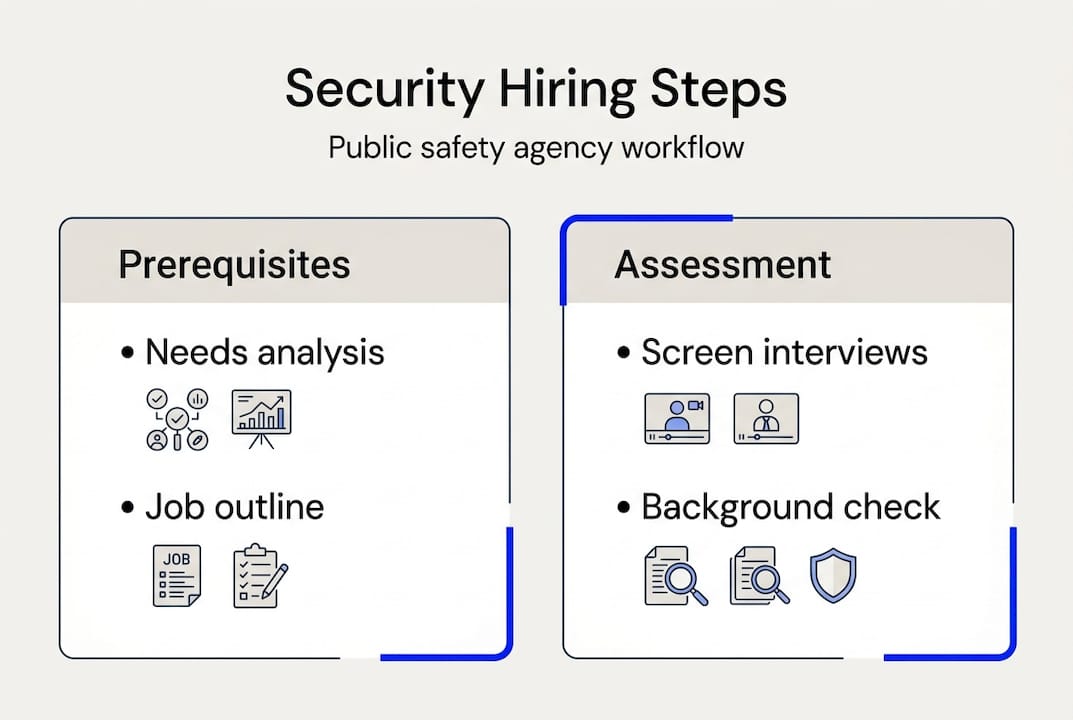
Precise job descriptions matter more than most agencies realize. A vague posting attracts a wide but poorly matched applicant pool, which increases screening costs and extends time-to-hire. HR cybersecurity playbooks consistently recommend combining technical skill requirements with soft skill criteria, such as communication under pressure and ethical judgment, in every security job description.
Key prerequisites to define before posting any security role:
- Required certifications and licenses specific to your jurisdiction
- Physical fitness or medical standards for field positions
- Security clearance levels or background investigation tiers
- Reporting structures and supervisory expectations
- Applicable legal requirements, including compliance in public safety hiring obligations under federal and state law
| Prerequisite category | Examples for public safety roles |
|---|---|
| Technical skills | Network security, surveillance systems, incident response |
| Certifications | CISSP, CompTIA Security+, state guard license |
| Legal requirements | FCRA compliance, state background check statutes |
| Physical standards | Fitness tests, vision/hearing thresholds |
| Soft skills | Crisis communication, ethical decision-making |
Pro Tip: Involve your agency’s legal team and union representatives early in the job description drafting process. Misaligned language in a JD can create compliance exposure before a single candidate applies.
Agencies that invest time in this foundation phase consistently report faster hiring cycles and better retention outcomes, because candidates self-select more accurately when expectations are clearly defined from the start.
Craft a secure and effective recruiting workflow
With prerequisites established, the next challenge is building a recruitment pipeline that is both operationally efficient and secure. Public safety agencies handle sensitive information at every stage of hiring, from application data to background investigation records, and that data requires active protection.
Sourcing strategies vary widely across agencies, but the most effective approaches combine multiple channels. Internship programs account for 55% of cybersecurity sourcing in organizations that report strong pipeline health. Apprenticeships and military job fairs also deliver candidates with discipline, structured training backgrounds, and security-oriented mindsets that align well with public safety culture.
Once candidates enter your pipeline, the application platform itself becomes a security concern. Secure hiring channels require encrypted data transmission, multi-factor authentication for both applicants and HR staff, role-based access controls (RBAC) that limit who can view sensitive files, and device monitoring to detect unauthorized access attempts. These are not optional enhancements. They are baseline requirements for any agency processing law enforcement or security candidate data.
Steps to build a secure recruitment workflow:
- Select an application platform with end-to-end encryption and audit logging
- Implement identity verification at the point of application submission
- Restrict file access using the principle of least privilege (PoLP)
- Train all HR staff on data handling protocols before the posting goes live
- Conduct regular access reviews throughout the active hiring cycle
Statistic callout: 90% of hiring managers consider hands-on IT experience when evaluating security candidates, while 89% weigh entry-level certifications. Degrees alone rarely determine hiring outcomes in this field.
Screening at the early pipeline stage should include basic technical assessments and identity verification before candidates advance to interviews. This filters out misrepresented credentials early and protects your agency’s time. Reviewing background screening best practices before designing your workflow ensures your process aligns with both legal standards and operational needs. Agencies that fail to protect candidate data during recruitment expose themselves to liability that extends well beyond the hiring decision itself.
Set up structured screening and interviews for public safety
Once candidates reach your shortlist, the evaluation process must be rigorous, consistent, and defensible. Public safety security roles demand a multi-step selection framework that tests candidates across multiple dimensions, not just technical knowledge.

The FBI’s guide to police hiring outlines a model that applies broadly to public safety security roles: initial application and screening, written assessment, structured interview, conditional offer, extensive background investigation including polygraph and records checks, medical and psychological evaluation, and academy or field training. This sequence is deliberately layered. Each step is designed to surface disqualifying information before the agency invests further resources.
For cybersecurity and hybrid security roles, the interview stage should include scenario-based questions that mirror real operational conditions. Security Magazine notes that strong HR screening questions for security leaders cover risk assessment methodology, incident response decision-making, policy development experience, and stakeholder communication under pressure. These questions reveal how a candidate thinks, not just what they know.
Structured interview components for public safety security roles:
- Behavioral questions tied to specific competency rubrics
- Technical scenario walkthroughs relevant to the role
- Panel interviews that include both HR and operational supervisors
- Standardized scoring sheets completed independently by each interviewer
- Documented debrief sessions before final decisions are made
“Consistency in the interview process is not just a fairness issue. It is a legal protection for your agency and a quality control mechanism for your hiring outcomes.”
For sensitive positions, polygraph examinations and probationary periods add an additional layer of verification. These tools are standard in law enforcement hiring and are increasingly being applied to cybersecurity roles within government and public safety contexts. Knowing the full range of types of background checks available, and understanding the background check legal requirements that govern their use, is essential before designing this phase.
Pro Tip: Train every interviewer on structured interview techniques and implicit bias awareness before the process begins. Inconsistent evaluation methods are one of the most common sources of legal challenge in public safety hiring decisions.
Verify and onboard with robust background checks and risk mitigation
Selecting a top candidate is not the finish line. Verification is where public safety hiring either holds or fails. A thorough background investigation must be completed before any conditional offer becomes final, and that investigation should be treated as a structured risk assessment, not a checkbox.
For physical security roles, thorough background checks must cover criminal history at the local, state, and federal levels, driving record review, physical fitness assessment, and verification of all claimed certifications and licenses. Any gap in this process creates an exploitable vulnerability in your agency’s personnel integrity.
Verification steps for public safety security hires:
- Criminal history check across all jurisdictions where the candidate has lived or worked
- Driving record review for roles involving vehicle operation or field response
- Certification and license verification directly with issuing authorities
- Reference checks with structured questions and documented responses
- Physical and medical assessment appropriate to the role’s demands
- Financial history review for roles with access to sensitive systems or funds
NIST SP 1308 provides a risk management framework that maps workforce gaps to security posture. Agencies can use this approach to assess where a candidate’s profile aligns with or diverges from the risk tolerance of the specific role, then make hire, train, or decline decisions based on evidence rather than intuition.
“Every unverified claim in a personnel file is a latent liability. Agencies that treat onboarding documentation as a formality often discover that reality during an audit or incident review.”
Onboarding should extend well beyond paperwork. Structured training programs, compliance orientation, and mentorship pairings during the first 90 days significantly improve both retention and performance. Maintaining complete, auditable records of every verification step protects your agency in regulatory reviews and legal proceedings. Understanding data privacy in background checks and the standards governing pre-employment investigations ensures your records management practices remain defensible over time.
Pro Tip: Build a standardized onboarding checklist that mirrors your verification steps. When every new hire completes the same documented sequence, your agency creates a consistent baseline that supports both compliance and performance management.
Why a ‘one size fits all’ approach misses the mark in public safety security hiring
The frameworks in this guide are essential, but they are starting points, not endpoints. Public safety agencies operate in environments where both cyber and physical threats evolve faster than most hiring processes can adapt. A process designed for last year’s threat landscape may already be misaligned with what your agency actually needs today.
One of the most persistent mistakes in security hiring is over-indexing on credentials at the expense of adaptability. A candidate with a long list of certifications but limited operational experience in high-pressure environments may underperform compared to a motivated candidate with fewer credentials but demonstrated judgment under stress. The hiring process must be designed to surface that distinction.
Retention data and post-hire performance reviews are underutilized tools in most agencies. Feeding that information back into your hiring criteria, interview questions, and sourcing strategies creates a continuous improvement loop that generic hiring templates cannot replicate. Reviewing advanced hiring risk management strategies helps agencies move beyond compliance and toward genuine operational excellence.
The agencies that get security hiring right treat it as a living process, not a fixed procedure.
Empower your agency with next-level security hiring solutions
Building a security hiring process with this level of rigor requires more than good intentions. It requires tools, workflows, and expertise specifically designed for the public safety environment.

OMNI Intel provides pre-employment screening solutions built specifically for law enforcement, fire, EMS, dispatch, and private security organizations. From automated background checks for public safety to investigator-driven verification workflows and compliance documentation, OMNI Intel’s platform is designed to reduce hiring risk, accelerate timelines, and produce defensible outcomes. If you are ready to secure your hiring process with a platform that understands the stakes of public safety personnel decisions, OMNI Intel is built for exactly that mission.
Frequently asked questions
What are the most important steps in a security hiring process for public safety?
The most critical steps are a structured needs assessment, precise job descriptions, secure recruiting channels, multi-layered screening, and thorough background investigations. Effective HR playbooks also emphasize interviewer training and consistent evaluation metrics throughout the process.
How do you ensure data security during hiring?
Secure hiring requires encrypted platforms, role-based access controls, identity verification at application, and ongoing device monitoring. Secure hiring protocols also recommend applying the principle of least privilege so only authorized personnel can access sensitive candidate files.
Which matters more for security hiring: degrees or hands-on experience?
Hands-on experience and certifications consistently outweigh degrees in security hiring decisions. 90% of hiring managers prioritize IT experience and 89% value entry-level certifications when evaluating candidates for cybersecurity and security-adjacent roles.
How long does a thorough public safety hiring process take?
A complete public safety hiring process typically spans several weeks to several months. The FBI’s police hiring guide describes a multi-step sequence including background investigation, polygraph, and medical evaluation that can extend the process to a year for certain law enforcement positions.