

How to ensure hiring compliance for public safety agencies
TL;DR:
- Compliance failures in public safety hiring can lead to legal action and erosion of community trust.
- A layered system of federal, state, and agency requirements demands thorough documentation and ongoing monitoring.
- Continuous training, policy updates, and technology integration are essential to maintain a defensible hiring process.
A single compliance failure in public safety hiring can unravel years of institutional credibility. When a law enforcement agency skips a required affirmative action step, misapplies a background check standard, or fails to document a selection decision, the consequences extend far beyond an internal audit. Federal investigations, discrimination lawsuits, and erosion of community trust follow quickly. Public safety agencies face a uniquely demanding regulatory environment, one where the stakes of getting hiring wrong are measured not just in legal fees but in officer integrity and public safety outcomes. This guide presents a clear, step-by-step compliance framework designed specifically for HR professionals and hiring managers at law enforcement, fire, EMS, dispatch, and government agencies seeking defensible, streamlined hiring practices.
Table of Contents
- Understanding compliance foundations in public safety hiring
- Preparation: Building a compliant hiring process
- Execution: Step-by-step compliant recruiting and screening
- Verification, audits, and ongoing compliance monitoring
- Troubleshooting: Common compliance mistakes and how to fix them
- Why most hiring compliance slips are preventable — but only with continuous action
- Streamline and secure your public safety hiring with OMNI Intel
- Frequently asked questions
Key Takeaways
| Point | Details |
|---|---|
| Understand core compliance | Know key laws, EEO requirements, and model program elements for public safety hiring. |
| Prepare before you post | Build job-related criteria, document policies, and assign trained compliance managers before recruitment starts. |
| Audit each hiring stage | Monitor applicant data, test tools for bias, and keep audit-ready records throughout the process. |
| Correct and improve | Spot errors early with regular reviews, then train staff and update policies for continuous improvement. |
Understanding compliance foundations in public safety hiring
Compliance in public safety hiring is not a single rule. It is a layered system of federal statutes, agency directives, and state-level requirements that interact in ways that can catch even experienced HR teams off guard. Understanding the full regulatory landscape is the first step toward building a defensible hiring process.
At the federal level, public safety agencies must navigate Title VII of the Civil Rights Act, the Americans with Disabilities Act (ADA), the Age Discrimination in Employment Act (ADEA), and the Fair Credit Reporting Act (FCRA). Federal contractors and agencies also fall under the jurisdiction of the Office of Federal Contract Compliance Programs (OFCCP). For federal agencies specifically, the EEOC’s MD-715 guidelines establish the framework for model Equal Employment Opportunity (EEO) programs. These guidelines require leadership commitment, barrier analysis, self-assessments, and regular reporting. The compliance public safety hiring landscape demands that agencies treat EEO not as a checkbox but as an operational priority.
The core components of a model EEO program under MD-715 include:
- Demonstrated leadership commitment from agency heads and senior officials
- Proactive barrier analysis to identify and remove obstacles to equal employment
- Applicant flow logs and availability analyses to track demographic representation
- Affirmative action plans with measurable goals and timetables
- Recordkeeping systems that support audit readiness at any time
As OFCCP requires, affirmative action plans, applicant flow logs, availability analyses, and comprehensive recordkeeping are mandatory. Public safety agencies must comply with MD-715 for model EEO programs that include leadership commitment and barrier analysis at every level of the organization.
The consequences of non-compliance are significant and measurable. The EEOC received 81,055 discrimination charges in fiscal year 2023 alone, a figure that underscores how frequently hiring practices come under scrutiny. Public safety agencies face additional layers of examination because their personnel decisions directly affect community safety.
“Physical fitness tests, polygraph requirements, and psychological evaluations used in public safety hiring must be validated as job-related and consistent with business necessity. Failure to meet this standard exposes agencies to adverse impact claims under Title VII.”
| Compliance area | Key requirement | Risk if ignored |
|---|---|---|
| Title VII | Non-discriminatory selection criteria | Federal investigation, back pay liability |
| ADA | Reasonable accommodation in hiring | Lawsuit, consent decree |
| FCRA | Pre-adverse action notices for background checks | Civil penalties up to $1,000 per violation |
| MD-715 | Model EEO program with barrier analysis | Loss of federal funding, corrective action |
| OFCCP | Affirmative action plans and flow logs | Debarment from federal contracts |
Common compliance gaps in public safety agencies include inconsistent documentation of interview decisions, failure to conduct barrier analysis for physical testing, and outdated affirmative action plans that no longer reflect current workforce demographics. Recognizing these gaps early is far less costly than addressing them after a formal complaint.
Preparation: Building a compliant hiring process
Strong compliance does not begin when a candidate applies. It begins months earlier, when HR leaders define job requirements, establish selection criteria, and build the documentation infrastructure that will support every subsequent hiring decision.
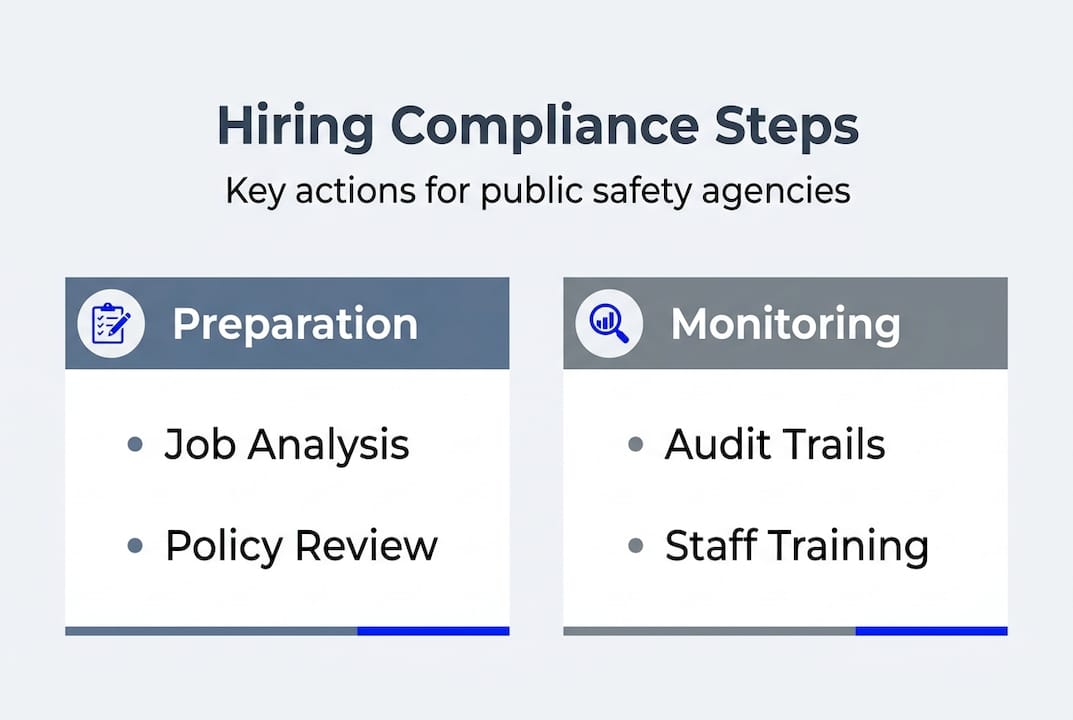
The foundation of compliant preparation is a thorough job analysis. For public safety roles, this means identifying the specific physical, cognitive, and behavioral competencies required for the position and documenting the evidence that each requirement is job-related. Adverse impact analysis using the four-fifths rule is a critical mechanic here: if any demographic group’s selection rate falls below 80% of the highest-performing group’s rate, that signals a potential compliance issue requiring investigation. Job analysis results should be reviewed by legal counsel before they are finalized.
Once job requirements are established, agencies should develop policy templates that govern every stage of the hiring process. These templates should address how applications are reviewed, how interviews are structured, how background checks are ordered, and how final selections are documented. Each template should include a version history to demonstrate that policies are actively maintained.
Pro Tip: Assign a designated EEO coordinator before recruiting begins. This person should review all job postings, interview guides, and selection criteria for potential compliance issues before any candidate ever sees them.
Documentation infrastructure is equally important. Agencies should establish a centralized audit trail system that captures every decision point in the hiring process, from the initial job posting through the final offer. This includes applicant flow logs, interview scorecards, background check authorization forms, and any accommodation requests received.

| Compliance prep element | Traditional approach | Tech-enabled approach |
|---|---|---|
| Job analysis documentation | Manual notes, paper files | Digital templates with version control |
| Applicant flow tracking | Spreadsheets updated manually | ATS with automated demographic capture |
| Interview scoring | Unstructured notes | Structured scorecards with rating anchors |
| Background check management | Fax and paper forms | Integrated FCRA-compliant platforms |
| Adverse impact analysis | Annual manual calculation | Real-time dashboard with alerts |
Staff training is the final preparation element that agencies frequently underestimate. Every manager involved in hiring decisions should receive training on EEO obligations, ADA accommodation requirements, and the agency’s specific selection criteria. The screening process steps for public safety roles are more complex than most private-sector equivalents, and untrained hiring managers are one of the most common sources of compliance failures. Agencies should also ensure that staff responsible for verifying applicant credentials understand both the legal requirements and the practical mechanics of credential verification.
Execution: Step-by-step compliant recruiting and screening
With preparation complete, agencies can move into active recruiting with confidence. Each stage of the recruiting process carries specific compliance obligations that must be addressed in sequence.
-
Job advertising. All postings must include an EEO statement and, where applicable, affirmative action language. Postings should be distributed through channels that reach diverse candidate pools, and the distribution strategy should be documented as part of the affirmative action plan.
-
Application collection. Agencies must collect demographic data separately from the application itself, typically through a voluntary self-identification form. This data feeds the applicant flow log required by OFCCP. Applicant flow logs and availability analyses are mandatory for federal contractors and public agencies.
-
Structured interviews. Every candidate for the same position should be asked the same questions in the same order. Responses should be scored using pre-established rating anchors. Structured interviews dramatically reduce the risk of subjective bias and provide a documented basis for selection decisions that can withstand audit scrutiny.
-
Background checks. This stage carries the most complex compliance requirements. Under the FCRA, agencies must obtain written authorization before ordering a background check, provide a pre-adverse action notice if negative information may affect the hiring decision, and allow the candidate time to dispute inaccurate information. State laws add additional requirements in many jurisdictions. Agencies should review FCRA compliance details and applicable background check laws before finalizing their screening protocols. For practical guidance on implementation, resources on conducting background checks for public safety agencies provide step-by-step direction.
-
Selection and documentation. Every selection decision must be documented with a clear rationale tied to the job-related criteria established during preparation. If a candidate is rejected, the reason must be recorded. If a conditional offer is rescinded based on a background check, the FCRA adverse action process must be completed in full.
Pro Tip: Use an applicant tracking system (ATS) with built-in compliance tracking to automate flow log updates, flag missing documentation, and generate audit-ready reports. AI compliance best practices recommend integrating EEO into the strategic mission and using ATS tools with compliance tracking and regular audits as core components of a modern recruiting program.
Verification, audits, and ongoing compliance monitoring
Compliance is not a destination. It is a continuous process that requires regular verification, honest self-assessment, and a willingness to correct course when data reveals problems.
The most important ongoing monitoring tool is the adverse impact analysis. Agencies should run this calculation at least quarterly, applying the four-fifths rule to each stage of the selection process: application review, interview, background check, and final selection. If any stage shows a selection rate below 80% for a protected group relative to the highest-performing group, that stage requires immediate review.
For agencies using AI-driven tools in screening or decision support, the compliance obligations are more demanding. AI tools demand bias audits, transparency notices, human oversight, and continuous monitoring to ensure that automated recommendations do not introduce or amplify discriminatory patterns. Employer liability for AI-driven bias is not diminished by the fact that a vendor supplied the tool. Agencies must contractually require bias audit results from vendors and review those results regularly. Resources on AI in hiring and AI in background checks provide current guidance on managing these obligations.
“To prevent violations, implement self-assessment checklists, monitor applicant data by protected class, and compare results to benchmarks. Address barriers proactively rather than waiting for a formal complaint to force corrective action.”
Audit trail maintenance is equally critical. Every hiring decision, accommodation request, and adverse action notice should be retained according to the agency’s records retention schedule, which must meet or exceed the minimums established by applicable federal and state law. Agencies should also review hiring data privacy obligations to ensure that retained records are stored securely and accessed only by authorized personnel.
| Monitoring activity | Recommended frequency | Responsible party |
|---|---|---|
| Adverse impact analysis | Quarterly | EEO coordinator |
| AI vendor bias audit review | Semi-annually | HR director and legal counsel |
| Applicant flow log reconciliation | Monthly | HR analyst |
| Background check process audit | Annually | Compliance officer |
| Staff EEO and ADA training | Annually, with updates | Training coordinator |
Common ongoing compliance pitfalls to watch for include:
- Failing to update affirmative action plans when workforce demographics change significantly
- Allowing structured interview guides to drift toward informal, unscored conversations
- Neglecting to review vendor contracts for AI bias audit requirements
- Storing applicant records in unsecured systems that do not meet data privacy standards
- Skipping pre-adverse action notices when background check results influence decisions
Troubleshooting: Common compliance mistakes and how to fix them
Even well-prepared agencies encounter compliance problems. The difference between agencies that manage these problems effectively and those that face formal investigations is usually the speed and quality of their response.
The most frequent compliance mistake in public safety hiring is adverse impact from physical fitness tests or written examinations that have not been validated as job-related. If your adverse impact analysis reveals a disparity, the immediate response is to pause use of the test, commission a validation study, and document the steps taken. Do not simply discontinue the test without analysis, as that creates its own documentation gap.
A second common failure is incomplete applicant tracking. If your flow logs cannot account for every applicant who entered the process and every decision point where candidates were eliminated, you have an audit vulnerability. The fix is to audit your ATS configuration, identify where data capture breaks down, and implement required fields that prevent records from being saved without complete information.
Pro Tip: During quarterly compliance reviews, pull a random sample of ten rejected applicant files and verify that each contains a documented selection rationale, a completed flow log entry, and, where applicable, a completed adverse action notice. This spot-check approach surfaces documentation gaps before auditors do.
AI tool misuse is an emerging and underappreciated compliance risk. Agencies that rely on automated resume screening or AI-driven scoring without maintaining human oversight and bias audit records are exposed to significant liability. The EEOC guidance is clear: veterans’ preferences authorized by law are exempt from Title VII challenge only if not used as a pretext for discrimination, criminal records require individualized assessment tied to job-relatedness and consideration of less discriminatory alternatives, and AI tools demand bias audits, transparency notices, human oversight, and continuous monitoring. These are not optional best practices. They are compliance requirements.
“Individualized assessment of criminal history is not just a best practice. It is a legal obligation under EEOC guidance, requiring agencies to consider the nature of the offense, the time elapsed, and the specific duties of the position before making an adverse decision.”
Agencies should also review hiring technology enhancements to ensure that any technology introduced into the hiring process is evaluated for compliance implications before deployment, not after a complaint surfaces.
Common red flags to watch for during compliance reviews include:
- Interview notes that reference protected characteristics such as age, family status, or disability
- Selection rates that differ significantly across demographic groups at any process stage
- Background check results used as automatic disqualifiers without individualized assessment
- Missing or incomplete adverse action documentation in rejected candidate files
- Vendor contracts that do not address bias audit obligations or data privacy requirements
Why most hiring compliance slips are preventable — but only with continuous action
After working through the mechanics of compliance preparation, execution, and monitoring, a harder truth emerges: most compliance failures in public safety hiring are not caused by ignorance of the rules. They are caused by treating compliance as a project that gets completed and filed away.
Agencies invest in policy development, conduct a round of staff training, and then allow those policies to drift as personnel change, technology evolves, and operational pressures push compliance tasks to the bottom of the priority list. This is policy drift, and it is one of the most underappreciated risks in public safety HR. A policy that was legally sound three years ago may be inadequate today if it has not been updated to reflect new EEOC guidance on AI tools or revised state ban-the-box laws.
The agencies that maintain the strongest compliance records are those that have embedded compliance into everyday operational decisions rather than treating it as an annual audit exercise. They assign clear ownership, schedule regular reviews, and create a culture where hiring managers feel comfortable raising compliance questions before decisions are made rather than after.
One lesson from the field that rarely appears in compliance guides: over-trust in vendor tools is a growing source of liability. Agencies assume that a background screening platform or AI recruiting tool is compliant by design. That assumption is dangerous. Vendor tools require the same scrutiny as internal processes, including contractual audit rights, regular bias review, and human oversight of automated recommendations. The investigation principles that govern thorough candidate vetting apply equally to the tools used to conduct that vetting.
Pro Tip: Schedule quarterly compliance refreshes that include scenario-based drills. Present hiring managers with realistic case studies involving adverse impact questions, accommodation requests, or criminal history decisions and work through the correct response together. This builds institutional muscle memory that holds up under pressure.
Streamline and secure your public safety hiring with OMNI Intel
The compliance framework outlined in this guide is rigorous because public safety hiring demands it. But rigorous does not have to mean slow or burdensome. The right technology and expert support can automate documentation, flag compliance gaps in real time, and reduce the administrative load on your HR team without sacrificing accuracy or defensibility.

OMNI Intel’s pre-employment screening services are built specifically for public safety agencies, incorporating FCRA-compliant workflows, investigator-driven background checks, and audit-ready documentation at every stage. Whether you are building a new compliance program from the ground up or strengthening an existing one, OMNI Intel’s platform integrates with your hiring process to support defensible, evidence-based decisions. Explore the full range of background investigations and recruiting solutions designed to protect your agency, your personnel, and the communities you serve.
Frequently asked questions
What is the four-fifths rule in hiring compliance?
The four-fifths rule signals possible adverse impact when any demographic group’s selection rate falls below 80% of the highest-performing group’s rate at any stage of the hiring process. Agencies should apply this calculation quarterly across every selection stage.
How does using AI affect hiring compliance?
AI tools require bias audits, transparency notices, human oversight, and ongoing monitoring to remain compliant. Employer liability for AI-driven discrimination is not reduced simply because a third-party vendor supplied the tool.
What are public safety agencies’ unique compliance responsibilities?
Public safety agencies must comply with MD-715 requirements for model EEO programs, including demonstrated leadership commitment, barrier analysis for all selection procedures, and regular self-assessments that go beyond what most private employers must maintain.
Do veterans’ preference policies violate Title VII?
Veterans’ preferences authorized by law are generally exempt from Title VII challenges, provided they are not used as a pretext for discrimination against other protected groups. Agencies should document the legal basis for any preference policy they apply.