
Evidence-based Recruitment Steps for Public Safety
Public safety agencies need reliable hiring processes to select candidates who uphold community trust and safety standards. Traditional recruitment methods often rely on subjective judgments that introduce bias and inconsistency into hiring decisions. Evidence-based recruitment offers a structured alternative, using validated assessments, standardized procedures, and data-driven analysis to identify candidates most likely to succeed in demanding public safety roles. This guide outlines practical steps recruitment professionals can implement to improve candidate selection, reduce hiring risks, and build stronger teams through research-backed methods tailored specifically for law enforcement, fire services, EMS, and related agencies.
Table of Contents
- Understanding The Evidence-Based Recruitment Approach
- Preparing For Evidence-Based Recruitment: Key Prerequisites
- Executing The Recruitment Steps: From Sourcing To Interviewing
- Verifying And Improving Your Evidence-Based Hiring Outcomes
- Enhance Your Public Safety Recruitment With OMNI Intel Solutions
- Frequently Asked Questions
Key takeaways
| Point | Details |
|---|---|
| Structured approach reduces bias | Evidence-based methods standardize evaluation criteria and minimize subjective decision-making throughout the hiring process. |
| Data improves candidate selection | Validated assessments and consistent scoring provide measurable insights into candidate suitability for public safety roles. |
| Verification ensures safety | Comprehensive background investigations confirm candidate integrity and protect agency reputation and community trust. |
| Continuous improvement matters | Regular process reviews and outcome tracking help agencies refine recruitment strategies based on actual hiring results. |
Understanding the evidence-based recruitment approach
Evidence-based recruitment transforms hiring from an intuitive process into a systematic methodology grounded in research and measurable outcomes. For public safety agencies, this approach addresses critical challenges including high turnover costs, liability risks from poor hiring decisions, and the need to maintain public confidence through transparent personnel selection.
The core principle involves replacing gut feelings with validated tools and standardized procedures. Instead of relying on interviewer impressions alone, agencies collect objective data through structured assessments, behavioral interviews, and comprehensive background investigations. This shift helps identify candidates who possess not just technical skills but also the psychological resilience, ethical judgment, and interpersonal abilities essential for public safety work.
Common biases that evidence-based methods help counteract include:
- Confirmation bias where interviewers seek information supporting initial impressions rather than challenging assumptions
- Similarity bias favoring candidates who resemble current employees or share interviewer backgrounds
- Recency bias giving disproportionate weight to information presented late in interviews
- Halo effect allowing one positive trait to overshadow potential concerns

Implementing best practices for law enforcement hiring in 2026 requires commitment to transparency and consistency. Agencies document decision criteria before reviewing applications, use identical evaluation standards across all candidates, and maintain records that demonstrate fair treatment. This structured approach not only improves selection accuracy but also provides legal protection by showing defensible, job-related hiring decisions.
Evidence-based recruitment shifts focus from who interviewers like to who data indicates will succeed, creating fairer outcomes and stronger teams.
The transparency inherent in evidence-based methods builds trust with candidates and communities alike. When agencies can articulate exactly why they selected specific individuals based on measurable qualifications, they demonstrate accountability and professionalism that strengthens public confidence in their personnel.
Preparing for evidence-based recruitment: key prerequisites
Successful implementation begins long before posting job announcements. Agencies must first establish clear foundations that enable consistent, data-driven decision-making throughout the recruitment cycle.
Start by defining precise job requirements through collaboration with subject matter experts currently performing the role. These practitioners provide insights into daily challenges, critical competencies, and situations that distinguish high performers from adequate ones. Document not just technical skills but also cognitive abilities, personality traits, and values alignment that predict success in your specific organizational culture.
Selecting validated assessment tools represents a crucial preparation step. Psychological evaluations, situational judgment tests, and skills assessments should demonstrate reliability and validity for public safety contexts. Review research supporting each tool’s predictive accuracy and ensure assessments measure job-relevant attributes rather than general intelligence or personality factors unrelated to performance.
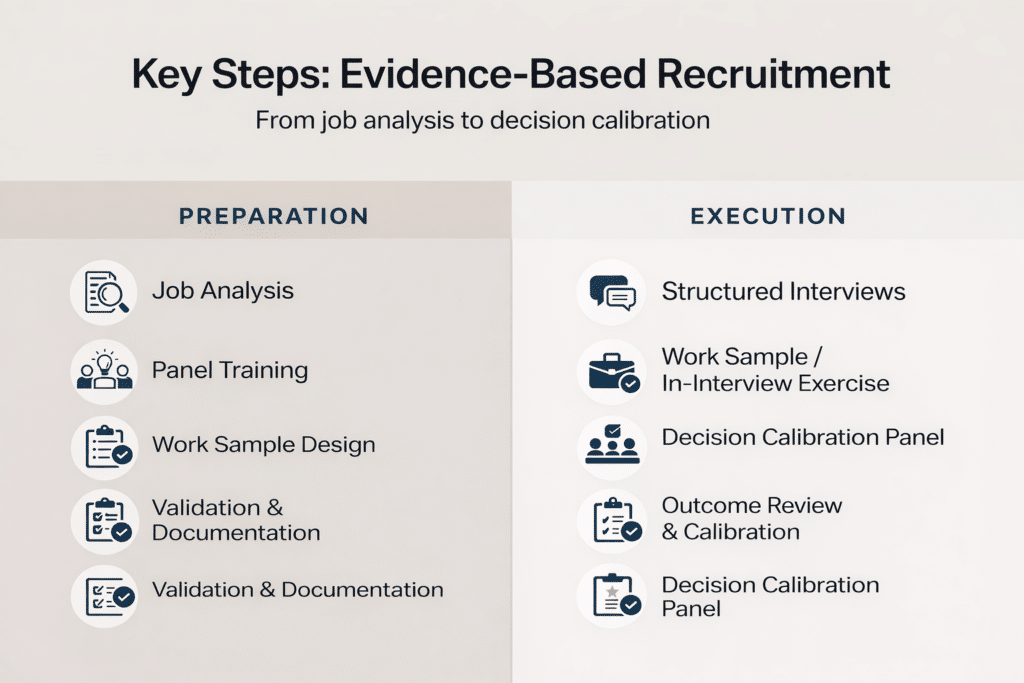
Assemble and train hiring panels to evaluate candidates consistently. Panel members need calibration sessions where they practice scoring sample responses using standardized rubrics. This training reduces individual biases and ensures different interviewers reach similar conclusions when evaluating identical candidate presentations. Regular calibration maintains consistency as panel composition changes over time.

The step by step screening process for public safety hiring emphasizes establishing clear decision thresholds before reviewing any applications. Determine minimum qualifications, preferred attributes, and disqualifying factors in advance. Document these criteria and share them with all hiring team members to prevent standards from drifting during evaluation.
Pro Tip: Pilot new assessment tools with current employees to verify they distinguish between high and low performers before using them for candidate selection. This validation step identifies tools that actually predict success in your specific environment.
Invest in reliable data management systems that track candidate information, assessment scores, and hiring outcomes. These systems enable pattern analysis that reveals which selection methods best predict long-term success and where process improvements could enhance efficiency or accuracy.
Executing the recruitment steps: from sourcing to interviewing
Implementation follows a systematic sequence that maintains consistency while allowing flexibility to address each role’s unique requirements.
- Source diverse candidate pools through multiple channels including professional networks, educational institutions, community organizations, and digital platforms. Broad sourcing reduces selection bias by ensuring qualified individuals from varied backgrounds have equal opportunity to apply.
- Screen applications using predetermined criteria that focus exclusively on job-relevant qualifications. Remove identifying information unrelated to job performance to prevent unconscious bias from influencing initial decisions about who advances.
- Administer validated assessments measuring cognitive abilities, personality traits, and situational judgment relevant to public safety work. Standardize testing conditions and provide clear instructions to ensure fair comparison across candidates.
- Conduct structured interviews using identical core questions for all candidates in the same role. Behavioral questions asking candidates to describe past experiences handling specific situations provide better predictive validity than hypothetical scenarios. Supplement core questions with role-specific probes that explore technical knowledge or specialized skills.
- Score responses using detailed rubrics defining what constitutes strong, adequate, and weak answers. Multiple interviewers independently rate each response, then compare scores to identify discrepancies requiring discussion. This process surfaces different perspectives while maintaining objectivity.
- Document all evaluation data in standardized formats that enable comparison and analysis. Record not just final scores but also specific observations supporting those ratings.
Implementing hiring process best practices for public safety agencies means treating interviews as data collection opportunities rather than casual conversations. Structure creates consistency that improves prediction accuracy.
Pro Tip: Conduct interviewer calibration sessions quarterly where panel members score recorded interview responses, then discuss rating differences to maintain consistent standards across evaluators and over time.
| Interview Type | Structure Level | Predictive Validity | Time Investment |
|---|---|---|---|
| Unstructured | Low | 0.20 | Moderate |
| Semi-structured | Medium | 0.35 | Moderate |
| Fully structured | High | 0.51 | High |
| Structured + work samples | Very high | 0.63 | Very high |
The table illustrates how increased structure correlates with improved prediction of candidate success, justifying the additional time investment required for rigorous evidence-based approaches.
Maintain detailed records throughout execution. Documentation serves multiple purposes including legal compliance, process improvement analysis, and training materials for new hiring team members. Transparency in data collection builds confidence that selection decisions reflect merit rather than favoritism or bias.
Verifying and improving your evidence-based hiring outcomes
Candidate verification through comprehensive background investigations represents the final critical step before extending offers. Even candidates who excel in assessments and interviews require thorough vetting to confirm their suitability for positions requiring public trust.
Pre-employment screening services verify candidate claims about education, employment history, certifications, and criminal records. For public safety roles, investigations extend beyond standard checks to include credit history reviews, social media analysis, and interviews with personal references who can speak to character and judgment.
Background investigations serve multiple functions. They confirm candidates provided accurate information during the application process, demonstrating integrity essential for public safety work. They also identify potential risk factors including financial pressures, substance abuse issues, or patterns of problematic behavior that might compromise job performance or agency reputation.
Establish clear standards for what background findings constitute disqualification versus concerns requiring additional evaluation. Document these standards and apply them consistently to avoid discriminatory practices. Some agencies use tiered systems where certain findings automatically disqualify candidates while others trigger individualized assessments considering factors like time elapsed, rehabilitation efforts, and relevance to job duties.
Evaluating recruitment success requires tracking metrics beyond simple time-to-hire or cost-per-hire figures. Monitor:
- New hire performance ratings during probationary periods
- Retention rates comparing evidence-based hires to those selected through previous methods
- Complaint or disciplinary action rates for recent hires
- Supervisor satisfaction with new employee preparedness
- Candidate diversity across demographic categories
Analyze these metrics to identify which assessment tools and interview questions best predict actual job success. Discontinue methods showing weak correlation with performance and invest more heavily in approaches demonstrating strong predictive validity.
| Verification Method | Information Confirmed | Typical Timeline | Risk Mitigation Value |
|---|---|---|---|
| Criminal records check | Convictions, pending charges | 3-7 days | High |
| Employment verification | Job titles, dates, performance | 5-10 days | Medium |
| Education verification | Degrees, certifications | 5-10 days | Medium |
| Credit history review | Financial responsibility | 2-5 days | Medium |
| Reference interviews | Character, judgment, behavior | 7-14 days | High |
Continuous improvement distinguishes truly evidence-based recruitment from agencies simply going through motions. Schedule quarterly reviews where hiring team members analyze recent selection decisions, discuss what worked well, and identify opportunities for refinement. This iterative approach ensures your recruitment process evolves based on actual results rather than remaining static.
Share outcome data with hiring panels to demonstrate how their evaluation decisions translated into employee performance. This feedback loop helps interviewers calibrate their assessments and reinforces the value of maintaining structured, consistent evaluation approaches even when time pressures tempt shortcuts.
Enhance your public safety recruitment with OMNI Intel solutions
Implementing evidence-based recruitment requires robust tools that streamline verification processes while maintaining thoroughness and accuracy. OMNI Intel provides specialized solutions designed specifically for public safety agencies seeking to enhance candidate selection through comprehensive screening and background investigation capabilities.

Our public safety pre-employment screening services leverage law enforcement investigation principles to conduct thorough candidate vetting that goes beyond surface-level checks. We verify employment history, educational credentials, professional licenses, and criminal records while maintaining strict compliance with privacy regulations and fair hiring practices.
Integrated background checks for public safety help agencies identify potential risks before extending offers, protecting both organizational reputation and community safety. Our platform provides detailed reports that support informed hiring decisions based on complete, accurate candidate information.
Streamline your workflow with applicant screening integration that connects seamlessly with existing hiring systems. This integration reduces administrative burden while ensuring no candidates slip through gaps in your verification process.
Frequently asked questions
What defines evidence-based recruitment for public safety agencies?
Evidence-based recruitment uses validated assessment tools, standardized evaluation procedures, and data analysis to make hiring decisions based on measurable predictors of job success rather than subjective impressions. This approach relies on research demonstrating which candidate attributes correlate with effective performance in public safety roles. Agencies collect consistent data across all applicants, apply identical evaluation criteria, and track hiring outcomes to continuously refine selection methods based on actual results rather than assumptions.
How do background checks improve public safety hiring outcomes?
Comprehensive background investigations verify candidate integrity and identify potential risk factors that could compromise job performance or public trust. These checks confirm applicants provided accurate information about their history, revealing patterns of behavior relevant to suitability for positions requiring ethical judgment and community confidence. Thorough vetting reduces liability risks and protects agency reputation by ensuring only candidates meeting established character standards receive offers. Background screening also demonstrates due diligence that courts recognize as reasonable precaution against negligent hiring claims.
What tools are essential for implementing evidence-based recruitment?
Successful implementation requires validated psychological assessments measuring traits predictive of public safety performance, structured interview protocols with detailed scoring rubrics, and reliable background investigation services. Agencies also need data management systems tracking candidate information and hiring outcomes to enable analysis identifying which selection methods work best. Interviewer training programs ensuring consistent evaluation across panel members and clear documentation standards supporting transparent, defensible hiring decisions complete the essential toolkit.
How can agencies continuously improve their recruitment process?
Track metrics including new hire performance ratings, retention rates, and time-to-productivity to identify which selection methods best predict success. Conduct quarterly reviews analyzing recent hiring decisions and outcomes, then adjust assessment tools or interview questions based on patterns revealed. Provide feedback to hiring panels showing how their evaluations correlated with actual employee performance, reinforcing effective practices and correcting approaches that failed to predict success. Regular calibration sessions maintain consistent standards as panel composition changes over time.
Why does structured interviewing improve candidate selection accuracy?
Structured interviews asking identical core questions and using standardized scoring rubrics eliminate inconsistency that reduces predictive validity in unstructured conversations. Research shows structured approaches achieve validity coefficients around 0.51 compared to 0.20 for unstructured interviews, meaning they predict actual job performance more than twice as accurately. Standardization also reduces bias by focusing evaluation on job-relevant responses rather than rapport or similarity to interviewers. Multiple independent raters scoring responses provide additional objectivity that improves selection decisions.