

FCRA compliance in public safety: what HR pros must know
Even police departments, fire agencies, and EMS organizations are not exempt from the Fair Credit Reporting Act (FCRA), and that surprises more compliance officers than it should. The FCRA sets binding federal standards for how employers use third-party background checks, and FCRA applies fully to consumer reporting agency (CRA) background screens in high-risk hiring environments, including public safety. One missed disclosure form, one improperly timed adverse action notice, or one skipped consent step can expose your agency to costly litigation and reputational harm. This guide walks through every critical obligation so your agency can hire with both speed and legal confidence.
Table of Contents
- What is FCRA compliance and who does it apply to?
- Core steps in FCRA-compliant background screening
- Special considerations: Investigative, credit, and AI-driven reports
- FCRA compliance and the EEOC: Navigating overlap for high-risk hires
- Why FCRA compliance is public safety’s most overlooked risk
- How to simplify FCRA compliance for public safety hiring
- Frequently asked questions
Key Takeaways
| Point | Details |
|---|---|
| FCRA applies fully | All public safety agencies must meet FCRA standards when hiring with background checks. |
| Follow detailed steps | Every FCRA-compliant check requires proper notice, consent, and timing before hiring decisions. |
| Account for special reports | Investigative, credit, and AI-driven reports all have added FCRA rules and agency risks. |
| Integrate EEOC guidelines | Combine FCRA steps with EEOC individual assessments for criminal background findings. |
| Document and train | Meticulous recordkeeping and staff training are crucial for staying compliant and defending hiring decisions. |
What is FCRA compliance and who does it apply to?
The Fair Credit Reporting Act is a federal law that governs how employers collect, use, and act on background information obtained through a third-party CRA. Many HR professionals associate FCRA with credit checks, but its reach is far broader. Criminal history reports, employment verifications, and even social media monitoring files compiled by a CRA all fall under FCRA’s jurisdiction.
Public safety agencies are not a special carve-out. No exemptions exist for law enforcement, fire departments, or emergency services when using a CRA for hiring or promotion decisions. The same procedural rules that apply to a retail employer apply to a police chief filling a patrol officer vacancy.
Under FCRA, every applicant has specific rights that your agency must protect:
- Disclosure: Applicants must receive a clear, standalone written notice that a background check will be conducted.
- Written consent: A signed authorization from the applicant is required before any CRA report is ordered.
- Pre-adverse action notice: Before rejecting a candidate based on report findings, the agency must provide the report and a summary of rights.
- Dispute opportunity: Candidates must have a reasonable window to challenge inaccurate information.
- Final adverse action notice: If the decision stands, a formal notice with CRA contact details and rights information must follow.
State and local laws, including ban-the-box ordinances, may add procedural layers on top of these federal requirements. But those laws never reduce federal FCRA duties. They only expand them. Understanding background checks explained for public safety contexts is the foundation for building a defensible process.
Pro Tip: Keep your FCRA disclosure form as a standalone document. Bundling it with an employment application is a common violation that plaintiffs’ attorneys actively look for.
Core steps in FCRA-compliant background screening
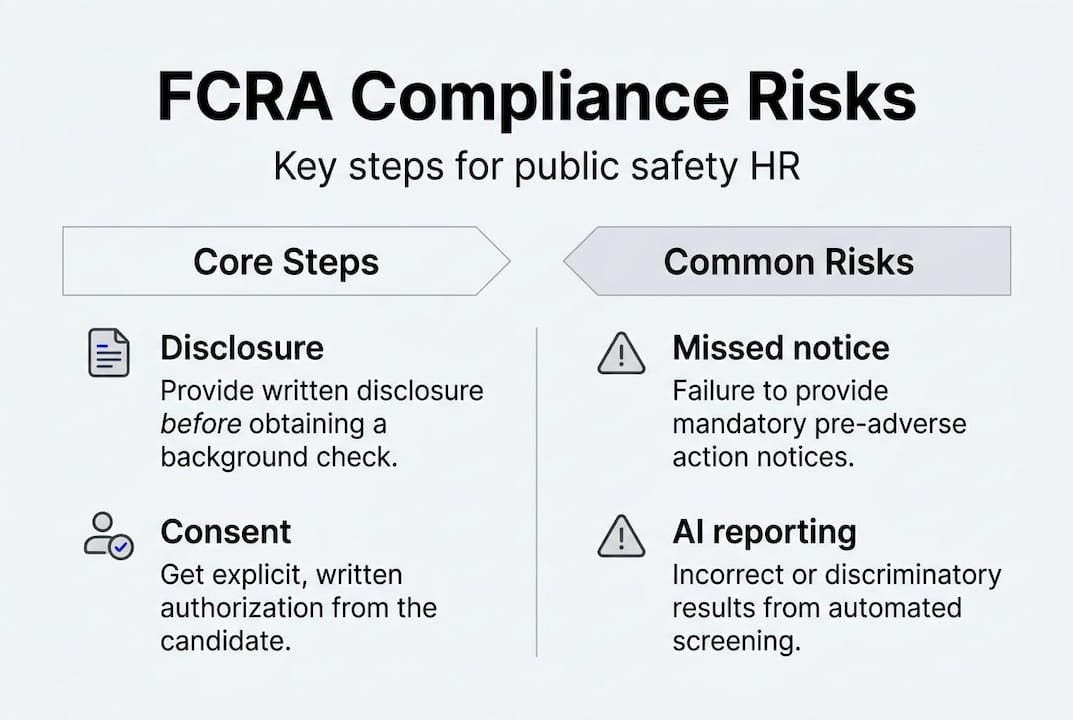
Compliance is not a single action. It is a sequence of documented steps, each with timing requirements that matter especially in public safety, where urgency often tempts HR teams to cut corners. Here is the required sequence:
- Provide standalone disclosure to the applicant before ordering any report.
- Obtain written authorization signed by the applicant.
- Order the CRA report only after both steps above are complete.
- Review the report and determine if any findings may affect the hiring decision.
- Issue a pre-adverse action notice that includes the report, a summary of rights, and the CRA’s contact information.
- Allow a dispute period (typically five business days is considered reasonable, though FCRA does not specify an exact number).
- Issue the final adverse action notice if the decision does not change after the dispute window.
Timing is where public safety HR teams most often stumble. Roles in law enforcement or EMS carry urgency, and agencies sometimes issue a final adverse action notice before the candidate has had a genuine opportunity to dispute the findings. Train on adverse action timing to ensure disputes are possible before any offer is formally withdrawn.
| Step | Document required | Timing requirement |
|---|---|---|
| Disclosure | Standalone written notice | Before ordering report |
| Consent | Signed authorization | Before ordering report |
| Pre-adverse action | Report plus summary of rights | Before final decision |
| Dispute window | None (candidate-initiated) | Reasonable time allowed |
| Final adverse action | Written notice with CRA info | After dispute period closes |
Investigative consumer reports, which are based on personal interviews rather than database searches, require an additional written notice describing the nature and scope of the investigation. This step is separate from the standard disclosure and is easy to overlook.

Pro Tip: Build your FCRA step checklist directly into your applicant tracking system so no phase is skipped under hiring pressure. Reviewing background check steps for public safety will help you map each phase to your existing workflow.
Special considerations: Investigative, credit, and AI-driven reports
Not all background reports carry the same FCRA obligations. Public safety HR professionals need to understand three specific report categories that carry elevated compliance risk.
Investigative consumer reports are based on interviews with neighbors, coworkers, or references. They require a separate written notice to the applicant explaining the nature and scope of the investigation. Failing to send this notice is a distinct FCRA violation, independent of the standard disclosure requirement.
Credit reports trigger additional protections under FCRA and should only be ordered when the financial information is directly relevant to the role in question. Using credit data for a position with no financial responsibility is difficult to legally justify and increases disparate impact risk.
AI-generated and automated monitoring reports are now squarely in FCRA’s scope. AI and monitoring dossiers are treated as FCRA consumer reports under CFPB 2024 to 2025 guidance. This means any vendor compiling behavioral profiles, social media activity, or continuous monitoring data on your employees or applicants must be treated as a CRA.
| Report type | Extra FCRA notice required | Key risk area |
|---|---|---|
| Standard criminal/employment | No | Timing of adverse action |
| Investigative (interview-based) | Yes, nature and scope notice | Missing separate notice |
| Credit report | No, but use must be justified | Disparate impact exposure |
| AI/monitoring compiled file | Yes, treated as CRA report | Vendor classification errors |
Agencies must not rely on informal or oral background information gathered outside the CRA process when making employment decisions. If a supervisor heard something about a candidate from a former colleague, that information cannot substitute for a formal, FCRA-compliant report.
“The CFPB and EEOC are actively monitoring how emerging technology intersects with background screening. Agencies that adopt AI-driven tools without reviewing their FCRA obligations are accepting significant legal exposure.”
Understanding AI in public safety background checks is no longer optional for compliance officers managing modern screening programs.
FCRA compliance and the EEOC: Navigating overlap for high-risk hires
FCRA governs the process of background screening. The Equal Employment Opportunity Commission (EEOC) governs the outcome and its potential discriminatory impact. Both frameworks apply simultaneously, and failing to account for their overlap is one of the most costly mistakes a public safety HR team can make.
When an applicant’s criminal record surfaces, FCRA requires you to follow the adverse action process. The EEOC requires something additional: an individualized assessment. Individual assessment for criminal records must weigh the nature and severity of the offense, the time elapsed since the offense, the nature of the job, and evidence of rehabilitation.
For public safety roles, this assessment carries extra weight. A disqualifying record for a patrol officer position may not be disqualifying for a civilian administrative role within the same agency. Treating all criminal records identically, regardless of role, creates disparate impact exposure under Title VII.
Here is what a defensible individual assessment process looks like in practice:
- Document the offense: Record the specific charge, conviction date, and sentence.
- Assess role relevance: Determine whether the offense directly relates to the duties and risks of the position.
- Evaluate recency: Consider how much time has passed and whether the behavior pattern has continued.
- Review rehabilitation evidence: Look at employment history, references, and any program completion since the offense.
- Record your reasoning: Write a clear, role-specific rationale for your decision before issuing any adverse action notice.
Ban-the-box laws in many jurisdictions require agencies to delay criminal history inquiries until later in the hiring process. These laws do not remove FCRA obligations. They add to them. Reviewing criminal screening and FCRA requirements together ensures your process satisfies both federal and local standards.
Pro Tip: Create a standardized individual assessment template for your agency. Using a consistent format across all applicants with criminal records strengthens your defense against disparate impact claims and demonstrates good faith compliance.
Why FCRA compliance is public safety’s most overlooked risk
Public safety agencies are built around urgency and security. That culture, while admirable, creates a specific blind spot: procedural compliance gets treated as secondary to filling a critical role fast. This is where real-world FCRA violations accumulate.
One missing disclosure, one adverse action notice issued a day too early, one AI monitoring vendor not classified as a CRA. These are not minor technicalities. They are actionable violations that a disqualified candidate’s attorney can exploit, regardless of whether the underlying hiring decision was correct.
Seasoned HR leaders in public safety understand something that newer compliance officers often learn the hard way: FCRA mistakes do not just cost money in settlements. They damage community trust in the agency’s judgment and integrity. When a department’s hiring process becomes a news story, the harm extends far beyond the courtroom.
The next compliance frontier is digital. AI tools and continuous employee monitoring platforms are expanding what counts as a consumer report under FCRA. Agencies adopting these tools without reviewing their vendor agreements and compliance workflows are building risk into their infrastructure. Staying current on explained public safety background checks is not a one-time exercise. It is an ongoing operational discipline.
How to simplify FCRA compliance for public safety hiring
Navigating FCRA’s procedural requirements while managing the speed and scrutiny of public safety hiring is a real operational challenge. OMNI Intel is built specifically for agencies that cannot afford compliance gaps.

OMNI Intel’s pre-employment screening platform integrates FCRA-compliant workflows directly into your hiring process, automating disclosure delivery, consent collection, and adverse action timing so nothing falls through the cracks. For agencies requiring deeper vetting, our pre-employment investigations team conducts investigator-driven checks built on law enforcement principles. Whether you’re managing a single vacancy or a department-wide recruitment cycle, OMNI Intel reduces compliance risk while accelerating your path to qualified, thoroughly vetted candidates.
Frequently asked questions
Does FCRA compliance apply to all public safety roles?
Yes, FCRA applies fully to any public safety role involving background checks through a third-party CRA, with no exemptions identified for law enforcement, fire, or EMS agencies.
What steps must agencies take for FCRA compliance?
Agencies must provide standalone disclosure, obtain written consent, issue pre-adverse and adverse action notices, and allow a reasonable dispute window. FCRA step requirements include disclosure, consent, notice, and dispute at each phase of the screening process.
Is an AI-generated background profile considered a consumer report?
Yes, the CFPB has confirmed that AI-generated monitoring reports are classified as FCRA consumer reports, meaning the vendors producing them must be treated as CRAs with all corresponding obligations.
How do EEOC rules interact with FCRA in public safety hiring?
FCRA governs the procedural steps, while EEOC guidance requires an individualized criminal record assessment that considers offense nature, time elapsed, rehabilitation, and direct relevance to the specific public safety role.