
Verify candidate integrity to protect public safety hiring
TL;DR:
- Candidate misrepresentation is widespread, especially with 98.8% of AI-crafted applications containing embellishments, posing operational risks for public safety entities. Traditional background checks are insufficient against sophisticated fraud, requiring layered verification combining AI analysis, behavioral assessments, and investigator oversight at every hiring stage. Implementing a comprehensive, compliance-driven process with continuous monitoring is essential to safeguard community safety and organizational integrity.
Candidate misrepresentation is far more pervasive than most public safety leaders are prepared to acknowledge. Research indicates that resume fraud affects 44-70% of applicants, and among those who heavily use AI to craft their applications, the misrepresentation rate climbs to a staggering 98.8%, with an average of 6.6 embellishments per resume. For a police department, fire service, EMS agency, or dispatch center, this is not an abstract HR problem. It is an operational liability. The personnel you place in the field, behind the wheel of an emergency vehicle, or on the other end of a 911 call must be exactly who they claim to be. This guide lays out a structured, evidence-based approach to verifying candidate integrity at every stage of the hiring process.
Table of Contents
- The hidden risks of unchecked candidate integrity
- Traditional background checks: Strengths and blind spots
- Next-gen integrity tools: AI, behavioral screens, and layered verification
- Integrating integrity verification in the public safety hiring process
- The uncomfortable truth: Why most public safety agencies underestimate integrity risk
- Strengthen your agency’s hiring integrity with proven solutions
- Frequently asked questions
Key Takeaways
| Point | Details |
|---|---|
| Candidate fraud is widespread | Over 44% of applicants misrepresent themselves, with even higher rates for AI-assisted candidates. |
| Traditional checks fall short | Legacy verification methods miss many modern forms of fraud and need to be supplemented. |
| Layered verification is essential | Combining AI, behavioral interviews, and dynamic checks ensures stronger integrity screening. |
| Costs are massive | Resume fraud causes hundreds of billions in annual losses and significant agency liability. |
| Policy and training matter | Embedding verification checks at every hiring step and training teams is vital for sustainable results. |
The hidden risks of unchecked candidate integrity
With this context on the scope of the problem, let’s break down the specific risks agencies face when integrity goes unchecked.
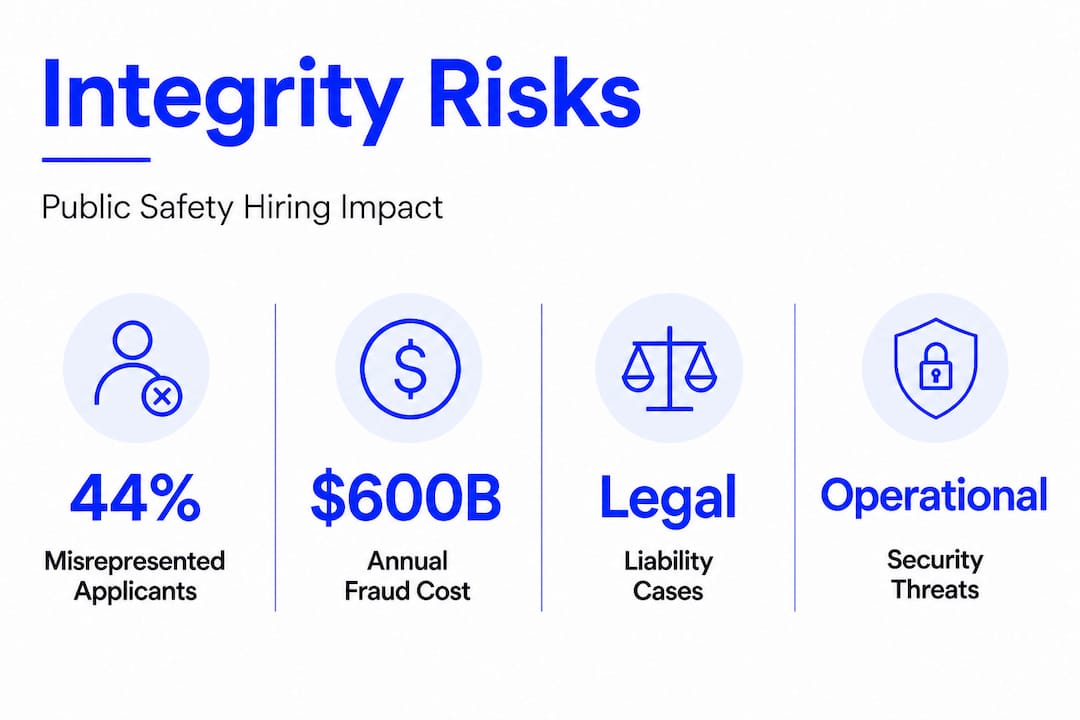
The consequences of hiring a misrepresenting candidate in a civilian organization are costly. In a public safety agency, those consequences can be catastrophic. When an officer, firefighter, or dispatcher is hired based on falsified credentials or embellished experience, the agency does not just face a performance problem. It faces legal exposure, community trust erosion, and in some cases, direct threats to life and safety.
The financial and operational cost of resume fraud
| Cost Category | Impact on Public Safety Agencies |
|---|---|
| Legal liability | Lawsuits from misconduct tied to unqualified hires |
| Retraining costs | Resources spent correcting skill gaps from false claims |
| Reputation damage | Loss of public trust after high-profile hiring failures |
| Operational disruption | Reduced unit effectiveness from underqualified personnel |
| Termination and rehire | Full recruitment cycle costs repeated |
| Civil settlements | Payouts tied to incidents involving fraudulent hires |
These costs accumulate rapidly. Across all US industries, the annual cost of resume fraud is estimated at $600 billion. Public safety agencies, operating under heightened scrutiny and with personnel who carry legal authority, bear a disproportionate share of those risks.

Risks unique to public safety agencies
The stakes in public safety hiring are unlike those in almost any other sector. Consider the following scenarios that illustrate why verifying applicant credentials is non-negotiable:
- A law enforcement candidate falsifies prior police experience to appear more qualified, then struggles to make sound judgments under pressure, resulting in a use-of-force incident.
- A firefighter candidate misrepresents physical fitness certifications, creating a danger to themselves and their crew during a structural fire.
- A dispatch applicant embellishes their crisis communication training, leading to delayed or incorrect emergency responses.
- A private security hire fabricates a clean criminal background, creating direct liability for the contracting agency.
Each of these scenarios has real-world precedents. They are not hypothetical risks. They are documented patterns that emerge when integrity verification is treated as a formality rather than a foundational safeguard.
“Among applicants who rely heavily on AI to craft their resumes and applications, the misrepresentation rate reaches 98.8%, with an average of 6.6 embellishments per submission.” This is not a rounding error. It is a systemic integrity crisis that demands a systemic response.
The rise of AI-assisted application fraud has fundamentally changed the threat landscape. Candidates can now generate polished, technically convincing resumes that overstate qualifications, fabricate certifications, and obscure problematic employment history, all within minutes. Traditional screening methods were not designed to detect this level of sophisticated misrepresentation.
Traditional background checks: Strengths and blind spots
Now that we’ve established the stakes, it’s important to review current verification tools and their limitations.
Most public safety agencies rely on a combination of background checks, reference verification, and resume review to screen candidates. These tools have genuine value. They are legally defensible, they establish a compliance baseline, and they catch the most obvious forms of fraud. But they were built for a different era of deception.
Comparison of traditional verification methods
| Verification Method | Strengths | Blind Spots |
|---|---|---|
| Criminal background check | Catches prior convictions, FCRA-compliant | Does not detect embellished skills or fabricated credentials |
| Reference checks | Validates character and work history | Easily gamed with coached references or false contacts |
| Resume review | Identifies inconsistencies in dates and roles | Cannot detect AI-generated content or subtle embellishments |
| Employment verification | Confirms job titles and tenure | Does not assess performance quality or reason for departure |
| Education verification | Confirms degrees and certifications | May miss unaccredited institutions or forged documents |
The gap between what traditional checks confirm and what they miss is exactly where modern candidate fraud lives. AI amplifies fraud intensity, making traditional checks insufficient when used alone. Agencies that rely exclusively on these methods are operating with a false sense of security.
Where traditional methods succeed
Criminal history checks remain essential. They are legally required in most public safety contexts, they integrate with national databases, and they provide a documented, defensible record. Reference checks, when conducted by trained investigators rather than administrative staff, can surface behavioral patterns that no database will reveal. Resume vetting, when done systematically, can flag chronological gaps and inconsistencies that warrant deeper inquiry.
These tools are not obsolete. They are incomplete. The key insight is that credential verification strategies must evolve alongside the fraud tactics they are designed to detect.
Where traditional methods fall short
The most significant blind spot is AI-enabled embellishment. A candidate who uses AI to craft their application can produce a resume that is grammatically flawless, contextually coherent, and technically accurate in its general claims, while still misrepresenting specific qualifications. Traditional resume review has no mechanism to detect this.
Proxy fraud is another growing threat, particularly in written assessments and online interviews. A candidate may have someone else complete a skills test or written exam on their behalf, then perform differently once hired. Verifying employment history through direct contact with previous supervisors, rather than HR departments alone, can help surface these discrepancies, but it requires more time and investigative skill than most agencies currently invest.
Pro Tip: Do not treat reference checks as a checkbox exercise. Train your investigators to ask behavioral questions that require specific examples, and cross-reference those examples against the timeline and roles listed on the resume. Inconsistencies in those details often reveal more than any database search.
Next-gen integrity tools: AI, behavioral screens, and layered verification
Traditional methods alone aren’t enough, so how can agencies detect integrity issues with today’s advanced threats?
The answer is a layered approach that combines technology with human judgment. No single tool catches every form of fraud. But when you stack AI-driven analysis, structured behavioral interviews, skills validation, and dynamic verification protocols, the gaps narrow considerably.
A layered integrity verification framework
-
AI-driven resume analysis. Deploy tools that scan submitted resumes for statistical anomalies, AI-generated language patterns, and credential inconsistencies. These systems can flag resumes that are likely AI-generated or that contain phrasing inconsistent with the candidate’s stated experience level. This is the first filter, not the last.
-
Structured behavioral interviews. Design interview questions around the STAR method (Situation, Task, Action, Result) and require candidates to provide specific, verifiable examples from their stated work history. Trained interviewers can detect rehearsed or vague responses that suggest fabrication. This layer validates attitude, values, and real-world judgment, not just technical claims.
-
Skills validation assessments. For roles requiring specific technical competencies, administer proctored assessments that candidates must complete in real time. This directly counters proxy fraud and confirms that the skills listed on the resume are genuinely held by the person in front of you.
-
Multi-factor identity verification. Confirm that the person completing assessments and interviews is the same person whose credentials are being reviewed. This is especially important for remote hiring processes, where proxy fraud is most easily executed.
-
Investigator-driven credential checks. Move beyond automated database queries for critical roles. Have trained investigators directly contact licensing bodies, educational institutions, and previous employers to confirm the specific claims made on the application. This is the standard that AI in recruitment for public safety platforms should support, not replace.
-
Continuous post-hire monitoring. Integrity verification does not end at the offer letter. Monitoring for new criminal activity, license revocations, or social media conduct that conflicts with agency values is an essential post-hire safeguard.
Statistic callout: Among heavy AI users in the applicant pool, misrepresentation reaches 98.8% with layered automated and behavioral solutions required to detect and address this scale of fraud effectively.
The layered approach works because it forces a candidate to be consistent across multiple verification points. A fabricated credential may survive a database check but fail an investigator-driven call to the issuing institution. An AI-generated resume may pass initial screening but collapse under a structured behavioral interview. Each layer adds friction that honest candidates navigate easily and fraudulent candidates struggle to maintain.
It is also worth noting that compliance matters throughout this process. Understanding background check laws that govern what agencies can ask, when they can ask it, and how they must handle the resulting information is not optional. A legally defensible process is one that is both thorough and compliant.
Pro Tip: Prioritize skills validation early in the process, before investing significant investigator time in full background checks. If a candidate cannot demonstrate the core competencies they claim, the deeper investigation becomes unnecessary, saving both time and resources.
Integrating integrity verification in the public safety hiring process
To ensure results, here’s how public safety agencies can make these checks an ongoing part of every hire.
Adopting better tools is only part of the solution. The other part is embedding those tools into a structured, repeatable process that every hiring manager and investigator follows consistently. Ad hoc integrity checks create gaps. A documented workflow creates accountability.
A step-by-step integrity verification workflow
-
Pre-application screening. Establish minimum eligibility requirements and use automated screening to filter applications that do not meet basic criteria. Flag applications with AI-generated language patterns for closer review before advancing candidates.
-
Initial skills and identity validation. Administer a proctored skills assessment early in the process. Confirm the candidate’s identity against submitted documentation before proceeding.
-
Structured behavioral interview. Conduct a structured interview using standardized questions tied to the core competencies of the role. Document responses in detail for later comparison against verified work history.
-
Investigator-driven background investigation. Assign a trained investigator to verify all material claims on the application, including education, certifications, employment history, and any professional licenses. Direct contact with issuing institutions is required for critical credentials.
-
Reference investigation. Contact references using behavioral questions, and where possible, contact former supervisors who are not listed as references to obtain an uncoached perspective on the candidate’s performance and conduct.
-
Final suitability review. Compile all findings into a documented suitability report and review against the agency’s established standards. Any unresolved discrepancies should be addressed directly with the candidate before an offer is extended.
-
Post-hire monitoring enrollment. Upon hire, enroll the new employee in a continuous monitoring program that tracks criminal activity, license status changes, and relevant public conduct.
The annual cost of resume fraud to US organizations is $600 billion, and agencies that lack a structured process for conducting agency background checks absorb a significant portion of that cost through bad hires, repeated recruitment cycles, and legal exposure.
Policy, training, and systems support
Embedding integrity verification into your hiring process requires more than a checklist. It requires organizational infrastructure:
- Written policies that define verification requirements for each role category
- Training programs for hiring managers and investigators on fraud detection techniques
- Technology platforms that integrate screening tools with your applicant tracking system
- Clear documentation standards that create a defensible record for every hiring decision
- Regular audits of the hiring process to identify gaps and update procedures as fraud tactics evolve
Staying current on employment law compliance is equally important, as the legal framework governing pre-employment investigations continues to evolve at both the state and federal levels.
Pro Tip: One of the most common pitfalls is treating integrity verification as a back-end process that only activates after a conditional offer. Agencies that integrate verification touchpoints throughout the entire hiring funnel, not just at the end, catch more fraud earlier and at lower cost.
The uncomfortable truth: Why most public safety agencies underestimate integrity risk
There is a pattern that emerges across agencies of all sizes and types. Leadership invests in background check systems, trains investigators on compliance procedures, and builds a hiring process that looks rigorous on paper. Then a problematic hire slips through anyway. The post-incident review almost always reveals the same finding: the red flags were present, but the process did not surface them because the investigators were looking for the wrong things.
The uncomfortable truth is that most agencies are overconfident in their procedural checks. They assume that because a process exists, it is working. But a process that catches obvious fraud while missing sophisticated misrepresentation is not a working process. It is a liability dressed as a safeguard.
Traditional tools create a false sense of security because they are familiar. A criminal background check that returns clean feels like a green light. A reference who speaks positively about a candidate feels like confirmation. But AI amplifies fraud intensity in ways that make clean results increasingly unreliable as standalone indicators of integrity.
The deeper issue is mindset. Agencies that truly excel at integrity verification do not treat it as a compliance exercise. They treat it as an investigative discipline. Their investigators approach every application with the same skepticism and rigor they would apply to a criminal investigation. They look for inconsistencies, probe for specifics, and follow discrepancies wherever they lead, even when the candidate seems likable and the timeline seems plausible.
Technology adoption without culture change is one of the most dangerous traps in this space. An agency can deploy the most sophisticated AI-driven screening platform available and still fail to catch fraud if the investigators using it do not understand what they are looking for or why it matters. Tools support the process. They do not replace the judgment of a skilled, skeptical investigator.
The practical wisdom here is straightforward: invest in training your people to think like investigators, not administrators. Require them to document their reasoning, not just their findings. Create a culture where raising a concern about a candidate is encouraged, not seen as slowing down the hiring process. And use platforms like those that track AI background check trends to stay ahead of emerging fraud tactics rather than reacting to them after a bad hire.
Leadership sets the tone. When agency leaders treat integrity verification as a strategic priority rather than an HR function, investigators follow suit. That shift in attitude is often the difference between a process that looks rigorous and one that actually is.
Strengthen your agency’s hiring integrity with proven solutions
Having explored the strategies, tools, and mindset shifts that define effective integrity verification, the next step is putting those principles into practice with the right platform behind you.

OMNI Intel is built specifically for the demands of public safety hiring. Its pre-employment screening services combine investigator-driven checks with AI-assisted analysis, giving agencies the depth of a traditional background investigation with the speed and consistency of modern technology. Whether you are screening law enforcement candidates, fire and EMS personnel, dispatch operators, or private security staff, OMNI Intel’s background checks for public safety are tailored to the specific integrity standards your roles require. From initial screening through post-hire monitoring, OMNI Intel’s pre-employment investigations give your agency a defensible, compliant, and thorough foundation for every hiring decision.
Frequently asked questions
What are the most common types of candidate fraud in public safety hiring?
The most common forms include resume embellishments, false credentials, misrepresented work history, and AI-generated application responses, with misrepresentation rates reaching 44-70% across the general applicant pool.
How does AI impact candidate integrity checks?
AI tools significantly amplify the ease and intensity of fraud, making traditional verification methods less reliable on their own, which is why AI amplifies fraud intensity and requires agencies to combine behavioral interviews and advanced detection techniques alongside conventional checks.
At what stage should integrity verification be applied in the hiring process?
Integrity checks should be embedded at every stage of the process, from initial application screening through background investigation and post-offer validation, given that fraud affects 44-70% of applicants across the hiring funnel.
Why is candidate integrity especially crucial for public safety agencies?
Public safety roles carry legal authority and direct responsibility for community welfare, meaning integrity lapses do not just affect organizational performance but can result in operational failures, legal liability, and direct harm to the public.
What’s the financial impact of not verifying candidate integrity?
US organizations collectively lose an estimated $600 billion annually to resume fraud and related hiring mistakes, with public safety agencies facing additional exposure through legal liability and reputational damage.