

Hiring risk mitigation guide for public safety agencies
Public safety agencies operate under a standard that most employers never face: a single bad hire can endanger lives, erode community trust, and expose the agency to significant legal liability. Many HR leaders and hiring managers respond to this pressure by adding more screening layers, more checks, more steps. The instinct is understandable, but it often misses the point. True risk mitigation in public safety hiring is not about volume. It is about structure, evidence, and role relevance applied consistently across every candidate, every time. This guide delivers a practical, evidence-based framework for achieving exactly that.
Table of Contents
- Why mitigating hiring risk matters in public safety
- Core risk mitigation strategies: Structure, evidence, and fairness
- Skills-based and assessment-based hiring: Targeting the right risks
- Documentation, monitoring, and legal defensibility
- Common pitfalls and real-world examples to avoid
- A smarter path: What most agencies miss about hiring risk mitigation
- Get expert help: Streamline your public safety hiring risk mitigation
- Frequently asked questions
Key Takeaways
| Point | Details |
|---|---|
| Structure reduces risk | Applying the same hiring stages and criteria to all candidates cuts down on bias and legal exposure. |
| Skills and relevance first | Assessment and screening methods must fit the public safety role for safer, evidence-based decisions. |
| Document every step | Keeping thorough records makes your process defensible in case of questions or legal challenges. |
| Don’t confuse volume with safety | More checks are not always better; smarter, role-specific tools make the difference. |
Why mitigating hiring risk matters in public safety
With that expectation set, let’s clarify why the stakes are uniquely high for public safety agencies.
Hiring decisions in law enforcement, fire and EMS, dispatch centers, and private security carry consequences that extend far beyond the agency itself. When a poorly vetted officer, dispatcher, or security professional is placed in a role they are not suited for, the ripple effects touch communities, colleagues, and the agency’s legal standing simultaneously. Negligent hiring claims, civil rights complaints, and operational failures have all been traced back to gaps in pre-employment vetting processes that were either rushed or inconsistently applied.
The risks most agencies face fall into three broad categories:
- Negligent hiring liability: Courts have consistently held that employers can be held responsible when they knew, or should have known, that a candidate posed a foreseeable risk. In public safety, this standard is applied with particular scrutiny.
- Compliance failures: Background investigation procedures that are not FCRA-compliant, or that apply different standards to different candidate groups, expose agencies to regulatory action and discrimination claims.
- Operational and reputational damage: A hire who lacks the judgment, integrity, or physical readiness for a public safety role can compromise team performance, trigger internal affairs investigations, and damage the public’s trust in the agency.
Staffing pressure makes all of this harder. Many agencies are operating with significant vacancies, and the temptation to accelerate hiring timelines is real. But recruitment performance metrics like time-to-fill and cost-per-hire, while useful for tracking pipeline efficiency, must never be optimized at the expense of quality signals. Speed that increases bad-hire risk is not efficiency. It is a deferred liability.
“Rushing hiring can reduce the quality of eventual hires and increase the risk of costly errors. Monitoring pipeline speed alongside quality indicators is essential to ensure that pressure to fill vacancies does not override sound vetting practices.”
Agencies that want to protect themselves need to start by understanding what comprehensive screening best practices actually look like in practice, and how data privacy in public safety hiring intersects with their investigative obligations. Both dimensions matter and neither can be treated as secondary.
Core risk mitigation strategies: Structure, evidence, and fairness
Understanding what’s at stake, how can agencies practically mitigate risk?

The answer lies in three foundational principles: structure, evidence, and fairness. These are not abstract ideals. They are operational disciplines that, when applied consistently, reduce variance, limit subjectivity, and create a defensible record of every hiring decision. Skills-based hiring research confirms that applying the same evaluation stages to all candidates and prioritizing evidence-based evaluation are core methodologies for reducing bias and hiring risk.
Here is how agencies can put each principle into practice:
-
Apply a standardized evaluation sequence. Every candidate for a given role should move through the same stages in the same order. This means a defined application review, a structured interview, a role-relevant assessment, a background investigation, and a conditional offer, all in a consistent sequence. Deviation from this sequence for individual candidates, even with good intentions, creates legal exposure.
-
Prioritize objective, documented evidence over subjective impressions. Interview panels should use scored rubrics tied to job-relevant competencies. Assessment results should be recorded and retained. Hiring managers should document the specific rationale behind every advancement or rejection decision, not just the outcome.
-
Use blind and objective evaluation tools where possible. Removing identifying information from initial application reviews, using standardized scoring sheets, and rotating interview panel members all reduce the influence of unconscious bias. Transparency and bias reduction are not just ethical goals; they are legal protections.
-
Ensure compliance in public safety hiring is embedded in the process, not treated as a final checkpoint. FCRA requirements, Equal Employment Opportunity Commission (EEOC) guidance, and state-specific background check laws should shape how the process is designed, not just reviewed after the fact.
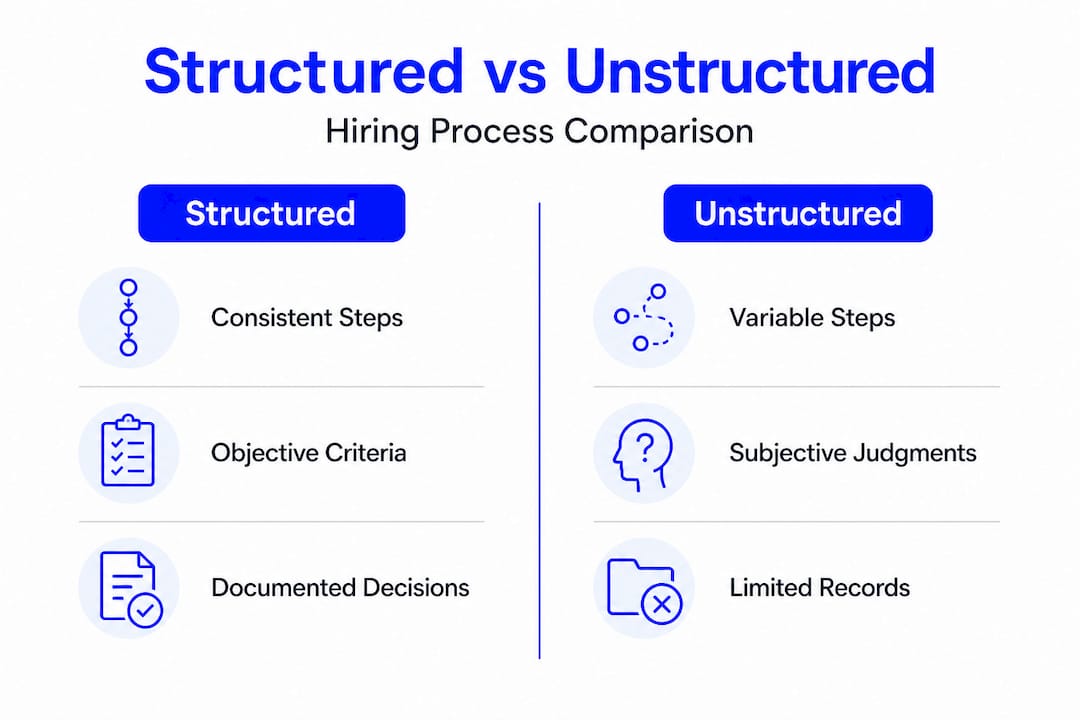
The contrast between structured and unstructured approaches is significant:
| Dimension | Structured hiring | Unstructured hiring |
|---|---|---|
| Candidate evaluation | Same stages for all | Varies by interviewer or manager |
| Decision rationale | Documented and scored | Informal, often undocumented |
| Bias exposure | Reduced through standardization | Higher due to subjectivity |
| Legal defensibility | Strong, with clear records | Weak, difficult to reconstruct |
| Quality of hire | More predictable | Highly variable |
| Compliance risk | Lower when properly designed | Higher, especially under scrutiny |
Reviewing employment law compliance tips alongside your internal process design is a practical step that many agencies overlook until a dispute forces the issue.
Pro Tip: Every hiring decision, including the decision not to advance a candidate, should have a written rationale on file. If your process is ever challenged, documentation is your first and most important line of defense.
Skills-based and assessment-based hiring: Targeting the right risks
A key way to increase structure and fairness is to focus on what matters for each role.
Credentials and years of experience are useful filters, but they are imperfect proxies for actual job performance. A candidate with a criminal justice degree and five years in a non-public-safety role may be far less ready for a patrol position than someone with two years of direct field experience and demonstrated situational judgment. Skills-first hiring approaches target role-relevant capabilities directly, using tools designed to surface what a candidate can actually do, not just what they have done on paper.
In public safety contexts, role relevance is a precise concept. It means identifying the specific competencies, physical capacities, behavioral patterns, and decision-making abilities that predict success and safety in a given position, and then building assessments around those dimensions. For a patrol officer, that might include situational judgment tests, physical fitness evaluations, and integrity-focused structured interviews. For a dispatcher, it might center on multitasking assessments, stress response simulations, and communication accuracy tests.
What role-relevance means in practice for public safety positions:
- Law enforcement: Judgment under pressure, use-of-force decision-making, integrity and ethics, physical fitness, community relations competencies
- Fire and EMS: Physical endurance, medical knowledge, teamwork under stress, equipment operation, emergency decision-making
- Dispatch: Multitasking capacity, verbal communication clarity, stress tolerance, data entry accuracy, protocol adherence
- Private security: Observation skills, report writing, conflict de-escalation, access control procedures, physical presence and fitness
The following table illustrates how different assessment tools align with specific risk categories:
| Assessment tool | Risk it helps minimize | Public safety application |
|---|---|---|
| Situational judgment tests | Poor decision-making under pressure | Patrol, dispatch, EMS triage |
| Structured behavioral interviews | Inconsistent evaluation, bias | All roles |
| Physical fitness assessments | Operational incapacity | Law enforcement, fire, EMS |
| Integrity and ethics inventories | Misconduct, dishonesty | Law enforcement, security |
| Cognitive ability tests | Inability to process complex information | Dispatch, investigations |
| Blind resume review | Name or demographic bias | All roles, initial screening |
The critical limitation to acknowledge is that no single tool eliminates all risk. An integrity inventory does not catch every candidate with a history of dishonesty. A physical fitness test does not predict long-term behavioral suitability. The power of skills-based candidate screening lies in layering these tools so that each one compensates for the blind spots of the others.
Pro Tip: When selecting assessment tools, require vendors to provide validity evidence specific to public safety roles. A tool validated for corporate sales positions may not perform reliably when used to screen law enforcement candidates.
Documentation, monitoring, and legal defensibility
With method and tools in place, maintaining reliability means effective monitoring and documentation.
Risk mitigation is not a one-time design exercise. It is an ongoing operational discipline. The selection tools an agency uses must be role-relevant and consistently applied, and the documentation supporting every decision must be sufficient to defend the process if it is ever reviewed or challenged. This is not a hypothetical concern. Disputes about bias, qualifications, and suitability arise regularly in public safety hiring, and agencies without clear records are at a significant disadvantage.
The types of documentation that agencies should maintain throughout the hiring process include:
- Job analysis records: Written documentation of the specific competencies, qualifications, and physical requirements for each role, updated regularly to reflect changes in duties or legal requirements
- Evaluation rubrics and scoring sheets: Completed scoring documents for every candidate who advances past the initial screening stage, retained even for candidates who are not hired
- Interview notes and panel assessments: Structured notes tied to specific competency dimensions, not general impressions, signed and dated by each evaluator
- Background investigation reports and rationale: Complete investigation findings, the agency’s interpretation of those findings, and the documented rationale for any adverse action taken as a result
- Adverse action notices: FCRA-compliant pre-adverse and adverse action notices sent to candidates when background findings influence a hiring decision, with copies retained on file
- Pipeline tracking data: Records of candidate flow through each stage, including demographic breakdowns, to identify potential disparate impact patterns before they become legal exposure
Monitoring pipeline data serves a dual purpose. It helps agencies ensure that speed pressures are not quietly degrading quality standards, and it surfaces statistical patterns that might indicate unintended bias in the process. If adverse action rates are disproportionately concentrated in a particular demographic group, that is a signal that warrants immediate process review, not a problem to be explained away after the fact.
Reviewing a hiring process documentation checklist against your current records is a practical way to identify gaps before they become liabilities. Agencies should also build ensuring hiring compliance reviews into their annual HR calendar, and use recruitment campaign monitoring tools to track pipeline quality in real time rather than retrospectively.
Statistical callout: Agencies that track both time-to-fill and adverse action rates simultaneously are significantly better positioned to detect process failures early. Speed without quality monitoring is not efficiency. It is risk accumulation.
Common pitfalls and real-world examples to avoid
To complete this overview, it is useful to see how theory meets reality and what can go wrong.
Even agencies with good intentions make predictable errors in hiring risk mitigation. Understanding these pitfalls in concrete terms is often more useful than reviewing abstract principles, because the errors tend to appear in the gaps between policy and practice.
The four most common pitfalls in public safety hiring risk mitigation are:
-
Inconsistent application of standards across candidate groups. An agency may have a written policy requiring background investigations for all finalists, but in practice, investigations are initiated at different stages for different candidates, or certain steps are waived under staffing pressure. This inconsistency is both a fairness problem and a legal vulnerability. If a candidate who was not fully investigated later causes harm, the agency’s deviation from its own policy will be central to any negligent hiring claim.
-
Relying on a single screening tool as a definitive indicator. A polygraph examination, a psychological evaluation, or a credit check may each provide useful information, but none of them is a reliable standalone predictor of job suitability. Agencies that treat any single tool as a pass/fail gate without layering additional evidence are creating a false sense of security while potentially screening out qualified candidates on the basis of a single data point.
-
Failing to document the rationale for adverse decisions. The decision not to hire a candidate, particularly one who has passed most stages of the process, must be documented with specificity. “Did not meet our standards” is not a defensible rationale. The specific finding, the policy or competency standard it relates to, and the decision-making process that led to the adverse action must all be on record.
-
Treating risk mitigation as a pre-hire-only concern. Many agencies invest heavily in pre-employment vetting but have no systematic process for monitoring employee behavior or performance post-hire. Risk does not end at onboarding. Continuous monitoring, periodic re-vetting for sensitive roles, and clear procedures for responding to post-hire concerns are all components of a complete risk mitigation strategy.
Consider a scenario that illustrates how these pitfalls interact. An agency is under pressure to fill several patrol vacancies quickly. A candidate clears the structured interview and physical assessment but has a minor financial disclosure issue flagged in the background investigation. Under normal circumstances, the agency’s policy requires a supervisor review and documented rationale before proceeding. Under staffing pressure, the supervisor verbally approves moving forward without creating a written record. The candidate is hired. Two years later, the officer is involved in an incident that prompts a review of the original hiring file. The missing documentation creates significant legal exposure for the agency, not because the hiring decision was necessarily wrong, but because the process was not followed and recorded.
Practical compliance steps can prevent exactly this kind of outcome. Reviewing risk reduction best practices from a legal perspective reinforces why defensibility matters even before any dispute arises.
“Defensibility is not just about winning a legal challenge. It is about demonstrating that the agency exercised reasonable care at every stage of the hiring process, which is the standard courts and oversight bodies apply when evaluating negligent hiring claims.”
A smarter path: What most agencies miss about hiring risk mitigation
With the details covered, let’s step back and look at what even experienced HR leaders sometimes get wrong.
The most persistent misconception in public safety hiring is that risk is proportional to the number of checks performed. Add a polygraph. Add a credit check. Add a social media review. Add a second psychological evaluation. The logic seems sound: more information should mean fewer surprises. But this approach creates its own problems. It extends timelines, increases costs, introduces additional legal compliance obligations, and can actually obscure the signal within the noise. When every candidate is subjected to a battery of loosely connected checks, the results become harder to interpret, not easier.
What agencies actually need is not more checks. They need better design. A process that is structured, role-relevant, consistently applied, and thoroughly documented will outperform a sprawling checklist every time. It will produce more defensible decisions, identify genuinely unsuitable candidates more reliably, and do so in a timeframe that does not drive qualified candidates to accept offers elsewhere.
There is also a strategic dimension that many HR leaders undervalue. Defensibility, structure, and pipeline transparency are not just compliance requirements. They are organizational assets. An agency that can demonstrate a rigorous, fair, and well-documented hiring process is better positioned in litigation, better positioned in regulatory reviews, and better positioned to attract candidates who value integrity and professionalism. That is not a minor benefit. In a competitive public safety labor market, reputation matters.
The practical starting point is not to add another vendor or another tool. It is to evaluate the existing process with fresh eyes. Document what is actually happening at each stage, not just what the policy says should happen. Identify where variance is creeping in, where documentation is thin, and where role relevance has not been clearly established. Then refine those elements before adding anything new. Streamlining vetting processes is often more valuable than expanding them.
Pro Tip: Start your process improvement by auditing your last 20 hiring decisions. For each one, ask: could you reconstruct the full rationale from the documentation on file? If the answer is no for more than a few, you have found your highest-priority gap.
Get expert help: Streamline your public safety hiring risk mitigation
For agencies that want to put these practices into action with less manual effort, here is how OMNI Intel can help.
OMNI Intel is built specifically for public safety agencies that need more than a generic background check platform. Whether your agency is managing pre-employment investigations for law enforcement candidates or running background checks for public safety roles across fire, EMS, dispatch, and security, OMNI Intel’s investigator-driven approach ensures that every check is role-relevant, FCRA-compliant, and thoroughly documented.

The platform integrates directly with your hiring workflow, supports continuous post-hire monitoring, and provides the structured documentation framework that makes your process legally defensible from day one. If your agency is ready to move from checkbox screening to a genuinely strategic public safety vetting process, OMNI Intel provides the tools, the expertise, and the public safety focus to make that transition effective and efficient. The goal is not more screening. It is smarter, safer, more defensible hiring.
Frequently asked questions
What are the key elements of hiring risk mitigation in public safety?
Key elements include structured procedures, role-relevant assessments, consistent documentation, and unbiased evaluation tools. Applying the same stages to all candidates and grounding decisions in evidence are the foundational methods for reducing variance and legal exposure.
Does using more screening tools always make hiring safer?
No. The best practice is using the right, role-relevant tools consistently and with supporting documentation. Risk mitigation requires that selection tools be appropriate for the role and defensible when challenged, not simply numerous.
How does skills-based hiring reduce risk?
Skills-based hiring targets the capabilities actually required for the role and supports objective, evidence-based decisions. Role-relevant assessment tools reduce the influence of credentials-only evaluation and surface actual job readiness more reliably.
Why is documentation important in hiring risk mitigation?
Documentation creates a clear record that can defend the agency if a process or hiring decision is legally challenged. When selection tools are consistently applied and the rationale for every decision is on file, agencies are far better positioned in disputes about bias, qualifications, or suitability.