

Employee risk management guide for public safety HR
TL;DR:
- Employee risk management extends beyond safety and compliance to include behavioral, legal, cybersecurity, and integrity considerations vital to public safety agencies.
- Implementing structured frameworks like ISO 31000, layered screening methods, and ongoing monitoring helps agencies proactively identify and mitigate workforce risks effectively.
Employee risk management is far more than a safety checklist or an annual compliance review. Employee risk management spans safety hazards, behavioral concerns, legal compliance, cybersecurity threats, and integrity issues, making it one of the most consequential functions in any public safety agency. For HR professionals and agency leaders, the stakes are uniquely high: a single hiring misstep or undetected behavioral risk can erode public trust, expose the agency to liability, and compromise community safety. This guide walks through definitions, frameworks, modern screening approaches, and actionable strategies to help your agency build a genuinely proactive risk management program.
Table of Contents
- What is employee risk management?
- Core frameworks and methodologies
- From background checks to behavioral analytics: Modern screening approaches
- Implementing employee risk management: Best practices for public safety agencies
- Integrating employee risk management with agency strategy
- A fresh perspective: Why most agencies miss the point of employee risk management
- Take action: Modern tools for employee risk management in public safety
- Frequently asked questions
Key Takeaways
| Point | Details |
|---|---|
| Comprehensive risk categories | Employee risk management addresses safety, behavioral, compliance, cybersecurity, and ethical threats. |
| Modern frameworks are essential | Applying structured methodologies and layered assessments keeps public safety HR aligned and compliant. |
| Beyond background checks | Behavioral analytics and insider threat monitoring are now critical for effective risk management. |
| Culture is the foundation | Embedding risk management into agency culture and strategy ensures ongoing, proactive risk reduction. |
| Integrated solutions exist | Specialized tools help agencies streamline screening and monitoring for safer, more effective teams. |
What is employee risk management?
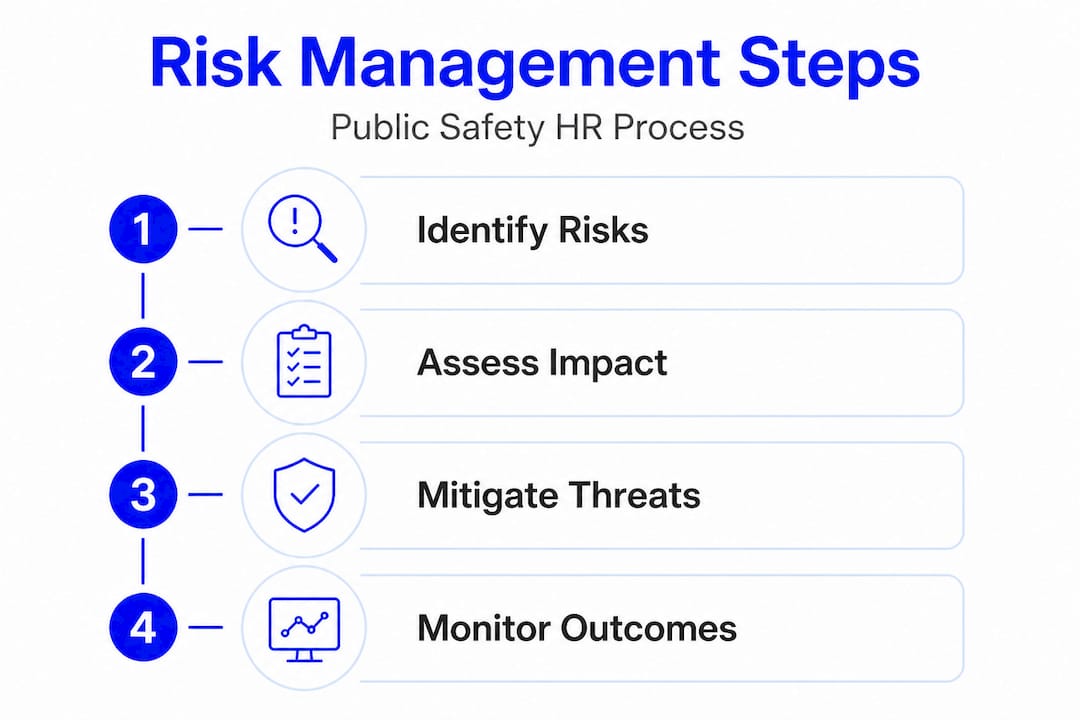
Employee risk management is not simply about preventing workplace injuries or enforcing conduct policies. At its core, employee risk management is the process of identifying, assessing, and mitigating risks associated with a workforce, covering everything from operational failures and legal exposure to reputational damage and ethical lapses.
For public safety agencies, this definition carries even greater weight. Law enforcement officers, firefighters, EMS personnel, dispatchers, and corrections staff operate in high-stakes environments where individual behavior directly affects community outcomes. A single officer’s misconduct can trigger lawsuits, federal investigations, and a loss of public confidence that takes years to rebuild. The risks are not abstract.
Key categories of employee risk in public safety settings include:
- Operational risk: Failures in performance, training gaps, or procedural non-compliance that affect service delivery
- Reputational risk: Misconduct, use-of-force violations, or off-duty behavior that damages the agency’s public image
- Legal and compliance risk: Violations of civil rights laws, labor regulations, or federal mandates that expose the agency to litigation
- Financial risk: Settlements, overtime costs from understaffing, or losses from fraudulent activity
- Integrity risk: Dishonesty during hiring, undisclosed conflicts of interest, or corruption that undermines the agency’s mission
Maintaining integrity in public safety hiring is not a peripheral concern. It is the foundation upon which all other risk management efforts rest.
“The breadth of employee risk management in HR extends well beyond physical safety. It encompasses the full spectrum of workforce-related threats to organizational stability, legal standing, and ethical culture.” — HR Risk Management Practitioner Consensus
Understanding these categories is the first step toward building a program that addresses the full scope of risk rather than just its most visible surface.
Core frameworks and methodologies
Having established what employee risk management covers, let’s explore the practical frameworks top agencies rely on to make it work.
The most widely referenced foundation for risk management across industries is ISO 31000, an international standard that provides principles and guidelines for systematic risk identification, evaluation, and treatment. When adapted for HR contexts, ISO 31000 gives public safety agencies a structured language and process for managing workforce risk that goes beyond intuition or reactive policy.
Core methodologies follow frameworks like ISO 31000 and incorporate HR-specific techniques including avoidance, retention, loss prevention, and transfer or sharing. Each technique has a distinct application in public safety.
The five-step HR risk management process:
| Step | Action | Public safety application |
|---|---|---|
| 1. Identify | Catalog all workforce-related risks | Map risks by role: patrol, dispatch, administration |
| 2. Assess | Evaluate likelihood and impact | Score risks by severity and frequency |
| 3. Prioritize | Rank risks for resource allocation | Focus on high-impact, high-probability risks first |
| 4. Mitigate | Apply controls and countermeasures | Implement screening, training, and monitoring |
| 5. Monitor | Track outcomes and adjust | Review metrics quarterly and after critical incidents |
This table is not merely theoretical. Agencies that formalize these five steps into documented procedures tend to respond faster to emerging risks, maintain better audit trails, and demonstrate due diligence in litigation scenarios.
The four core risk treatment techniques deserve attention individually:
- Risk avoidance means eliminating the risk entirely, such as disqualifying candidates with specific criminal histories for roles involving vulnerable populations.
- Risk retention means accepting a low-level risk because the cost of mitigation exceeds the potential impact, such as tolerating minor scheduling inefficiencies.
- Loss prevention means reducing the probability or severity of a risk event through controls like mandatory reporting, supervisory oversight, and structured employee background check steps.
- Risk transfer or sharing means shifting financial or legal exposure through insurance, indemnification clauses, or interagency agreements.
Scenario planning is another underused but powerful tool. By running tabletop exercises around hypothetical risk events, such as an officer’s undisclosed social media activity surfacing during a high-profile incident, agencies can identify gaps in their response protocols before a real crisis forces the issue.

Pro Tip: Avoid “checklist compliance.” Agencies that treat risk management as a box-ticking exercise rather than a living practice tend to be the ones caught off guard. Embed risk awareness into daily briefings, supervisory conversations, and performance reviews so that it becomes part of the agency’s operating culture, not just a policy document that gets reviewed once a year.
From background checks to behavioral analytics: Modern screening approaches
A framework is only as effective as the tools you use, so how do background investigations and behavioral analytics fit in?
Traditional background checks remain the cornerstone of pre-employment screening in public safety. They verify identity, confirm employment history, surface criminal records, and flag disqualifying information. But they have real limitations. A background check captures a snapshot in time. It cannot predict future behavior, detect subtle integrity concerns, or identify risks that emerge after hiring.
Traditional background checks should be layered with behavioral assessments to provide predictive value for integrity and safety risks, consistent with applicable compliance requirements. This layered approach is now considered best practice among high-performing public safety agencies.
Comparison: Traditional vs. layered modern screening
| Dimension | Traditional background check | Layered modern screening |
|---|---|---|
| Timing | Pre-employment only | Pre-employment and continuous |
| Data sources | Criminal records, employment history | Criminal records, social media, behavioral assessments, risk scoring |
| Predictive value | Low to moderate | Moderate to high |
| Compliance complexity | Moderate (FCRA, state laws) | Higher (FCRA, EPPA, NIST, state laws) |
| Cost | Lower | Higher, but offset by reduced turnover and liability |
| Insider threat detection | Limited | Significantly stronger |
Behavioral analytics platforms use structured data, including performance records, incident reports, peer feedback, and digital activity patterns, to generate risk scores that flag employees who may be trending toward misconduct, disengagement, or compromise. These tools are not infallible, but they add a predictive dimension that no static background check can replicate.
Insider threat programs are now an essential component of modern risk management, and NIST SP 800-53 PM-12 specifically mandates behavioral analytics programs for organizations handling sensitive information. For law enforcement agencies, dispatch centers, and government entities that manage classified data, criminal justice information, or sensitive community intelligence, this standard is not optional.
Key compliance obligations to understand:
- FCRA (Fair Credit Reporting Act): Governs the use of consumer reports, including background checks, in employment decisions. Requires written authorization, adverse action notices, and dispute procedures.
- EPPA (Employee Polygraph Protection Act): Restricts the use of polygraph testing in most employment contexts, with specific exemptions for public safety and security roles.
- NIST SP 800-53 PM-12: Mandates insider threat programs for federal and federally connected agencies, requiring behavioral monitoring and cross-departmental information sharing.
- State-specific regulations: Many states impose additional restrictions on criminal history inquiries, credit checks, and social media screening.
Ensuring background check legal compliance is not simply a legal obligation. It is a risk management strategy in itself. Agencies that cut corners on compliance expose themselves to EEOC complaints, class action lawsuits, and the kind of reputational damage that undermines public trust.
“Behavioral analytics and structured risk scoring are not surveillance tools. They are early warning systems that allow agencies to intervene constructively before a behavioral trend becomes a critical incident.” — Security and HR Integration Practitioner
Understanding public safety integrity screening as a distinct discipline, separate from general background investigations, helps agencies apply the right tools to the right risks at every stage of the employment lifecycle.
Implementing employee risk management: Best practices for public safety agencies
Modern screening tools give you data, but applying these insights requires a practical and cultural blueprint. Here is how agencies can execute effectively.
Risk management must be proactive and culturally embedded. Agencies that rely on a single tool, whether that is a background check, a polygraph, or a social media policy, without integrating these elements into a broader, living program tend to find themselves reacting to crises rather than preventing them.
A structured implementation sequence for public safety agencies:
- Conduct a risk inventory. Map every role in your agency to its associated risk categories. A patrol officer carries different risks than a records clerk or a dispatcher. Tailor your controls accordingly.
- Establish a cross-functional risk team. HR, security, IT, legal counsel, and operational supervisors should all have defined roles in the risk management program. Risk does not respect departmental boundaries.
- Develop documented risk protocols. For each identified risk category, document the trigger conditions, response procedures, escalation paths, and documentation requirements. Vague policies create inconsistent enforcement.
- Integrate screening into every stage of the employment lifecycle. Pre-employment screening is essential, but so is onboarding review, periodic re-screening, and continuous monitoring for employees in sensitive roles. Review employee monitoring best practices to understand what ongoing oversight looks like in practice.
- Run scenario planning exercises. Tabletop exercises that simulate risk events, such as an employee’s undisclosed financial distress becoming a corruption vulnerability, help teams identify gaps before real incidents expose them.
- Build feedback loops. After every critical incident or near-miss, conduct a structured after-action review that feeds lessons learned back into your risk protocols. This is how programs improve over time.
Statistic callout: Research on workforce risk consistently shows that organizations with proactive, integrated risk management programs experience significantly lower rates of employee misconduct, litigation, and turnover compared to those that rely on reactive, policy-only approaches. For public safety agencies, where the cost of a single misconduct incident can run into millions of dollars in legal fees and settlements, the return on investment for proactive risk management is substantial.
Pro Tip: Use your employee monitoring checklist as a living document, not a static form. Review and update it at least quarterly, after any significant incident, and whenever your agency’s risk profile changes due to new technology, new roles, or new community dynamics.
Common pitfalls to avoid:
- Over-reliance on technology: Behavioral analytics and automated screening tools are powerful aids, but they require human judgment to interpret and act on. An algorithm cannot replace a trained investigator’s contextual understanding.
- Policy without culture: A comprehensive written policy that no one follows is worse than a simple policy that everyone understands and applies consistently.
- Siloed risk management: When HR, IT, legal, and operations each manage their piece of the risk picture without sharing information, critical warning signs fall through the gaps.
- Neglecting post-hire risk: Many agencies invest heavily in pre-employment screening and then essentially stop monitoring. The risks that emerge after hiring, including financial stress, behavioral changes, and external influences, are just as consequential.
Integrating employee risk management with agency strategy
Best practices require genuine buy-in. Let’s cover how integration with your agency’s mission turns risk management into an ongoing operational advantage rather than a compliance burden.
A five-step HR framework is most effective when integrated into agency strategy, meaning that risk management principles are embedded in recruiting criteria, onboarding processes, training programs, performance management systems, and strategic planning cycles.
Practical integration points across the employment lifecycle:
- Recruiting: Define risk-relevant selection criteria, such as honesty, integrity, and resilience, as explicit competencies in job postings and interview frameworks. Use structured behavioral interviews to assess these traits consistently.
- Onboarding: Use the onboarding period to establish clear expectations around conduct, reporting obligations, and the agency’s risk culture. New employees are most receptive to cultural norms during their first 90 days.
- Ongoing development: Incorporate risk awareness into annual training, supervisory development programs, and leadership pipelines. Supervisors who understand risk management are your first line of defense.
- Performance management: Integrate behavioral risk indicators into performance review criteria. Early identification of declining performance, attitude shifts, or conduct concerns allows for constructive intervention before problems escalate.
- Strategic planning: Present risk data to agency leadership as part of the annual strategic planning cycle. Trends in misconduct complaints, use-of-force incidents, or turnover rates are strategic intelligence, not just HR metrics.
Aligning your employee monitoring workflow with strategic objectives ensures that the data you collect is not just stored but actively used to inform decisions at every level of the organization.
Continuous improvement is the final and perhaps most important element of strategic integration. Agencies that treat risk management as a completed project rather than an ongoing process will find their programs becoming obsolete as risks evolve. New technologies, changing community expectations, emerging legal standards, and shifts in workforce demographics all require regular reassessment of risk frameworks, tools, and protocols.
A fresh perspective: Why most agencies miss the point of employee risk management
At this point, you have the frameworks, practices, and strategies. Now consider what most articles and even agencies do not tell you.
The most common failure in employee risk management is not a lack of tools or policies. It is a lack of honest, ongoing leadership commitment. Many agencies invest in background screening platforms, behavioral analytics software, and comprehensive policy manuals, and then quietly allow those investments to atrophy because no one in leadership is willing to have the uncomfortable conversations that real risk management requires.
Real risk management means acknowledging that your agency may have promoted people who should not have been promoted. It means creating channels where line-level employees can report concerns about colleagues without fear of retaliation, and then actually acting on those reports. It means accepting that data can identify warning signs, but only a culture of accountability can address them.
The greatest risks in public safety agencies are often not the ones that show up in a background check or a risk score. They are cultural blind spots: the unwritten rules that protect problematic employees, the supervisory relationships that discourage honest feedback, and the organizational pressures that push people to overlook warning signs in the interest of maintaining staffing levels.
Deeper integrity strategies recognize this reality. They treat integrity not as a pre-employment filter but as an ongoing organizational commitment that requires active reinforcement at every level of the agency.
The agencies that do this well share a common characteristic: their leaders talk about risk management not as a compliance function but as a core expression of the agency’s values. They make it clear, through words and actions, that the agency’s commitment to integrity is non-negotiable, and that the tools and processes in place exist to support that commitment rather than substitute for it.
If your agency’s risk management program feels like a burden rather than a strength, that is a signal worth taking seriously. The goal is not to build a surveillance apparatus. It is to create an environment where integrity is the norm, risks are identified early, and the agency can fulfill its mission to the community with confidence.
Take action: Modern tools for employee risk management in public safety
Ready to put your agency’s employee risk management plan into action? Here is how you can move forward with specialized tools and support.
OMNI Intel is built specifically for the risk management challenges that public safety agencies face every day. From pre-employment screening that goes beyond basic criminal record checks to investigator-driven vetting processes that assess integrity, honesty, and suitability for sensitive roles, OMNI Intel’s platform is designed to close the gaps that generic HR tools leave open.

Whether your agency needs to strengthen its ensuring safe hires process, implement continuous post-hire monitoring, or align your screening workflow with current legal compliance standards, OMNI Intel offers tailored solutions that integrate with your existing hiring and HR platforms. Explore the monitoring process guide to see how a structured, technology-supported approach to ongoing risk management can protect your agency’s reputation, reduce liability, and support the integrity of your workforce at every stage of employment.
Frequently asked questions
What are the main types of risks managed in public safety HR?
Public safety HR manages safety, behavioral, compliance, cybersecurity, and integrity risks among employees, with each category requiring distinct assessment and mitigation strategies tailored to the specific demands of public safety roles.
How do insider threat programs enhance employee risk management?
Insider threat programs monitor for malicious, negligent, or compromised employees using behavioral analytics and cross-departmental data sharing, enabling agencies to detect and address internal risks before they escalate into critical incidents or security breaches.
Are traditional background checks enough to manage HR risk?
No. Layering background checks with behavioral assessments and continuous monitoring provides significantly better predictive value and ensures that agencies meet current compliance standards for integrity and safety screening.
What is a best practice for embedding risk management into agency culture?
Proactive, culturally embedded risk management requires engaging all levels of staff in scenario planning, maintaining clear documentation, and building continuous feedback mechanisms so that risk awareness becomes a shared organizational value rather than a top-down compliance mandate.
Recommended
- Employee monitoring best practices for public safety 2026
- Compliance In Hiring: Essential Guide For Public Safety HR
- Public Safety Hiring Guide: Effective Recruitment In 2026
- What is responsibility screening: a guide for public safety HR
- When Are Alhambra Employers Required to Correct Workplace Safety Hazards? – California United Law Group