

How to comply with background regulations for public safety hiring
TL;DR:
- Public safety background checks must comply with FCRA, EEOC Green factors, and state laws.
- An individualized assessment is essential to evaluate criminal records fairly and lawfully.
- Regular audits, proper documentation, and ongoing training ensure sustained compliance and risk mitigation.
Public safety agencies that mishandle background screening face consequences far more serious than administrative penalties. A single non-compliant hire can expose your agency to civil litigation, erode public trust, and place communities at risk. The EEOC mandates individualized assessment for criminal records using the Green factors, meaning blanket exclusions based on conviction history alone create real disparate impact liability. HR professionals and compliance officers in law enforcement, fire, EMS, and dispatch must navigate a layered regulatory environment where procedural fairness and heightened scrutiny coexist. This guide delivers a practical, step-by-step framework covering what regulations apply, how to build a compliant workflow, how to execute screening correctly, and how to maintain ongoing verification so your agency stays protected.
Table of Contents
- Understand core background screening regulations
- Prepare: Gather requirements and create a compliant framework
- Execute: Step-by-step compliant background screening
- Verify and audit: Ensuring continual regulatory compliance
- Editorial perspective: Why compliance is more than checking boxes
- Next steps: Advance your agency’s compliance
- Frequently asked questions
Key Takeaways
| Point | Details |
|---|---|
| Know the regulations | FCRA, EEOC, and state requirements set the framework for compliant background screening. |
| Create audit-ready workflows | Centralized, documented policies and practices simplify compliance and verification. |
| Prioritize individualized assessments | Evaluating criminal records using Green factors reduces legal risk and improves hiring outcomes. |
| Review and update regularly | Annual audits and prompt policy updates ensure agencies stay compliant with evolving regulations. |
Understand core background screening regulations
With the stakes set, let’s clarify the regulations that frame your agency’s screening process. Background screening in public safety is not governed by a single law. It sits at the intersection of federal mandates, state statutes, and agency-specific protocols, each carrying its own compliance obligations.
The Fair Credit Reporting Act (FCRA) establishes the procedural foundation for any agency using a consumer reporting agency to conduct background checks. It requires written disclosure, applicant consent, and a formal adverse action process before any hiring decision based on a report is finalized. Non-compliance with FCRA can result in statutory damages of up to $1,000 per violation, plus punitive damages in willful cases. Understanding FCRA compliance for HR is not optional; it is the baseline.
The Equal Employment Opportunity Commission (EEOC) adds another layer. The EEOC’s guidance on background check laws prohibits blanket exclusions of applicants with criminal records because such policies can produce disparate impact along racial and ethnic lines. Instead, agencies must apply what are known as the Green factors when evaluating criminal history.
The three Green factors are:
- Nature and gravity of the offense: How serious was the crime, and does it reflect a pattern of behavior incompatible with the role?
- Time elapsed since conviction: Has sufficient time passed to suggest rehabilitation or changed behavior?
- Job relatedness: Does the offense directly connect to the duties and responsibilities of the position being filled?
Applying these factors individually to each applicant is not just best practice. It is the standard the EEOC uses to evaluate whether your agency’s screening process is lawful.
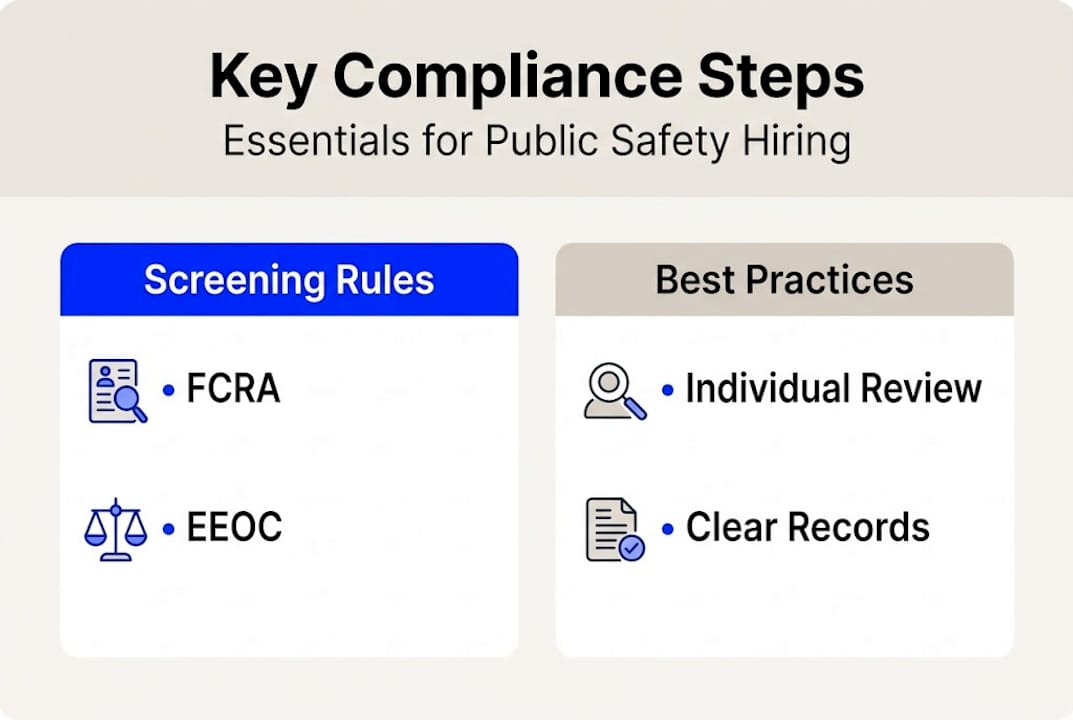
State regulations add further complexity. Many states have enacted “ban the box” laws that restrict when criminal history can be inquired about during the hiring process. Some states also impose specific requirements on the types of records that can be considered, how far back agencies can look, and what notification must be given to applicants. Review your state’s specific statutes alongside federal requirements.
| Regulatory framework | Governing body | Key requirement |
|---|---|---|
| FCRA | Federal Trade Commission | Written consent, adverse action notice |
| EEOC guidance | Equal Employment Opportunity Commission | Individualized criminal record assessment |
| State ban-the-box laws | State legislatures | Delayed criminal inquiry in hiring process |
| POST standards | State POST commissions | Agency-specific peace officer vetting protocols |
“Blanket exclusion policies that disqualify all applicants with any criminal record, regardless of the nature of the offense or the time elapsed, may violate Title VII of the Civil Rights Act.” — EEOC guidelines
For a thorough grounding in how these frameworks apply to your specific roles, the background checks guide for public safety provides role-specific context that generic HR resources often miss.
Prepare: Gather requirements and create a compliant framework
Once you understand the rules, assembling your agency’s toolkit is the next step. Compliance does not happen at the moment of screening. It is built into your policies, workflows, and documentation practices long before the first application arrives.
Start with the documents your agency must have in place before any screening begins. These include a written background screening policy, standardized applicant consent forms that meet FCRA requirements, detailed job descriptions that support individualized assessments, and a criminal record evaluation worksheet aligned with the Green factors. Without these documents, your agency cannot demonstrate that its process was fair and legally sound.
Core documentation checklist:
- Written background screening policy reviewed by legal counsel
- FCRA-compliant disclosure and authorization forms
- Individualized assessment worksheet for criminal record review
- Job descriptions that clearly define duties, responsibilities, and required integrity standards
- Adverse action letter templates (pre-adverse and final adverse)
- Consent forms for polygraph examination where applicable
For peace officer roles, the CA POST Background Investigation Manual provides one of the most detailed publicly available frameworks for structuring a thorough investigation. It covers personal history statements, reference interviews, financial background review, and polygraph protocols. Even agencies outside California benefit from reviewing it as a benchmark.
| Requirement area | EEOC/FCRA standard | POST manual standard |
|---|---|---|
| Criminal record review | Individualized Green factor assessment | Detailed personal history with disqualifying criteria |
| Consent and disclosure | Written FCRA authorization required | Signed release forms for all investigation components |
| Reference checks | Not mandated but recommended | Structured interviews with personal and professional references |
| Polygraph examination | Not federally required | Required for peace officers in many states |
| Documentation retention | Adverse action records required | Full investigation file retention per agency policy |
Building your workflow around a pre-employment check guide tailored to public safety ensures you are not adapting a corporate HR process to a context it was never designed for. The scrutiny required for someone carrying a badge and a firearm is categorically different from standard employment screening.
Data handling is equally critical. Your agency must address how applicant information is stored, who has access, and how long records are retained. The principles of data privacy in screening apply directly here, particularly when handling sensitive criminal history and medical information.

Pro Tip: Maintain a centralized, access-controlled digital record system for all background investigation files. This simplifies audit responses, reduces the risk of lost documentation, and demonstrates organizational accountability to regulators and oversight bodies.
Finally, align your internal policies with the investigation principles that distinguish public safety screening from standard employment background checks. The depth of inquiry, the sources consulted, and the standards applied must reflect the gravity of the roles being filled.
Execute: Step-by-step compliant background screening
With your framework in place, execute the screening process. Here is how to move from policy to practice without creating legal exposure.
Step-by-step compliant screening process:
- Post the position with accurate job descriptions. Every disqualifying criterion must be defensible as job-related. Vague or overbroad standards invite legal challenge.
- Accept applications and conduct initial review. Evaluate qualifications before any criminal history inquiry, particularly in ban-the-box jurisdictions.
- Extend a conditional offer of employment. Most background screening for public safety roles should occur post-conditional offer. This is the legally sound sequence under both EEOC guidance and many state laws.
- Obtain written FCRA authorization. Before ordering any consumer report, secure signed consent. Provide the required standalone disclosure document.
- Conduct the individualized background investigation. This includes criminal record search, reference interviews, employment verification, education verification, and financial history review where applicable.
- Apply Green factor analysis to any adverse criminal history. Document your assessment in writing, noting the nature of the offense, time elapsed, and specific job relatedness. Never skip this step.
- Administer polygraph examination where required. For peace officer candidates, follow your state POST requirements precisely.
- Issue pre-adverse action notice if disqualification is being considered. Provide the applicant a copy of the report and a reasonable time to respond.
- Make the final hiring decision and document the rationale. Issue a final adverse action notice if the decision is to decline, including required FCRA disclosures.
The FCRA/EEOC balance between procedural fairness and public safety’s heightened scrutiny is achieved through individualized assessments conducted post-conditional offer. This sequence protects your agency on both fronts.
“The post-conditional offer sequence is not a bureaucratic formality. It is the structural mechanism that allows agencies to apply rigorous scrutiny while preserving applicant rights under federal law.”
A common mistake agencies make is treating the criminal record check as a pass/fail filter. This is precisely the approach that generates legal liability. Instead, use background screening explained frameworks that treat each record as a data point requiring context, not a verdict.
Pro Tip: Document the justification for every disqualification in writing before communicating the decision to the applicant. If a decision is ever challenged, your written record is your defense. Undocumented decisions are indefensible decisions.
For agencies managing high-volume recruitment cycles, the risk of shortcuts increases. Reviewing avoiding hiring risks in pre-employment investigations provides practical guidance on maintaining rigor under operational pressure. The pre-employment screening process must be treated as a non-negotiable standard, not a variable one.
Verify and audit: Ensuring continual regulatory compliance
Executing the process is only part of compliance; ongoing verification is vital. A background screening program that was compliant in 2023 may not meet current standards in 2026. Regulations change. Court decisions reshape enforcement priorities. Your agency’s compliance posture must evolve accordingly.
Ongoing compliance checklist:
- Conduct a full internal audit of screening procedures at least once per year
- Review all consent and disclosure forms against current FCRA requirements
- Update individualized assessment worksheets when EEOC guidance or case law changes
- Verify that adverse action notice templates reflect current statutory language
- Confirm that all staff involved in screening have received updated compliance training
- Review state-specific ban-the-box and criminal record laws for any legislative updates
The CA POST auditing manual outlines how structured review cycles keep investigation standards current and defensible. Agencies following POST protocols benefit from a built-in audit framework that addresses personal history verification, reference quality, and documentation completeness.
| Compliance task | Frequency | Responsible party |
|---|---|---|
| Full screening policy review | Annual | HR director and legal counsel |
| FCRA form updates | Upon regulatory change | HR compliance officer |
| Green factor worksheet review | Annual or after EEOC guidance update | Background investigation supervisor |
| Staff compliance training | Annual | Training coordinator |
| State law review | Annual and upon legislative session | Legal counsel |
| Individual file audit sample | Quarterly | Compliance officer |
Agencies that implement structured audit cycles report measurably better outcomes. Consistent documentation practices reduce the time required to respond to legal challenges, and regular training reduces procedural errors that create liability. The connection between audit discipline and hiring accuracy is direct.
Post-hire monitoring is the final piece. Background screening does not end at the hire date. The employee monitoring guide for public safety explains how continuous activity monitoring catches emerging risks that pre-employment checks cannot anticipate. Combining rigorous pre-employment investigation with structured monitoring best practices creates a full-cycle compliance posture that protects your agency, your personnel, and the communities you serve.
Key takeaway: Agencies that treat compliance as an ongoing operational discipline, rather than a one-time procedural event, are significantly better positioned to withstand regulatory scrutiny and avoid costly hiring errors.
Editorial perspective: Why compliance is more than checking boxes
Having explored the practical steps, let’s consider what most guides overlook about real compliance. The agencies that struggle most with background screening regulations are rarely the ones that ignore the rules. They are the ones that follow them mechanically, without genuine understanding of why those rules exist.
The checkbox mentality is a silent liability. An agency can have signed consent forms, adverse action letters, and a Green factor worksheet on file and still make a fundamentally flawed hiring decision, because the documentation was completed after the fact, or the assessment was written to justify a predetermined outcome rather than to genuinely evaluate the candidate.
Real compliance requires that the individualized assessment actually drive the decision. That means a background investigator who finds a decade-old misdemeanor for a candidate applying to a non-enforcement administrative role must be empowered to recommend clearance, even if the agency’s culture leans toward automatic disqualification. The legal framework exists precisely to prevent that cultural bias from overriding evidence-based judgment.
The deeper risk is institutional. Agencies that use compliance as a shield rather than a standard tend to accumulate marginal hires over time. The process looks clean on paper, but the actual vetting is shallow. This is where avoiding hiring risks becomes a strategic priority, not just a legal one.
Strategic compliance means building a culture where thorough, honest assessment is the norm, where investigators are trained and empowered, and where documentation reflects genuine deliberation. That is the standard that protects agencies when it matters most.
Next steps: Advance your agency’s compliance
For agencies aiming to exceed compliance standards, expert support accelerates results. Building and maintaining a compliant background screening program is operationally demanding, and the cost of errors is high.

OMNI Intel’s pre-employment screening platform is purpose-built for public safety agencies, integrating FCRA-compliant workflows, individualized assessment tools, and investigator-driven processes into a single system. Whether your agency screens law enforcement candidates, firefighters, EMS personnel, or dispatch staff, OMNI Intel adapts to your specific regulatory environment.
From comprehensive background checks for agencies to full investigative services through OMNIScreen background investigations, OMNI Intel provides the infrastructure your compliance program needs to operate with precision and confidence. Connect with OMNI Intel’s team to discuss agency-specific solutions and build a screening program that meets 2026 regulatory standards from day one.
Frequently asked questions
What are the Green factors for criminal record assessment?
The Green factors are the nature and gravity of the offense, time elapsed since conviction, and job relatedness, as defined by EEOC guidance for individualized criminal record review.
How often should agencies audit their background screening procedures?
Agencies should conduct a full audit at least annually, and immediately whenever regulations change, following structured review cycles like those outlined in the CA POST manual.
What documentation is required for compliant background checks?
HR must retain applicant consent forms, screening policies, individualized assessment records, adverse action notices, and compliance checklists, as required by both FCRA standards and POST investigation protocols.
Do blanket exclusions for criminal records violate regulations?
Yes. Blanket exclusions risk disparate impact violations under Title VII and are explicitly discouraged by the EEOC, which requires individualized assessment for every applicant with criminal history.
What is the purpose of a polygraph in public safety background checks?
Polygraphs help verify applicant honesty on matters that are difficult to confirm through records alone, and are required for peace officer candidates by many agencies following POST protocols.