

Build public trust in security hiring: proven strategies
TL;DR:
- Public trust in safety agencies depends on transparent, fair, and community-aligned hiring practices.
- Modern vetting technology and continuous monitoring improve hiring speed, depth, and public confidence.
- Agencies must ensure consistent follow-through and transparent communication to truly build lasting trust.
Public safety agencies across the country are navigating a trust crisis that goes far beyond public relations. Over 70% of police agencies report that recruiting qualified candidates is significantly harder now than it was before 2020, producing a nearly 10% officer deficit that communities feel in real time. Staffing gaps translate directly into slower response times, reduced community engagement, and heightened public skepticism about whether agencies can be trusted to hire responsibly. The challenge is not simply filling seats. It is demonstrating, through every stage of the hiring process, that your agency is committed to integrity, fairness, and accountability. This guide unpacks the strategies that actually move the needle on public trust, from reforming vetting practices to embracing diversity and modern technology.
Table of Contents
- Why public trust matters in security hiring
- Breaking down the barriers: Current challenges in public safety hiring
- What the public expects: Aligning agency practices with community values
- How diversity and procedural justice improve trust
- Modernizing hiring: Technology, vetting reforms, and continuous improvement
- The uncomfortable truth: Why trust boils down to follow-through, not just policy
- How OMNI Intel helps agencies earn lasting public trust
- Frequently asked questions
Key Takeaways
| Point | Details |
|---|---|
| Trust requires more than policy | Effective hiring reforms must be matched with transparent, consistent action by agencies. |
| Diversity boosts legitimacy | Reflecting community demographics in hiring increases public confidence and agency effectiveness. |
| Align with public expectations | Updating hiring standards around minor offenses and mental health increases acceptance and reduces mistrust. |
| Invest in modern vetting | Leveraging real-time vetting and technology reduces risk and supports a trustworthy, efficient hiring process. |
Why public trust matters in security hiring
Trust is not a soft metric. For public safety agencies, it is the operational foundation on which everything else rests. When communities trust that their local law enforcement, fire departments, or dispatch centers hire qualified, vetted, and principled personnel, they cooperate with those agencies, report crimes, and support funding initiatives. When that trust erodes, the consequences are measurable: reduced cooperation, increased complaints, and diminished legitimacy in the eyes of the people agencies are sworn to protect.
The relationship between staffing shortages and public trust is direct and well-documented. Recruitment challenges affect not just operational capacity but also the public’s perception of whether an agency is functioning with appropriate rigor. When communities see agencies struggling to fill positions, they naturally question whether standards are being compromised to meet quotas.
High-profile incidents involving officers with problematic backgrounds have amplified this scrutiny. Each incident that surfaces a hiring failure becomes a public indictment of the entire vetting process. The public does not distinguish between one agency’s failure and another’s success. They see a systemic problem, and they demand systemic accountability.
“Public confidence in policing is not granted by default. It is earned through visible, consistent, and fair action at every level of the organization.”
Following law enforcement hiring best practices is no longer optional. It is the baseline expectation from communities that are more informed and more vocal than ever before. Agencies that treat hiring as a purely administrative function miss the larger point: every hire is a public statement about organizational values.
Key factors that erode public trust in security hiring include:
- Perceived lowering of standards to address staffing shortages
- Lack of transparency about disqualification criteria and appeal processes
- Inconsistent enforcement of background investigation standards across candidates
- Absence of community input in hiring policy development
- Failure to communicate hiring outcomes and agency accountability metrics
Community-oriented approaches, including neighborhood policing and procedural justice frameworks, offer a path forward. Research confirms that neighborhood policing directly boosts public confidence by creating visible, accountable relationships between officers and the communities they serve. These approaches work precisely because they make the hiring and deployment of personnel a matter of shared community interest, not just internal agency policy.
Breaking down the barriers: Current challenges in public safety hiring
Understanding the urgency of trust is one thing. Confronting the structural obstacles that prevent agencies from building it is another matter entirely. The modern public safety recruitment landscape presents a set of overlapping challenges that no single policy change can resolve.
The numbers tell a stark story. Over 70% of agencies report more difficult recruitment compared to pre-2020 conditions, and 77% have adjusted their hiring policies in response. These adjustments range from relaxing appearance standards to simplifying application processes, each carrying its own risk of public perception problems if not communicated clearly.
The most common barriers agencies face in public safety hiring today include:
- Prolonged vetting timelines that discourage qualified candidates from completing the process
- Outdated disqualification criteria that eliminate otherwise strong candidates for minor historical issues
- Insufficient community outreach that limits the applicant pool and reduces demographic diversity
- Fragmented background investigation systems that create inconsistency and compliance risk
- Lack of transparent communication about hiring standards and outcomes with the public
The table below illustrates how these barriers affect both recruitment volume and public trust:
| Barrier | Impact on recruitment | Impact on public trust |
|---|---|---|
| Prolonged vetting timelines | High candidate dropout rates | Minimal direct impact |
| Outdated disqualification criteria | Reduced applicant pool | Moderate concern if perceived as unfair |
| Insufficient community outreach | Limited diversity in applicants | Significant erosion of legitimacy |
| Fragmented background systems | Inconsistent vetting quality | High risk if failures become public |
| Lack of transparent communication | Lower applicant confidence | Direct erosion of community confidence |
Addressing hiring compliance in public safety requires agencies to treat these barriers not as isolated administrative problems but as interconnected trust risks. A vetting process that is technically compliant but opaque to the public does not build confidence. Neither does a community outreach program that is not backed by genuine reform in hiring criteria.
Pro Tip: Streamlining background checks does not mean weakening them. Agencies that invest in investigator-driven, technology-assisted vetting platforms can significantly reduce processing time without sacrificing the depth of inquiry that public safety hiring compliance demands. Speed and rigor are not mutually exclusive when the right tools are in place.
What the public expects: Aligning agency practices with community values
Public expectations around security hiring have evolved considerably, and agencies that operate on legacy assumptions risk widening the gap between their practices and community standards. Understanding what communities actually want, rather than what agencies assume they want, is essential to building genuine trust.
Research on public attitudes toward police hiring reveals a nuanced picture. Communities are not uniformly demanding stricter standards across the board. Instead, they support a more calibrated approach: flexibility on minor offenses and treated mental health conditions, combined with firm exclusions for violent histories and serious drug offenses.
This distinction matters enormously for hiring policy. An agency that automatically disqualifies a candidate for a decades-old minor offense may be losing qualified applicants while simultaneously failing to communicate why its standards serve the public interest. The community sees rigidity where it expects proportionality.
The comparison below shows how legacy disqualification standards differ from modern, community-aligned approaches:
| Disqualification category | Legacy standard | Modern community-aligned standard |
|---|---|---|
| Minor drug offense (10+ years ago) | Automatic disqualification | Case-by-case review |
| Treated mental health condition | Often disqualifying | Generally accepted with documentation |
| Violent criminal history | Disqualifying | Disqualifying (broad community support) |
| Serious drug trafficking offense | Disqualifying | Disqualifying (broad community support) |
| Financial misconduct (minor) | Variable | Case-by-case review |
What communities consistently prioritize in security hiring includes:
- Fairness and proportionality in how past conduct is evaluated
- Transparency about what disqualifies a candidate and why
- Inclusivity in outreach and application processes
- Accountability when a hire proves problematic after the fact
- Consistency in applying standards across all demographic groups
Agencies that commit to screening for integrity in a way that reflects these community values position themselves as partners in public safety rather than gatekeepers operating behind closed doors. That shift in positioning is itself a trust-building act.
How diversity and procedural justice improve trust
Diversity in public safety hiring is not simply a matter of equity. It is a practical trust-building strategy with documented outcomes. When an agency’s workforce reflects the demographic composition of the community it serves, residents are more likely to view that agency as legitimate, responsive, and accountable.

Diverse officers are statistically less likely to use excessive force, and their presence within an agency improves overall legitimacy in the eyes of the community. This is not incidental. It reflects the reality that representation signals investment in community safety as a shared value, not a top-down imposition.
Procedural justice in hiring reinforces this dynamic. When candidates, regardless of background, experience a hiring process that is respectful, transparent, and consistently applied, they carry that experience into their professional conduct. The values modeled during recruitment shape the culture of the agency over time.
However, the path to diversity is not without complications. Research on ethnic bias in vetting reveals that complex assessment scenarios can inadvertently disadvantage candidates from certain ethnic backgrounds, introducing bias at the evaluation stage even when formal criteria appear neutral. Agencies must audit their vetting instruments, not just their outreach efforts, to ensure fairness throughout the process.
Key principles for building diversity and procedural justice into hiring include:
- Audit all assessment tools for potential demographic bias before deployment
- Train hiring panels on structured, criteria-based evaluation to reduce subjectivity
- Set measurable diversity benchmarks tied to community demographics
- Communicate procedural justice standards publicly so candidates and communities can hold agencies accountable
- Track and report demographic outcomes at each stage of the hiring funnel
Pro Tip: Partner with community organizations, faith institutions, and local colleges to expand your applicant outreach. These partnerships signal genuine investment in best practices for diversity and often surface candidates who would not have found the agency through traditional recruitment channels. The hiring practices for public safety that consistently yield diverse, qualified pools share one common feature: intentional, sustained community engagement.
Modernizing hiring: Technology, vetting reforms, and continuous improvement
The tools available to public safety hiring professionals have advanced significantly, and agencies that fail to adopt modern vetting technology are operating at a measurable disadvantage, both in efficiency and in the quality of risk detection they can achieve.
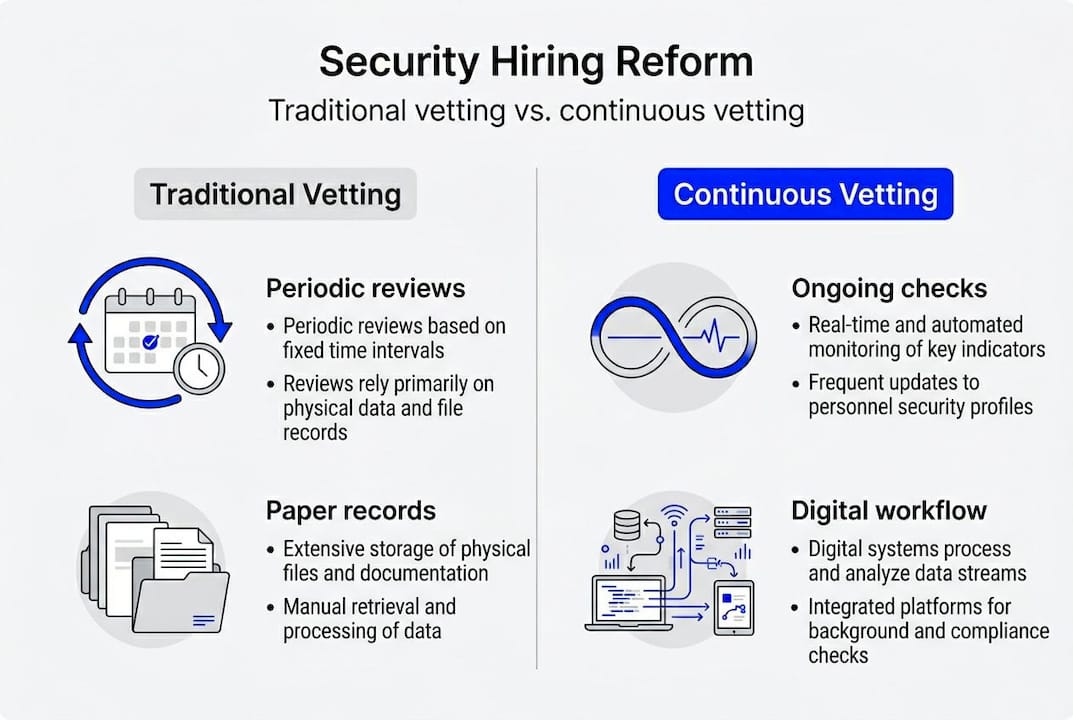
The federal government’s Trusted Workforce 2.0 initiative represents one of the most significant structural reforms to personnel vetting in recent decades. By shifting from periodic reinvestigations to continuous vetting, the framework enables agencies to detect emerging risks in real time rather than waiting years between formal reviews. Over half of agencies operating under this model report greater confidence in the integrity of their workforce as a result.
The operational impact of these reforms is significant. The table below summarizes how modern vetting technology compares to traditional approaches:
| Feature | Traditional vetting | Modern continuous vetting |
|---|---|---|
| Investigation frequency | Periodic (every 5-10 years) | Continuous, real-time monitoring |
| Risk detection speed | Delayed, often post-incident | Proactive, before incidents occur |
| Onboarding timeline | Weeks to months | Significantly reduced |
| Transparency to leadership | Limited reporting | Dashboard-level visibility |
| Compliance documentation | Manual, fragmented | Automated, audit-ready |
Beyond federal reforms, agencies should evaluate applicant tracking systems that integrate background investigation workflows directly into the recruitment pipeline. This integration eliminates the manual handoffs that slow down hiring and introduce inconsistency. When vetting is embedded in the process rather than bolted on at the end, both speed and rigor improve.
Pro Tip: Invest in platforms that allow you to streamline vetting workflows without sacrificing investigator oversight. Automation should handle data aggregation and flagging, while trained investigators retain decision-making authority. This balance is what separates a trustworthy vetting process from one that is merely fast.
Continuous improvement requires more than technology adoption. It demands a commitment to reviewing hiring outcomes, analyzing where qualified candidates drop out of the process, and adjusting policies based on evidence rather than assumption. Agencies that treat hiring as a living system, rather than a fixed procedure, are better positioned to adapt as community expectations and legal standards evolve.
The uncomfortable truth: Why trust boils down to follow-through, not just policy
Every strategy covered in this guide, from diversity initiatives to continuous vetting platforms, carries a fundamental limitation: none of it builds lasting public trust unless agencies follow through visibly and consistently. Policy announcements are not trust. They are promises. And communities have heard enough promises.
The pattern is familiar. An agency announces reformed hiring standards following a high-profile incident. Press releases go out. Community meetings are held. Then, months later, the community sees little evidence that anything has changed. In some cases, the public communication itself becomes the problem, because it raises expectations that the agency is not equipped or committed to meet.
Leadership accountability is the missing variable in most trust-building frameworks. It is not enough to implement a new vetting tool or publish a diversity report. Agency leaders must be willing to communicate honestly about failures, not just successes. When a hire proves problematic, the public response to how leadership handles that failure matters as much as the failure itself.
Building a trusted hiring process means treating transparency as an operational standard, not a crisis communication strategy. Agencies that publish regular, honest reports on hiring outcomes, including where they fell short and what they are doing differently, build credibility over time. That credibility is the actual foundation of public trust. Policies create the framework. Follow-through fills it with meaning.
How OMNI Intel helps agencies earn lasting public trust
The strategies outlined in this guide require more than good intentions. They require infrastructure, expertise, and tools designed specifically for the demands of public safety hiring.

OMNI Intel provides background checks for public safety agencies that go beyond surface-level screening. Our investigator-driven approach applies law enforcement investigation principles to every background review, ensuring that the depth and accuracy communities expect are built into every hire. From pre-employment screening services that reduce time-to-hire without compromising rigor, to pre-employment investigations that surface risks before they become liabilities, OMNI Intel equips agencies with the tools to hire with confidence and communicate that confidence to the communities they serve. When your hiring process is built on verifiable integrity, public trust follows.
Frequently asked questions
What is the biggest barrier to public trust in security hiring?
Staffing shortages and inconsistent hiring standards create public doubt about whether agencies are vetting candidates with appropriate rigor. Harder recruitment across over 70% of police agencies signals to communities that standards may be slipping to fill gaps.
How does diversity in hiring impact community trust?
When agencies reflect local demographics, residents view them as more legitimate and responsive to community needs. Diverse recruitment also correlates with reduced use of excessive force and stronger community cooperation.
What are the public’s expectations for security hire backgrounds?
Communities support flexibility on minor historical offenses and treated mental health conditions but expect firm exclusions for violent or serious drug-related histories. Public attitudes reflect a preference for proportionality over blanket disqualification.
How do technology and reforms like Trusted Workforce 2.0 affect trust?
Continuous vetting platforms enable real-time risk detection and faster onboarding, making the hiring process more transparent and reliable. Trusted Workforce 2.0 specifically improved vetting speed and risk management confidence across participating agencies.