
Tailored screening: Maximizing safety in emergency services
TL;DR:
- Despite investing in advanced background tools, agencies often under-utilize risk data, leading to hiring vulnerabilities. Tailored, evidence-based screening protocols that incorporate role-specific criteria and structured decision-making are essential to prevent misconduct and improve community safety. Strong governance, accountability, and organizational culture are critical for translating screening insights into defensible hiring decisions.
Even when agencies invest in sophisticated background investigation tools, a dangerous gap often persists between the risk data collected and the hiring decisions ultimately made. Screening information may be under-weighted at the hiring decision point, leading to missed opportunities to prevent future misconduct. For recruitment officers and decision-makers in public safety agencies, this gap is not a minor administrative oversight. It is a structural vulnerability that places communities, colleagues, and institutional credibility at risk. This article examines why that gap exists, what tailored screening actually means in practice, and how agencies can build protocols that translate risk signals into defensible, evidence-based hiring outcomes.
Table of Contents
- Why traditional screening often falls short in emergency services
- What is tailored screening? Key concepts for public safety hiring
- Building an effective tailored screening protocol: Evidence and best practices
- Turning screening data into hiring decisions: Overcoming the human bias hurdle
- Why incremental change in screening isn’t enough: The case for structural accountability
- Next steps: Safe, effective hiring with comprehensive screening solutions
- Frequently asked questions
Key Takeaways
| Point | Details |
|---|---|
| Screening data is underused | Despite predictive indicators, many agencies let discretionary judgment override objective risk signals in hiring. |
| Tailored screening improves outcomes | Agencies using job- and risk-specific protocols see better prevention of misconduct and stronger community trust. |
| Decision-support, not dictation | Use validated tools like polygraph as one component—final hiring choices require holistic, transparent governance. |
| Accountability over automation | Move beyond adding tools to reforming decision systems and policies for real, lasting improvement in public safety hiring. |
Why traditional screening often falls short in emergency services
Standard background screening processes were not designed with the complexity of public safety roles in mind. Many agencies rely on checkbox-style vetting, collecting criminal history records, verifying employment dates, and running a credit check, then passing candidates forward if no obvious disqualifiers appear. The problem is not that these steps are wrong. The problem is that they are incomplete, and the data gathered rarely receives the analytical weight it deserves at the decision point.
Research consistently shows that predictive risk indicators are routinely collected but not meaningfully applied. A large-scale study found that 15 out of 19 pre-hire misbehavior indicators significantly predicted later misconduct, yet agencies reduced hiring chances by only 5% based on those disclosures. That statistic is striking. Agencies were sitting on predictive data and largely setting it aside.
“The failure is not in the screening tools themselves. The failure is in how agencies translate screening findings into structured, accountable hiring decisions.”
This pattern has real consequences. Officers and emergency personnel who exhibit early warning signs during pre-employment investigations go on to generate misconduct complaints, civil liability exposure, and, in the most serious cases, harm to the public they were hired to protect. The cost of a single bad hire in law enforcement, including litigation, termination proceedings, retraining, and reputational damage, can reach hundreds of thousands of dollars.
Several factors contribute to why traditional screening falls short:
- Lack of role specificity. Generic screening criteria do not account for the behavioral demands of specific emergency roles. A patrol officer, a 911 dispatcher, and a fire investigator each face distinct stressors and ethical challenges that require different vetting benchmarks.
- Inconsistent application. Without standardized scoring or decision protocols, two candidates with nearly identical risk profiles may receive opposite hiring outcomes depending on which supervisor reviews the file.
- Over-reliance on disqualifying records. Many agencies treat background investigations as a search for hard disqualifiers rather than a systematic analysis of behavioral patterns and risk trajectories.
- Insufficient integration with public safety pre-employment screening platforms that can aggregate, weight, and present risk data in a structured format for decision-makers.
Agencies that invest in background check guidance designed specifically for public safety contexts are better positioned to close this gap. But tool access alone is not the answer. The underlying decision architecture must change.

What is tailored screening? Key concepts for public safety hiring
Traditional screening processes apply uniform criteria to every candidate regardless of role, jurisdiction, or organizational risk tolerance. Tailored screening takes a fundamentally different approach. It adapts the tools, criteria, and decision thresholds to the specific demands of the position being filled, the community the agency serves, and the behavioral patterns most predictive of misconduct in that context.
The distinction matters enormously in practice. Consider two agencies: a rural sheriff’s department hiring a deputy who will frequently work alone with minimal supervision, and a metropolitan transit authority hiring a security officer for a high-volume commuter environment. The risk profiles for those roles differ substantially. A one-size-fits-all screening protocol will either over-screen candidates for lower-risk positions or under-screen candidates for higher-risk ones.
| Feature | Generic screening | Tailored screening |
|---|---|---|
| Criteria basis | Uniform across all roles | Role, jurisdiction, and risk-specific |
| Tool selection | Standard battery applied equally | Tools selected based on job analysis |
| Decision protocol | Discretionary, supervisor-driven | Structured, evidence-based |
| Polygraph use | Inconsistent or absent | Formalized with clear policy boundaries |
| Outcome documentation | Minimal | Written justification required |
| Validation | Rarely assessed | Tied to criterion relevance and job fit |
Tailored screening in emergency services often formalizes pre-employment decision support using tools like polygraph examinations, with clear policy distinctions and retained decision authority residing with the agency rather than the examiner. This is a critical governance point. The tool informs. The agency decides.
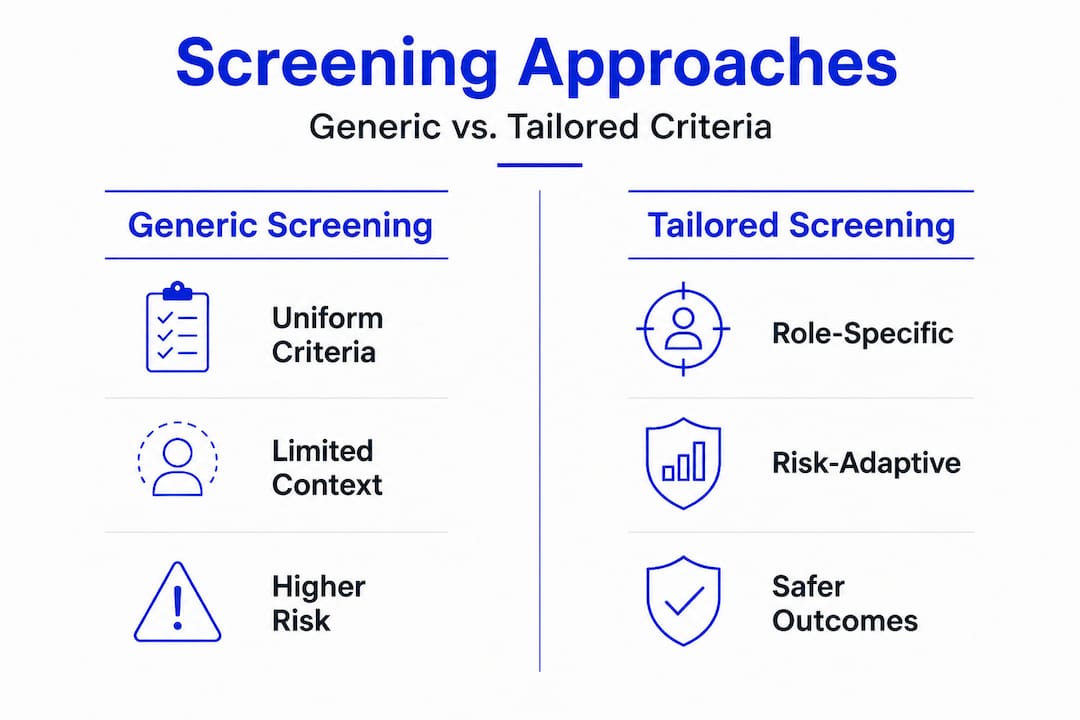
The tailored screening guide developed for public safety contexts emphasizes that specificity is not bureaucratic complexity for its own sake. It is a mechanism for ensuring that the right questions are asked of the right candidates in the right sequence. When an agency conducts a job analysis before selecting screening tools, it identifies the behavioral competencies and risk factors most relevant to that role. That analysis then drives which instruments are used, how results are weighted, and what threshold triggers additional review.
Pro Tip: Build screening policies that explicitly retain human judgment while demanding written, evidence-based explanations for every hiring and rejection decision. This protects the agency legally and creates an institutional record that supports continuous improvement over time.
The tailored screening solutions available to public safety agencies today can support this level of specificity without adding prohibitive administrative burden. The key is designing the protocol before selecting the tools, not the other way around.
Building an effective tailored screening protocol: Evidence and best practices
Understanding what tailored screening means is the foundation. Building a protocol that actually works requires a systematic approach grounded in validation, multi-method assessment, and transparent governance. Agencies that approach this process rigorously see measurable improvements in hire quality and reductions in early-career misconduct.
The following steps provide a practical framework for constructing a tailored screening protocol:
-
Conduct a formal job analysis. Before selecting any screening tool, identify the behavioral competencies, ethical demands, and environmental stressors specific to the role. This analysis should involve input from supervisors, experienced officers or personnel in similar roles, and, where available, data from past misconduct investigations.
-
Select tools based on criterion relevance. Every screening instrument should be chosen because it measures something demonstrably related to job performance or misconduct risk in that role. Adding psychological measures without strong validity evidence can produce limited incremental value. Tailoring should be tied to validation and criterion relevance, not to the availability or familiarity of a particular tool.
-
Implement a multi-method assessment approach. No single tool, whether a polygraph examination, a psychological inventory, a structured interview, or a criminal history check, provides a complete picture of candidate risk. Effective protocols combine multiple methods so that findings can be triangulated and no single instrument carries disproportionate weight.
-
Establish clear decision thresholds. Define in advance what findings at each stage of screening will trigger escalation, disqualification, or additional investigation. These thresholds should be documented and applied consistently across all candidates for a given role.
-
Require written justification for all hiring decisions. Whether a candidate is advanced, placed on hold, or disqualified, the decision-maker should document the specific screening findings that supported that outcome. This practice creates accountability and supports legal defensibility.
-
Review and validate the protocol periodically. Screening tools must be interpreted as decision-support with known accuracy limitations. Agencies must avoid over-reliance and preserve governance over hiring choices. Periodic review of outcomes, comparing screening findings against post-hire performance data, allows agencies to refine their protocols over time.
| Screening method | Strengths | Limitations |
|---|---|---|
| Criminal history check | Identifies disqualifying records, legally required | Does not capture behavioral patterns or unreported conduct |
| Psychological testing | Assesses personality traits and risk factors | Validity varies by instrument; must be validated for the role |
| Polygraph examination | Surfaces undisclosed information | Accuracy limitations; must be used as decision-support only |
| Structured interview | Behavioral indicators, communication assessment | Interviewer bias risk without standardized scoring |
| Reference and employment verification | Confirms history, surfaces patterns | Depends on candor of references; may miss critical information |
| Social media and open-source review | Identifies conduct not captured in records | Requires clear policy to avoid bias and legal exposure |
The step-by-step screening process for public safety hiring should treat each method as one layer of a larger evidentiary picture. Agencies that follow background screening best practices consistently report that multi-method protocols produce more defensible outcomes and reduce the likelihood of misconduct slipping through the initial vetting process.
One practical consideration worth emphasizing: the sequence in which screening tools are applied matters. Placing resource-intensive assessments like psychological evaluations and polygraph examinations later in the process, after initial criminal history and employment verification checks have cleared candidates, reduces cost and administrative burden without compromising thoroughness.
Turning screening data into hiring decisions: Overcoming the human bias hurdle
Designing a rigorous protocol is essential. But the most carefully constructed screening process can be undermined at the final decision point if the agency lacks a structured mechanism for translating findings into outcomes. This is where many agencies falter, and where the consequences of failure are most direct.
Human judgment is not inherently unreliable. Experienced hiring officials bring contextual knowledge and professional insight that no algorithm can fully replicate. The danger arises when discretionary judgment is used to override structured screening evidence without documentation or accountability. Risk signals can be predictive but not meaningfully affect hiring if decision protocols allow human judgment to override structured evidence without explanation.
“Structured decision protocols do not eliminate human judgment. They discipline it, ensuring that intuition and experience operate within a framework that demands evidence and produces accountability.”
Several concrete practices help agencies bridge the gap between screening data and final hiring decisions:
- Decision matrices. A decision matrix assigns weighted scores to findings from each screening method and produces a composite risk profile for each candidate. Decision-makers use this profile as the primary input for their recommendation, rather than relying on an overall impression formed from reviewing a file.
- Calibration sessions. Regular meetings among hiring officials to review borderline cases and discuss how screening findings were weighted promote consistency and surface implicit biases that may be influencing outcomes.
- Blind review protocols. Where feasible, having a second reviewer assess screening findings without knowledge of the primary reviewer’s recommendation reduces confirmation bias and anchoring effects.
- Mandatory override documentation. When a decision-maker chooses to advance a candidate despite concerning screening findings, or to disqualify a candidate despite a clean profile, that decision must be documented with specific reasoning. This practice is protective for the agency and instructive for future hiring cycles.
The screening workflow guide for public safety agencies provides a structured template for implementing these practices without creating prohibitive administrative overhead. Agencies that have adopted structured decision protocols report not only improved hire quality but also reduced time-to-hire, because decision-makers spend less time deliberating over ambiguous cases when clear thresholds and documentation requirements are in place.
Pro Tip: Implement a decision matrix that requires written justification for every hiring and rejection outcome. Even a brief, structured explanation forces decision-makers to articulate their reasoning, which reduces implicit bias and creates an institutional record that supports legal defensibility and continuous protocol improvement.
The goal of pre-employment investigations ensuring safe hires is not to eliminate all risk from hiring. That is not achievable. The goal is to ensure that the risk signals collected during screening are given their appropriate weight in the final decision, and that the agency can demonstrate, if challenged, that its process was systematic, evidence-based, and consistently applied.
Why incremental change in screening isn’t enough: The case for structural accountability
There is a tendency among public safety agencies to treat screening improvement as a tool procurement problem. The reasoning goes: if the current process is missing red flags, the solution is to add a new instrument, update a form, or subscribe to a new data service. This approach is understandable. It is also insufficient.
The evidence is clear that the most significant failures in public safety hiring are not failures of tool capability. They are failures of governance. Agencies that delegate hiring authority to a polygraph examiner, a psychological evaluator, or an automated screening platform without maintaining clear institutional ownership of the decision are not improving their process. They are redistributing accountability in ways that create new vulnerabilities.
Model policy recommends that agencies, not tool operators, own hiring outcomes, and must interpret results with consideration of known accuracy limitations. This is not a bureaucratic formality. It is a statement about where accountability must reside. When a problematic hire later generates misconduct, the agency cannot point to a polygraph result or a psychological report as the decision-maker. The agency made the decision. The tools informed it.
True structural accountability requires several things that go beyond tool selection. It requires that hiring policies explicitly define who owns each stage of the screening decision and what authority they hold. It requires that override decisions be subject to review by a second authority. It requires that outcome data, specifically the relationship between screening findings and post-hire performance, be systematically collected and used to refine the protocol. And it requires that the agency’s leadership treat screening integrity as an organizational value, not an administrative function.
The agencies that have made the most meaningful progress in reducing misconduct-related hiring failures are those that have embedded integrity in law enforcement screening into their organizational culture. They treat the screening process as a reflection of their institutional values, not merely a compliance requirement. When a hiring official knows that every decision will be documented, reviewed, and compared against eventual outcomes, the incentive structure shifts. Evidence gets taken seriously. Risk signals get weighted appropriately. And the gap between data collected and decisions made begins to close.
Incremental tool improvements have a role to play. But they will not, on their own, produce the systemic change that public safety hiring requires. The structural reforms, governance frameworks, and cultural commitments are what ultimately determine whether a screening process protects the community it is designed to serve.
Next steps: Safe, effective hiring with comprehensive screening solutions
The frameworks covered in this article represent a significant shift from how many public safety agencies currently approach pre-employment vetting. Moving from checkbox-style processes to structured, evidence-based protocols requires both the right tools and the right institutional commitments.

OMNI Intel’s pre-employment screening services are built specifically for the complexity of public safety hiring. Whether your agency needs to strengthen its initial vetting process, implement structured decision protocols, or establish continuous post-hire monitoring, OMNI Intel provides investigator-driven, FCRA-compliant solutions tailored to your role-specific requirements. The platform’s pre-employment investigations go beyond records checks to deliver the behavioral and evidentiary depth that defensible hiring decisions require. Explore OMNI Intel’s full suite of background checks for public safety to find the right fit for your agency’s needs and risk profile.
Frequently asked questions
What is the difference between tailored and generic screening in emergency services?
Tailored screening adapts tools and criteria to the specific risks and roles of emergency services, while generic screening applies uniform criteria to all candidates regardless of position. Tailored screening emphasizes job- and jurisdiction-specific criteria to improve predictive accuracy and decision quality.
Why are predictive risk signals sometimes ignored during hiring?
Decision-makers may override structured screening data with discretionary judgment, diminishing its impact even when risk indicators are statistically predictive of future misconduct. Screening results may be under-weighted during hiring decisions when no structured protocol requires their explicit consideration.
Should agencies rely mainly on polygraph or psychological testing for pre-employment screening?
No. Both tools should function as decision-support instruments alongside multi-method assessments, not as the sole or primary basis for hiring outcomes. Decision-support tools should not be over-relied on and must be validated for the specific role and context in which they are applied.
What governance steps help ensure screening data shapes final hiring outcomes?
Agencies should implement written decision protocols, use structured decision matrices, and require documented justification whenever objective screening information is overridden. Structured decision protocols reduce bias in hiring and enhance the accountability that protects both the agency and the communities it serves.