

Continuous employee monitoring steps for public safety HR
TL;DR:
- Public safety agencies must implement continuous, automated employee vetting to prevent trust and compliance failures. Proper preparation, transparency, and balanced monitoring are essential to maintaining workforce trust and effective risk mitigation. Partnering with expert providers like OMNI Intel helps agencies develop compliant, ethical monitoring programs that support safety and legal standards.
Public safety agencies operate in an environment where a single missed warning sign can cascade into a compliance failure, a community trust crisis, or a costly legal liability. When a dispatcher with a recent financial fraud conviction continues processing sensitive data undetected, or a law enforcement officer develops a pattern of concerning off-duty behavior that goes unreported for months, the consequences extend far beyond the individual. Real-time information mitigates risk, and federal mandates under Trusted Workforce 2.0 now require public safety agencies to move beyond periodic background checks toward continuous, automated vetting. This guide walks HR and compliance officers through every critical step of building and sustaining that program.
Table of Contents
- Understanding regulatory mandates and pitfalls
- Preparation: Building your monitoring foundation
- Step-by-step: Executing continuous employee monitoring
- Verification and overcoming common obstacles
- Why balance matters more than more monitoring: Our take
- Partner with OMNI Intel for effective public safety monitoring
- Frequently asked questions
Key Takeaways
| Point | Details |
|---|---|
| Real-time risk mitigation | Continuous employee monitoring helps HR catch problems early and meet compliance requirements in public safety. |
| Balance transparency and privacy | Transparent policies and minimal-intrusion monitoring build trust and make adoption easier for your agency. |
| Follow structured steps | Success depends on careful preparation, adherence to legal requirements, and responsive workflows. |
| Monitor and adapt processes | Regularly review your monitoring effectiveness and address tech or resource barriers to ensure compliance. |
Understanding regulatory mandates and pitfalls
Before any agency can implement continuous employee monitoring with confidence, it must understand the regulatory landscape that governs the practice. Trusted Workforce 2.0 (TW 2.0) represents the most significant overhaul of federal personnel vetting policy in decades, shifting the model from periodic reinvestigations conducted every five or ten years to a continuous, automated process that generates real-time alerts.
Under TW 2.0, automated record checks on criminal and agency data form the backbone of continuous vetting (CV). When an alert is triggered, it initiates a formal investigation and adjudication process rather than simply flagging a file for later review. This distinction is critical. The old model allowed risk to accumulate silently between reinvestigation cycles. The new model closes that window.
Understanding the difference between traditional periodic checks and continuous monitoring helps clarify what your agency is actually committing to.
| Feature | Traditional periodic checks | Continuous monitoring |
|---|---|---|
| Frequency | Every 5 to 10 years | Real-time, automated |
| Data sources | Criminal, employment history | Criminal, financial, agency, behavioral |
| Alert mechanism | Manual review cycle | Automated trigger with adjudication workflow |
| Employee notification | At reinvestigation | Ongoing, policy-driven |
| Compliance alignment | Legacy standards | TW 2.0, FCRA-compliant frameworks |
Following employee monitoring best practices specific to public safety ensures your program aligns with both federal mandates and the operational realities of law enforcement, fire, EMS, and dispatch environments.
Common pitfalls in early implementation include three recurring failures that agencies must anticipate. First, lack of transparency with employees about what is being monitored and why creates immediate morale and legal exposure. Second, privacy violations stemming from over-broad data collection that exceeds what is necessary for the stated security purpose. Third, inadequate response workflows when alerts are generated, leaving HR teams without a clear protocol for investigation and adjudication. Research on monitoring acceptance trends confirms that employees who understand the purpose and scope of monitoring are significantly more cooperative and less likely to contest the process.
“Continuous vetting is not surveillance for its own sake. It is a structured, rights-respecting mechanism for ensuring that individuals entrusted with public safety remain suitable for that trust over the full arc of their careers.”
The monitoring process guide for public safety agencies provides additional context on how to structure your program within these regulatory boundaries, particularly for agencies navigating state-level privacy laws alongside federal mandates.
Key pitfalls to avoid at the regulatory stage:
- Failing to conduct a legal review before launching automated checks
- Assuming state law mirrors federal TW 2.0 requirements without verification
- Neglecting to establish a formal adjudication protocol before the first alert fires
- Overlooking union contract obligations that may require negotiation before implementation
- Treating continuous monitoring as a technology project rather than a compliance program
Preparation: Building your monitoring foundation
Once the regulatory framework is clear, the work of building an internal foundation begins. This preparation phase is where most agencies either set themselves up for sustainable compliance or create the conditions for future failures. Rushing past it is a costly mistake.
Technology adaptation difficulties affect 98% of agencies attempting to implement continuous vetting, which means the preparation phase is not optional. It is the difference between a program that functions as intended and one that generates alerts no one knows how to process.
Pre-implementation documentation checklist:
- Written monitoring policy reviewed by legal counsel
- Employee notification forms and acknowledgment records
- Data minimization policy specifying what is collected, retained, and deleted
- Audit trail requirements documented and tested
- Roles and responsibilities matrix for HR, IT, legal, and supervisors
- Vendor contracts reviewed for data security and FCRA compliance
- Integration testing plan for monitoring system and existing HR platforms
The policy itself must address several specific elements to withstand scrutiny. Employee notification language must be clear and written at an accessible reading level, not buried in a policy appendix. Data minimization means collecting only what is necessary for the specific security purpose, not building a broad behavioral profile. Audit trails must capture every access event, alert, investigation action, and adjudication outcome with timestamps.
| Policy element | Minimum requirement | Best practice |
|---|---|---|
| Employee notification | Written notice at enrollment | Annual re-acknowledgment plus alert-specific notice |
| Data minimization | Collect only security-relevant data | Formal data inventory with retention schedule |
| Audit trail | Log alert and adjudication events | Log all system access, queries, and exports |
| Employee access | Right to review their own records | Formal request process with response timeline |
| Consent documentation | Signed acknowledgment | Biennial renewal with updated policy language |
Pro Tip: Assign a dedicated monitoring compliance officer, separate from the general HR function, who owns the program documentation, vendor relationships, and audit readiness. This single role prevents the diffusion of accountability that causes most implementation failures.
Technology selection deserves careful attention. The monitoring system must integrate with your existing HR information system, your records management system, and ideally your background investigation platform. Gaps in integration create manual handoffs that introduce delay and error. Review data privacy guidance specific to public safety hiring environments before finalizing any vendor selection, particularly regarding data residency, encryption standards, and breach notification obligations.

Consent and privacy considerations under regulatory guidance require that employees understand they are being monitored, what data sources are checked, how alerts are handled, and what rights they retain. Ethical monitoring practices consistently emphasize that employees who feel respected and informed are more likely to accept monitoring as a professional obligation rather than resent it as an intrusion.
The implementation workflow resource provides a structured sequence for agencies moving from policy drafting through technology deployment, with specific checkpoints for legal review, union consultation, and pilot testing.
Step-by-step: Executing continuous employee monitoring
With the foundation in place, the execution phase begins. This is where the program becomes operational, and where the quality of your preparation determines how smoothly the process runs. Each step must be followed in sequence to maintain compliance and protect both the agency and its employees.
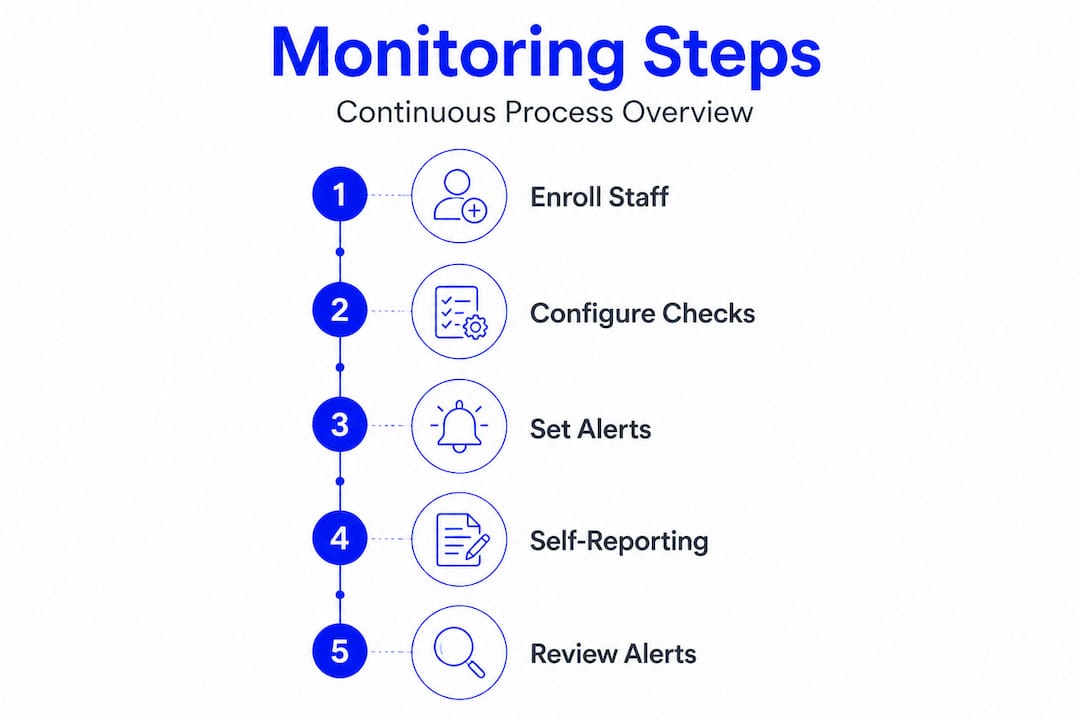
Step 1: Enrollment
Under TW 2.0, enrollment is automatic following a favorable determination, meaning employees who receive a favorable adjudication outcome are automatically enrolled in continuous vetting without requiring a separate consent event at that stage. However, your agency’s written policy must have already notified employees of this enrollment process before they reach that determination point. Document enrollment dates, the determination that triggered enrollment, and the employee’s acknowledgment of the monitoring policy.
Step 2: Configure automated checks and data sources
Work with your technology vendor to configure the specific data sources that will be checked continuously. For most public safety roles, this includes criminal record repositories, financial records relevant to security clearance, agency disciplinary databases, and sex offender registries. Establish the frequency of automated checks for each data source, noting that some sources update in real time while others update on a batch schedule.
Step 3: Define alert thresholds and workflows
Not every data event warrants the same response. Define alert tiers based on severity. A new criminal charge triggers a different workflow than a change of address. Document the specific criteria for each tier, the responsible party for initial review, the timeline for escalation, and the adjudication authority. This prevents the common failure mode where alerts pile up unreviewed because no one knows who owns them.
Step 4: Maintain employee self-reporting requirements
Automated monitoring does not replace the obligation to self-report. Self-reporting remains required for specific categories of events including arrests, foreign travel, financial changes, and cohabitant issues, among others. Employees must understand that the existence of automated monitoring does not relieve them of this duty. Build self-reporting reminders into annual training, onboarding, and policy acknowledgment cycles.
Step 5: Investigate and adjudicate alerts
When an alert fires, the investigation and adjudication process must follow a documented protocol. Assign the alert to the responsible investigator within your defined timeline. Gather corroborating information. Provide the employee an opportunity to respond before any adverse action is taken. Document every step. The post-hire monitoring guide for public safety HR teams provides detailed guidance on structuring this investigative process in a way that holds up to legal scrutiny.
Step 6: Document outcomes and maintain audit readiness
Every alert, investigation, and adjudication outcome must be documented with sufficient detail to support an audit. This means recording the data event that triggered the alert, the investigation steps taken, the evidence reviewed, the adjudication decision, and any resulting personnel action. Use the employee monitoring checklist to verify that each case file meets documentation standards before closing.
Statistic callout: 98% of agencies implementing continuous vetting under TW 2.0 report technology adaptation difficulties, underscoring the need for thorough preparation before execution rather than attempting to resolve integration problems after the program is live.
Pro Tip: Run a tabletop exercise before going live. Walk your HR, legal, and supervisory team through a simulated alert scenario from detection through adjudication. This surfaces workflow gaps, role confusion, and documentation deficiencies before they affect a real case.
Verification and overcoming common obstacles
Executing a continuous monitoring program is not a one-time deployment. It requires ongoing verification that the program is functioning as intended, that it remains compliant with evolving regulations, and that it is not inadvertently undermining the workforce trust it is meant to protect.
Transparency drives acceptance, with 52% acceptance rates among employees when monitoring practices are clearly communicated and justified. The same research notes that employees consistently prefer monitoring focused on productivity outcomes over granular time-use surveillance, a finding that carries direct implications for how public safety agencies frame and scope their monitoring programs.
| Common obstacle | Best-practice solution |
|---|---|
| IT integration failures | Pilot test with a single unit before agency-wide rollout |
| Alert volume overwhelming HR | Tiered alert system with automated triage for low-risk events |
| Employee resistance | Pre-launch briefings, written Q&A, and ongoing feedback channel |
| Unclear adjudication authority | Written RACI matrix with named decision-makers by alert tier |
| Data security gaps | Annual third-party security audit of monitoring platform |
| Regulatory changes outpacing policy | Quarterly policy review cycle with legal counsel |
| Union or labor relations friction | Early consultation and negotiated monitoring agreement |
Transparency and feedback loops are not soft considerations. They are structural requirements for a program that will endure. Agencies that launch monitoring programs without an employee feedback mechanism consistently report higher grievance rates, more legal challenges, and lower cooperation with self-reporting obligations.
Ethical monitoring guidelines recommend using the least intrusive methods capable of achieving the security objective, deleting data once its purpose is served, and giving employees meaningful access to their own records. These principles are not in conflict with rigorous public safety vetting. They are what makes rigorous vetting sustainable.
Key verification indicators to track quarterly:
- Alert response time from detection to initial investigator assignment
- Adjudication completion rate within defined timelines
- Employee self-reporting compliance rate
- Grievance and legal challenge rate related to monitoring actions
- Audit finding rate from internal and external reviews
- Technology uptime and integration error rate
The post-hire monitoring solutions available for public safety agencies include built-in reporting dashboards that surface these indicators automatically, reducing the manual burden on compliance officers while improving audit readiness.
“Monitoring that employees understand and accept functions as a shared commitment to public safety. Monitoring that employees fear or resent functions as a source of organizational friction that undermines the very culture of integrity it is meant to reinforce.”
Understanding why post-hire monitoring matters in the public safety context goes beyond regulatory compliance. It is about maintaining the conditions under which trustworthy personnel continue to serve effectively, and identifying the rare cases where that trust has been broken before the consequences reach the community.
Why balance matters more than more monitoring: Our take
Here is the uncomfortable truth that most implementation guides will not tell you. The agencies that struggle most with continuous monitoring are not the ones that monitor too little. They are the ones that monitor too broadly, too opaquely, and with too little regard for the workforce culture they are operating within.
Technology adaptation difficulties affect 98% of agencies implementing TW 2.0 continuous vetting requirements. But the deeper problem is not the technology. It is the organizational assumption that more data, more alerts, and more surveillance automatically produce more safety. That assumption is wrong, and the evidence from agencies that have struggled through early TW 2.0 implementation bears this out.
When employees perceive monitoring as punitive rather than protective, self-reporting rates drop. When alert volumes overwhelm HR capacity, genuine risks get buried under low-priority flags. When adjudication timelines stretch because no one owns the workflow, the program loses credibility with both employees and supervisors. These failures are not technology failures. They are culture and design failures.
The agencies that have successfully adapted to continuous vetting requirements share a common characteristic. They treated the program as a trust-building exercise as much as a compliance exercise. They communicated clearly and repeatedly about what was being monitored and why. They built feedback mechanisms that allowed employees to raise concerns about the program itself. They invested in training for supervisors so that alert responses felt fair and consistent. They streamlined their vetting workflow rather than layering new monitoring on top of already strained HR processes.
The hard lesson from TW 2.0 implementation is that the goal is not maximum monitoring coverage. The goal is a monitoring program that is accurate enough to catch genuine risk, transparent enough to maintain workforce trust, and efficient enough to produce timely adjudication decisions. Breadth without those qualities is not safety. It is noise.
HR and compliance officers who approach continuous monitoring as a balance between security rigor and workforce respect will build programs that endure, that employees cooperate with, and that actually deliver the risk mitigation they promise. Those who treat it as a surveillance expansion project will find themselves managing grievances, legal challenges, and morale problems that cost far more than the risks they were trying to prevent.
Partner with OMNI Intel for effective public safety monitoring
Building a continuous monitoring program that meets TW 2.0 requirements, protects employee rights, and holds up to audit scrutiny is a significant undertaking. The steps outlined above provide the framework, but execution requires the right tools and the right partner.

OMNI Intel is built specifically for public safety agencies navigating exactly these challenges. From structuring your initial monitoring process guide to deploying investigator-driven post-hire checks that integrate with your existing HR systems, OMNI Intel brings law enforcement investigation principles to every stage of the vetting and monitoring lifecycle. Whether your agency is just beginning to implement continuous vetting or needs to strengthen an existing program, explore our pre-employment screening services and purpose-built background checks for public safety to see how a compliance-focused partner can reduce your risk exposure and improve program efficiency.
Frequently asked questions
What does continuous employee monitoring involve in public safety?
It means automated ongoing checks of criminal records, agency data, and other security-relevant sources, with real-time alerts that trigger formal investigation and adjudication, alongside required employee self-reporting for specific life events.
Why is transparency important for continuous monitoring acceptance?
52% acceptance rates are achieved when employees clearly understand what is monitored and why, while opaque monitoring programs generate stress, grievances, and higher turnover risk that undermine the program’s purpose.
How can agencies avoid common pitfalls with monitoring?
Agencies should use least intrusive methods capable of meeting the security objective, delete data once its purpose is fulfilled, and give employees a clear process for accessing and contesting their own records.
What technical hurdles do agencies face with continuous monitoring?
98% of agencies report significant difficulties integrating new monitoring technology with existing systems and adapting staffing resources to manage the alert and adjudication workload that continuous vetting generates.
Does continuous monitoring replace employee self-reporting?
No. Self-reporting remains required for specific categories of events even after automated monitoring enrollment, and employees must understand that automated checks do not relieve them of their individual reporting obligations.
Recommended
- Employee Monitoring Process Guide for Public Safety HR
- Implement employee monitoring workflow for public safety
- Monitor post-hire activity: Step-by-step guide for public safety HR
- Employee monitoring best practices for public safety 2026
- When Are Alhambra Employers Required to Correct Workplace Safety Hazards? – California United Law Group