

How to vet public safety candidates: a step-by-step guide
Public safety agencies across the country are under mounting pressure: agencies operating at 91% staffing capacity are scrambling to fill vacancies without sacrificing the rigorous standards that protect communities. A single bad hire in law enforcement, fire, or EMS can lead to disciplinary action, litigation, damaged community trust, and in the worst cases, tragedy. This guide delivers a clear, compliant, and field-tested roadmap for HR leaders and public safety administrators who need to vet candidates thoroughly, move efficiently through the hiring pipeline, and make evidence-based decisions that hold up legally and operationally.
Table of Contents
- Understanding the stakes and legal requirements
- Preparation: Tools, tests, and essential requirements
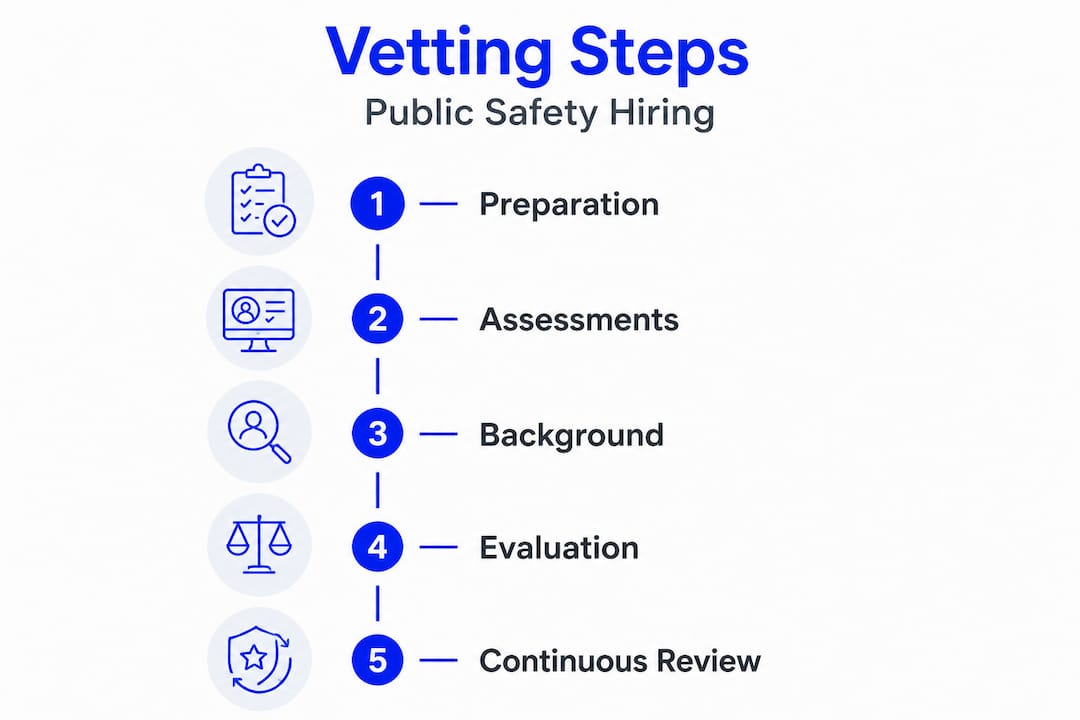
- How to conduct a comprehensive vetting process: Step-by-step
- Avoiding common pitfalls and improving outcomes
- Verifying outcomes and continuous improvement
- Hard-won lessons: Why effective vetting is an evolving challenge
- How OMNI Intel streamlines public safety candidate vetting
- Frequently asked questions
Key Takeaways
| Point | Details |
|---|---|
| Compliance is critical | Ensure all assessments are job-related and completed post-conditional offer to minimize legal risk. |
| Structured, multi-step process | A clear, sequenced approach using validated tests and checks yields the best hires. |
| Track and address attrition | Monitor drop-off at every stage and adjust strategies to improve retention and hire quality. |
| Continuous process improvement | Regularly review outcomes and update practices in response to candidate performance and legal changes. |
| Expert support helps | Specialized screening partners can streamline vetting and ensure thorough, compliant hiring. |
Understanding the stakes and legal requirements
Public safety hiring is not like filling a corporate role. The consequences of a poor vetting decision extend far beyond productivity metrics. Officers, firefighters, dispatchers, and EMS personnel carry legal authority, respond to life-threatening situations, and represent the agency’s integrity in every interaction. A flawed hire can trigger civil liability, expose an agency to federal scrutiny, and erode the public confidence that every department depends on to function.
The legal framework governing this process is equally complex. Several federal statutes directly shape how and when agencies can conduct evaluations and inquiries:
- Americans with Disabilities Act (ADA): Medical and psychological evaluations must occur after a conditional job offer (CJO) has been extended, not before. Agencies that conduct psych evaluations during initial screening stages risk ADA violations with serious legal consequences.
- Fair Credit Reporting Act (FCRA): Any background check conducted through a third-party consumer reporting agency must comply with FCRA notification, disclosure, and adverse action requirements. This includes obtaining written authorization from the candidate before the check is run.
- Equal Employment Opportunity Commission (EEOC) guidelines: Blanket exclusions based on criminal history are generally impermissible. Agencies must consider the nature of the offense, time elapsed, and job relevance.
- State-specific statutes: Many states impose additional restrictions on inquiry topics, record access, and use of credit history in public employment decisions.
“Psychological evaluations must be post-conditional offer and job-related per the ADA.” Administering them any earlier creates both legal exposure and a skewed candidate experience.
A critically misunderstood area involves candidates with prior mental health treatment. Prior therapy, counseling, or a history of seeking mental health support is not an automatic disqualifier under the ADA or standard psychological evaluation frameworks. Evaluators must assess current functioning and behavioral patterns, not isolated historical incidents. Agencies that reflexively disqualify such candidates narrow their candidate pool unnecessarily and risk discriminatory practice claims.
Reviewing compliance in public safety hiring before launching any vetting process is strongly recommended. Understanding how your process maps against the applicable hiring compliance guide for your jurisdiction will prevent costly missteps. Even experienced HR teams can benefit from auditing their current protocols against updated legal standards, particularly as public defender interview legal standards and related case law continue to evolve across the public safety sector.
Pro Tip: Before your first candidate enters the pipeline, have legal counsel or a compliance officer review your entire process sequence, paying particular attention to the timing of each evaluation relative to conditional offer issuance.
Preparation: Tools, tests, and essential requirements
Effective vetting requires assembling the right tools, assessments, and logistical infrastructure before the first application arrives. Agencies that improvise their assessment stack mid-process introduce inconsistency and legal risk. A well-prepared vetting infrastructure treats the candidate experience as a reflection of the agency’s own operational standards.
Core assessment tools used across public safety disciplines include the following:
- Minnesota Multiphasic Personality Inventory (MMPI-3): The most widely used structured psychological instrument in law enforcement and fire hiring. It identifies psychopathology and behavioral risk patterns relevant to high-stress public safety roles.
- Candidate Physical Ability Test (CPAT): The standardized physical fitness assessment used in firefighter selection nationwide. It evaluates stair climb, hose drag, equipment carry, ladder raise, forcible entry, search, rescue, and ceiling breach tasks.
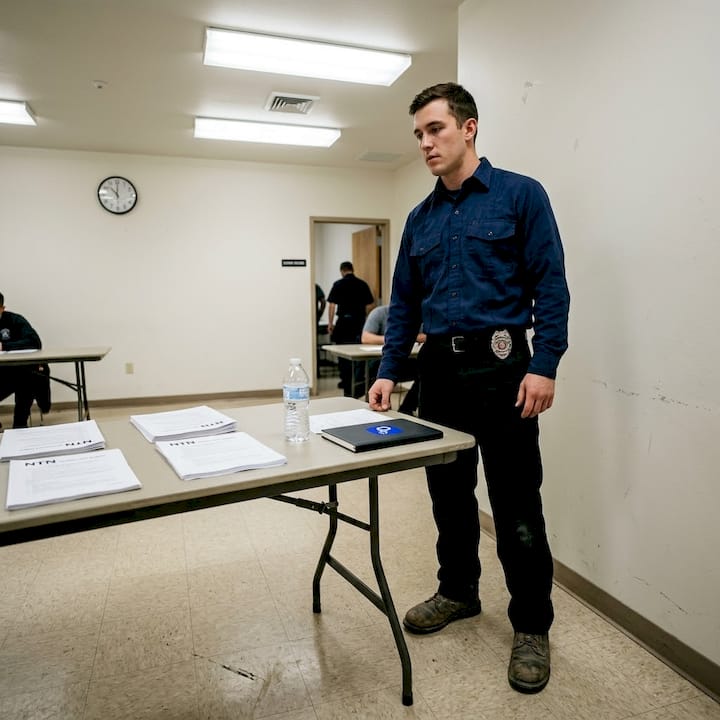
- Written cognitive exams: Administered by third parties such as the National Testing Network (NTN) or locally developed instruments. These assess reading comprehension, reasoning, situational judgment, and written communication skills.
- Oral board interviews: Structured panel interviews designed to evaluate communication, ethical reasoning, and situational response. Panels typically include ranking officers, HR staff, and sometimes community members.
- Polygraph examination: Used widely in law enforcement hiring to verify background investigation disclosures. Some agencies use voice stress analysis as an alternative.
- Background investigation: A detailed review covering criminal records, employment history, driving records, financial history, social media, and reference interviews. This is one of the most time-intensive stages.
- Psychological clinical interview: Conducted by a licensed psychologist following the MMPI and post-CJO, this adds qualitative depth to psychometric data.
For firefighter candidates specifically, the process includes NTN written, CPAT physical, oral boards, background, and polygraph, with EMT certification frequently listed as preferred or required. Fire agencies should also define minimum requirements clearly up front, including age ranges (typically 18 to 35 at hire, depending on jurisdiction), body composition standards, and state certification prerequisites.
The following table summarizes key assessment tools by role type:
| Assessment tool | Law enforcement | Fire and EMS | Dispatch | Private security |
|---|---|---|---|---|
| Written cognitive exam | Required | Required | Required | Often required |
| Physical fitness test | Required | CPAT required | Optional | Varies |
| Polygraph | Common | Common | Less common | Rare |
| Psychological evaluation | Required | Required | Recommended | Optional |
| Background investigation | Required | Required | Required | Required |
| Medical examination | Post-CJO | Post-CJO | Post-CJO | Post-CJO |
Before candidates are identified, your agency should have background check authorization forms ready, credential verification checklists prepared, and a defined timeline for each stage. Compressed hiring pipelines that skip preparation result in bottlenecks and inconsistent application of standards. Reviewing a background check guide specific to public safety will help your team sequence data-gathering activities correctly and avoid the FCRA pitfalls that slow down or invalidate results.
Pro Tip: Begin preparing background check authorization packets and credential verification checklists before the job posting even closes. Starting this work early cuts two to three weeks from your average time-to-hire without cutting any corners.
How to conduct a comprehensive vetting process: Step-by-step
With preparation complete, the vetting process moves through a structured sequence. Each stage serves a distinct purpose, and sequence matters as much as content. Skipping ahead or reordering steps to save time routinely creates problems that cost more time later.
-
Initial application and minimum qualification screening: Review applications against non-negotiable minimums: age, citizenship, education, driver’s license, and certification prerequisites. Automated screening tools can flag disqualifying conditions without requiring manual review of every file. This stage typically eliminates 20 to 40 percent of applicants before any testing begins.
-
Written examination: Administer the cognitive assessment. Written exam failure rates for firefighters run 30 to 50 percent, and similar attrition occurs across law enforcement and dispatch pipelines. Score ranking matters here: candidates are typically ranked by score, and only the top tier advances. Effective attrition from this stage alone can exceed 80 percent of the original pool when combined with ranking cutoffs.
-
Physical ability test: For fire and law enforcement roles, administer the CPAT or agency-specific physical test. Ensure all candidates receive clear instructions and preparation materials in advance. Transparency at this stage reduces candidates who fail due to lack of preparation rather than genuine inability.
-
Oral board interview: A structured panel interview with standardized scoring. All panelists should receive training on bias prevention, question sequencing, and scoring calibration before the session. This stage assesses verbal reasoning, ethical judgment, and interpersonal communication under mild pressure.
-
Conditional job offer: Extend the CJO to top-ranked candidates who have cleared all pre-offer stages. This is the legal trigger point for ADA-regulated assessments. Do not initiate medical exams, psychological evaluations, or drug screens before this moment.
-
Background investigation: The most detailed stage. A thorough background investigation covers criminal history at local, state, and federal levels; verified employment history with departure reasons; driving record; civil litigation and restraining orders; financial history where permissible; social media review; and personal reference interviews. Background and polygraph steps eliminate 10 to 15 percent of candidates who have passed earlier stages. This is where undisclosed prior conduct and falsified application information surfaces.
-
Polygraph or voice stress examination: Administered post-CJO, the polygraph addresses specific topics identified during the background investigation and probes for undisclosed conduct. It is not a substitute for the background investigation but rather a verification layer.
-
Psychological evaluation: Administered post-CJO by a licensed psychologist. IACP recommends psychological evaluation as a post-CJO tool designed both to screen out pathology and to select in candidates with demonstrated stress resistance, emotional regulation, and integrity.
-
Medical examination: Confirms physical fitness to perform essential functions of the role. Must be consistent across all candidates offered the same position.
-
Final review and hiring decision: Compile all findings into a unified candidate package and conduct a structured final review with HR and command leadership before extending a formal offer.
The following comparison table identifies select-in traits versus screen-out indicators at the psychological evaluation stage:
| Select-in traits | Screen-out indicators |
|---|---|
| Stress tolerance and resilience | Impulse control deficits |
| Emotional stability under pressure | Paranoid or antisocial patterns |
| Consistent, transparent disclosure | Significant deception indicators |
| Accountability and judgment | Substance abuse history with no demonstrated recovery |
| Adaptability and teamwork orientation | Extreme rigidity or authority conflicts |
“The goal of psychological evaluation in public safety hiring is not simply to exclude the unfit, but to identify the genuinely suited.” Agencies that treat this step as a box to check rather than a decision-making tool consistently see higher rates of early-career misconduct and washout.
Avoiding common pitfalls and improving outcomes
Even well-designed vetting processes break down in execution. Understanding where failures typically occur, and why, gives HR leaders the diagnostic insight needed to correct course before a problematic hire reaches the field.
Common pitfalls include:
- Skipping or compressing stages under staffing pressure: Agencies facing vacancy pressure sometimes eliminate or rush stages to fill positions faster. This trade-off consistently produces hires who fail in training, generate early disciplinary action, or create liability exposure.
- Failing to track attrition by stage: Without stage-by-stage attrition data, it is impossible to identify where your process is losing qualified candidates versus appropriately filtering unqualified ones. Tracking allows continuous calibration.
- Neglecting disciplinary record sharing: The “wandering officer” problem, where officers with serious misconduct histories move from agency to agency, persists in part because agencies fail to share or verify complete disciplinary records. Databases such as state decertification indexes address this gap, but proactive verification remains essential.
- Over-relying on isolated incidents: A single negative indicator rarely tells the whole story. Agencies that disqualify candidates based on an isolated minor incident, without examining the broader behavioral pattern, lose good candidates and sometimes retain poor ones who simply lack a documented record.
- Setting fitness standards that don’t predict performance: Research shows that body fat percentage and age both predict firefighter academy failure, even post-offer. Physical standards should be empirically validated against job performance rather than set arbitrarily.
Solutions that agencies have implemented successfully:
- Retention strategies like pay increases, benefits improvements, and faster hiring timelines are reducing early-year attrition for agencies that commit to systematic reform.
- Agencies simplifying processes, relaxing appearance standards, and adjusting pay structures are expanding their eligible candidate pools without lowering core integrity standards.
- Reviewing the public safety compliance guide and the agency’s compliance hiring guide regularly ensures processes remain current as regulations evolve.
Statistic callout: Agencies operating with significant vacancy rates report that accelerating the hiring process from application to offer by even 30 days measurably improves candidate yield, particularly among competitive candidates who receive multiple offers.
Pro Tip: When reviewing edge-case candidates, look for behavioral patterns rather than reacting to individual incidents. One minor financial issue in a candidate’s past is different from a pattern of financial irresponsibility. Context, trajectory, and candor during the process all matter.
Verifying outcomes and continuous improvement
Completing the vetting process is not the end of the work. The true test of any hiring system is what happens after the candidate joins the agency. Without systematic outcome tracking, your process is a hypothesis, not a validated model.
Key verification and improvement practices include:
- Retention tracking by cohort: Monitor whether new hires are still employed at 6 months, 1 year, 2 years, and 5 years. Cohorts that wash out at high rates signal a vetting or onboarding problem worth investigating.
- Incident and disciplinary pattern analysis: Track early-career incidents (within the first 24 months) and correlate them with assessment data from the hiring process. This reveals which screening tools actually predicted risk and which did not.
- Training performance feedback: Academy instructors and field training officers have direct visibility into candidate strengths and weaknesses. Structured feedback from these evaluators should loop back to the HR team that made the hiring decision.
- Exit interview data: When candidates leave early, whether voluntarily or through separation, exit interviews and separation documentation provide critical signals about where the hiring or onboarding process failed.
- Annual process review: At minimum, convene a review of your vetting protocol annually. Retaining workforce stability requires aligning recruitment and retention strategies, which means your hiring standards must evolve alongside compensation, training quality, and agency culture.
- Update assessment protocols to reflect current research: Psychological instruments, physical fitness standards, and background investigation protocols should be reviewed against the latest empirical evidence regularly, not simply carried forward from prior practice.
Use a hiring compliance checklist to formalize this review cycle. Documenting each process change, its rationale, and its observed outcome creates an institutional memory that protects the agency and supports defensible hiring decisions under legal scrutiny.
Hard-won lessons: Why effective vetting is an evolving challenge
After working with agencies across law enforcement, fire, EMS, and dispatch, one truth stands out above the rest: there is no static “gold standard” vetting process. What worked five years ago may not serve your agency today, and what works in a large metropolitan department may be counterproductive in a rural sheriff’s office with a different candidate pool, different budget constraints, and different community expectations.
The agencies that consistently make strong hires are not the ones with the longest checklists. They are the ones that treat vetting as a living process, calibrated by feedback, updated by research, and executed with professional judgment. Rigid, checkbox-driven processes often produce a false sense of security. They catch the obvious red flags but miss the candidate who has learned to navigate standardized tests while masking deeply problematic behavioral patterns.
Holistic review, meaning the integration of all available data into a coherent narrative about the candidate, consistently outperforms fragmented, stage-by-stage pass/fail gatekeeping. A candidate who scores modestly on the written exam but demonstrates exceptional resilience in the oral board, a spotless background, and strong character references may outperform a high scorer who reveals entitlement patterns in the polygraph debrief. Judgment, not just process, separates the best-run agencies from the rest.
The legal landscape adds its own pressure. As compliance risk evolves, agencies must be prepared to defend every decision in their process, including decisions not to hire. Documentation discipline is not bureaucratic overhead. It is liability protection.
The contrarian insight is this: the agencies most focused on speed and standardization are often the ones most at risk. Speed has value, but only when it compresses administrative lag, not when it compresses substantive review. The best investment a public safety HR team can make is in evaluators, investigators, and systems that can move quickly and rigorously at the same time.
How OMNI Intel streamlines public safety candidate vetting
Applying every stage of this guide manually, across dozens or hundreds of candidates, is a significant operational undertaking. It demands investigative expertise, legal compliance knowledge, and logistical coordination that many agencies simply do not have in-house.

OMNI Intel was built specifically for this challenge. As a public safety pre-employment screening platform, OMNI Intel integrates investigator-driven background checks, FCRA-compliant workflows, and AI-assisted candidate review into a single system designed for law enforcement, fire, EMS, dispatch centers, and government entities. The platform addresses the speed-versus-rigor dilemma directly: agencies using OMNI Intel reduce time-to-hire without reducing investigative depth. From thorough background checks for public safety to fully documented pre-employment investigations, OMNI Intel delivers the accuracy, compliance, and speed that modern public safety hiring demands.
Frequently asked questions
What is the most important step in vetting public safety candidates?
Psychological evaluation post-conditional offer is among the most critical steps, as it ensures ADA compliance while identifying candidates with the emotional stability, stress tolerance, and integrity required for high-stakes public safety roles.
How can agencies reduce high attrition rates in public safety hiring?
Simplifying hiring, relaxing appearance standards, and increasing pay have all demonstrated measurable impact on reducing attrition and improving workforce stability across multiple agency types and sizes.
Do background checks eliminate all hiring risks?
Background checks significantly reduce risk but cannot operate in isolation. When background and polygraph steps are paired with thorough psychological evaluation, structured interviews, and interdisciplinary record sharing, the combined process provides a far more defensible and accurate candidate picture.
Are candidates with prior therapy disqualified automatically?
No. Under established psychological evaluation standards, prior therapy is not an automatic disqualifier. Evaluators assess current functioning, behavioral patterns, and treatment outcomes rather than the simple fact of having sought mental health support.
Why do so many firefighter candidates fail at early stages?
Written exam failure runs 30 to 50 percent, and effective overall attrition exceeds 80 percent when ranking systems are applied. Combined with physical test washout and background screening, the early pipeline is designed to be demanding, reflecting the equally demanding nature of the role itself.
Recommended
- Public Safety Vetting Process: Ensuring Trustworthy Hires
- Step by Step Hiring Process for Public Safety Agencies
- How to Recruit Qualified Candidates for Public Safety Roles
- Master the Public Safety Recruitment Process Easily
- Interviews Aren’t Tests…But You Should Study: 4 Tips To Success At Your Public Defender Interview – Naro Law