

How to Ensure Candidate Integrity in Public Safety Hiring
Candidate integrity is defined as the consistent demonstration of honesty, ethical behavior, and accountability verified through structured process controls applied before and during hiring. For public safety agencies, law enforcement departments, fire and EMS services, and dispatch centers, this is not a preference. It is a non-negotiable operational requirement. Knowing how to ensure candidate integrity means combining structured interviewing, FCRA-compliant background investigations, documented decision trails, and multi-assessor panels into a single, auditable system. This guide delivers that system in full, covering every stage from initial screening prerequisites through advanced fraud detection technologies.
How to ensure candidate integrity: tools and prerequisites
Verifying candidate integrity begins before a single interview question is asked. Recruiters and HR professionals must establish the structural conditions that make honest assessment possible. Without these foundations, even well-designed questions produce unreliable results.
The core prerequisites fall into four categories:
- Structured interview design. All candidates receive the same questions, in the same order, scored against the same rubric. This eliminates the subjective drift that allows dishonest candidates to exploit inconsistent interviewers.
- Background screening components. A complete pre-employment background investigation covers identity verification, employment history, education credentials, criminal history, professional license status, and credit history where legally permitted. For public safety roles, the background check scope must extend to decertification indexes and law enforcement misconduct registries.
- Interviewer training and bias management. Panel members must be trained to recognize and disclose conflicts of interest before assessments begin. Multiple assessors from diverse backgrounds reduce the risk that any single evaluator’s bias skews the outcome.
- Legal compliance. Pre-employment assessments must comply with EEOC guidelines, avoid adverse impact, and carry documented job-related validity to remain legally defensible. The Uniform Guidelines on Employee Selection Procedures (UGESP) and the four-fifths rule govern how test results can be used in selection decisions.
| Prerequisite | Purpose | Key Compliance Standard |
|---|---|---|
| Identity verification | Confirms candidate is who they claim to be | FCRA, state privacy laws |
| Criminal history check | Surfaces disqualifying offenses | EEOC ban-the-box guidance |
| Employment verification | Detects fabricated work history | UGESP job-relatedness standard |
| Education credential check | Confirms claimed degrees and certifications | State licensing board records |
| Conflict-of-interest disclosure | Protects panel fairness | Agency ethics policies |
Technology adds a fifth prerequisite layer. Live video verification with liveness detection confirms that the person completing a remote screening is physically present and not using a proxy. This matters acutely in public safety hiring, where identity fraud during the application phase has increased alongside remote hiring adoption.

Pro Tip: Before any interview panel convenes, circulate a written conflict-of-interest declaration form. Panel members who cannot manage a disclosed conflict must be excused entirely, not simply recused from scoring one question.
How to implement structured interviewing to detect integrity
Structured interviewing is the most reliable method for evaluating candidate integrity because it standardizes the conditions under which every candidate is assessed. Structured interviewing using standardized questions, scoring rubrics, and interviewer calibration reduces bias and improves the reliability of integrity assessments. That reliability is what makes the results defensible in a legal challenge or internal audit.
Implementing a structured integrity interview requires six deliberate steps:
-
Define the integrity competencies the role demands. For a law enforcement dispatcher, these include truthfulness under pressure, accurate reporting, and resistance to peer influence. For a patrol officer, add use-of-force judgment and chain-of-command compliance. Competencies must be documented before questions are written.
-
Write behavioral and situational questions tied to each competency. Behavioral questions ask candidates to describe past conduct: “Describe a time when you discovered a colleague had falsified a report. What did you do?” Situational questions present hypothetical scenarios: “You observe a supervisor accepting a gift from a vendor. What steps do you take?” Both formats require candidates to articulate ethical reasoning, not just state a preference.
-
Build a scoring rubric with defined performance anchors. Each rubric level must describe observable behaviors, not vague adjectives. A score of 4 on an honesty rubric might read: “Candidate described a specific incident, named the ethical principle at stake, took documented action, and accepted the outcome without minimizing their role.” A score of 1 reads: “Candidate gave a generic answer with no specific incident or outcome.”
-
Calibrate all interviewers before the first candidate is assessed. Calibration means all panel members score the same practice response independently, then compare scores and reconcile differences. Calibration on rubric scales and notes mapped directly to rubric anchors significantly improve the defensibility and accuracy of integrity assessment decisions.
-
Capture verbatim notes during the interview, not summaries after. Memory degrades within minutes of a conversation. Notes written in real time and linked to specific rubric criteria produce the evidentiary record needed for audits and legal review.
-
Prohibit off-process coaching and candidate-specific hints. Panel members must not share questions with candidates in advance, discuss scores with other panelists before independent scoring is complete, or offer informal feedback that advantages one candidate over another.
Pro Tip: Record the specific words a candidate uses when answering an integrity question. Vague, abstract language (“I always try to do the right thing”) is a reliable signal of rehearsed deflection. Specific, incident-grounded language (“I filed a written report with my supervisor on March 14th”) signals genuine recall.
Effective integrity-assessment questions for public safety roles include: “Tell me about a time you had to report information that reflected poorly on your team.” “Describe a situation where you were pressured to overlook a policy violation. What did you decide?” “Walk me through a moment when you made an error in a high-stakes situation and how you handled the disclosure.” These questions are not trick questions. They are diagnostic instruments that reveal whether a candidate’s ethical reasoning is automatic or situational.
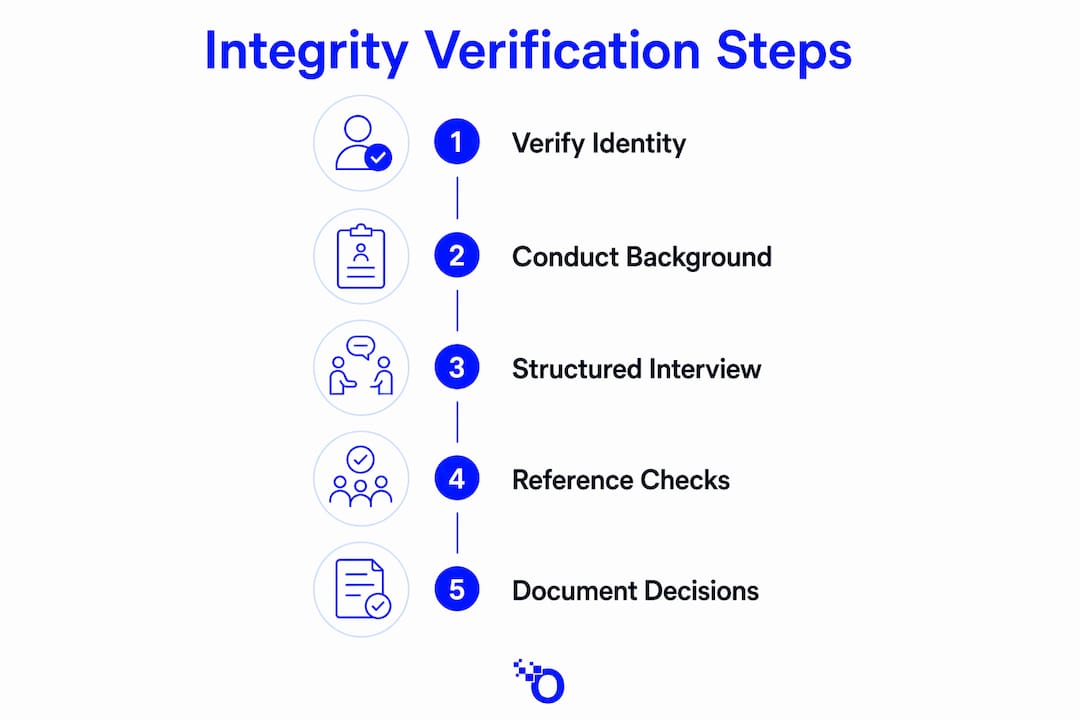
What background and reference checks ensure trustworthy public safety hires?
Background investigations are the verification layer that confirms or contradicts what candidates claim in interviews. For public safety agencies, a failed background check is not a disqualifier to be negotiated. It is a hard gate.
The components of a complete investigator-driven background check for public safety roles include:
- Employment verification. Contact each prior employer directly through official channels, not through candidate-supplied contact information. Verify dates of employment, job title, reason for separation, and eligibility for rehire. Discrepancies between a candidate’s stated history and verified records are immediate red flags.
- Education and credential verification. Confirm degrees, certifications, and professional licenses through the issuing institution or licensing board. Fabricated credentials are more common than most agencies expect, particularly for specialized technical roles in dispatch and forensics.
- Criminal history check. Run checks at the county, state, and federal levels. A single-jurisdiction search misses records from other states. For law enforcement candidates, cross-reference the National Decertification Index to identify officers previously decertified in other jurisdictions.
- Reference checks with direct supervisors. Peer references are insufficient for public safety hiring. Structured, role-focused questions to referees and documentation of responses improves reliability and reduces the risk that candidates control the narrative.
| Check Type | Standard Approach | Investigator-Driven Approach |
|---|---|---|
| Employment verification | Accept candidate-supplied contact info | Verify employer via official registry, call HR directly |
| Reference check | Accept candidate-nominated referees | Cross-verify referee identity, contact supervisors independently |
| Criminal history | Single-state search | Multi-jurisdiction, federal, and decertification index search |
| Education check | Accept diploma copy | Contact issuing institution directly for confirmation |
Cross-verifying referee identity is a step most agencies skip and should not. Candidates have been known to supply phone numbers that route to friends posing as former supervisors. Confirming a referee’s identity through LinkedIn, official agency directories, or licensing board records before conducting the reference call takes less than ten minutes and eliminates a significant fraud vector.
Layered screening including live video verification with liveness checks and stage-gated background checks detects fraud attempts before the offer stage. This means background clearance must be completed and confirmed before any conditional offer is extended, not after.
Pro Tip: Build a reference check template that asks referees to confirm specific facts first (dates, titles, responsibilities) before asking evaluative questions. Factual discrepancies surface before the referee has time to construct a favorable narrative.
How to document and audit integrity-related hiring decisions
Documentation is the mechanism that transforms a well-run hiring process into a legally defensible one. Without it, even the most thorough integrity assessment is vulnerable to challenge. Recruitment integrity should be treated as a risk management issue, with transparent processes and record-keeping enabling random audits.
A complete documentation system for integrity-based hiring includes the following steps:
-
Record all interview notes in a standardized template linked to rubric criteria. Notes must be written during the interview, not reconstructed afterward. Each note entry should reference the specific question asked, the candidate’s response in their own words, and the rubric score assigned with a brief justification.
-
Store background screening results in a secure, centralized digital record. Paper files create audit gaps. Digital records with access logs, version control, and timestamp metadata provide the chain of custody that regulators and legal counsel require.
-
Log all conflict-of-interest disclosures and the actions taken in response. If a panel member disclosed a conflict and was excused, that decision must be recorded with the date, the nature of the conflict, and the name of the replacement assessor. Early disclosure and management of conflicts of interest by panel members enhances the fairness and integrity of recruitment.
-
Conduct random audits of completed hiring files at least quarterly. Audits should verify that all required documents are present, that scores align with notes, and that no candidate received preferential treatment outside the documented process. Audit findings must themselves be documented and used to update process controls.
-
Retain records for the legally required period. Under EEOC regulations, employment records related to hiring decisions must be retained for a minimum of one year from the date of the decision. For public safety agencies subject to additional state or federal oversight, retention requirements may extend further.
Pro Tip: Assign a single records custodian for each hiring cycle. That person is responsible for confirming that every required document is filed before the hiring decision is finalized. This single accountability point prevents the “I thought someone else filed it” gap that undermines audits.
The benefit of this documentation discipline extends beyond legal protection. Agencies that maintain complete hiring records can analyze patterns across hiring cycles, identify interviewers whose scores consistently diverge from panel consensus, and detect process drift before it becomes a liability.
Which emerging technologies strengthen integrity verification?
Technology does not replace human judgment in public safety hiring. It removes the fraud vectors that human judgment cannot reliably detect at scale. The most effective tools in 2026 address the specific vulnerabilities that remote and hybrid hiring processes have introduced.
- Live video verification with liveness detection. This technology confirms that the person completing a remote screening session is physically present and not using a pre-recorded video or a proxy. Liveness checks use facial movement analysis and randomized prompt responses to verify identity in real time. For agencies conducting remote initial screenings, this is now a baseline requirement, not an optional enhancement.
- AI-powered anomaly detection. Screening platforms with anomaly detection flag inconsistencies across a candidate’s application materials, such as employment dates that conflict across documents, credential formatting inconsistencies, or address histories that do not align with stated employment locations. These flags do not disqualify candidates automatically. They generate investigator-driven follow-up tasks.
- Behavioral analytics in scenario-based assessments. Unpredictable scenario testing, where candidates respond to situations they cannot prepare for in advance, produces behavioral data that is harder to fabricate than rehearsed interview answers. Response time, decision sequencing, and reasoning transparency all serve as integrity indicators.
- Integration with applicant tracking and compliance systems. Screening results that feed directly into an applicant tracking system (ATS) create a continuous, timestamped record of every verification step. This integration eliminates manual data transfer errors and ensures that no candidate advances past a screening gate without documented clearance.
- Human oversight as a non-negotiable final layer. No algorithm makes the final hiring decision in a public safety role. Technology surfaces data. Trained investigators and HR professionals interpret it. The background screening best practices that govern public safety hiring require human accountability at every decision point.
The agencies that adopt these tools most effectively treat them as force multipliers for their investigators, not replacements. A fraud detection flag from an AI system is the beginning of an investigation, not the end of a candidacy.
Key takeaways
Ensuring candidate integrity in public safety hiring requires a multi-layered system of structured interviewing, investigator-driven background checks, conflict-managed panels, and auditable documentation applied consistently across every candidate.
| Point | Details |
|---|---|
| Structure every interview | Use uniform questions, scoring rubrics, and calibrated panels to produce defensible integrity assessments. |
| Treat background checks as hard gates | Complete all verification before extending any conditional offer, with multi-jurisdiction criminal and decertification checks. |
| Document every decision | Record interview notes, rubric scores, reference outcomes, and conflict disclosures in a centralized digital system. |
| Audit the process, not just the candidate | Conduct quarterly random audits of hiring files to detect process drift and maintain legal defensibility. |
| Use technology to close fraud gaps | Deploy live video verification and AI anomaly detection as investigator support tools, with human oversight retained for all final decisions. |
What experience has taught me about hiring integrity in public safety
The hardest part of integrity verification is not detecting outright lies. Most candidates who fabricate credentials or conceal misconduct do so through omission, not invention. They leave gaps in employment history unexplained. They provide referees who are friends, not supervisors. They give interview answers that are technically true but strategically incomplete.
What I have found, working with public safety agencies across law enforcement, fire, and EMS, is that the agencies with the strongest hiring integrity are not the ones with the most sophisticated technology. They are the ones with the most disciplined process. A structured interview conducted by a calibrated, conflict-free panel, followed by an investigator-driven background check and a documented reference call to a verified supervisor, catches more dishonesty than any AI tool deployed without that foundation.
The second insight that most articles miss is that protecting the process from bias is as important as vetting the candidate. A panel member who has a prior relationship with a candidate, or who has been informally briefed on a candidate’s performance, contaminates the integrity of the assessment regardless of how honest the candidate is. Multi-assessor panels and no off-process coaching are not bureaucratic formalities. They are the structural controls that make the process trustworthy.
My practical recommendation: treat every hiring cycle as a risk management event. Document what you did, why you did it, and what you found. When an audit comes, and in public safety it will, the agencies that survive it are the ones that can show their work.
— Matt
How Omniintel supports integrity verification in public safety hiring

Omniintel is built specifically for the verification demands of public safety recruitment. Its pre-employment screening services cover identity verification, multi-jurisdiction criminal history, decertification index searches, employment and education confirmation, and structured reference check support, all within an FCRA-compliant, investigator-driven framework. The platform integrates live video verification with liveness detection and AI-powered anomaly flagging to close the fraud gaps that standard background check vendors miss. For agencies that need to move faster without sacrificing rigor, Omniintel’s pre-employment investigations provide the depth of a full investigative file with the speed of a purpose-built screening platform. If your agency is hiring for roles where integrity is non-negotiable, Omniintel is the verification infrastructure that makes that standard enforceable.
FAQ
What does candidate integrity mean in hiring?
Candidate integrity is the consistent demonstration of honesty, ethical behavior, and accountability that a recruiter verifies through structured assessments and background investigations. In public safety hiring, it is evaluated through behavioral interviews, multi-jurisdiction background checks, and verified reference calls.
How do structured interviews help evaluate candidate integrity?
Structured interviews use uniform questions, scoring rubrics, and calibrated panels to assess every candidate under the same conditions, removing the subjective drift that allows dishonest candidates to exploit inconsistent interviewers. Verbatim notes mapped to rubric anchors produce a defensible record of the integrity assessment.
What background checks are required for public safety candidates?
Public safety candidates require multi-jurisdiction criminal history checks, National Decertification Index searches, employment and education verification through official channels, and professional license confirmation. Reference checks must be conducted with direct supervisors, not candidate-nominated peers.
How should hiring decisions be documented for integrity audits?
Every interview note, rubric score, background screening result, reference check outcome, and conflict-of-interest disclosure must be stored in a centralized digital record with access logs and timestamps. Quarterly random audits of completed hiring files verify process compliance and detect scoring inconsistencies.
What role does technology play in verifying candidate honesty?
Live video verification with liveness detection confirms remote candidate identity, while AI anomaly detection flags inconsistencies across application documents for investigator follow-up. Technology surfaces fraud signals. Trained HR professionals and investigators make all final hiring decisions.