

Workforce Integrity Workflow for Public Safety Agencies
A workforce integrity workflow is a structured, multi-stage process that applies identity verification, fraud detection, compliance checks, ongoing rescreening, and audit documentation to ensure public safety personnel are trustworthy, qualified, and legally compliant at every stage of employment. For law enforcement agencies, fire departments, dispatch centers, and government entities, this process is not optional. A single compromised hire can expose communities to harm, trigger federal investigations, and permanently damage an agency’s credibility. Platforms like Socure’s RiskOS and frameworks like NIST SP 800-63 have formalized what the best agencies already knew: workforce integrity workflow demands a risk-adaptive, continuously monitored system, not a one-time background check at onboarding.
What are the essential components of a workforce integrity workflow?
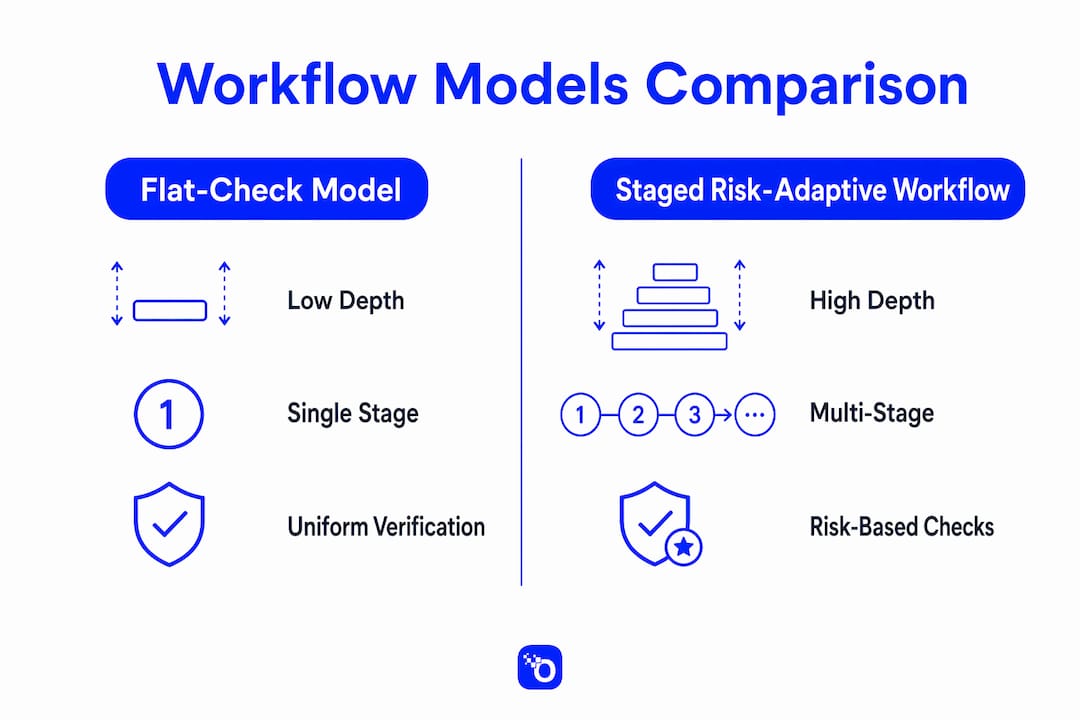
A workforce integrity workflow operates as a triggered, step-up verification process with stages conditioned on risk signals rather than a flat checklist applied uniformly to every candidate. This architecture matters because it concentrates investigative resources where risk is highest, reducing friction for low-risk applicants while applying rigorous scrutiny where it is warranted. The result is a faster, more defensible hiring process.
The workflow unfolds across five sequential stages:
-
Input collection. The agency gathers candidate-submitted data: full legal name, date of birth, Social Security number, government-issued ID, and employment history. This stage also captures device behavioral signals and digital intelligence, such as IP reputation and browser fingerprinting, which feed into early fraud scoring.
-
Identity enrichment and fraud scoring. The system cross-references submitted data against authoritative identity databases, credit header files, and fraud registries. Tools like Socure’s RiskOS apply machine learning scorecards to generate a risk score that determines whether the candidate proceeds to standard processing or triggers a conditional step-up.
-
Conditional routing. Candidates who exceed a defined risk threshold are routed to document verification, which requires submission of a government-issued ID with liveness detection, or selfie re-verification. Candidates below the threshold proceed directly to decision output. This conditional logic prevents unnecessary friction for the majority while catching high-risk profiles.
-
Background investigation and compliance checks. At this stage, criminal history, sex offender registries, the National Decertification Index, civil records, and employment verification are reviewed. Agencies with access to OMNI Intel’s investigator-driven checks apply law enforcement investigation principles rather than relying solely on automated database pulls.
-
Unified decision output with audit trail. The workflow produces a single decision record that includes the outcome, stable reason codes, and a traceable evaluation ID. This audit trail is the evidentiary backbone of the process.
Pro Tip: Never treat reason codes as internal metadata. They are the documented rationale that protects your agency during EEOC complaints, ADA audits, and civil litigation. Require your screening vendor to provide stable, human-readable reason codes in every decision record.
The table below compares a traditional flat-check model against a staged, risk-adaptive workflow:
| Dimension | Traditional flat-check model | Staged risk-adaptive workflow |
|---|---|---|
| Verification depth | Uniform for all candidates | Scaled to individual risk score |
| Fraud detection | Limited to criminal history | Includes digital signals and behavioral data |
| Processing time | Consistent but often slow | Faster for low-risk; deeper for high-risk |
| Audit documentation | Minimal | Unified decision with reason codes and evaluation ID |
| Legal defensibility | Moderate | High, with traceable decision rationale |
How to operationalize ongoing workforce integrity with rescreening
Treating workforce verification as a one-time pre-hire event is the most common and most costly mistake public safety agencies make. Periodic rescreening and event-triggered verification are the operational mechanisms that sustain integrity in workforce programs after the badge is issued. Internal role changes, promotions to supervisory positions, and transfers to sensitive units all create new risk profiles that the original background investigation did not assess.
A functional ongoing rescreening program follows this sequence:
-
Establish a rescreening schedule. Most agencies conduct annual or biennial background reviews for all sworn and civilian personnel. High-sensitivity roles, such as internal affairs, narcotics units, and IT administrators with access to criminal justice information systems, warrant more frequent review cycles.
-
Define event triggers. Role changes, promotions, security clearance upgrades, and adverse incident reports should automatically initiate a new verification cycle. Ignoring rescreening triggered by internal role changes misses integrity risks arising from internal mobility and shifting authority.
-
Coordinate across HR, compliance, and operational managers. Rescreening does not belong to a single department. HR owns the scheduling and record-keeping function. Compliance officers track regulatory requirements and adverse finding escalations. Operational managers flag behavioral changes or performance concerns that may warrant an unscheduled review.
-
Escalate adverse findings through a defined protocol. When a rescreening surfaces a new criminal charge, a civil judgment, or a financial irregularity, the agency needs a documented escalation path. This path should specify who receives the finding, what individualized assessment process applies, and what timeline governs the response.
-
Maintain updated screening records and documentation. Every rescreening cycle must produce a dated record that is stored in the employee’s compliance file. These records are the primary evidence base during accreditation reviews, internal investigations, and litigation.
The operational benefits of this model extend beyond compliance. Agencies that conduct employee monitoring best practices consistently report earlier detection of conduct issues, reduced liability exposure, and stronger community trust. The key operational requirements for a sustainable rescreening program include:
- Written policy specifying rescreening frequency by role classification
- Documented consent forms updated at each rescreening cycle
- Integration between the agency’s HRIS and the screening vendor’s platform
- Clear chain of custody for adverse finding reports
- Legal review of escalation protocols to confirm FCRA compliance
How do legal guidelines shape workforce integrity workflows for public safety agencies?
Legal compliance is not a constraint layered onto a workforce integrity workflow after the fact. It is a structural requirement that shapes every decision point from initial application through ongoing monitoring. Three regulatory frameworks govern this space for public safety agencies: the Americans with Disabilities Act, EEOC enforcement guidance on criminal records, and NIST SP 800-63 identity assurance standards.
ADA compliance in AI-assisted hiring. The ADA requires that employers avoid hiring technologies that unfairly screen out qualified individuals with disabilities. This obligation extends to algorithmic scoring tools, automated resume filters, and AI-driven fraud detection systems. Agencies must evaluate their screening technology regularly to confirm that it does not produce disparate outcomes for applicants with physical, cognitive, or behavioral disabilities. Reasonable accommodations must be provided throughout the application and verification process unless the agency can demonstrate undue hardship.
EEOC guidance on criminal records. The EEOC requires individualized assessment of criminal records before any adverse employment decision. Categorical exclusions based solely on the existence of a criminal record are prohibited unless the agency can demonstrate job-relatedness and business necessity. The individualized assessment must consider:
- The nature and gravity of the offense
- The time elapsed since the offense or completion of sentence
- The nature of the job being sought and the specific duties involved
NIST SP 800-63 identity assurance levels. For agencies operating digital identity verification, NIST SP 800-63 standards define three assurance levels: Identity Assurance Level (IAL), Authenticator Assurance Level (AAL), and Federation Assurance Level (FAL). Selecting the appropriate level for each role type is a compliance requirement, not a technical preference. A patrol officer accessing a criminal justice information system requires a higher IAL than a civilian records clerk, and the verification workflow must reflect that distinction.
Agencies that build ADA and EEOC requirements into their workflow architecture from the start spend significantly less time and legal expense responding to complaints than those that retrofit compliance after a challenge arises.
The practical implication is that key compliance steps must be mapped to specific decision points in the workflow, with documented rationale at each stage. Compliance is not a checkbox. It is a traceable record of deliberate, lawful decision-making.
What are best practices for workflow management to maximize workforce integrity?
Effective workflow management processes convert policy intent into operational reality. The gap between an agency’s written integrity standards and its actual hiring and monitoring practices is almost always a workflow design failure, not a personnel failure. Closing that gap requires deliberate architecture, not good intentions.

Workflow management best practices specify that agencies must map tasks, assign owners, automate verification steps, track KPIs, and continuously audit and refine their processes based on outcomes. Each of these elements serves a distinct function in a public safety context.
Mapping tasks and handoffs with clear ownership means that every step in the screening and monitoring process has a named role responsible for completion and a defined handoff protocol. Ambiguous ownership is the primary cause of process gaps, where a candidate clears one stage but the next stage is never initiated because no one was accountable for the trigger.
Automating verification and monitoring processes reduces human error and processing time. Integration between the agency’s applicant tracking system, HRIS, and screening platform eliminates manual data re-entry, which is a common source of both error and delay. Automation also enforces process consistency: every candidate at a given risk level receives the same verification steps, which is a legal requirement as much as an operational preference.
Pro Tip: Audit your workflow for bypass points at least twice per year. High-risk verification steps must always operate in a non-bypassable manner even during operational exceptions such as help desk resets. A single bypassed step during an emergency hire can create the exact vulnerability the entire workflow was designed to prevent.
The table below compares weak and strong workflow management practices across four dimensions:
| Dimension | Weak practice | Strong practice |
|---|---|---|
| Task ownership | Shared or undefined | Named role with documented accountability |
| Automation level | Manual data entry and routing | System-driven triggers and integrations |
| KPI tracking | Informal or absent | Defined metrics reviewed on a set schedule |
| Audit trail | Incomplete or inconsistent | Unified decision records with reason codes |
Tracking KPIs for performance and compliance gives agency administrators objective data on where the workflow is performing and where it is failing. Relevant KPIs include average time-to-decision per candidate, percentage of applications requiring step-up verification, adverse finding rates by role type, and rescreening completion rates by scheduled cycle. These metrics are the foundation of continuous improvement.
Regularly refining workflows based on feedback and results is the discipline that separates agencies with mature integrity programs from those that treat their workflow as a static document. Quarterly reviews with HR, compliance, legal counsel, and operational leadership should assess whether the current workflow is producing the intended outcomes and whether regulatory changes require process updates.
Key takeaways
A workforce integrity workflow succeeds only when it combines staged, risk-adaptive verification with continuous rescreening, legal compliance architecture, and auditable decision records at every step.
| Point | Details |
|---|---|
| Stage-based verification | Apply conditional step-up checks based on risk scores, not uniform processing for all candidates. |
| Ongoing rescreening | Schedule periodic reviews and trigger new verifications for role changes to catch post-hire integrity risks. |
| Legal compliance integration | Build ADA, EEOC, and NIST SP 800-63 requirements into workflow decision points from the start. |
| Non-bypassable high-risk steps | Enforce system-driven verification at critical stages to prevent impersonation and process circumvention. |
| Audit trail completeness | Maintain unified decision records with stable reason codes and traceable evaluation IDs for every screening cycle. |
Why most agencies underestimate the workflow, not the screening
I have reviewed integrity programs at agencies ranging from small municipal police departments to large county sheriff’s offices, and the pattern is consistent. The screening tools are often adequate. The workflow surrounding those tools is almost always the weak point.
The most common failure I see is the absence of a documented escalation protocol for adverse findings. An agency will invest in a credible background investigation platform, receive a finding that warrants individualized assessment, and then have no defined process for what happens next. The finding sits in a queue. A hiring manager makes an informal decision. No record exists. That sequence is both a legal liability and an integrity failure.
The second failure is treating audit trail completeness as an IT concern rather than a leadership concern. Unified decision outcomes with stable reason codes and attributable sources are the evidentiary foundation of every defensible hiring decision your agency makes. When a candidate files an EEOC complaint or a civil rights attorney requests your decision rationale, the audit trail is your answer. If it does not exist in complete form, you are exposed.
The third failure is workflow rigidity in the face of internal mobility. Agencies that conduct thorough pre-employment screening but apply no verification when a civilian employee moves into a role with access to sensitive systems are creating a gap that bad actors can exploit. The integrity verification process must follow the person through their career, not just their application.
My recommendation is straightforward. Map your current workflow on paper, identify every decision point, and ask two questions at each one: who owns this step, and what happens if it is skipped? The answers will tell you exactly where your program is vulnerable.
— Matt
How OMNI Intel supports your agency’s workforce integrity program

OMNI Intel is built specifically for the operational and legal demands of public safety agencies. Its pre-employment screening services apply investigator-driven background investigations that go beyond automated database pulls, covering criminal history, the National Decertification Index, employment verification, and identity proofing aligned with NIST assurance standards. For agencies managing ongoing compliance, OMNI Intel’s background investigations platform supports periodic rescreening cycles and event-triggered verifications with full audit documentation. Integration with existing HRIS and recruiting platforms reduces manual handoffs and enforces process consistency across every hire. Whether you lead a law enforcement agency, a fire department, or a dispatch center, OMNI Intel provides the workflow infrastructure your integrity program requires.
FAQ
What is a workforce integrity workflow?
A workforce integrity workflow is a structured, multi-stage process that applies identity verification, fraud detection, background investigation, and ongoing rescreening to confirm that public safety personnel meet legal and operational standards throughout their employment. It replaces one-time pre-hire checks with a continuous, risk-adaptive system.
How often should public safety agencies conduct rescreening?
Most agencies conduct annual or biennial rescreening for all personnel, with more frequent cycles for high-sensitivity roles. Periodic rescreening and event-triggered verification are both required to address risks from role changes, promotions, and adverse incident reports.
What legal requirements apply to workforce integrity workflows?
Public safety agencies must comply with ADA guidance on AI-enabled hiring fairness, EEOC requirements for individualized criminal record assessments, and NIST SP 800-63 identity assurance levels for digital verification. Each framework applies to specific decision points within the workflow.
Why are audit trails critical in workforce integrity programs?
Audit trail completeness with unified decision outcomes, stable reason codes, and traceable evaluation IDs is the evidentiary foundation for responding to EEOC complaints, civil litigation, and accreditation reviews. Without complete records, reconstructing decision rationale during disputes becomes impossible.
What makes a workforce integrity workflow legally defensible?
A legally defensible workflow documents every decision point with a named owner, applies individualized assessment for adverse findings per EEOC guidance, avoids categorical exclusions, and maintains complete audit records. Non-bypassable verification steps at high-risk stages prevent both impersonation and process circumvention.