

Staff Screening in City Youth Programs: What Hiring Managers Need
City youth programs must establish written disqualification criteria, run layered background checks across every employee and volunteer, and maintain an ongoing monitoring cadence before placing any adult in contact with youth. The Office for Victims of Crime frames screening as one protective layer in a broader safety framework, not a standalone safeguard. The National Recreation and Park Association (NRPA) reinforces that volunteers deserve the same scrutiny as paid staff.
Immediate actions for city HR and safety officers:
- Adopt a written screening policy with published disqualification criteria before any hire or volunteer placement begins
- Collect signed consent and FCRA-compliant authorization forms from every applicant
- Run identity verification, multi-county criminal checks, and sex offender registry searches at minimum
- Document every disqualification decision with supporting evidence and an appeal pathway
- Schedule annual comprehensive re-screening and activate continuous monitoring alerts for all active staff
Table of Contents
- What Minimum Policy and Legal Requirements Must a City Youth Program Have?
- What Screening Layers Should City Youth Programs Use?
- How Do You Build a Role-Based Risk Assessment for Youth Staff?
- What Counts as a Disqualifier, and How Do You Document the Decision?
- Step-by-Step Operational Checklist for Municipal Screening Programs
- How Should City Programs Store and Retain Screening Records?
- OMNI Intel Supports Municipal Youth Program Screening
- Key Takeaways
- Screening Programs Reveal More Than Criminal Records
- Useful Resources and Next Steps
- FAQ
What Minimum Policy and Legal Requirements Must a City Youth Program Have?
Before a single background check runs, the policy infrastructure must be in place. Municipal audits in New York State found uneven and undocumented screening practices across program staff, a finding that exposes cities to significant legal liability. A defensible policy covers six core components.
| Policy Component | What It Must Include |
|---|---|
| Purpose and scope | Who is covered: employees, volunteers, contractors, and interns |
| Disqualification criteria | Published list of automatic disqualifiers, established before screening begins |
| Consent and authorization | Signed form with name, date of birth, SSN if available, and scope of searches |
| Designated review team | Named individuals with confidential access to screening results |
| Appeal process | Written timeline and steps for applicants to contest a disqualification |
| Retention and confidentiality | Storage location, access controls, and destruction schedule |
Automatic disqualifiers typically include any history of sexual victimization of a child, convictions involving minors, violent or sexually exploitative behavior, and falsified application information. Pending felony or misdemeanor charges involving minors often trigger immediate ineligibility until resolved, as reflected in Chesterfield County’s co-sponsored youth program policy. The City of Gastonia’s volunteer screening policy demonstrates how a municipal program documents authorization forms, confidentiality obligations, and annual re-screening requirements in a single governing document.
State statutes in some jurisdictions mandate fingerprinting and direct law enforcement checks for roles with unsupervised youth access. Consult municipal counsel before finalizing the disqualifier list, because background check laws for public agencies vary by state and role category.
Pro Tip: Publish your disqualification criteria in the job posting itself. Applicants who self-select out save your team review time and reduce adverse-action paperwork.
What Screening Layers Should City Youth Programs Use?
The OJP six-layer screening model gives city programs a structured framework for combining checks based on role risk. Not every role requires every layer, but the selection logic must be documented.
- Fingerprint-based FBI and state checks are required by statute in many jurisdictions for roles with unsupervised youth contact, as outlined in SafeKidsThrive’s screening guidance.
| Role Category | Minimum Layers | Additional Layers |
|---|---|---|
| Incidental contact (facilities, admin) | Identity, SSN, multi-county criminal, sex offender registry | Employment verification |
| Supervised contact with youth | All above plus child abuse registry, reference checks | Driving record if transport involved |
| Unsupervised one-on-one access | All above plus fingerprint-based FBI/state check | Social media, credential verification |
Select vendors that pull from county court records directly, not only aggregated databases, and confirm FCRA compliance before signing any contract.
How Do You Build a Role-Based Risk Assessment for Youth Staff?
A risk assessment answers three questions for each position: How often does this person interact with youth? Are those interactions supervised? How vulnerable is the youth population served? Answers to those three questions determine the screening tier.
| Risk Tier | Role Examples | Defining Factors | Required Checks |
|---|---|---|---|
| Low | Administrative staff, facilities crew | No direct youth contact | Identity, multi-county criminal, sex offender registry |
| Medium | Group activity leaders, supervised coaches | Regular supervised contact | Low-tier checks plus child abuse registry, reference verification |
| High | One-on-one tutors, overnight trip leaders, counselors | Unsupervised or extended contact | All checks plus fingerprinting, credential and driving verification |
Document the risk-tier assignment for each position in writing and obtain legal sign-off when a role crosses a jurisdictional fingerprinting threshold. Parks and recreation programs often underestimate how many roles fall into the medium or high tier once transportation and after-hours supervision are factored in.
What Counts as a Disqualifier, and How Do You Document the Decision?
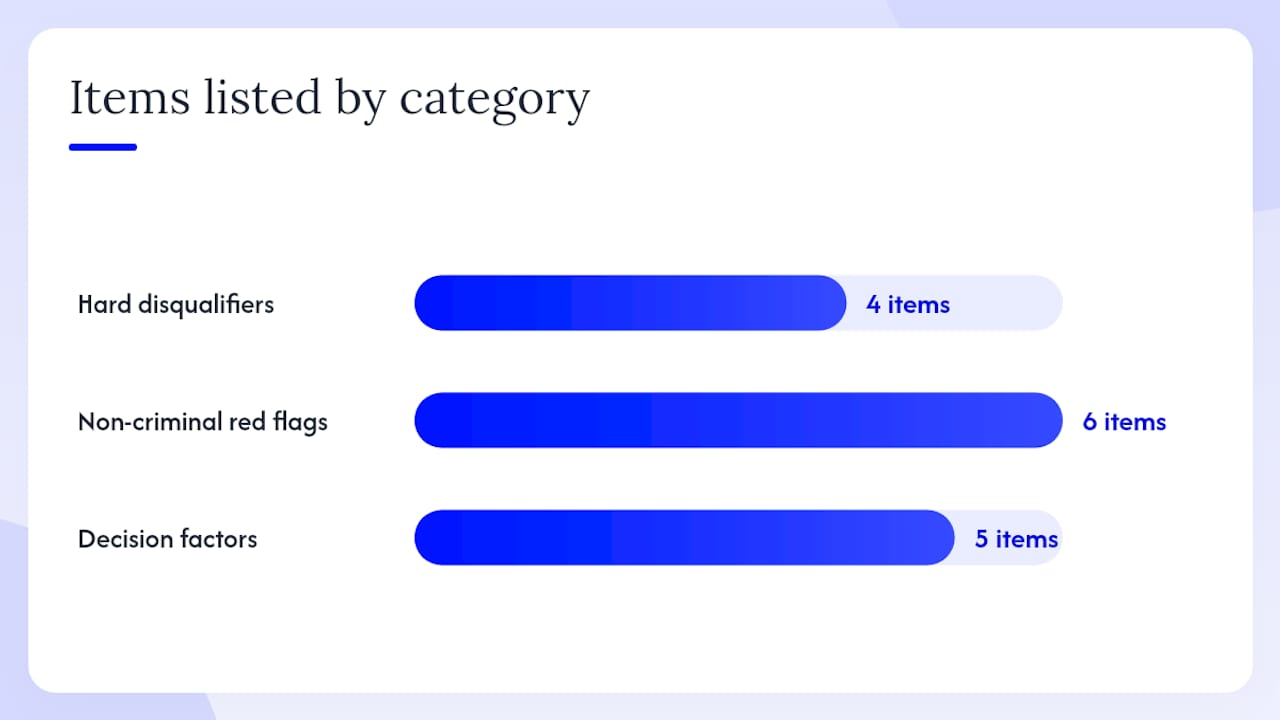
Hard disqualifiers require no further deliberation: sexual offenses involving a minor, convictions for child abuse or exploitation, violent felonies within a defined lookback period, and termination for misconduct with a child. These findings end the process.
Non-criminal red flags require documented investigation before a decision is made:
- Unexplained employment gaps of six months or longer
- Multiple address or identity discrepancies across the application and background report
- References who cannot confirm dates, titles, or the nature of the applicant’s work
- Alias names or prior legal name changes not disclosed on the application
- Pending charges involving minors, even at the misdemeanor level
The OVC reference guide specifically calls out non-criminal red flags as a required part of any thorough vetting process.
| Decision Factor | Weight in Review |
|---|---|
| Severity of offense or finding | Primary: automatic disqualifier if on the published list |
| Recency | Secondary: more recent findings carry greater weight |
| Relevance to role | Secondary: a theft conviction matters less for an admin role than for a cash-handling one |
| Corroboration | Supporting: a single unverified flag warrants follow-up, not automatic rejection |
| Applicant explanation | Contextual: documented and considered, not determinative |
When a disqualification decision is made, issue a pre-adverse action notice, provide the applicant a copy of the report and a summary of FCRA rights, and allow a reasonable response period before the final adverse action notice goes out. FCRA compliance guidance for public agencies details the exact procedural steps. The Bridgewater Township, NJ ordinance illustrates how a local government structures its appeal panel and defines the timeline for applicant responses.
Step-by-Step Operational Checklist for Municipal Screening Programs
| Week | Action | Owner |
|---|---|---|
| — | Adopt written policy and disqualifier list; obtain legal sign-off | HR lead, legal advisor |
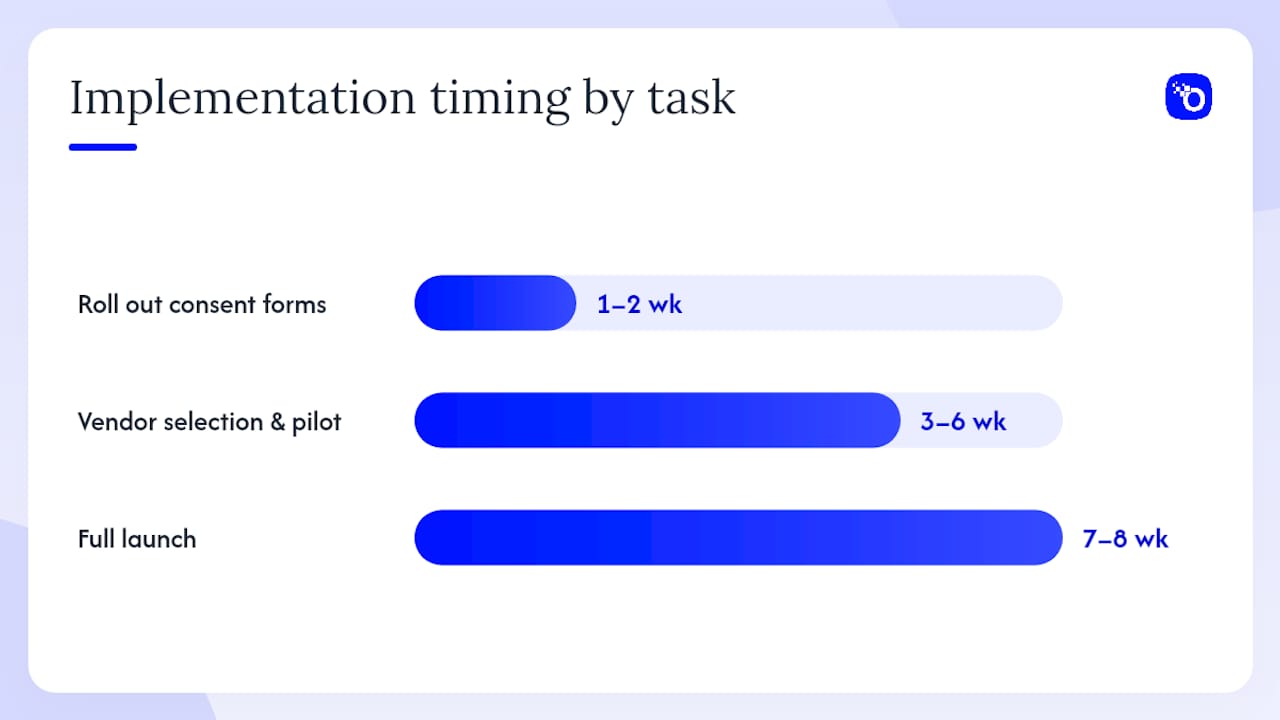
| 1–2 | Roll out consent and authorization forms; train hiring managers | HR lead, hiring managers |
| 3–6 | Select and integrate vendor; run pilot on incoming seasonal cohort | Vendor liaison, HR lead |
| 7–8 | Full launch; activate continuous monitoring for all active staff | Records custodian, review team |
| Ongoing | Annual re-screening cycle; quarterly audit of monitoring alerts | Designated review team |
Budget line items to include: per-check costs by layer, fingerprinting fees where mandated, staffing hours for the review team, annual re-screening allocation, and vendor integration costs. Centralized screening contracts, similar to the model used by large federal youth employment programs, improve coverage consistency and reduce per-check costs at scale.
Pro Tip: Batch seasonal staff and volunteers into cohorts of 20–30 and submit them simultaneously. Most vendors prioritize batch submissions, which cuts average turnaround time and lets your review team process results in a single sitting rather than managing a trickle of individual reports.
How Should City Programs Store and Retain Screening Records?
| Record Type | Storage Location | Access | Retention Period |
|---|---|---|---|
| Signed consent forms | Secure HR file, separate from personnel file | Review team only | Duration of service plus applicable city retention schedule |
| Background reports | Encrypted digital storage or locked physical file | Review team only | Minimum 5 years or per state statute |
| Adverse-action notices | Secure HR file | HR lead, legal advisor | Minimum 5 years |
| Monitoring alerts and dispositions | Encrypted log | Review team, legal advisor | Duration of service plus 5 years |
FCRA requires that consumer reports be used only for the stated permissible purpose and that applicants receive pre-adverse and adverse-action notices with dispute rights. When law enforcement or child-protection agencies issue a subpoena, the records custodian coordinates with legal counsel before releasing any screening document. Data privacy practices for public agencies cover encryption standards and access-control protocols in detail.
Collaborating with local child-protection agencies on mandatory reporting obligations is a separate legal duty. Screening records may be relevant evidence; preserve them in their original form once a report is made.
OMNI Intel Supports Municipal Youth Program Screening
City programs that need to move from policy to execution quickly face a practical problem: assembling a vendor stack that covers FCRA compliance, county-level criminal searches, sex offender and child abuse registry checks, fingerprinting coordination, and continuous post-hire monitoring is operationally complex. OMNI Intel consolidates those capabilities into a single platform built for public agencies.

OMNI Intel’s pre-employment screening services are designed for municipal and government clients, with FCRA-compliant workflows, county-level court record coverage, and API integration with existing HRIS platforms. Continuous monitoring alerts activate immediately when a new record is associated with an enrolled staff member or volunteer, giving your review team the response window it needs. A pilot program scoped to one seasonal cohort, with defined KPIs for turnaround time, match rate, and cost per screened individual, gives city leadership the evidence needed to scale confidently. Contact OMNI Intel to scope a municipal pilot and get your screening program fully operational within eight weeks.
Key Takeaways
City youth programs that establish written criteria, run layered checks, and maintain continuous post-hire monitoring build the most defensible and effective screening programs available to municipal HR.
| Point | Details |
|---|---|
| Written criteria come first | Publish disqualification criteria before screening begins; retroactive criteria create legal exposure. |
| Layer checks by role risk | Match screening depth to contact frequency and supervision level using a documented risk-tier matrix. |
| Annual re-screening is the floor | NRPA and municipal audit guidance both recommend annual comprehensive re-screening for all active staff and volunteers. |
| Document every decision | Record the finding, the weight assigned, the decision, and the appeal outcome for every disqualification. |
| OMNI Intel for municipal programs | OMNI Intel provides FCRA-compliant, county-level screening and continuous monitoring built for city agencies. |
Screening Programs Reveal More Than Criminal Records
The most consistent failure point in municipal youth program screening is not the absence of a background check policy. It is the gap between the written policy and what actually happens during a seasonal hiring surge. Cities that screen carefully in January often skip steps in May when 40 summer camp counselors need to start in two weeks.
The non-criminal red flags are where that pressure does the most damage. Employment gaps, inconsistent addresses, and references who cannot confirm basic facts are the findings that get waived when a program is understaffed and the pool is thin. Those are also the findings that, in retrospect, were the clearest warning signs. A documented review process with a standing review team, rather than ad hoc decisions by whoever is available, is the structural fix that holds under pressure.
Useful Resources and Next Steps
- What You Need to Know about Background Screening: A Reference Guide for Youth-Serving Organizations and their Communities | Office of Justice Programs
- What You Need to Know about Background Screening: A Reference Guide for Youth-Serving Organizations and their Communities
- NRPA BIB Recommended Guidelines for Screening Volunteers
- Preventing Child Abuse — Screening & Background Checks (SafeKidsThrive)
- Background Checks at Municipal Youth (New York State OSC audit)
- Chapter 28: Criminal History Background Check for Recreation Personnel — Township of Bridgewater, NJ
- Background Checks for Co-Sponsored Youth (Chesterfield)
This article provides general informational guidance on screening practices and is not legal advice. Consult municipal counsel and your state’s relevant agencies to confirm requirements applicable to your program.
FAQ
What checks are required for city youth program staff?
At minimum, city programs should run identity verification, multi-county criminal history, and a national sex offender registry search for every employee and volunteer. Roles with unsupervised youth access typically require fingerprint-based state and FBI checks as well.
How often should youth program staff be re-screened?
NRPA guidelines and municipal audit recommendations both support annual comprehensive re-screening for all active staff and volunteers, supplemented by continuous monitoring alerts between cycles.
What is the role of youth program staff screening in cities?
Staff screening in city youth programs is the formal process of verifying identity, criminal history, and registry status before placing adults in contact with youth, combined with ongoing post-hire monitoring to catch new findings during employment.
Do volunteers need the same background checks as paid staff?
Yes. NRPA explicitly recommends treating volunteers with the same screening scrutiny as paid employees, particularly in park, recreation, and municipal youth program settings.
What happens when a background check returns a disqualifying finding?
The designated review team issues a pre-adverse action notice, provides the applicant a copy of the report and FCRA rights summary, allows a response period, and then issues a final adverse action notice if the disqualification stands. The entire process and its documentation must be retained per the city’s record-retention schedule.