

What Is Agency Liability for Public Safety Agencies
Agency liability is the legal principle that holds a principal, such as a law enforcement agency or fire department, accountable for the acts of its agents when those acts occur within the scope of their authority or employment. For public safety administrators, understanding this principle is not optional. A single incident involving an officer, dispatcher, or EMS responder acting under your agency’s authority can expose the entire organization to civil litigation, regulatory sanction, and reputational damage. The doctrines of vicarious liability and respondeat superior sit at the center of this exposure, and every agency administrator needs to understand precisely how they operate.
What is agency liability and what causes it?
Agency liability is defined in law as the responsibility a principal bears for the conduct of an agent acting on the principal’s behalf. A principal’s liability for an agent’s torts depends on the master-servant relationship and whether the harmful conduct occurred in the ordinary course of employment. That standard applies directly to public safety agencies, where officers, firefighters, and dispatchers operate with broad discretionary authority in high-stakes environments.
Three conditions must align for agency liability to attach. First, a recognized legal relationship must exist between the principal and agent, whether through employment, appointment, or formal authorization. Second, the agent’s conduct must fall within the scope of that relationship. Third, the conduct must have been performed for the benefit of the principal, not as a purely personal act. Claimants must demonstrate an active legal relationship, conduct within scope, and that the conduct served the defendant’s interests.

The legal basis for liability extends across both tort and contract contexts. In tort, the most common trigger is negligence or misconduct by an agent during the performance of assigned duties. In contract, an agent who enters agreements within their actual or apparent authority binds the principal to those terms. A principal may be liable even when the agent exceeds written job descriptions, provided the act falls within actual, apparent, or customary authority.
Two important exceptions limit this exposure. A principal is generally not liable for acts an agent commits outside the scope of employment, such as a purely personal detour during a shift. Nor is a principal liable for the independent torts of a contractor, unless a non-delegable duty applies. Understanding where these boundaries sit is the first step toward managing exposure.
- Actual authority: Expressly granted through job descriptions, policies, or direct instruction.
- Apparent authority: Created by the principal’s conduct or representations that lead third parties to reasonably believe authority exists.
- Customary authority: Implied by the nature of the role and standard industry practice.
- Scope of employment: The geographic, temporal, and functional boundaries within which an agent’s acts bind the principal.
Pro Tip: Document every formal grant of authority in writing. When an incident occurs, investigators and courts will examine what authority was actually conferred, not what was assumed.
How does agency liability differ from vicarious liability and personal agent liability?
The terms “agency liability” and “vicarious liability” are often used interchangeably, but they describe related rather than identical concepts. Agency liability is the broader legal framework governing the principal-agent relationship across both contract and tort law. Vicarious liability is a specific tort doctrine within that framework, focused on shifting responsibility for harm from agent to principal based on the qualifying relationship and the connection between the wrongful act and the agent’s duties.
The distinction matters practically. An agency administrator facing a contract dispute with a vendor will analyze agency liability principles to determine whether the officer who signed the agreement had authority to bind the department. A plaintiff suing over a use-of-force incident will invoke vicarious liability under respondeat superior to hold the department responsible for the officer’s conduct. Both analyses draw on the principal-agent relationship, but they apply different legal tests.
Personal agent liability is a separate question. An agent becomes personally liable when acting for an undisclosed principal, when exceeding granted authority, or when committing intentional torts that fall outside any reasonable scope of employment. This distinction is critical for public safety agencies because individual officers can face personal civil liability even when the agency is also named as a defendant.
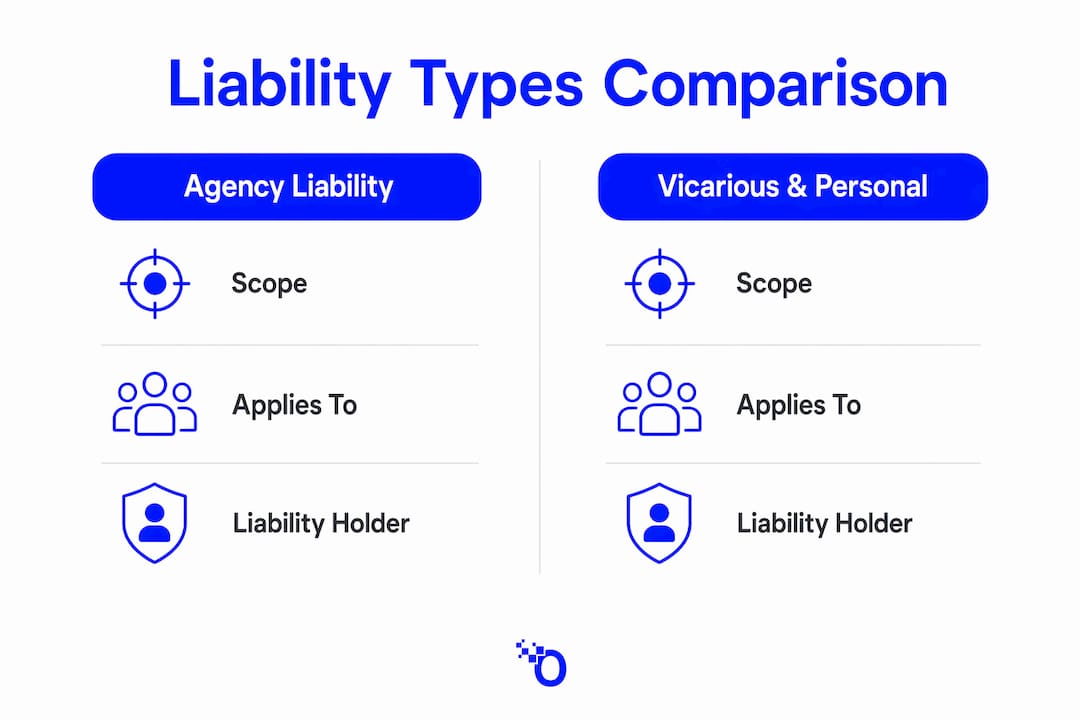
The table below summarizes the key distinctions:
| Concept | Scope | When it applies | Who bears liability |
|---|---|---|---|
| Agency liability | Contract and tort | Agent acts within authority on principal’s behalf | Principal, and sometimes agent jointly |
| Vicarious liability | Tort only | Wrongful act within scope of employment | Principal (employer) |
| Personal agent liability | Contract and tort | Agent exceeds authority or acts for undisclosed principal | Agent personally |
| Ostensible authority | Contract and tort | Third party reasonably believes authority exists | Principal, regardless of actual grant |
Ostensible authority, also called apparent authority, deserves particular attention in public safety contexts. Third-party perceptions driven by uniforms, badges, and communication signals create liability risks that extend beyond formally granted authority. A citizen who reasonably believes an officer has authority to make a particular decision, based on the officer’s uniform and conduct, can hold the agency liable even if that specific action was never authorized.
What are practical examples of agency liability in public safety agencies?
Agency liability is not an abstract legal concept. It plays out in concrete, costly scenarios across law enforcement, fire and EMS, dispatch centers, and private security firms every year. The following examples illustrate how the doctrine applies in public safety operations.
- Use-of-force incidents: An officer who uses excessive force during an arrest is acting within the scope of employment, even if the force itself was unauthorized. The agency faces liability under respondeat superior because the officer was performing a core duty at the time of the incident.
- Vehicle accidents during patrol: A patrol officer who causes a traffic collision while responding to a call is performing an assigned duty. The agency bears liability for resulting injuries, even if the officer violated department driving policy.
- Negligent hiring: Principals can be directly liable when they fail to conduct adequate background investigations before hiring, and a foreseeable harm results. An agency that hires a dispatcher with a documented history of falsifying records, without verifying that history, faces direct liability if the dispatcher’s conduct later causes harm.
- Apparent authority and off-duty conduct: An off-duty officer who intervenes in a situation while wearing a department-issued jacket and identifying as law enforcement may create apparent authority. The agency can face liability for that officer’s conduct even though the officer was not on duty.
- Supervisory negligence: A fire captain who fails to enforce safety protocols during a training exercise, resulting in injury to a recruit, exposes the department to liability both for the captain’s negligence and for the department’s failure to supervise.
- Dispatch errors: A dispatcher who provides incorrect information to responding units, leading to a delayed response and resulting harm, acts within the scope of employment. The agency bears liability for the operational consequences.
The zone of risk test examines whether the employee was where they were supposed to be, performing duties that promoted the agency’s mission, even if those duties were performed improperly. This standard means that an officer who commits misconduct while on patrol is more likely to trigger agency liability than one who commits the same act while on personal leave. The role of background checks in agency reputation is directly tied to this risk: hiring personnel with disqualifying histories creates foreseeable exposure that courts will hold agencies accountable for.
How can public safety agencies manage and reduce agency liability risks?
Reducing agency liability requires a governance framework that addresses authority, training, documentation, and accountability at every level of the organization. Insurance alone is not a risk management strategy. Leadership must ensure staff have clear role definitions, training, and accountability to maintain risk frameworks and reduce exposure. The following steps translate that principle into operational practice.
-
Define authority in writing. Every position in the agency should have a written job description that specifies the scope of authority, the limits of discretion, and the escalation routes for decisions outside that scope. Vague authority grants create apparent authority risks and make it harder to defend against liability claims.
-
Conduct thorough pre-employment screening. Negligent hiring is one of the most preventable sources of direct principal liability. Compliance in public safety hiring reduces the risk of placing personnel with disqualifying histories into roles where foreseeable harm can result. FCRA-compliant background investigations, including criminal history, reference verification, and psychological evaluation, are the standard of care.
-
Deliver documented training. Training and risk-accountability reviews embedded in leadership and performance management are not optional. Training records serve a dual purpose: they reduce the likelihood of misconduct, and they provide evidence of due diligence when liability is contested. Courts examine whether agencies trained personnel on the specific risks that led to the incident.
-
Implement risk treatment options. Risk treatment options include avoiding, reducing, sharing, transferring, or retaining risk, with training and policies serving as common loss prevention controls. Agencies should map their highest-exposure roles, identify the most likely harm scenarios, and apply the appropriate treatment. High-frequency, low-severity risks may be retained. Low-frequency, high-severity risks should be transferred through liability insurance or reduced through policy controls.
-
Monitor employees post-hire. Authority and conduct do not remain static after hiring. Continuous monitoring of employee activity, including social media conduct, off-duty incidents, and performance indicators, allows agencies to identify emerging risks before they become liability events. The employee risk management guide for public safety HR provides a practical framework for structuring this process.
-
Document incidents systematically. Clear documentation aligns with legal tests on scope of employment and supports defense or liability assessment. When an incident occurs, agencies should capture location, timing, assigned duties, and the agent’s conduct in relation to those duties. These facts map directly onto the legal tests courts apply.
Pro Tip: Set a formal risk appetite statement at the executive level. When supervisors know the agency’s tolerance for specific risk categories, they make better real-time decisions about authority and escalation, which reduces the frequency of conduct that falls outside sanctioned boundaries.
What legal nuances should public safety agencies know about agency liability?
Agency liability law is not static. Courts continue to refine the standards that determine when a principal bears responsibility for an agent’s conduct, and public safety agencies face a set of legal nuances that private employers do not always encounter.
The foreseeability standard is central to most modern liability analyses. A court will ask whether the type of harm that occurred was a foreseeable consequence of the agent’s authorized activities, not merely whether the specific act was authorized. This means that even well-intentioned policy violations can trigger liability if the underlying risk was foreseeable and the agency failed to address it.
| Legal concept | Definition | Public safety implication |
|---|---|---|
| Respondeat superior | Principal liable for agent’s torts within scope of employment | Agencies bear liability for officer misconduct during active duty |
| Foreseeability | Harm must be a predictable result of authorized activity | Agencies must address known risk patterns, not just specific prohibited acts |
| Non-delegable duty | Certain duties cannot be transferred to contractors | Agencies retain liability for core public safety functions regardless of outsourcing |
| Ostensible authority | Liability based on third-party perception of authority | Uniforms and badges create liability exposure beyond formal grants |
| Intentional tort exception | Principals generally not liable for purely personal intentional torts | Agencies may avoid liability for off-duty misconduct with no nexus to employment |
Intentional torts present a particular challenge. Courts have held that agencies can be liable for intentional misconduct, including assault or civil rights violations, when the conduct is closely connected to the agent’s authorized duties. An officer who uses excessive force during an authorized arrest is not acting purely personally. The connection to the authorized activity is sufficient to sustain agency liability in most jurisdictions.
Independent contractors present a different problem. Agencies that rely on contracted personnel for security, dispatch support, or medical services may believe they have transferred liability to the contractor. Non-delegable duties, however, mean that certain core public safety functions cannot be legally transferred. Supervisor liability analysis in employment law reinforces this point: the principal’s responsibility for foreseeable harm does not disappear simply because the agent holds a contractor designation rather than an employee title.
Key takeaways
Agency liability exposes public safety agencies to legal responsibility for agent conduct within the scope of authority, and the most effective defense combines documented authority limits, thorough pre-employment screening, and continuous post-hire monitoring.
| Point | Details |
|---|---|
| Agency liability definition | A principal bears legal responsibility for agent acts performed within the scope of authority or employment. |
| Vicarious liability distinction | Vicarious liability is a tort-specific subset of agency liability, triggered by the respondeat superior doctrine. |
| Apparent authority risk | Uniforms, badges, and public conduct create liability exposure beyond formally granted authority. |
| Negligent hiring exposure | Failing to screen personnel for foreseeable risks creates direct principal liability independent of respondeat superior. |
| Risk management priority | Documented training, written authority limits, and post-hire monitoring are the primary controls for reducing agency liability. |
Why agency liability deserves more than a legal briefing
I have worked with public safety administrators who treat agency liability as a legal department problem. They receive a briefing from counsel after an incident, update a policy, and move on. That approach consistently produces the same result: the next incident.
The agencies that genuinely reduce their liability exposure treat this as an operational governance issue, not a legal one. They ask whether every supervisor understands the scope of authority they are granting when they assign a task. They ask whether their training records would hold up in court, not just whether training occurred. They ask whether their hiring process would reveal a candidate’s prior misconduct before that candidate is placed in a role where the same misconduct becomes foreseeable.
The most overlooked risk I see is apparent authority. Administrators focus on what they have formally authorized and assume that limits their exposure. Courts do not see it that way. If your agency’s conduct, equipment, or communications lead a reasonable person to believe an agent has authority, the agency may be liable regardless of what the policy manual says. That is a governance problem, not a legal technicality.
The practical answer is to close the gap between formal authority and perceived authority. Write job descriptions that are specific enough to be defensible. Train supervisors to recognize when personnel are operating at the edge of their authority. Build a post-hire monitoring program that catches behavioral drift before it becomes a liability event. These are not expensive interventions. They are the baseline standard of care for any agency that takes its legal responsibilities seriously.
— Matt
How Omniintel helps agencies reduce liability before and after hiring
Agency liability often begins at the hiring decision. An agency that places a candidate with a disqualifying history into a high-authority role has already created foreseeable exposure before that individual reports for their first shift.

Omniintel’s pre-employment screening services are built specifically for public safety agencies, applying investigator-driven background investigation principles to law enforcement, fire and EMS, dispatch centers, and private security firms. Every screening is FCRA-compliant and designed to surface the behavioral and criminal history patterns that predict foreseeable harm. Beyond the hire, Omniintel’s continuous monitoring tools track post-hire activity so agencies can identify emerging risks before they escalate into liability events. For agencies serious about reducing exposure, the process starts with background checks for public safety that are thorough enough to hold up under legal scrutiny.
FAQ
What is the agency liability definition in simple terms?
Agency liability means a principal, such as a public safety agency, is legally responsible for harm caused by an agent acting within the scope of their authority or employment. The doctrine applies in both contract and tort law.
What is the difference between agency liability and vicarious liability?
Vicarious liability is a tort-specific doctrine within the broader framework of agency liability, holding principals responsible for an agent’s wrongful acts under respondeat superior. Agency liability also covers contract obligations created by agents acting with actual or apparent authority.
When is an agent personally liable rather than the principal?
An agent bears personal liability when acting for an undisclosed principal, exceeding granted authority, or committing intentional torts with no connection to authorized duties. In these cases, the principal may not be bound by the agent’s conduct.
How does apparent authority create liability for public safety agencies?
Apparent authority arises when third parties reasonably believe an agent has authority based on the principal’s conduct or representations, including uniforms and badges. Public safety agencies can face liability for agent conduct that falls outside formal authority if the agency’s own signals created that reasonable belief.
What is the most effective way to manage agency liability risk?
The most effective approach combines written authority limits, documented pre-employment screening, ongoing staff training, and continuous post-hire monitoring. Public safety compliance practices that address both formal authority and perceived authority provide the strongest defense against liability claims.