

What Is a Qualified Candidate Pool for Public Safety Hiring
A qualified candidate pool is a curated group of applicants who have been pre-screened and confirmed to meet all essential job requirements, making them eligible for immediate hiring consideration. For public safety agencies, whether law enforcement, fire and EMS, or dispatch centers, this concept is not a convenience. It is a structural necessity. Vacancies in these roles carry real public risk, and delays caused by unvetted applicant backlogs cost agencies both time and community trust. Understanding how to define, build, and manage a qualified candidate pool is one of the most consequential skills an HR professional in public safety can develop.
What is a qualified candidate pool in public safety recruitment?
A qualified candidate pool, sometimes called an agency talent pool in public-sector contexts, is a formally assessed group of applicants who have satisfied the minimum and preferred qualifications for a defined role or category of roles. According to Spryple’s glossary, qualified candidates meet essential job requirements including education, certifications, licenses, experience, and regulatory conditions. In public safety, those conditions are rarely optional. A police officer candidate who lacks POST certification, or a paramedic who cannot demonstrate current NREMT credentials, is not a qualified candidate regardless of other strengths.
Core qualifications that define pool eligibility
The qualifications for job candidates in public safety roles typically fall into three categories: credential-based, regulatory, and behavioral. Credential-based requirements include specific degrees, certifications, and licenses. Regulatory requirements include background check clearances, FCRA-compliant screening results, and compliance with state or federal hiring standards. Behavioral requirements, assessed through structured interviews and psychological evaluations, determine whether a candidate’s conduct history and decision-making patterns align with the demands of the role.

NSW Government guidance on public-sector talent pools specifies that pool entry requires at least three capability-based assessments conducted by multiple assessors. This multi-assessor requirement exists precisely because public safety roles demand a level of confidence in candidate suitability that a single interview cannot provide. Candidate pools established under this standard carry a validity period of up to 18 months, after which reassessment is required to maintain pool integrity.
Assessment methods used to confirm qualification
The most defensible candidate pools in public safety use a combination of structured capability assessments, panel interviews, physical fitness evaluations, and investigator-driven background checks. Each method addresses a different dimension of qualification. Capability assessments test job-relevant knowledge and judgment. Panel interviews introduce multiple evaluator perspectives, reducing individual bias. Physical fitness standards confirm operational readiness. Background investigations verify the factual accuracy of everything a candidate has claimed.
Pro Tip: Document the specific assessment criteria used to admit each candidate to your pool. If a hiring decision is ever challenged, that documentation is your primary defense.
The following qualifications are non-negotiable for most public safety candidate pools:
- Valid state-issued law enforcement, EMS, or fire certification
- Clean or adjudicated criminal history meeting agency standards
- Verified education credentials (high school diploma, associate’s degree, or higher depending on role)
- Passing scores on written and physical fitness examinations
- Psychological evaluation clearance
- Drug screening results within the agency’s accepted parameters
- FCRA-compliant background investigation with no disqualifying findings
How does a qualified candidate pool differ from talent pools and pipelines?
These three terms are used interchangeably in many HR conversations, but they describe meaningfully different stages of the recruitment process. Conflating them leads to process errors, compliance gaps, and wasted sourcing effort.
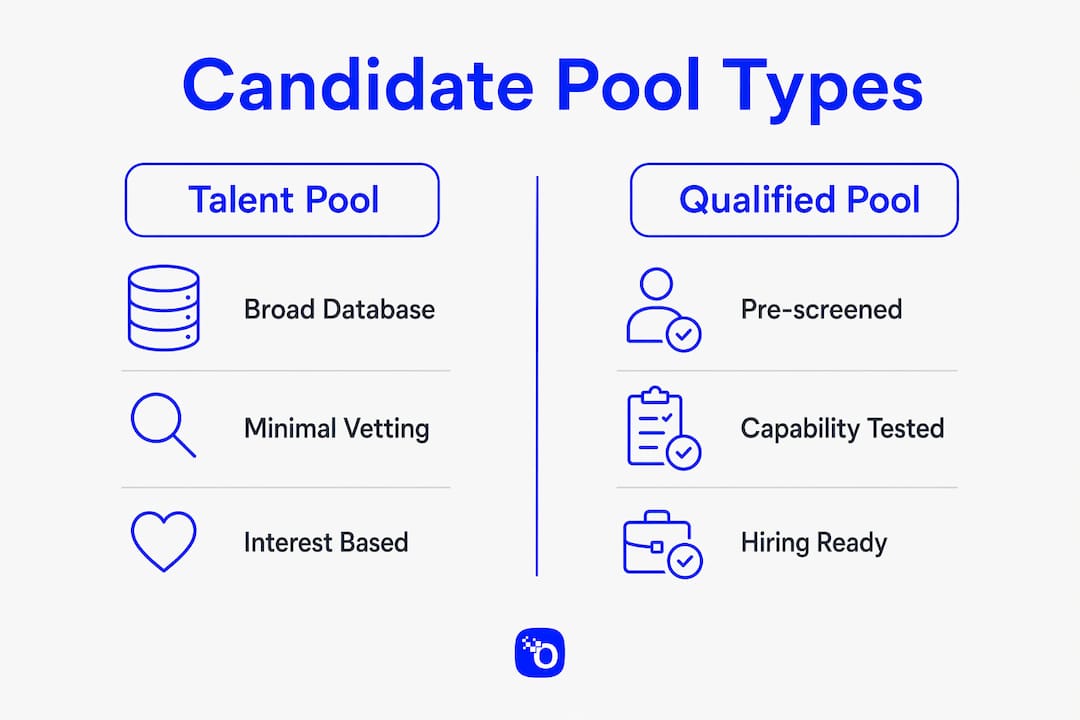
SmartRecruiters defines talent pipelines as candidates qualified for specific jobs, while talent pools are broader databases of potential candidates not yet fully vetted for job-specific roles. A qualified candidate pool sits between these two: it is more rigorously assessed than a general talent pool but may not yet be matched to a specific open position.
The table below clarifies the distinctions that matter most for public safety HR teams.
| Concept | Scope | Vetting level | Hiring readiness |
|---|---|---|---|
| Talent pool | Broad database of interested candidates | Minimal or none | Not ready; requires full evaluation |
| Qualified candidate pool | Pre-screened group meeting defined qualifications | Moderate to high | Ready for role-specific selection |
| Talent pipeline | Role-specific, actively progressing candidates | High | Actively being considered for specific vacancies |
In practical terms, a law enforcement agency might maintain a talent pool of applicants who have expressed interest through a career fair or online application portal. From that group, candidates who complete written exams, physical fitness tests, and initial background screenings move into the qualified candidate pool. Those who advance to oral boards and are ranked for a specific opening become part of the active pipeline.
USAJOBS’ ATP platform operationalizes this distinction at the federal level. Candidates in a federal talent pool are pre-vetted and listed on an approved shared hiring certificate, meaning agencies can access them without restarting the full assessment process. This model illustrates why the distinction matters: a shared, pre-qualified pool reduces duplicated vetting effort across agencies hiring for similar roles.
The distinction also matters for compliance. Public safety agencies operating under civil service rules, consent decrees, or federal hiring regulations must document which stage of assessment each candidate has completed. Treating a broad talent pool as a qualified candidate pool, and making selection decisions from it, creates legal exposure. The public safety compliance guide for HR managers addresses exactly this kind of procedural risk.
Why is maintaining a qualified candidate pool critical for public safety agencies?
Public safety agencies face a hiring environment unlike most other sectors. Vacancies are not merely operational inconveniences. An understaffed police department, fire station, or dispatch center creates direct risk to community safety. Maintaining a qualified candidate pool is the most reliable mechanism for reducing time-to-hire without sacrificing the vetting standards that protect both the agency and the public.
iCIMS research confirms that pre-evaluated candidate pools reduce time spent resourcing in competitive environments by allowing agencies to engage interested candidates who have already been assessed. This is particularly significant in public safety, where specialized certifications and clearance requirements mean the eligible applicant population is already smaller than in general labor markets.
The strategic benefits of a well-maintained pool include:
- Faster time-to-hire. When a vacancy opens, the agency draws from a pool of already-screened candidates rather than restarting sourcing from zero. This can compress hiring timelines from months to weeks.
- Improved regulatory compliance. Candidates admitted to the pool have already passed FCRA-compliant background checks, credential verifications, and capability assessments. Selection decisions made from this pool carry a documented compliance trail.
- Stronger candidate engagement. Candidates who have invested time in the assessment process and been admitted to a pool remain more engaged than cold applicants. Agencies that communicate regularly with pool members see lower candidate drop-off rates when positions open.
- Reduced cost per hire. Reusing assessment results across multiple hiring cycles eliminates redundant screening costs. For agencies conducting full investigator-driven background checks, this represents a meaningful budget impact.
- Continuity during surges. Natural disasters, civil unrest, or sudden retirements can create rapid staffing needs. An active qualified pool allows agencies to respond without compromising vetting standards under pressure.
Pro Tip: Set a calendar reminder 90 days before your candidate pool’s validity period expires. Proactive outreach to pool members before expiration prevents the loss of qualified candidates who have since accepted positions elsewhere.
The consequences of an insufficient or improperly maintained pool are concrete. An agency that allows its pool to go stale, or that admits candidates without completing all required assessments, faces two simultaneous risks: it either cannot fill vacancies quickly enough, or it fills them with candidates whose qualifications have not been fully verified. Neither outcome is acceptable in a public safety context. The step-by-step hiring process for public safety agencies outlines how structured pool management prevents both failure modes.
Best practices for building and managing qualified candidate pools
Building a defensible, effective candidate pool requires deliberate design from the start. The following practices reflect both regulatory guidance and operational experience in public safety recruiting.
Segment pools by role, location, and certification type
A single undifferentiated pool creates selection confusion and compliance risk. Separate pools for patrol officers, detectives, dispatchers, paramedics, and fire suppression personnel allow agencies to apply role-specific qualification standards consistently. Geographic segmentation matters as well, since state certification requirements vary and candidates qualified in one jurisdiction may not meet standards in another.
iCIMS describes candidate pools as organized by attributes including role, location, and skill, with the explicit goal of reducing sourcing time in competitive environments. Applying this segmentation logic to public safety pools means each pool has a defined scope, a defined qualification standard, and a defined validity period.
Use private and shared pool governance models appropriately
Oracle’s talent management documentation distinguishes between private and shared pools, with controlled access preventing unqualified candidates from being added by unauthorized users. For multi-agency consortiums or regional hiring programs, shared pools offer efficiency gains, but only when governance rules define who can add, remove, or modify candidate records. Without those controls, pool quality degrades over time.
The table below outlines governance considerations for both pool types.
| Pool type | Access model | Best use case | Key risk |
|---|---|---|---|
| Private pool | Single agency controls all additions | Agency-specific roles with unique standards | Siloed; cannot be shared across agencies |
| Shared pool | Multiple agencies or users can contribute | Regional hiring consortiums, federal programs | Quality dilution without strict governance |
Do not rank candidates within the pool
NSW Government guidance explicitly states that ranking within pools is discouraged. Candidates are either qualified or they are not. Ranking introduces competitive ordering at the pool stage, which can create legal challenges and undermine the fairness principles that public-sector hiring is designed to uphold. Reserve ranking for the final selection stage, when a specific vacancy is being filled from pool members.
Refresh pool records and re-engage candidates regularly
Oracle’s governance model addresses the risk of stale candidate records directly, noting that uncontrolled changes degrade qualification claims over time. Practically, this means scheduling periodic re-verification of credentials, updating background check results as required, and communicating with pool members to confirm continued interest and availability. A candidate whose certification has lapsed or who has accepted another position should not remain in an active pool.
Effective candidate sourcing strategies for public safety also include proactive outreach through law enforcement academies, fire training programs, and EMS certification courses. These channels produce candidates who are already on a qualification pathway, reducing the assessment burden at the pool entry stage. Guidance on recruiting qualified candidates for public safety roles covers these sourcing channels in detail.
Key takeaways
A qualified candidate pool is the foundation of compliant, efficient public safety hiring, and its value depends entirely on the rigor of the assessment process used to build it.
| Point | Details |
|---|---|
| Definition matters | A qualified pool contains only candidates who have completed all required assessments and meet every non-negotiable credential standard. |
| Distinguish pool types | Talent pools, qualified candidate pools, and pipelines serve different functions; conflating them creates compliance and selection errors. |
| No ranking in pools | Candidates are admitted based on qualification standards, not competitive order; ranking belongs at the final selection stage. |
| Governance prevents staleness | Shared pools require defined ownership and permission controls to prevent quality dilution over time. |
| Pool validity is finite | Public-sector pools typically expire within 18 months; proactive re-engagement prevents losing qualified candidates before vacancies open. |
Why the industry gets candidate pools wrong, and what actually fixes it
The most common mistake I see public safety agencies make is treating the candidate pool as a filing system rather than a living asset. Agencies invest heavily in the initial assessment process, admit candidates to the pool, and then do nothing until a vacancy opens. By that point, six to twelve months may have passed. Certifications have lapsed. Candidates have taken other jobs. The pool that looked strong at creation is functionally empty when it matters most.
The fix is not complicated, but it requires a shift in how HR teams think about candidate relationships. A qualified pool member is not a passive record. That person made a significant investment in your agency’s assessment process. They deserve regular communication, honest timelines, and advance notice when their pool eligibility is approaching expiration. Agencies that treat pool members this way see dramatically higher conversion rates when vacancies open.
The second mistake is conflating speed with thoroughness. Under staffing pressure, agencies sometimes admit candidates to pools before all assessments are complete, intending to finish the process later. This creates a false sense of readiness and genuine legal exposure. The investigator-driven background check, in particular, cannot be deferred. A candidate whose background has not been fully verified is not a qualified candidate, regardless of how well they performed on the written exam.
Technology adoption is improving this picture. Platforms that integrate applicant tracking with background investigation workflows allow agencies to track exactly where each candidate stands in the qualification process, preventing premature pool admission. The agencies I have seen execute this well share one characteristic: they treat the qualification standard as non-negotiable and build their processes around it, rather than adjusting the standard to fit their timeline.
— Matt
How Omniintel supports compliant candidate pool creation
Building a qualified candidate pool for a public safety agency requires more than a spreadsheet and good intentions. It requires verified credentials, FCRA-compliant background investigations, and a screening process designed specifically for the integrity standards law enforcement, fire, EMS, and dispatch roles demand.

Omniintel’s pre-employment screening services are built for exactly this environment. From investigator-driven background checks to continuous post-hire monitoring, Omniintel gives public safety HR teams the documentation and compliance infrastructure needed to admit candidates to a qualified pool with confidence. Agencies that partner with Omniintel reduce screening turnaround time, maintain audit-ready records, and protect their communities by ensuring every pool member has been thoroughly vetted. Contact Omniintel to see how its background check services can support your agency’s next hiring cycle.
FAQ
What is a qualified candidate pool?
A qualified candidate pool is a pre-screened group of applicants who have met all essential job requirements, including credentials, assessments, and regulatory standards, making them eligible for selection when a vacancy opens.
How long does a candidate pool remain valid?
Public-sector guidance, including NSW Government standards, sets candidate pool validity at up to 18 months. Agencies should re-verify credentials and re-engage pool members before that period expires.
Should candidates in a pool be ranked?
No. Public-sector best practice, as documented by NSW Government, discourages ranking within candidate pools. Eligibility is determined by qualification standards, and competitive ranking is reserved for the final selection stage.
What is the difference between a talent pool and a qualified candidate pool?
A talent pool is a broad database of interested candidates with minimal vetting. A qualified candidate pool contains only applicants who have completed formal assessments and met all defined qualification criteria for a specific role or role category.
What qualifications are required for public safety candidate pools?
Qualifications typically include state-issued certifications, passing scores on written and physical examinations, psychological evaluation clearance, drug screening results, and a completed FCRA-compliant background investigation with no disqualifying findings.