

What Is Community Safety Compliance: A Guide for Agencies
Community safety compliance is defined as the active adherence to legal, policy, and best practice standards that govern how public safety agencies and community programs create secure environments for all residents. Unlike traditional law enforcement metrics focused on arrest rates, this framework measures whether agencies meet regulatory obligations, coordinate across disciplines, and invest in upstream social conditions. The Brookings Institution identifies community safety as the public safety equivalent of public health, shifting focus from reactive crime management to preventive investment in housing, employment, and mental health. For compliance officers, public safety directors, and community leaders, understanding this framework is the foundation for reducing legal exposure, protecting agency reputation, and building genuine community trust.
What is community safety compliance and what standards govern it?
Community safety compliance, known in regulatory and policy circles as public safety regulatory adherence, refers to the structured process by which agencies meet legally mandated and professionally recognized standards for protecting community welfare. These standards span federal statutes, state regulations, local ordinances, and voluntary best practice frameworks adopted by professional bodies such as the Commission on Accreditation for Law Enforcement Agencies (CALEA) and the National Fire Protection Association (NFPA).
The regulatory environment governing community safety programs includes several distinct layers:
- Federal mandates: Title VI of the Civil Rights Act, the Americans with Disabilities Act (ADA), and the Fair Credit Reporting Act (FCRA) impose compliance obligations on agencies receiving federal funding or conducting background investigations.
- State-level frameworks: Many states now require agencies to maintain documented use-of-force policies, mental health diversion protocols, and officer wellness programs as conditions of certification.
- Local ordinances: Municipal codes govern everything from building safety inspections to noise abatement, each carrying compliance obligations for community program administrators.
- Voluntary accreditation standards: CALEA accreditation, for example, requires agencies to document and audit over 480 standards covering personnel, operations, and community relations.
The following table illustrates how compliance standards differ by agency type and regulatory source:
| Agency Type | Primary Regulatory Source | Key Compliance Obligation |
|---|---|---|
| Law enforcement | CALEA, state POST boards | Use-of-force policy, officer certification |
| Fire and EMS | NFPA, state EMS boards | Equipment inspection, training hours |
| Dispatch centers | APCO, state 911 authorities | Call handling protocols, data security |
| Non-profit safety programs | IRS, state charity regulators | Program documentation, grant reporting |
| Private security firms | State licensing boards, FCRA | Background screening, license renewal |
States are now creating centralized Office of Community Safety hubs that coordinate multidisciplinary safety efforts, moving away from reactive police-only models. This structural shift represents an emerging gold standard, integrating mental health response, housing support, and violence prevention under a single compliance umbrella. Agencies that align with these centralized frameworks reduce fragmentation and demonstrate a higher level of regulatory maturity to oversight bodies.
Robust compliance tracking in high-risk sectors reduces regulatory fines by up to 90%, a figure that translates directly to public safety contexts where consent decrees and federal oversight agreements carry significant financial and operational consequences. That number signals that compliance is not merely a legal formality. It is a measurable risk management strategy.
How do community safety compliance models differ from traditional approaches?
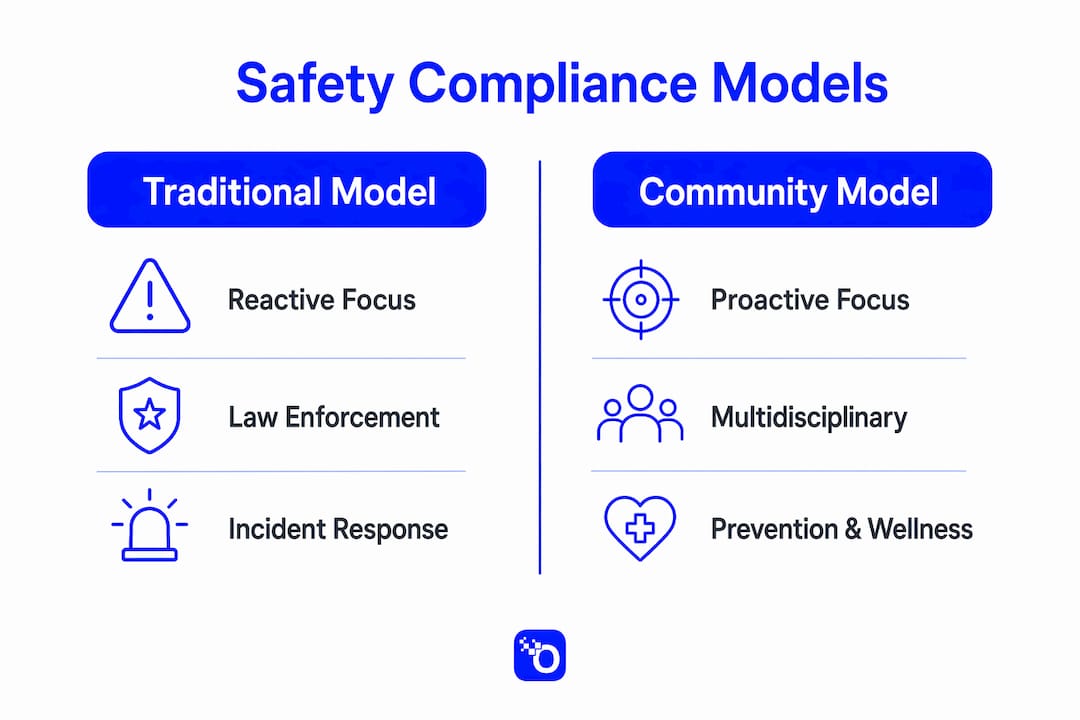
Traditional public safety models operate on a reactive premise: law enforcement responds to crime after it occurs, documents the incident, and measures success through clearance rates and response times. Community safety compliance models invert this logic entirely.

Community safety reframes public safety by emphasizing investment in social determinants and community conditions rather than reactive crime management. This means compliance programs must now account for whether agencies are coordinating with housing authorities, mental health providers, and workforce development organizations, not just whether officers are meeting training hour requirements.
| Dimension | Traditional public safety model | Community safety compliance model |
|---|---|---|
| Primary focus | Crime response and arrest rates | Prevention, coordination, and social investment |
| Compliance measure | Policy documentation and training logs | Outcome tracking, interagency coordination audits |
| Key partners | Courts, prosecutors, corrections | Health departments, housing agencies, schools |
| Risk indicator | Crime statistics | Social determinant gaps, coordination failures |
| Success metric | Clearance rate, response time | Reduction in repeat incidents, community trust scores |
The benefits of the holistic model are concrete. Agencies operating under multidisciplinary compliance frameworks report fewer use-of-force incidents, lower rates of officer misconduct complaints, and stronger community cooperation during investigations. These outcomes are not incidental. They are the direct product of compliance structures that require agencies to document, audit, and improve their community engagement practices.
The challenge lies in the transition. Agencies accustomed to siloed operations face significant resistance when compliance frameworks require them to share data with health departments or defer certain calls to mental health responders. Leadership buy-in is not optional in this context. It is a compliance prerequisite.
Pro Tip: When shifting to a community-centered compliance model, map your agency’s existing interagency agreements first. Gaps in memoranda of understanding (MOUs) with health and housing partners are among the most common compliance deficiencies identified during accreditation reviews.
What are the common challenges in ensuring community safety compliance?
Compliance failures in public safety rarely stem from deliberate misconduct. They originate in structural gaps, coordination breakdowns, and cultural resistance that accumulate over time until they produce a crisis.
Lack of coordination among municipal agencies is a primary challenge, and new safety offices serve to integrate efforts across health, social services, and law enforcement. New York City’s Office of Community Safety was created specifically to address this fragmentation, recognizing that broad safety visions fail without concrete coordination mechanisms. The lesson for compliance officers is direct: a compliance program that exists only within one agency’s boundaries is structurally incomplete.
The most common pitfalls in community safety compliance include:
- Siloed agency operations: When law enforcement, public health, and housing agencies operate without shared data systems or joint protocols, compliance gaps are inevitable and often invisible until an incident exposes them.
- Paper-based verification systems: Agencies relying on manual checklists and paper documentation cannot produce real-time compliance evidence during audits or legal proceedings. Digital, real-time verification using photo-verified checklists and geofence approvals represents the current operational standard.
- Neglecting training and culture: Technology frameworks fail when staff are not prepared for real-world conditions. Role-specific training is not supplemental to compliance. It is the mechanism through which policy becomes practice.
- Inadequate monitoring of post-hire personnel: Compliance does not end at the point of hire. Agencies that fail to monitor employee conduct and credential status after onboarding accumulate risk that surfaces during misconduct investigations.
“Coordination is necessary to transform broad safety visions into concrete action.” — NYC Office of Community Safety
The legal stakes of compliance failure extend well beyond financial penalties. The 2026 Airbus manslaughter conviction demonstrated that governance and reputation risks from safety failures can outlast the original incident by years, reshaping how courts and regulators assess organizational culpability. Public safety agencies face the same exposure. A single documented compliance failure, whether in hiring, use-of-force policy, or interagency coordination, can trigger federal oversight, civil litigation, and irreversible damage to community trust.
What practical strategies help agencies enhance community safety compliance?
Effective compliance is not achieved through policy documents alone. It requires deliberate operational structures, technology adoption, and a culture of accountability that runs from the executive level to the field.
The following strategies represent the best practices for community safety compliance that produce measurable results:
-
Establish or align with a multidisciplinary safety office. Whether your jurisdiction has a formal Office of Community Safety or not, agencies should create internal coordination protocols that mirror this structure. Assign a compliance liaison to each partner agency, document joint protocols, and schedule quarterly coordination audits.
-
Adopt digital compliance tracking systems. Replace paper-based checklists with platforms that provide real-time verification, audit trails, and automated alerts for expiring certifications or policy violations. Mobile teams using photo-verified checklists and geofence approvals produce compliance evidence that holds up in legal proceedings.
-
Implement Crime Prevention Through Environmental Design (CPTED). CPTED principles emphasize maintenance, lighting, and physical design to reduce property-related crime. Compliance programs that incorporate CPTED assessments demonstrate a proactive, documented approach to community risk management that satisfies both regulatory and community expectations.
-
Conduct role-specific compliance training. Generic annual training does not meet the standard. Compliance training must be tailored to the specific risks and regulatory obligations of each role, whether that is a patrol officer, a dispatcher, or a volunteer coordinator. Role-specific training is critical alongside technology for compliance programs to function under real-world conditions.
-
Integrate resident input into compliance planning. Community safety compliance is not solely an internal regulatory exercise. Agencies that incorporate resident feedback into safety planning demonstrate compliance with civil rights frameworks and build the community trust that makes enforcement more effective.
-
Audit interagency agreements annually. MOUs with health departments, housing authorities, and social service providers should be reviewed and updated each year. Outdated or absent agreements are a documented compliance deficiency in most accreditation frameworks.
Pro Tip: Use your agency’s accreditation review cycle as a forcing function for compliance audits. Agencies that treat accreditation as an ongoing process rather than a periodic event consistently outperform peers on regulatory inspections and federal oversight assessments.
Community members assess safety compliance through consistent, respectful interactions rather than policy documents alone. This finding has direct operational implications: compliance programs must measure behavioral outcomes, not just documentation completeness. An agency with a perfect policy binder but a pattern of disrespectful community interactions is not compliant in any meaningful sense.
How does hiring compliance contribute to community safety outcomes?
Pre-employment screening and continuous employee monitoring are not administrative functions. They are foundational compliance mechanisms that determine whether the personnel representing your agency meet the integrity standards your community expects.
The importance of safety compliance in hiring begins before the first interview. Agencies that fail to conduct thorough background investigations before extending conditional offers expose themselves to negligent hiring liability, federal consent decree risk, and the operational consequences of placing unqualified or compromised personnel in positions of public trust.
Effective hiring compliance in public safety programs requires:
- FCRA-compliant background investigations that cover criminal history, employment verification, reference checks, and credential validation across all jurisdictions where a candidate has lived or worked.
- Decertification index checks to identify officers who have been decertified in other states, a gap that paper-based or limited-scope checks routinely miss.
- Social media and open-source intelligence (OSINT) reviews conducted within legal parameters to identify conduct that may disqualify a candidate under agency policy or state law.
- Continuous post-hire monitoring that tracks criminal activity, license status changes, and professional sanctions in real time rather than waiting for annual reviews.
Continuous monitoring addresses a compliance gap that most agencies acknowledge but few have closed. An officer hired under a clean record can accumulate disqualifying conduct after onboarding. Without automated monitoring systems, agencies discover these issues only after an incident, at which point the legal and reputational damage is already done. Agencies that implement continuous employee monitoring as a standing compliance practice shift from reactive damage control to proactive risk management.
The connection between hiring compliance and community safety outcomes is direct and documented. Agencies with rigorous pre-employment screening programs report fewer use-of-force complaints, lower rates of officer misconduct, and stronger performance on community trust surveys. Compliance in hiring is not a bureaucratic checkpoint. It is the first line of defense for community safety.
Key takeaways
Community safety compliance requires coordinated, multidisciplinary action across hiring, operations, training, and interagency partnerships to produce measurable reductions in community risk.
| Point | Details |
|---|---|
| Define compliance broadly | Safety compliance spans hiring, operations, training, and interagency coordination, not just policy documentation. |
| Coordination is the core challenge | Siloed agencies consistently fail compliance audits; formal interagency agreements are a regulatory requirement, not optional. |
| Digital verification is the standard | Real-time, photo-verified compliance tracking replaces paper systems and produces defensible audit evidence. |
| Hiring compliance protects communities | FCRA-compliant screening and continuous post-hire monitoring are foundational to community safety outcomes. |
| Culture determines compliance success | Role-specific training and respectful community interactions are measurable compliance indicators, not soft skills. |
Why compliance culture matters more than compliance paperwork
After working alongside public safety agencies for years, I have observed a consistent pattern: the agencies that struggle most with compliance are rarely the ones with the fewest policies. They are the ones with the most policies and the least accountability for following them.
The shift toward community-centered compliance models is real and accelerating. States are building centralized safety offices, federal oversight bodies are raising documentation standards, and courts are expanding the definition of organizational liability. What I find most telling is that the agencies navigating this shift successfully are not the ones with the largest compliance budgets. They are the ones where leadership treats compliance as an operational value rather than an audit obligation.
Technology matters. Digital verification systems, real-time monitoring platforms, and AI-assisted screening tools have genuinely raised the floor on what adequate compliance looks like. But I have seen agencies deploy sophisticated platforms and still fail accreditation reviews because their staff did not understand why the system existed or how to use it under pressure.
The uncomfortable truth is that compliance culture is built through leadership behavior, not policy language. When a chief or director visibly prioritizes compliance, asks hard questions about coordination gaps, and holds supervisors accountable for training completion, the organization follows. When compliance is treated as a box-checking exercise delegated to a single administrator, it fails. The paperwork may look identical. The outcomes are not.
— Matt
How Omniintel supports community safety compliance for public safety agencies
Omniintel is built specifically for the compliance demands facing law enforcement, fire and EMS, dispatch centers, and government entities. Its investigator-driven approach to pre-employment screening goes beyond automated database checks, applying law enforcement investigation principles to verify credentials, uncover disqualifying history, and produce FCRA-compliant documentation that holds up under legal scrutiny.

For agencies looking to close the gap between policy and practice, Omniintel’s background check services include decertification index reviews, continuous post-hire monitoring, and AI-assisted candidate screening integrated directly into existing hiring workflows. Whether you are a compliance officer building a new screening program or a public safety director responding to an oversight requirement, Omniintel provides the evidence-based infrastructure that community safety compliance demands.
FAQ
What is community safety compliance?
Community safety compliance is the adherence to legal, regulatory, and best practice standards that govern how public safety agencies and community programs create secure environments for residents. It spans hiring practices, interagency coordination, training requirements, and operational documentation.
How does community safety compliance differ from traditional law enforcement compliance?
Traditional law enforcement compliance focuses on internal policy adherence and officer certification. Community safety compliance extends to interagency coordination with health, housing, and social service providers, measuring outcomes across the full social determinant spectrum rather than arrest and clearance rates alone.
What are the biggest risks of non-compliance for public safety agencies?
Non-compliance exposes agencies to federal consent decrees, civil litigation, loss of accreditation, and reputational damage that can persist for years. Legal precedents show that governance failures extend liability well beyond direct financial penalties to organizational leadership.
What role does pre-employment screening play in community safety compliance?
Pre-employment screening is a foundational compliance requirement. FCRA-compliant background investigations, decertification index checks, and credential verification protect agencies from negligent hiring liability and prevent unqualified personnel from entering positions of public trust.
How can agencies measure community safety compliance effectively?
Agencies should track documentation completeness, interagency coordination audit results, training completion rates by role, and community trust survey scores. Digital compliance platforms that provide real-time verification and automated alerts produce the most defensible and actionable compliance data.