

What Is Negligent Hiring? A Legal Guide for Employers
Negligent hiring is defined as employer liability that arises when an organization fails to exercise reasonable care in screening a job candidate, and that candidate subsequently causes harm to a third party, coworker, or member of the public. The legal doctrine holds that employers bear responsibility for foreseeable harm when they place an unfit individual in a role without conducting an adequate investigation. For HR professionals and agency directors, understanding negligent hiring is not an abstract legal exercise. It is a direct operational risk with documented financial consequences. A 2024 Ohio case resulted in a $27 million verdict after an employer failed to conduct background checks and training, resulting in fatal harm. That figure represents the cost of skipping steps most HR teams already know they should take.
What is negligent hiring and how does the law define it?
Negligent hiring is a tort claim grounded in the principle that employers have a duty of reasonable care when selecting personnel, particularly for roles that carry foreseeable risk to others. Courts do not require employers to predict every possible harm. They require employers to investigate what a reasonable inquiry would have revealed before extending an offer.

The duty/breach/foreseeability framework clarifies negligent hiring as risk-based liability, not simply post-hire misconduct liability. This distinction matters. An employer is not automatically liable because a hired employee later commits a harmful act. Liability attaches when the employer’s failure to investigate made that harm foreseeable and preventable.
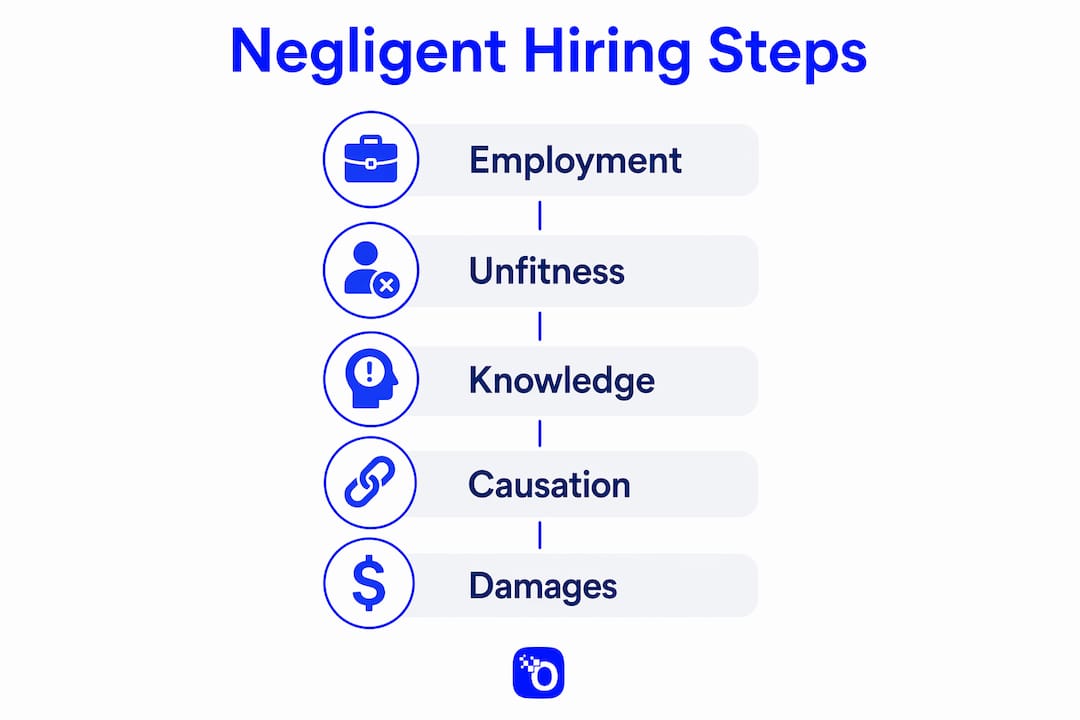
To establish a negligent hiring claim, plaintiffs must prove five elements: an employment relationship existed, the employee was unfit for the role, the employer knew or should have known of that unfitness through reasonable investigation, the employer breached its duty of care in screening, and that breach was the proximate cause of the harm suffered. Each element must be established independently, and courts scrutinize the employer’s pre-hire conduct closely.
The “knew or should have known” standard is the most consequential element for HR teams. It means that ignorance of a candidate’s disqualifying history is not a defense if a basic background check would have surfaced that history. Constructive knowledge, what a reasonable employer would have discovered, carries the same legal weight as actual knowledge.
What are the legal elements that establish negligent hiring liability?
Courts across jurisdictions apply a consistent analytical structure when evaluating negligent hiring claims. Understanding each element allows HR professionals to build a defensible hiring process from the ground up.
-
Employment relationship. The claim requires proof that the individual who caused harm was, in fact, employed by the defendant organization. Independent contractors present a more complex analysis, but courts look at the degree of control exercised rather than the label assigned to the relationship.
-
Employee unfitness for the role. Unfitness is evaluated relative to the specific position, not in the abstract. A candidate with a history of financial fraud may be unfit for a bookkeeping role but not necessarily for a grounds maintenance position. The role’s risk profile defines the relevance of any prior conduct.
-
Employer knowledge, actual or constructive. This is where background checks and reference verifications become legally significant. If a criminal record check, licensure verification, or reference call would have revealed disqualifying information, the employer is treated as having known that information, regardless of whether the check was actually run.
-
Breach of reasonable care. Reasonable care is not a fixed standard. It scales with the risk profile of the role. A security guard with unsupervised access to residential properties requires a more thorough investigation than a data entry clerk working in a supervised office environment. Courts assess whether the depth of screening matched the foreseeable risk.
-
Proximate cause. The plaintiff must demonstrate that the employer’s failure to screen adequately was a direct contributing cause of the harm. If the harm would have occurred regardless of the screening gap, the proximate cause element fails. This is why defense attorneys focus heavily on whether a proper background check would have actually changed the hiring decision.
The interplay between elements three and five is where most litigation concentrates. Employers who document their screening decisions contemporaneously, recording what was checked, what was found, and how the decision was reached, are significantly better positioned to defeat proximate cause arguments. Courts evaluate contemporaneous screening documentation to determine if reasonable investigation occurred, not reconstructed evidence assembled after a lawsuit is filed.
Examples of negligent hiring and roles with the highest risk exposure
Negligent hiring claims are not evenly distributed across industries. Certain roles generate disproportionate exposure because the nature of the work creates direct, foreseeable contact with vulnerable individuals or high-value assets.
The following categories represent the highest-risk scenarios HR professionals encounter:
-
Roles with unsupervised access to vulnerable populations. Positions in childcare, elder care, residential services, and behavioral health facilities carry the most acute exposure. A caregiver with a prior conviction for abuse who is hired without a criminal history check represents a textbook negligent hiring scenario. Courts have consistently found liability in these cases because the harm was entirely foreseeable given the role’s nature.
-
Financial control and property access positions. Bookkeepers, payroll administrators, property managers, and anyone with signatory authority over accounts present elevated risk when prior fraud, theft, or embezzlement history goes unchecked. Failure to verify financial credentials or conduct credit history reviews in these roles has supported successful negligent hiring claims.
-
Security, law enforcement, and private protection roles. A security guard who assaults a client, or a law enforcement officer with a history of excessive force complaints at a prior agency, represents a category where law enforcement background investigations must go beyond a standard criminal record check. The Omniintel platform was built specifically for this sector because the consequences of a screening gap in public safety are categorically more severe than in most commercial environments.
-
Transportation and logistics. The Supreme Court’s 2026 ruling in Montgomery v. Caribe Transport held that negligent hiring claims against brokers fall under the safety exception to FAAAA federal preemption, meaning state-law negligent hiring suits can now proceed against transportation brokers. This ruling expanded liability exposure significantly for an industry that previously relied on federal preemption as a shield.
-
Volunteer and non-employee personnel. Many organizations treat volunteers as outside the scope of negligent hiring doctrine. Courts do not. Nonprofits, faith-based organizations, and government agencies that place volunteers in roles involving children or vulnerable adults face the same duty of care as paid-employee contexts.
Pro Tip: When evaluating risk exposure by role, ask one question before designing the screening protocol: if this person causes harm in the course of their duties, would a reasonable jury conclude that a basic background check would have revealed a warning sign? If the answer is yes, the screening depth is insufficient.
How does reasonable care in screening protect against negligent hiring claims?
Reasonable care is the legal standard employers must meet to defeat a negligent hiring claim, and its threshold is not uniform. Screening diligence must be tailored to the role’s risk profile. Applying the same background check package to a file clerk and a licensed paramedic does not satisfy the reasonable care standard for the paramedic.
The table below illustrates how screening depth should scale with role risk:
| Role risk level | Recommended screening components |
|---|---|
| Low risk (supervised, no vulnerable access) | Identity verification, criminal history check, employment verification |
| Moderate risk (financial access, client-facing) | Above, plus credit history review, reference interviews, professional license check |
| High risk (unsupervised access to vulnerable populations) | Above, plus sex offender registry, multi-state criminal search, driving record, drug screening |
| Critical risk (law enforcement, security, public safety) | All of the above, plus decertification index check, psychological evaluation, social media review, investigator-driven reference interviews |
The distinction between low-risk and critical-risk screening is not merely procedural. It reflects the legal principle that foreseeability of harm determines the duty of care. A public safety agency that hires an officer without checking the national decertification index has failed a standard that courts will hold as obvious given the role’s authority and access.
Documentation is the other half of the reasonable care equation. Courts assess what was done at the time of hire, not what an employer claims was standard practice. Every screening step should generate a written record: the date the check was ordered, the vendor used, the results received, and the hiring decision rationale. This contemporaneous paper trail is the employer’s primary defense in litigation.
FCRA compliance adds another layer of obligation for employers using third-party consumer reporting agencies to conduct background checks. Adverse action procedures, including pre-adverse action notices and candidate dispute rights, must be followed precisely. Failure to comply with FCRA requirements can compound a negligent hiring claim with separate statutory liability.
Pro Tip: Ban-the-box ordinances and EEOC guidance on criminal history use do not eliminate the duty to investigate. They regulate how and when criminal history is considered. Employers operating in jurisdictions with ban-the-box laws must still conduct criminal history checks; they simply must time them correctly and apply individualized assessment before making adverse decisions.
What practices minimize negligent hiring risks and strengthen legal defense?
Reducing negligent hiring exposure is a function of process design, documentation discipline, and ongoing vigilance. The following practices represent the operational foundation of a defensible hiring program:
-
Develop written screening policies tied to job classifications. A documented policy that specifies which checks apply to which role categories demonstrates institutional commitment to reasonable care. Courts view the absence of written policy as evidence of indifference to foreseeable risk. The pre-employment screening checklist framework provides a starting point for building role-specific protocols.
-
Retain all screening records for the duration of employment plus applicable statute of limitations. Most negligent hiring claims arise after an incident, sometimes years after hire. Records that have been purged cannot be produced in litigation. A retention schedule of at least seven years is a defensible baseline for most jurisdictions.
-
Train HR staff to recognize red flags during the application and interview process. Gaps in employment history, inconsistencies between application data and verified records, and unexplained license lapses are all indicators that warrant deeper investigation. HR staff who cannot articulate what they look for in a background report are a liability in themselves.
-
Conduct periodic re-verification for high-risk roles. Reasonable care does not end at hire. Employees in positions involving ongoing access to vulnerable populations, financial systems, or law enforcement authority should be subject to periodic license checks, criminal history updates, and continuous monitoring. The post-hire monitoring function is as legally significant as the pre-hire investigation.
-
Apply individualized assessment before adverse action. When a background check reveals disqualifying information, the decision to withdraw an offer must be documented with reference to the specific role, the nature of the finding, and the time elapsed since the relevant conduct. A blanket exclusion policy applied without individualized assessment creates EEOC exposure while also undermining the reasonableness argument in a negligent hiring defense.
-
Review and update screening procedures annually. The legal environment governing background checks changes with new state legislation, court decisions, and federal agency guidance. The 2026 Montgomery v. Caribe Transport ruling is a recent example of how expanded broker liability can shift due diligence obligations overnight. Annual policy reviews catch these shifts before they create gaps.
The transportation sector’s response to the Montgomery ruling offers a practical model for other industries. Brokers who maintain written vetting processes and periodically re-verify carrier safety ratings and insurance documentation are positioned to demonstrate reasonable care even under the expanded state-law standard. The same logic applies to any employer in a sector where liability exposure is evolving.
Key takeaways
Negligent hiring liability is established when an employer’s failure to conduct a reasonable pre-hire investigation makes foreseeable harm legally attributable to the organization, not just to the individual employee who caused it.
| Point | Details |
|---|---|
| Five-element legal test | Courts require proof of employment, unfitness, employer knowledge, breach of care, and proximate cause. |
| Risk-scaled screening | Screening depth must match the role’s foreseeable risk, not a one-size-fits-all checklist. |
| Documentation is the defense | Contemporaneous records of screening decisions are the primary evidence in negligent hiring litigation. |
| Liability is expanding | The 2026 Supreme Court ruling extended negligent hiring exposure to transportation brokers under state law. |
| Post-hire monitoring matters | Reasonable care obligations extend beyond the hire date for roles with ongoing access to vulnerable populations. |
Why negligent hiring risk management belongs at the center of HR strategy
Most HR teams treat background checks as a compliance checkbox. That framing is the source of most negligent hiring exposure I see in practice. The legal standard is not “did you run a check.” It is “did you run the right check, at the right depth, for this specific role, and did you document your reasoning.” Those are four separate questions, and most organizations can only answer the first one confidently.
The cases that result in nuclear verdicts, the $27 million outcomes that make legal news, are almost never the result of an employer who ran no checks at all. They are the result of employers who ran inadequate checks, or who ran the right checks but failed to act on what they found, or who had no written policy connecting screening findings to hiring decisions. The gap between “we do background checks” and “we have a defensible screening program” is where liability lives.
Public safety agencies face this problem with particular intensity. A law enforcement agency that hires an officer without checking the national decertification index is not just legally exposed. It is placing someone with a documented history of misconduct into a role with arrest authority, use-of-force authority, and community trust. The harm potential is categorically different from a retail hire gone wrong. That is why investigator-driven checks, the kind that go beyond automated database queries to include direct reference interviews and record verification, are not optional for high-risk public safety roles. They are the standard of care.
The trend line on negligent hiring liability is moving in one direction. The Montgomery v. Caribe Transport ruling is one data point. State legislatures are expanding the categories of employers subject to heightened screening obligations. Courts are increasingly receptive to nuclear verdict arguments when employers cannot produce contemporaneous documentation of their screening process. HR professionals who treat this as a legal department problem rather than an operational one will find themselves explaining their screening gaps in deposition.
— Matt
How Omniintel helps agencies prevent negligent hiring exposure

Omniintel’s pre-employment screening platform is built specifically for public safety agencies, law enforcement, fire and EMS, dispatch centers, and private security firms where the consequences of a screening gap are most severe. The platform delivers investigator-driven background investigations that go beyond automated database queries, covering criminal history, decertification index checks, license verification, reference interviews, and continuous post-hire monitoring. Every screening step generates contemporaneous documentation that supports both reasonable care standards and FCRA compliance requirements. For agencies that need to demonstrate defensible, role-calibrated due diligence, Omniintel provides the structured process and the paper trail that courts look for. Explore Omniintel’s background check services to see how the platform aligns with your agency’s specific risk profile and hiring obligations.
FAQ
What is the negligent hiring definition in legal terms?
Negligent hiring is a tort claim holding employers liable for harm caused by an employee when the employer failed to exercise reasonable care in investigating that employee’s fitness for the role before hire. The standard requires that the harm was foreseeable given what a reasonable investigation would have revealed.
What are the most common examples of negligent hiring?
The most frequently litigated examples involve security guards who assault clients, caregivers with prior abuse convictions placed in elder or childcare roles, and financial employees with undisclosed fraud histories given access to accounts. In each case, a basic background check would have surfaced the disqualifying history.
How do negligent hiring laws vary by state?
Most states recognize negligent hiring as a common law tort, applying the five-element test of employment, unfitness, knowledge, breach, and causation. Some states have codified specific screening obligations for particular industries, such as childcare or healthcare, creating statutory duties that run parallel to the common law standard.
Does negligent hiring liability apply after the employee is hired?
Yes. Related doctrines of negligent supervision and negligent retention extend the employer’s duty of care beyond the hire date. If an employer becomes aware of an employee’s unfitness during employment and fails to act, liability can attach to subsequent harm under the retention theory rather than the hiring theory.
How can employers avoid negligent hiring claims?
Employers reduce exposure by conducting role-calibrated background investigations, documenting every screening step contemporaneously, training HR staff to recognize and act on red flags, applying individualized assessment before adverse action, and implementing post-hire monitoring for high-risk positions. Written policy connecting screening standards to job classifications is the foundation of a defensible program.