

What Is Candidate Scoring for Public Safety Hiring?
Candidate scoring is the systematic process of assigning standardized, evidence-backed ratings to job applicants based on their match with predefined, role-specific criteria using structured scales. In public safety recruitment, where a single bad hire can compromise community trust or officer safety, this process is not optional. It is the difference between a defensible hiring decision and a liability. Effective scoring uses 6–12 core competencies with behavioral anchors on a 4–5 point scale to produce consistent, auditable results. The benefits of candidate scoring include reduced bias, faster time-to-hire, and legal defensibility, all of which matter enormously when hiring law enforcement officers, firefighters, dispatchers, or EMS personnel.
What is candidate scoring and why does it matter?
Candidate scoring, known in HR practice as structured candidate evaluation, is a method of measuring applicant qualifications against job-specific criteria using consistent rating instruments. The industry standard term is behaviorally anchored rating scale (BARS), and it forms the backbone of any reliable scoring system. Without it, interview panels in public safety agencies default to gut instinct, which is neither fair nor legally defensible.

The stakes in public safety hiring are uniquely high. A patrol officer, a 911 dispatcher, or a firefighter operates in high-pressure, high-consequence environments. Hiring errors in these roles carry real costs: civil liability, community harm, and reputational damage to the agency. Structured candidate evaluation methods create a documented record that shows why a candidate was selected or rejected, which is critical when hiring decisions face legal scrutiny.
Predictive validity improves from .20 with unstructured interviews to .51 and up to .57 when behavioral anchors are applied. That shift represents a measurable improvement in the accuracy of hiring decisions. For a fire department or police agency filling safety-sensitive roles, that accuracy gap is not a statistic. It is the difference between a qualified hire and a preventable incident.
The public safety vetting process demands more than a resume review. Candidate scoring gives hiring managers a structured framework to compare applicants on the same dimensions, using the same standards, every time.
What are the key components of effective candidate scoring?
Reliable candidate scoring rests on three pillars: well-defined competencies, behavioral anchors, and real-time evidence capture. Each element reinforces the others. Remove one, and the entire system loses integrity.
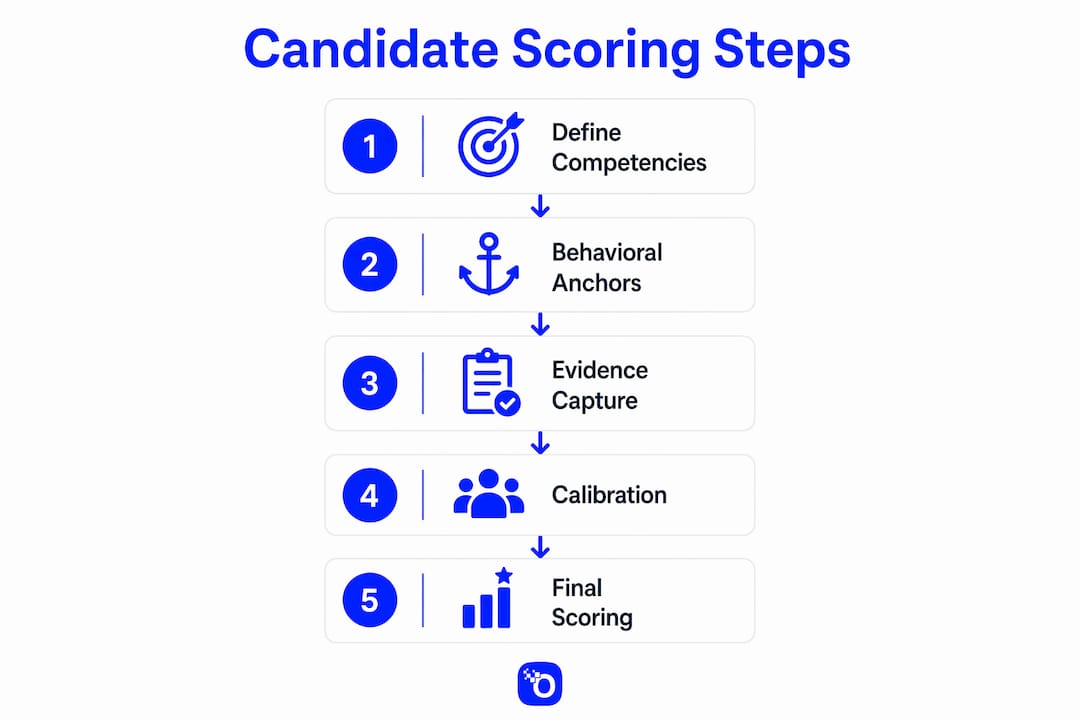
Defining the right competencies
Public safety roles require competencies that reflect the actual demands of the job. A law enforcement position might prioritize integrity, situational judgment, communication under stress, and de-escalation skill. A dispatch role might weight active listening, multitasking, and composure. Agencies should identify 6–12 competencies per role, no more. Broader lists dilute focus and create scoring fatigue among interviewers.
Each competency must be tied directly to the job description and, where applicable, to POST (Peace Officer Standards and Training) requirements or equivalent regulatory standards. This alignment protects the agency if a hiring decision is ever challenged under Title VII or the Americans with Disabilities Act.
Behavioral anchors: converting opinion into observation
Behavioral anchors define what each rating point looks like in practice. A 1-point response on “situational judgment” sounds different from a 3-point or 5-point response, and those differences must be written down before interviews begin. The U.S. Office of Personnel Management identifies numeric scales without behavioral anchors as a common and costly mistake. Without anchors, a score of “3” from one interviewer means something entirely different from a “3” given by another.
Anchor-writing workshops are the mechanism that prevents chaos during debrief sessions. Teams that skip this step often find themselves back-engineering rubrics from candidates they already favor, which undermines the entire purpose of structured scoring.
Pro Tip: Run a calibration exercise before your first interview cycle. Have each panelist independently score a sample response, then compare results. Significant disagreement signals that your anchors need sharper language.
Evidence capture during interviews
Ratings without documented evidence are noise. Experienced practitioners treat real-time note-taking as non-negotiable. Interviewers must capture direct quotes or close paraphrases at the moment a candidate responds. These notes become the audit trail that justifies every score assigned.
- Record verbatim quotes or close paraphrases during the interview, not after.
- Tie each note to a specific competency on the scorecard.
- Avoid evaluative language in notes (“great answer”). Use descriptive language (“described a specific incident where she de-escalated a domestic dispute by…”).
- Store completed scorecards in the applicant tracking system (ATS) immediately after each interview panel.
- Retain scoring records for a minimum period consistent with your agency’s records retention policy and applicable employment law.
How do scoring models compare: composite vs. multiple hurdle?
Two primary frameworks govern how agencies aggregate candidate scores: the compensatory (composite) model and the multiple hurdle model. Each serves a different purpose, and the choice between them carries significant implications for both hiring quality and legal compliance.
The compensatory model combines scores across all assessment components into a single weighted total. A strong performance in one area can offset a weaker performance in another. Composite scoring models yield more defensible hiring outcomes in regulated environments because they reflect the full range of a candidate’s capabilities rather than a single data point.
The multiple hurdle model requires candidates to meet a minimum threshold at each stage before advancing. Failing any hurdle eliminates the candidate, regardless of performance elsewhere. This model is common in public safety hiring because certain competencies, such as physical fitness, psychological fitness, or background clearance, are non-negotiable. A candidate who scores brilliantly in interviews but fails a psychological evaluation cannot be hired into a law enforcement role.
| Model | How It Works | Key Advantage | Key Limitation | Best For |
|---|---|---|---|---|
| Compensatory (Composite) | Scores averaged or weighted across all components | Higher statistical validity; reflects full candidate profile | A critical weakness can be masked by high scores elsewhere | General public safety roles with broad competency requirements |
| Multiple Hurdle | Must pass each stage to advance | Enforces non-negotiable minimums; reduces risk in safety-sensitive roles | Can eliminate strong candidates on a single poor day | Law enforcement, corrections, roles with regulatory fitness standards |
| Hybrid | Composite scoring within hurdle stages | Balances flexibility with mandatory thresholds | More complex to administer and document | Large agencies running multi-stage hiring processes |
Public safety agencies benefit most from a hybrid approach: composite scoring within each stage, combined with hard hurdles for medical, psychological, and background clearance components. This structure captures the statistical advantages of composite models while preserving the safety-critical minimums that regulated roles demand.
What role does AI play in candidate scoring today?
AI-driven candidate scoring platforms are changing how public safety agencies process large applicant pools. These tools parse job descriptions into discrete criteria, including tenure, certifications, domain knowledge, and physical requirements, then map each applicant’s profile against those criteria to generate a fit score with documented rationale.
AI-driven platforms reduce time-to-hire by up to 50% by automating the initial screening phase. For agencies managing hundreds of applications for a single patrol officer opening, that reduction is operationally significant. It allows HR staff to focus their time on candidates who have already cleared an objective first filter.
The critical design principle for AI scoring in public safety is the human-in-the-loop requirement. Automated scoring replaces manual subjective screening with consistent, explainable evaluation recorded directly in the ATS, but a trained human reviewer must validate every AI-generated score before it influences a hiring decision. This is not just a best practice. It is a legal and ethical requirement in safety-sensitive hiring contexts.
Key considerations for AI-assisted scoring in public safety agencies:
- Confirm the platform produces transparent, explainable scores with documented rationale, not black-box rankings.
- Verify the scoring criteria are validated against the specific job requirements for your agency’s roles.
- Audit AI scoring outputs regularly for disparate impact across protected classes, consistent with EEOC guidance.
- Integrate AI scoring outputs with your ATS so that scores and rationale are retained as part of the official hiring record.
- Review data privacy in hiring obligations before deploying any AI tool that processes candidate personal data.
Pro Tip: Disclose AI use in your hiring process to candidates at the point of application. Transparency reduces legal exposure and builds trust with applicants who may later request an explanation of their evaluation.
How to implement candidate scoring in a public safety agency
Implementation is where most agencies stumble. The framework exists in theory, but the execution breaks down at the level of interviewer behavior, documentation discipline, and calibration consistency. The following steps reflect the sequence that produces reliable, defensible results.
-
Define job-specific criteria. Start with a job task analysis for each role. Identify the 6–12 competencies that predict success in that specific position. Align criteria with POST standards, NFPA requirements, or equivalent regulatory frameworks where applicable.
-
Build structured scorecards. Create a scorecard for each interview stage. Each competency should include a behavioral question, a 4–5 point rating scale, and written behavioral anchors for each scale point. Scorecards should be role-specific, not generic.
-
Run anchor-writing workshops before interviews begin. Bring the full interview panel together to write and agree on what a 1, 3, and 5 response looks like for each competency. This step prevents post-hoc rationalization and aligns pass/fail thresholds before any candidate is evaluated.
-
Train interviewers on evidence capture. Require all panelists to take real-time notes during interviews. Notes must describe observable behavior, not evaluative impressions. Conduct a practice round with a sample response before the live interview cycle.
-
Score independently before debriefing. Each panelist completes their scorecard before the group discussion. Revealing scores simultaneously during calibration prevents anchoring effects, where the first score stated pulls all subsequent scores toward it.
-
Integrate scoring with background screening. Candidate scores from interviews and assessments should feed directly into the broader pre-employment investigation workflow. Background check findings, psychological evaluations, and polygraph results each represent a separate data layer that informs the final hiring decision. Review compliance steps for public safety hiring to confirm your process meets legal requirements.
-
Retain all scoring documentation. Store completed scorecards, evidence notes, and calibration records in your ATS. These records are your defense if a rejected candidate files a discrimination claim. Well-documented scoring is also the foundation for proving employment decisions were based on objective criteria, not protected characteristics.
Key takeaways
Effective candidate scoring in public safety hiring requires behavioral anchors, real-time evidence capture, and calibrated scoring panels to produce decisions that are both accurate and legally defensible.
| Point | Details |
|---|---|
| Behavioral anchors are non-negotiable | Numeric scales without written anchors reduce scoring to subjective opinion, not objective observation. |
| Evidence capture drives defensibility | Scores without documented quotes or paraphrases cannot withstand legal scrutiny or internal audit. |
| Composite models offer higher validity | Combining multiple assessment methods produces more accurate and defensible outcomes than single-method evaluation. |
| AI accelerates screening with guardrails | AI scoring tools cut time-to-hire significantly, but human review and transparent rationale are required in public safety contexts. |
| Simultaneous score reveal prevents bias | Calibration sessions where scores are revealed at the same time eliminate anchoring effects and preserve independent judgment. |
Scoring is an evidence problem, not a scorecard problem
I have reviewed hiring processes at agencies that had beautifully designed scorecards and still made indefensible decisions. The scorecards were not the failure point. The interviewers were filling them out from memory, 20 minutes after the interview ended, with no notes to reference. Every score was a reconstruction, not a record.
The insight from Metaview’s research that candidate scoring is fundamentally an evidence collection challenge resonates with everything I have seen in practice. You can have the most sophisticated rubric in the world, but if your interviewers are not capturing observable behavior in real time, the scores are fiction dressed up as data.
The second pattern I see repeatedly is agencies that treat calibration as a formality. They hold the debrief, but one senior panelist speaks first, and everyone else adjusts. That is not calibration. That is consensus masquerading as objectivity. Simultaneous score revelation is not a procedural nicety. It is the mechanism that makes independent judgment possible.
For public safety agencies specifically, the legal exposure from poor scoring practices is not hypothetical. Hiring discrimination claims are expensive, time-consuming, and damaging to agency reputation. The legal criteria for hiring decisions are clear: criteria must be job-related, consistently applied, and documented. Structured scoring, done correctly, satisfies all three requirements.
The agencies that get this right share one characteristic: they treat scoring as a discipline, not a checkbox. They train interviewers, run calibration workshops, capture evidence in real time, and retain records systematically. That commitment is what separates defensible hiring from expensive mistakes.
— Matt
How OMNI intel supports structured public safety hiring
Candidate scoring produces better hiring decisions, but it does not operate in isolation. The most rigorous interview scorecard cannot reveal a candidate’s undisclosed disciplinary history, prior decertification, or financial vulnerabilities that create integrity risks in a law enforcement role.

OMNI Intel’s pre-employment screening services are built specifically for public safety agencies that need background investigations to match the rigor of their structured scoring processes. OMNI Intel integrates investigator-driven background checks, FCRA-compliant reporting, and applicant screening directly into your hiring workflow, so scoring data and background findings inform the same final decision. Whether you are hiring patrol officers, dispatchers, or private security personnel, OMNI Intel gives your agency the complete picture that structured scoring alone cannot provide.
FAQ
What is candidate scoring in hiring?
Candidate scoring is the process of evaluating job applicants against predefined, job-specific criteria using standardized rating scales with behavioral anchors. It produces consistent, comparable, and auditable assessments across all candidates in a hiring process.
How many competencies should a public safety scorecard include?
Effective scoring systems use 6–12 core competencies per role. Fewer than six risks missing critical job requirements; more than twelve creates scoring fatigue and reduces reliability among interview panelists.
What is the difference between composite and multiple hurdle scoring?
Composite scoring averages results across all assessment components, allowing strengths to offset weaknesses. Multiple hurdle scoring requires candidates to meet a minimum threshold at each stage, making it the preferred model for safety-sensitive roles with non-negotiable fitness or background requirements.
Why do behavioral anchors matter in candidate evaluation?
Behavioral anchors define what each rating point looks like in observable terms, converting subjective impressions into objective observations. Without anchors, the same numeric score carries different meanings across different interviewers, which destroys interrater reliability.
How does AI improve the candidate scoring process?
AI-driven scoring tools parse job criteria and applicant data to generate transparent fit scores, reducing time-to-hire by up to 50%. Human reviewers must validate AI-generated scores before they influence hiring decisions, particularly in regulated public safety contexts.