

What Is Reputation Management for Public Safety Agencies
Reputation management is defined as the strategic, ongoing process of monitoring, influencing, and guiding how an organization is perceived by its stakeholders to build and preserve trust. For public safety agencies, including law enforcement departments, fire and EMS services, dispatch centers, and private security firms, this process is not optional. Gartner defines reputation management as influencing stakeholder perception from all touchpoints that impact the organization. That definition matters here because public safety agencies operate under constant scrutiny, where a single incident can reshape community trust within hours. Platforms like Brandwatch and HubSpot have documented the channels and cycles that drive online reputation, and practitioners at InstantPress have outlined the specific pressures law enforcement faces. Understanding what reputation management is, and how to apply it, is the first step toward protecting the credibility your agency has earned.
What is reputation management and how does it work?
Reputation management is a cross-functional process that goes well beyond public relations. Gartner stresses that reputation is shaped by internal decisions and behaviors, making organization-wide buy-in a requirement, not a preference. A police chief’s policy decision, a dispatcher’s response time, and a social media post from a frontline officer all contribute to how the public perceives the agency. No single communications team can manage that volume of influence alone.
The distinction between reputation and brand is worth clarifying. Brand is what an organization says about itself. Reputation is what stakeholders believe based on what they observe and experience. For a sheriff’s department or a fire district, reputation is built through years of consistent, accountable service. It can be damaged in minutes by a viral video or a poorly worded press release.

Reputation management is also not the same as damage control. Gartner notes that organizations focused only on replying to criticism, without addressing root causes, limit their long-term improvement. Agencies that treat reputation management as a reactive tool will always be behind the narrative. The goal is to build a foundation of credibility that holds up when pressure arrives.
How does reputation management function across internal and external dynamics?
Reputation management requires coordinated effort across every level of an organization. Leadership decisions set the tone. Operational practices either confirm or contradict the agency’s stated values. Frontline behaviors are visible to the public in ways that no communications strategy can fully control. All three must align for reputation management to function.
Cross-functional collaboration is the mechanism that makes alignment possible. A public information officer (PIO) cannot correct a narrative caused by a flawed hiring process. An HR director cannot repair community trust damaged by a use-of-force incident without support from legal, operations, and executive leadership. Reputation management works when all departments share responsibility for the agency’s public standing.
Consistent messaging across channels prevents narrative fragmentation. Brandwatch highlights that stakeholders assess credibility by consistency across search snippets, social media profiles, reviews, and AI-generated content. When a department’s website says one thing and its Facebook page implies another, the gap erodes trust faster than any single negative story.
Key factors that shape stakeholder perception inside and outside a public safety agency include:
- Leadership conduct and public statements that reflect the agency’s stated values
- Hiring and vetting practices that demonstrate commitment to integrity, including thorough background investigations
- Response times and service quality that communities experience directly
- Transparency in incident reporting and accountability measures
- Employee behavior on and off duty, including social media activity
Pro Tip: Assign a reputation management liaison in each department, not just communications. When HR, operations, and legal all have a designated point of contact for reputation-related issues, response coordination improves significantly.
What are the key components and channels of online reputation management?
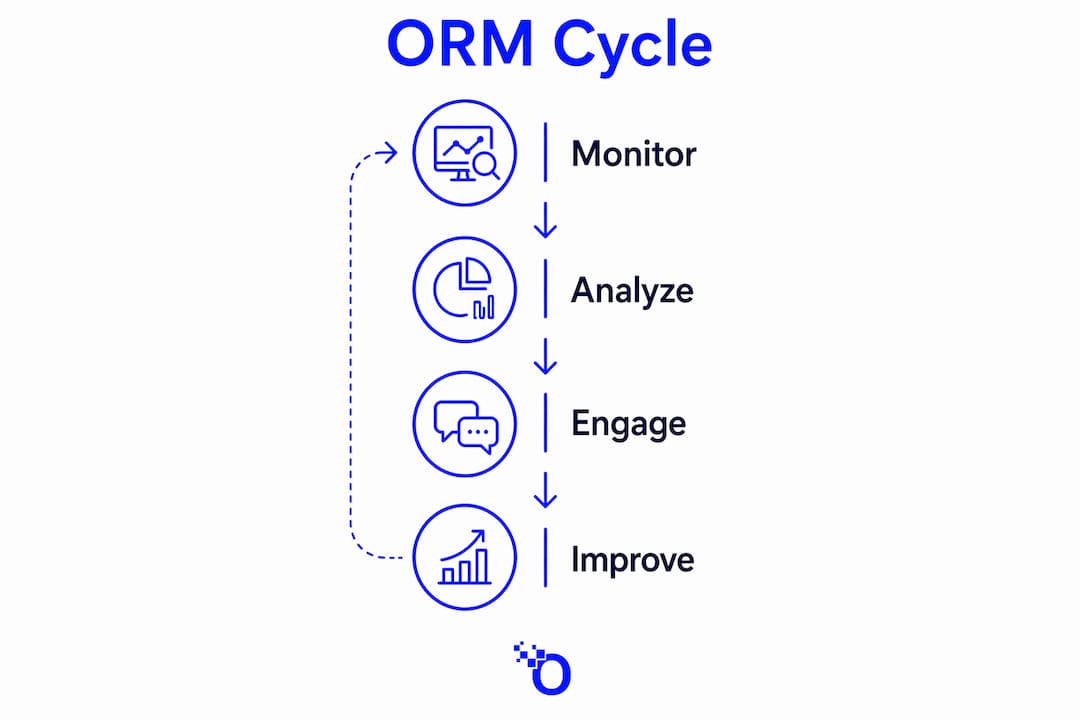
Online reputation management (ORM) is defined as a continuous cycle of monitoring digital channels, analyzing sentiment, acting to amplify positives or respond to negatives, and maintaining ongoing engagement. Brandwatch outlines five key channels for ORM: search engine results, review sites, social media, news outlets, and forums. Each channel carries different risks and requires different response protocols.
The four-stage ORM cycle
The ORM cycle operates in four stages that repeat continuously:
- Monitor — Track mentions, keywords, and sentiment across all five channels using tools like Google Alerts, Brandwatch, or Sprout Social.
- Analyze — Apply sentiment analysis to assess whether public opinion is trending positive, negative, or neutral, and identify the source of shifts.
- Act — Amplify positive content through SEO-optimized press releases and community stories. Address negative content with factual, timely responses.
- Maintain — Sustain engagement through consistent content publishing, community outreach updates, and proactive transparency reports.
HubSpot lists SEO, social media engagement, PR outreach, and review management as core strategies for maintaining a strong online presence. For public safety agencies, SEO matters because AI-powered search engines now summarize agency information automatically. If your agency’s search results surface outdated or inaccurate content, that summary becomes the public’s first impression.
ORM channel comparison for public safety agencies
| Channel | Primary Risk | Recommended Action |
|---|---|---|
| Search engine results | Outdated or negative news articles ranking high | Publish regular, factual content to push down harmful results |
| Social media | Viral incidents or officer conduct videos | Maintain active accounts with rapid response protocols |
| Review sites (Google, Yelp) | Negative community reviews of agency services | Respond professionally and document resolution steps |
| News outlets | Investigative reporting or incident coverage | Proactive media relationships and timely press releases |
| Forums and community boards | Unmoderated rumors or misinformation | Monitor and correct factual errors with official statements |
Sentiment analysis tools give agencies a measurable read on public opinion trends. Platforms like Brandwatch and Sprout Social assign sentiment scores to mentions, allowing communications teams to detect shifts before they escalate. An agency that sees a spike in negative sentiment after a policy change can respond with context and clarification before the story is set.
Why is reputation management especially critical for public safety agencies?
Public safety agencies face a reputation environment unlike any other sector. A use-of-force incident, a delayed emergency response, or an officer misconduct allegation can spread across social media within minutes. Agencies without a response plan lose control of their narrative within 90 minutes. That window is shorter than most agency leadership meetings.
AI search engines compound the speed problem. When a community member searches for a local police department after an incident, AI-generated summaries pull from the most recent and most-linked content. If that content is a critical news article, the AI summary reflects that framing. Agencies that publish regular, factual, and well-structured content give AI systems accurate material to summarize.
“Reputation management preserves earned trust and can shorten damage windows in crises, but it cannot fabricate trust without operational accountability.” — InstantPress, Reputation Management for Law Enforcement in 2026
That principle is the most important constraint in public safety reputation management. No communication strategy compensates for a pattern of misconduct, poor hiring decisions, or lack of transparency. Reputation management works when it reflects genuine operational integrity.
Agencies that have built strong reputations share several common practices:
- Proactive storytelling through regular community updates, officer spotlights, and transparency reports published before incidents occur.
- Rapid response playbooks that define who speaks, what is said, and through which channels within the first 90 minutes of a significant incident.
- Accountability documentation that shows the public what corrective actions were taken after complaints or incidents.
- Community engagement programs such as ride-alongs, town halls, and youth outreach that build goodwill before it is needed.
- Consistent personnel standards enforced through FCRA-compliant background screening and post-hire monitoring to prevent conduct issues before they become public crises.
The agencies that manage reputation most effectively treat it as infrastructure, not as a response mechanism. They build the foundation during calm periods so it holds during difficult ones.
How can public safety agencies implement effective reputation management strategies?
Effective reputation management requires a structured framework, not ad hoc responses. InstantPress emphasizes that agencies need core infrastructure approaches, including defined roles, prepared playbooks, and integrated monitoring tools. Without that structure, reputation management defaults to whoever is available when a crisis hits.
Staffing and role definition
Every agency needs at least three defined reputation management roles:
- Public Information Officer (PIO): The primary external voice for the agency. Responsible for press releases, media inquiries, and public statements during incidents.
- Internal Communications Lead: Manages messaging to agency personnel to prevent conflicting statements from reaching the public.
- Social Media Manager: Monitors channels in real time, responds to community comments, and escalates emerging issues to the PIO.
Smaller agencies that cannot staff all three roles should designate cross-trained personnel and establish clear escalation protocols.
Building and deploying rapid response playbooks
Prepared communication playbooks for rapid response, evidence release, and stakeholder communication are a best practice for public safety agencies. A playbook defines the first statement template, the approval chain, the channels to activate, and the timeline for follow-up communications. Agencies that prepare these documents before incidents occur respond faster and more consistently than those that draft responses under pressure.
Pro Tip: Run a tabletop exercise twice a year using a simulated incident scenario. Test your playbook against a realistic timeline and identify gaps before a real event exposes them.
Integrating monitoring tools and workflows
Monitoring tools must be integrated into daily workflows, not checked occasionally. Assign a team member to review sentiment dashboards each morning. Set up keyword alerts for the agency name, key personnel names, and common incident-related terms. When a negative mention appears, the response clock starts immediately.
Aligning operational transparency with communication shortens damage windows. When an agency publishes its use-of-force data, complaint statistics, and disciplinary outcomes proactively, it removes the information vacuum that rumors fill. HubSpot identifies proactive content publishing as one of the most effective long-term reputation strategies available.
Long-term community engagement builds the credibility reserve that agencies draw on during difficult periods. Agencies that are visible and accessible during normal operations face less severe reputation damage when incidents occur. The community already has a relationship with the agency and a basis for trust. That relationship is built through consistent presence, not crisis management.
Key Takeaways
Reputation management is the strategic process of monitoring, analyzing, and guiding stakeholder perception through aligned operations, consistent messaging, and proactive community engagement.
| Point | Details |
|---|---|
| Definition and scope | Reputation management covers all touchpoints that shape stakeholder perception, not just public communications. |
| ORM cycle | Monitor, analyze, act, and maintain across five channels: search, social media, reviews, news, and forums. |
| Public safety urgency | Agencies without a response plan lose narrative control within 90 minutes of a significant incident. |
| Accountability is foundational | Reputation management preserves earned trust but cannot manufacture it without genuine operational integrity. |
| Infrastructure over reaction | Agencies that build reputation systems before crises occur respond faster and sustain less long-term damage. |
Reputation management is not a communications problem
After years of working with public safety professionals on trust and credibility issues, the clearest pattern I have seen is this: agencies that treat reputation management as a communications function consistently underperform compared to those that treat it as an operational commitment.
The instinct to hand reputation management to the PIO or the social media team is understandable. Those roles are visible and measurable. But reputation is built in hiring decisions, in how complaints are handled, in whether officers are held to consistent standards. A well-crafted press release cannot fix a pattern of poor personnel decisions. I have watched agencies spend significant resources on media training while their post-hire monitoring practices were essentially nonexistent. The communications investment was wasted because the operational foundation was not there.
The agencies that do this well share one trait: leadership treats reputation as a governance issue, not a marketing issue. The chief or director is personally invested in the agency’s public standing and holds every department accountable for contributing to it. That accountability flows down through hiring standards, training requirements, and conduct expectations. Communications teams then have something real to communicate.
The other pitfall I see consistently is the reactive-only posture. Agencies wait for a crisis, respond, and then return to normal operations without addressing what caused the crisis. Gartner identifies this pattern as one of the primary reasons organizations fail to improve their reputations over time. Responding to criticism without changing the underlying behavior is a cycle, not a strategy.
Build the infrastructure now. Define your roles, write your playbooks, and integrate monitoring into daily operations. When the incident comes, and it will, you will respond from a position of credibility rather than scrambling to establish one.
— Matt
How OMNI Intel supports agency reputation through rigorous screening
Reputation management starts before an officer, dispatcher, or security professional ever reports for their first shift. The personnel decisions an agency makes during hiring directly shape the conduct, integrity, and public perception that reputation management must then sustain or repair.

OMNI Intel provides pre-employment background screening built specifically for law enforcement, fire and EMS, dispatch centers, and private security firms. The platform applies investigator-driven background investigation principles to vet applicants thoroughly before they join your agency. OMNI Intel also supports ongoing employee monitoring through OMNIView™, giving agencies continuous visibility into post-hire conduct risks. When your personnel standards are high and consistently enforced, your reputation reflects that commitment. Learn more about how OMNI Intel’s screening and monitoring solutions protect your agency’s standing at omniintel.co.
FAQ
What is reputation management in simple terms?
Reputation management is the process of monitoring and influencing how an organization is perceived by the public and key stakeholders. It combines proactive communication, operational accountability, and digital monitoring to build and protect credibility over time.
What is online reputation management (ORM)?
ORM is the continuous practice of monitoring and managing an organization’s presence across digital channels, including search results, social media, review sites, news outlets, and forums. Brandwatch defines ORM as a cycle of monitoring, analyzing, acting, and maintaining engagement across those channels.
Why is reputation management important for public safety agencies?
Public safety agencies operate under intense public scrutiny, and trust can erode rapidly when incidents occur. Agencies without prepared response plans can lose control of their narrative within 90 minutes, making proactive reputation management a critical operational function, not a communications afterthought.
How does hiring affect agency reputation?
Personnel conduct is one of the most visible drivers of public perception for any public safety agency. Agencies that apply rigorous pre-employment investigations and post-hire monitoring reduce the risk of conduct incidents that damage community trust and require costly reputation repair.
What are the first steps to improve your agency’s reputation?
Define your PIO, internal communications, and social media roles clearly. Build rapid response playbooks before an incident occurs. Integrate daily monitoring of digital channels using tools like Google Alerts or Brandwatch. Align your public communications with transparent operational practices so your messaging reflects verifiable facts.