

Candidate Red Flag Detection in Public Safety Hiring
Candidate red flag detection is the practice of identifying warning signs within applicant information, behavior, and background data that indicate potential fraud, misrepresentation, or unsuitability for a role. In public safety hiring, where officers, dispatchers, and emergency personnel carry authority over lives and communities, these signals carry consequences that extend far beyond a bad hire. The 2025 Greenhouse Workforce and Hiring Report found that 28% of candidates admit to using AI to generate fake work samples. That figure alone demands that HR professionals in law enforcement, fire and EMS, and dispatch agencies treat candidate vetting as a structured investigative process, not a gut-check exercise.
What is candidate red flag detection and why does it matter for public safety?
Candidate red flag detection is the formal process of spotting anomalies across a candidate’s resume, interview behavior, background records, and digital presence that may signal dishonesty, poor fit, or integrity risk. The industry term for this practice within investigative hiring frameworks is pre-employment integrity screening. Both terms describe the same goal: identifying warning signals before a hire becomes a liability.

Public safety agencies face a higher standard than most employers. A police officer, firefighter, or 911 dispatcher who misrepresents their background does not just undermine team performance. They create direct risk to the public they are hired to protect. The hiring red flags guide for public safety published by OMNI Intel outlines how legal frameworks and identification methods intersect in this sector specifically.
Red flags fall into three broad categories: documentary inconsistencies, behavioral signals, and background discrepancies. Documentary inconsistencies include resume date gaps, credential claims that cannot be verified, and formatting that suggests a document was altered. Behavioral signals emerge during interviews, such as evasive answers or an inability to give concrete examples. Background discrepancies surface through criminal record checks, reference validation, and social media review.
The stakes in public safety hiring make early detection non-negotiable. Agencies that skip structured screening risk hiring candidates whose integrity issues only surface after they are in the field, at which point the damage to community trust and agency reputation is already done.
What are the common types of candidate red flags to watch for?
Red flags appear across every stage of the hiring process. Recognizing them requires a systematic review of documents, direct observation during interviews, and verification through third-party sources.
Resume and document red flags
- Unexplained employment gaps longer than three months with no supporting context
- Dates that overlap between two listed employers without explanation
- Job titles that cannot be verified through public records or direct employer contact
- Credentials, certifications, or degrees listed without issuing institution details
- Formatting inconsistencies suggesting a document was edited after original creation
- Vague job descriptions that avoid quantifiable responsibilities or outcomes
Interview and behavioral red flags
- Inability to provide specific, verifiable examples when asked behavioral questions
- Scripted or rehearsed answers that do not adapt to follow-up questions
- Evasiveness when asked about reasons for leaving previous roles
- Inconsistency between answers given in the initial screening and the in-person interview
- Evasive answers and lack of preparation are among the top predictive indicators of poor performance and fraud across industries
Online and background red flags
- LinkedIn profile that contradicts resume dates, titles, or employer names
- Social media content that conflicts with stated values or professional conduct standards
- Failure to produce valid government-issued ID when requested
- AI-assisted fraud leaves technical signatures such as inconsistent network activity and scripted, unnatural responses detectable during interviews
- References who cannot be independently verified or who provide only vague, generic feedback
Each of these signals alone may have an innocent explanation. The concern rises when multiple signals appear together, or when a candidate’s explanation for one anomaly creates a new inconsistency elsewhere. That compounding effect is where the real risk lives.
How does the presence of multiple red flags change the risk assessment?
A single red flag is a prompt to ask a follow-up question. Two or more independent red flags are a signal to pause the process and conduct deeper verification. This distinction comes directly from a Bayesian reasoning approach to candidate screening, where each independent warning signal multiplies the probability of fraud or unsuitability rather than simply adding to it.
The practical implication is significant. A candidate who has one unexplained employment gap may have taken time off for personal reasons. A candidate who has an unexplained gap, a credential that cannot be verified, and a LinkedIn profile that contradicts their resume presents a compounding pattern. Each anomaly makes the others more credible as evidence of deliberate misrepresentation.
The triage rule that follows from this reasoning is clear: one red flag triggers a follow-up, while two or more independent red flags demand stopping recruitment for deeper verification. Public safety HR teams should document each flag as it is identified and track whether flags are isolated or interconnected.
| Number of red flags | Independence | Recommended action |
|---|---|---|
| 1 | Isolated | Schedule a follow-up question or clarification |
| 2 | Related (same source) | Request documentation and verify directly |
| 2 | Independent (different sources) | Pause process; initiate deeper background review |
| 3 or more | Any | Escalate to senior investigator or compliance officer |
Pro Tip: Document every red flag in writing at the time it is identified. This creates an audit trail that protects your agency legally and supports defensible hiring decisions if a candidate challenges the outcome.
The table above is not a disqualification checklist. It is a decision framework for allocating investigative resources. Public safety agencies operate under legal obligations, including FCRA compliance, that require fair and consistent treatment of all candidates. Structured triage protects both the agency and the applicant.
How do you tell the difference between nervousness and genuine dishonesty?
Nervousness and dishonesty produce similar surface behaviors. Both can cause a candidate to pause before answering, speak quickly, or avoid eye contact. The difference lies in the content of the answer, not the delivery. Nervous candidates give specific, verifiable answers, while dishonest candidates remain vague and scripted regardless of how the question is framed.
A candidate who is nervous about a behavioral question like “Tell me about a time you made a difficult decision under pressure” will still provide a real incident with names, dates, and outcomes. A candidate who is being evasive will give a general answer that could apply to any situation, then redirect to a talking point. That pattern of deflection is the actual red flag, not the nervousness itself.
Structured interview techniques reduce the risk of misreading these signals. Behavioral prompts, standardized scoring rubrics, and consistent question sets across all candidates create an objective baseline. Red flags must be treated as signals, not verdicts, with structured scorecards used to reduce bias and spot deviations objectively.
Practical steps to separate nervousness from dishonesty
- Ask the same behavioral question in two different ways and compare the answers for consistency
- Follow up with a specific detail question: “What was the outcome of that decision six months later?”
- Ask the candidate to walk you through a work sample or past project in real time, not from memory alone
- Note whether the candidate’s answer becomes more specific or more vague when pressed for detail
- Compare interview answers against resume claims and reference feedback for alignment
Pro Tip: If a candidate’s story changes when you ask for a specific detail, that inconsistency is more meaningful than any single behavioral cue. Inconsistency under follow-up questioning is the clearest indicator of rehearsed misrepresentation.
Overreliance on intuition leads to bias. Combining behavioral observation with background verification and references produces hiring decisions that are both accurate and defensible. For public safety agencies, that defensibility matters as much as the decision itself.
What practical steps can public safety HR teams take to detect and confirm red flags?
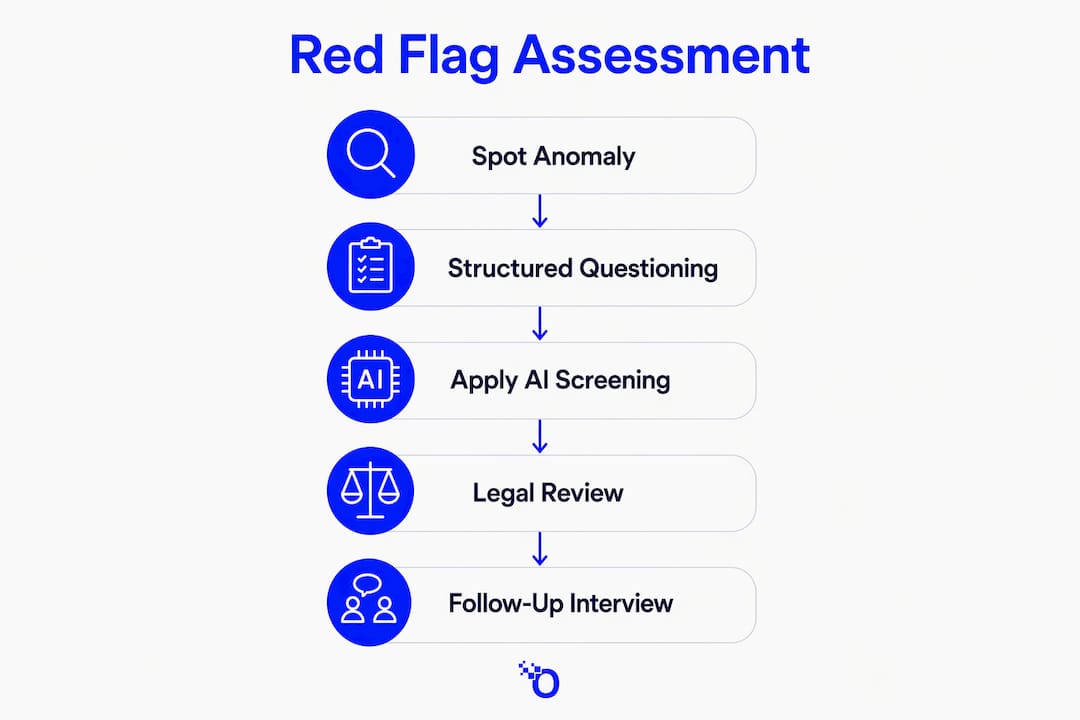
Detection without verification is incomplete. The goal is not just to spot a potential problem but to confirm or rule it out through a structured process. The “Spot, Probe, Verify” method treats red flags as hypotheses to test rather than conclusions to act on. Each step builds the evidentiary foundation needed for a defensible hiring decision.
Step 1: Spot the anomaly
Review all submitted documents for inconsistencies before the first interview. Compare resume dates, job titles, and credential claims against publicly available records. Flag any discrepancy for follow-up.
Step 2: Probe through structured questioning
Use behavioral interview questions designed to elicit specific, verifiable responses. Ask candidates to describe real situations with named outcomes. Note whether answers are consistent across multiple interviewers or sessions.
Step 3: Verify through independent sources
- Conduct a full background investigation, including criminal history, employment verification, and education confirmation
- Validate references directly, using contact information obtained independently rather than provided by the candidate
- Authenticate government-issued ID through accepted verification protocols
- Use timed assessments for technical roles to confirm that submitted work samples reflect the candidate’s actual ability
- Review publicly available social media for content that contradicts stated values or professional conduct standards
Step 4: Apply AI-aware screening techniques
AI-generated content in work samples has identifiable characteristics. Timed assessments and verbal walkthroughs of submitted work are the most reliable countermeasures. Asking a candidate to explain their reasoning process in real time reveals whether they understand the work they submitted. AI-assisted fraud also produces technical signatures such as IP address anomalies and unnatural response patterns that technology-assisted screening can flag.
Step 5: Coordinate with legal and compliance
Every red flag that leads to a hiring decision must be documented and reviewed against applicable law. FCRA compliance governs how background check findings are used in employment decisions. Agencies should involve legal counsel or a compliance officer before acting on background data that could be considered sensitive under federal or state law. The integrity verification process for public safety hiring integrates reference validation, background investigations, and behavioral checks into a single workflow that supports both accuracy and compliance.
Step 6: Conduct a follow-up interview when warranted
When verification surfaces new questions, a second structured interview is appropriate. Present the discrepancy directly and give the candidate an opportunity to explain. Document the response. A candidate who provides a credible, verifiable explanation resolves the flag. A candidate who becomes defensive, changes their story, or cannot provide supporting documentation confirms it.
This six-step process is not bureaucratic overhead. For public safety agencies, it is the minimum standard required to protect communities, uphold agency integrity, and meet legal obligations in hiring.
Key Takeaways
Candidate red flag detection is most effective when it combines structured documentation, Bayesian triage, behavioral interviewing, and independent verification into a single repeatable process.
| Point | Details |
|---|---|
| Define red flags precisely | Red flags are anomalies in documents, behavior, or background data that signal potential fraud or misrepresentation. |
| Apply Bayesian triage | Two or more independent red flags demand a pause in recruitment and deeper verification, not just a follow-up question. |
| Separate nervousness from dishonesty | Nervous candidates give specific, verifiable answers; evasive candidates stay vague even under direct follow-up. |
| Use the Spot, Probe, Verify method | Treat every red flag as a hypothesis to test through questioning and independent source confirmation. |
| Document every step | Written records of each flag and the agency’s response protect against legal challenge and support defensible decisions. |
Why structured detection beats instinct in public safety hiring
Public safety hiring is the one context where the cost of a bad hire is not measured in lost productivity. It is measured in public trust, officer safety, and community harm. I have seen agencies dismiss clear documentary inconsistencies because a candidate interviewed well. I have also seen agencies disqualify candidates over a single unexplained gap that turned out to be a medical leave. Both errors come from the same source: substituting instinct for process.
The shift that actually changes outcomes is treating every red flag as a data point, not a verdict. When you document anomalies, apply a consistent triage framework, and verify through independent sources, you stop making decisions based on how a candidate made you feel. You start making decisions based on what the evidence shows. That is the standard law enforcement agencies apply to investigations. It belongs in their hiring processes too.
The fraud landscape has also changed in ways that make intuition less reliable than it was five years ago. AI-generated work samples, synthetic identities, and coached interview responses are now accessible to anyone willing to use them. The 2025 Greenhouse data showing 28% of candidates admitting to AI-generated fake samples is not a future concern. It is a current reality that demands current countermeasures.
The agencies that get this right are not necessarily the ones with the largest HR teams. They are the ones with the most consistent processes. A small dispatch center with a documented six-step verification workflow will outperform a large department that relies on experienced interviewers trusting their read of a room. Process beats intuition at scale, and it beats it in court too.
— Matt
How OMNI Intel supports red flag detection for public safety agencies
Public safety agencies need more than a generic background check vendor. They need a partner that understands the investigative standard their roles demand.

OMNI Intel’s pre-employment screening services are built specifically for law enforcement, fire and EMS, dispatch centers, and private security firms. The platform combines FCRA-compliant background investigations, AI-powered inconsistency detection, credential verification, and reference validation into a single workflow designed for the complexity of public safety hiring. Every check is conducted using investigator-driven principles, not automated pass-fail logic. If your agency is ready to replace gut-check hiring with evidence-based vetting, OMNI Intel provides the structure and the tools to make that shift.
FAQ
What is candidate red flag detection in simple terms?
Candidate red flag detection is the process of identifying warning signs in a candidate’s resume, interview behavior, or background records that may indicate fraud, misrepresentation, or poor fit for a role.
How many red flags does it take to disqualify a candidate?
No fixed number triggers automatic disqualification. The triage standard recommends that one red flag prompts a follow-up, while two or more independent flags require pausing recruitment for deeper verification.
What are the most common red flag signs in hiring for public safety roles?
The most common red flag signs in hiring include unverifiable credentials, inconsistent employment dates, evasive interview answers, AI-generated work samples, and social media content that contradicts stated professional values.
How do hiring managers avoid confusing nervousness with dishonesty?
Nervous candidates provide specific, verifiable answers even when anxious, while dishonest candidates give vague, scripted responses that do not hold up under direct follow-up questioning.
What tools help with red flag assessment in public safety hiring?
Timed assessments, behavioral interview scorecards, FCRA-compliant background investigations, reference validation, and AI-assisted inconsistency detection are the primary red flag assessment tools used in public safety recruitment.