

Transparency in Screening: Building Trust in Public Safety
Every American public safety leader faces growing expectations to provide open, honest hiring practices. As calls for accountability rise nationwide, HR managers must redefine what true transparency looks like during pre-employment screenings. By prioritizing clear communication and accessible screening information, your agency can build public trust, uphold legal standards, and reduce the risk of costly hiring missteps. Discover practical strategies for creating fair, compliant, and defensible candidate evaluations.
Table of Contents
- Defining Transparency In Public Safety Screening
- Legal Standards Shaping Screening Processes
- Best Practices For Clear Candidate Vetting
- Risks Of Opaque Screening Methods
- Ensuring Fairness And Agency Accountability
Key Takeaways
| Point | Details |
|---|---|
| Importance of Transparency | Transparency in public safety screening fosters community trust and accountability. |
| Legal Compliance | Agencies must navigate complex legal standards to ensure constitutional protections. |
| Best Practices for Vetting | Implementing standardized, multi-layered vetting processes enhances candidate evaluation. |
| Risks of Opaque Methods | Opaque screening can lead to bias, legal risks, and reduced public trust in safety agencies. |
Defining Transparency in Public Safety Screening
Transparency in public safety screening represents a critical foundation for building community trust and accountability. At its core, transparency means providing clear, accessible information about screening processes, policies, and outcomes to stakeholders and the public. Public safety agencies must move beyond opaque hiring practices toward a model of open communication and demonstrable fairness.
The key components of transparency in screening include:
- Open documentation of screening criteria
- Clear communication about background check processes
- Detailed reporting of screening decisions
- Mechanisms for appealing screening outcomes
- Public accessibility of non-confidential screening data
Systematic data collection and publication helps communities evaluate the fairness of law enforcement screening methods. This approach requires balancing comprehensive disclosure with essential privacy protections, ensuring that relevant information remains timely and accessible.
Effective transparency goes beyond mere information sharing. It involves creating structured systems that allow external evaluation of screening practices. Public safety agencies must develop robust frameworks that demonstrate commitment to integrity, allowing independent review of their candidate selection processes. This approach helps mitigate potential biases, reduce discriminatory practices, and enhance overall public confidence in recruitment and hiring standards.
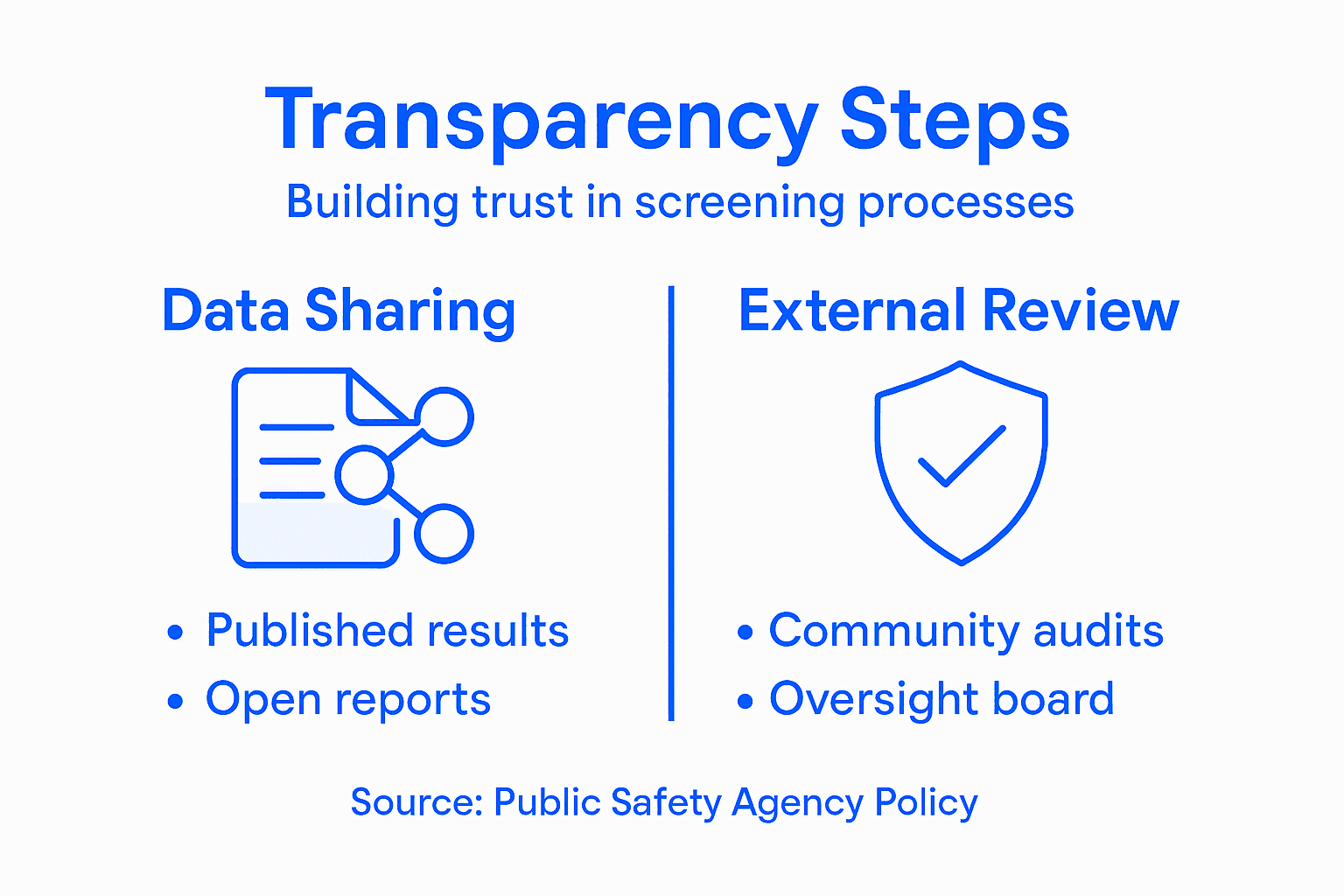
Pro tip: Implement a regular public reporting system that provides anonymized insights into your screening processes, highlighting decision-making criteria and outcomes without compromising individual privacy.
Legal Standards Shaping Screening Processes
Legal standards for public safety screening are complex frameworks that balance constitutional protections with essential security requirements. These standards emerge from a delicate intersection of federal statutes, constitutional amendments, and judicial interpretations that aim to protect both individual rights and community safety. Public safety agencies must navigate these intricate legal requirements while maintaining rigorous screening processes.
Key legal principles governing screening processes include:
- Protection against discriminatory practices
- Compliance with Fourth Amendment search requirements
- Adherence to fair employment screening regulations
- Maintaining individual privacy rights
- Ensuring non-discriminatory selection criteria
Constitutional protections for screening processes fundamentally require law enforcement and public safety agencies to conduct searches and screenings with reasonable suspicion, explicitly prohibiting arbitrary or discriminatory practices. Courts consistently evaluate screening methods on a case-by-case basis, ensuring that security needs are balanced against individual civil liberties.
Federal and state regulations provide comprehensive guidelines for public safety screening, establishing clear standards for background investigations, character assessments, and candidate evaluations. These legal frameworks mandate transparency, require documented decision-making processes, and establish mechanisms for candidates to challenge screening outcomes. By creating structured, accountable screening procedures, agencies can demonstrate their commitment to fairness while maintaining high standards of public safety recruitment.
Pro tip: Develop a comprehensive internal policy manual that explicitly details your screening process’s legal compliance strategies, ensuring every step meets constitutional and federal regulatory requirements.
Best Practices for Clear Candidate Vetting
Candidate vetting represents a critical process for maintaining the integrity and safety of public service organizations. Effective screening goes far beyond simple background checks, requiring a comprehensive and nuanced approach that balances thorough investigation with respect for individual privacy and rights. Public safety agencies must develop sophisticated strategies that provide meaningful insights into a candidate’s suitability for sensitive roles.
Key best practices for clear candidate vetting include:
- Establishing multi-layered screening protocols
- Implementing continuous evaluation mechanisms
- Utilizing diverse information sources
- Protecting candidate privacy rights
- Maintaining transparent decision-making processes
- Standardizing assessment criteria across roles
Modern personnel vetting strategies emphasize the importance of incorporating diverse information sources while maintaining rigorous privacy protections. This approach requires agencies to develop flexible, adaptive screening processes that can quickly identify potential risks without compromising individual civil liberties.

Comprehensive vetting involves more than traditional background investigations. Public safety agencies must create holistic assessment frameworks that consider character, reliability, and potential risk factors. This means developing standardized evaluation methods that are both thorough and fair, using multiple data points to create a comprehensive candidate profile. Advanced screening techniques should include psychological assessments, social media reviews, professional references, and continuous monitoring to ensure ongoing suitability for public safety roles.
Pro tip: Create a standardized vetting scorecard that objectively quantifies candidate suitability, ensuring consistent and defensible screening decisions across all public safety positions.
Risks of Opaque Screening Methods
Opaque screening methods represent a significant threat to the integrity and trustworthiness of public safety recruitment processes. When agencies fail to maintain clear, transparent candidate evaluation protocols, they expose themselves to substantial legal, ethical, and operational risks that can undermine institutional credibility. Public safety organizations must recognize the profound implications of obscure screening practices that limit accountability and potentially enable discriminatory decision-making.
Key risks associated with opaque screening methods include:
- Potential for unconscious bias and discriminatory practices
- Reduced institutional accountability
- Increased legal vulnerability
- Erosion of public trust
- Compromised candidate fairness
- Limited ability to challenge screening decisions
Biometric screening risks demonstrate how lack of transparency can lead to privacy violations and systematic discrimination. When screening processes are not clearly documented or explained, agencies create environments where arbitrary decisions can proliferate unchecked, potentially harming both individual candidates and organizational reputation.
The consequences of opaque screening extend beyond immediate hiring decisions. Agencies that maintain unclear evaluation methods risk long-term damage to their institutional credibility, making it increasingly difficult to recruit top talent and maintain community confidence. Comprehensive screening requires not just thorough investigation, but also a commitment to clear communication, consistent standards, and mechanisms that allow candidates to understand and potentially challenge screening outcomes.
Here is a comparison of transparency versus opacity in public safety screening methods:
| Aspect | Transparent Screening | Opaque Screening |
|---|---|---|
| Public Trust | Builds confidence | Erodes community trust |
| Accountability | Enables external review | Limits oversight |
| Legal Risk | Reduces legal challenges | Increases liability |
| Candidate Experience | Clearly defined, fair process | Unclear, perceived as unfair |
| Process Adaptability | Allows for continuous improvement | Hampers procedural refinement |
Pro tip: Develop a comprehensive screening transparency protocol that documents every stage of the evaluation process, providing clear rationales for decision points and establishing formal review mechanisms.
Ensuring Fairness and Agency Accountability
Ensuring fairness and accountability in public safety screening requires a comprehensive approach that goes beyond simple compliance with regulations. Public safety agencies must develop robust systems that actively promote transparency, eliminate systemic biases, and create meaningful mechanisms for ongoing evaluation and improvement. This commitment demands a proactive strategy that centers on integrity, consistent standards, and genuine community engagement.
Key elements of fair and accountable screening include:
- Establishing clear, objective evaluation criteria
- Implementing standardized review processes
- Creating independent oversight mechanisms
- Tracking and analyzing screening decision data
- Providing candidates with meaningful appeal options
- Regularly auditing screening practices for potential bias
Comprehensive accountability strategies demonstrate that effective oversight involves more than punitive measures. Agencies must develop data-driven approaches that prevent misconduct, promote transparent decision-making, and actively involve community perspectives in refining screening protocols.
Accountability is not a static concept but a dynamic process of continuous improvement. Public safety organizations must create flexible frameworks that allow for regular assessment and refinement of screening practices. This means developing sophisticated tracking systems that can identify potential systemic issues, providing clear pathways for feedback, and maintaining a commitment to evolving best practices that reflect changing community needs and emerging understanding of fairness.
The following table summarizes the roles of independent oversight in public safety screening:
| Oversight Function | Benefit to Agency | Impact on Community |
|---|---|---|
| Review Board Analysis | Identifies bias or inconsistencies | Boosts perception of fairness |
| Data Tracking Audits | Flags recurring process issues | Enables informed public dialogue |
| Appeals Mechanism Review | Improves candidate satisfaction | Enhances trust in outcomes |
Pro tip: Establish a quarterly review board with diverse community representation to analyze screening decisions, identify potential biases, and recommend procedural improvements.
Elevate Transparency and Trust in Your Public Safety Hiring Process
Building trust through transparent screening is essential for any public safety agency committed to fairness and accountability. The challenges of opaque screening practices and the risks they pose can be addressed by adopting comprehensive, clear candidate vetting methods that protect privacy while ensuring thorough evaluation. With increased public scrutiny and legal standards demanding fairness, agencies must implement screening protocols that are not only rigorous but also openly communicated.
OMNI Intel is designed to empower your agency with AI-driven, tailored background screening solutions that align perfectly with the principles of transparency discussed in this article. Our platform supports multi-layered screening, continuous monitoring, and standardized decision-making processes to help you reduce hiring risks and build community confidence. Discover proactive ways to safeguard your recruitment integrity by exploring our Hiring Best Practices | OMNI Intel and learn how to implement transparent, evidence-based screening today.

Start transforming your candidate vetting process now with OMNI Intel’s trusted platform. Visit Get Started to experience how transparent screening fosters fairness and strengthens agency accountability. Don’t wait to build a safer, more reliable workforce that your community deserves.
Frequently Asked Questions
What is transparency in public safety screening?
Transparency in public safety screening involves providing clear and accessible information about screening processes, policies, and outcomes to build community trust and accountability.
Why is transparency important in public safety recruitment?
Transparency is essential because it fosters community trust, enhances accountability, reduces biases, and allows for external evaluation of screening practices, ultimately improving public confidence in safety agencies.
What legal standards impact public safety screening processes?
Legal standards for public safety screening involve protections against discrimination, compliance with constitutional requirements, adherence to fair employment regulations, and respect for individual privacy rights, all aimed at ensuring fair and just screening methods.
What are best practices for clear candidate vetting in public safety agencies?
Best practices include establishing multi-layered screening protocols, implementing continuous evaluations, protecting privacy rights, standardizing assessment criteria, and maintaining transparency throughout the decision-making process.