
How to Conduct Employee Background Checks for Agencies
A single misstep in hiring can jeopardize the safety and reputation of any American public safety agency. The pressure to uphold trust and compliance drives the need for rigorous employee background checks at every stage. By establishing clear, legally compliant protocols and leveraging authoritative investigative tools, HR managers can protect their organizations from risks while promoting fairness and transparency throughout the hiring process.
Table of Contents
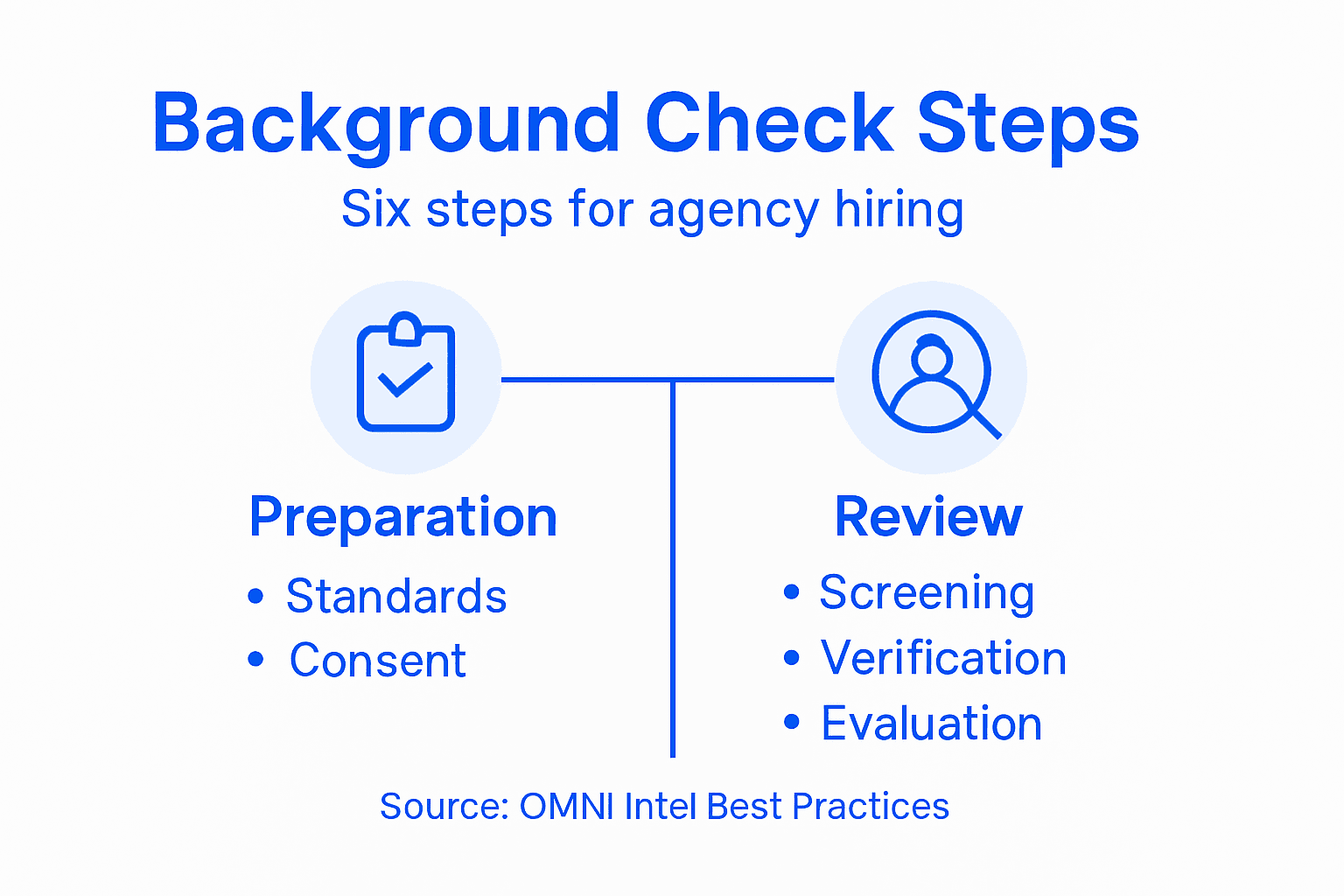
- Step 1: Define Background Check Requirements And Protocols
- Step 2: Gather Candidate Details And Consent Authorizations
- Step 3: Utilize Screening Tools And Investigative Databases
- Step 4: Verify Credentials And Cross-Check Information
- Step 5: Evaluate Findings Against Agency Standards
- Step 6: Document Results And Finalize Hiring Decisions
Quick Summary
| Key Point | Explanation |
|---|---|
| 1. Establish Clear Standards | Define background check protocols that comply with federal guidelines to ensure fair candidate evaluation and organizational integrity. |
| 2. Obtain Candidate Consent | Collect explicit written consent and provide clear disclosures about the background check process to protect candidate privacy and ensure transparency. |
| 3. Utilize Multiple Screening Tools | Leverage various investigative databases to gather comprehensive information on candidates, ensuring accurate and thorough evaluations. |
| 4. Verify Information Thoroughly | Employ direct source validation to confirm education, work history, and credentials, minimizing discrepancies and false claims. |
| 5. Document Decisions Rigorously | Maintain clear records of background investigation results and hiring decisions to ensure compliance, transparency, and future auditing. |
Step 1: Define background check requirements and protocols
Defining background check requirements and protocols is a critical first step in creating a comprehensive and legally compliant hiring process for public safety agencies. The goal is to establish clear, consistent standards that protect both the organization and potential candidates while ensuring thorough candidate evaluation.
Agencies must carefully design background check protocols that align with federal guidelines. The EEOC background check regulations mandate several key considerations for employers:
- Obtain written candidate permission before requesting background reports
- Apply screening standards equally to all candidates
- Avoid discriminatory practices based on protected characteristics
- Ensure fair and consistent evaluation processes
A robust background check protocol typically involves multiple verification stages, including:
- Criminal history verification through state and federal repositories
- Employment history confirmation
- Educational credential validation
- Professional license and certification checks
- Financial background screening
When developing these protocols, agencies must prioritize comprehensive documentation and systematic evaluation. National fingerprint-based background checks provide an additional layer of identification and verification, ensuring more accurate candidate assessment.
Background checks are not just a procedural requirement but a critical safeguard for maintaining organizational integrity and public safety.
Pro tip: Implement a standardized review process with multiple checkpoints to ensure thorough and consistent background investigations across all candidate evaluations.
Step 2: Gather candidate details and consent authorizations
Gathering candidate details and obtaining consent authorizations is a critical phase in the background check process for public safety agencies. This step ensures legal compliance, protects candidate privacy, and establishes a transparent hiring framework.
Agencies must carefully approach candidate consent and information collection, which involves several key components:
- Provide clear written disclosure about background check intentions
- Obtain explicit written consent from candidates
- Explain the scope and purpose of background investigations
- Allow candidates to review and challenge potential findings
- Protect personally identifiable information
The documentation process typically requires collecting:
- Full legal name and contact information
- Social Security number
- Signed authorization forms
- Government-issued identification
- Employment and education history details
When implementing employment screening protocols, agencies should integrate consent processes seamlessly into their onboarding workflow. This approach ensures both legal compliance and candidate understanding of the background investigation process.
Transparency and clear communication are fundamental to building trust during the candidate screening process.
Pro tip: Develop standardized consent forms that are clear, concise, and explicitly outline the background check process to minimize candidate confusion and potential legal complications.

Step 3: Utilize screening tools and investigative databases
Utilizing screening tools and investigative databases is a sophisticated process that requires strategic approach and comprehensive understanding of available resources. Public safety agencies must leverage multiple data sources to conduct thorough background investigations that reveal critical candidate information.
Agencies can implement national fingerprint-based background checks that provide comprehensive criminal history insights across federal and state repositories. These screening methodologies involve several key investigative techniques:
- Access state criminal record databases
- Submit fingerprint records for positive identification
- Cross-reference multiple information sources
- Verify employment and educational credentials
- Conduct nationwide criminal background searches
Effective screening requires integrating multiple investigative tools:
- Federal criminal history repositories
- State law enforcement databases
- National sex offender registries
- Professional license verification systems
- Credit reporting agency background check services
When implementing employment screening protocols, agencies should prioritize comprehensive data collection that addresses potential insider threat risks and ensures candidate suitability for sensitive public safety roles.
Here’s how different investigative databases contribute to candidate screening outcomes:
| Database Type | Information Provided | Screening Impact |
|---|---|---|
| Federal Criminal Repositories | National criminal history | Identifies federal offenses |
| State Law Enforcement Databases | Local arrest records | Reveals state or local convictions |
| Professional License Systems | License status, credentials | Validates professional eligibility |
| Credit Reporting Agencies | Financial background | Assesses risk factors |
| Sex Offender Registries | Registry listings | Flags public safety concerns |
Comprehensive background investigations are the foundation of maintaining organizational integrity and public trust.
Pro tip: Develop a systematic cross-referencing approach that combines multiple investigative databases to create the most accurate and comprehensive candidate profile possible.
Step 4: Verify credentials and cross-check information
Verifying credentials and cross-checking information is a meticulous process that requires thorough investigation and strategic validation of candidate background details. Public safety agencies must develop comprehensive verification protocols to ensure the accuracy and reliability of candidate-provided information.
Agencies can leverage employment eligibility verification systems to confirm identity and work authorization by systematically comparing information across multiple official records. The credential verification process involves several critical steps:
- Request official transcripts directly from educational institutions
- Contact previous employers for comprehensive work history verification
- Validate professional licenses and certifications
- Check references through direct communication
- Confirm social security number and identity through authorized databases
Effective credential verification requires a multi-layered approach:
- Primary source verification
- Secondary document cross-referencing
- Comprehensive background investigation techniques
- Digital database confirmation
- Direct communication with issuing authorities
When conducting background information checks, agencies must maintain strict adherence to legal standards that prevent discriminatory practices while ensuring thorough information validation.
Accurate credential verification is the cornerstone of building a trustworthy and competent public safety workforce.
Pro tip: Develop a standardized verification checklist that ensures consistent and comprehensive credential validation across all candidate screening processes.
Step 5: Evaluate findings against agency standards
Evaluating background check findings against established agency standards requires a systematic and objective approach that balances comprehensive assessment with legal compliance. Public safety agencies must develop rigorous frameworks for interpreting background investigation results while maintaining fairness and protecting candidate rights.
Agencies should implement systematic background evaluation protocols that carefully assess candidate history against predefined organizational criteria. The evaluation process involves several critical considerations:
- Assess potential risks to organizational security
- Determine candidate suitability for specific roles
- Identify potential disqualifying factors
- Evaluate integrity and behavioral consistency
- Maintain objective and unbiased review standards
Comprehensive findings evaluation requires a structured approach:
- Compare background details against position-specific requirements
- Review historical information holistically
- Consider context and patterns of behavior
- Assess potential rehabilitation or mitigating circumstances
- Document rationale for decision making
When reviewing background investigation results, agencies must ensure decisions are consistent, fair, and free from discriminatory practices that could violate federal employment guidelines.
Background evaluations are not about eliminating candidates but understanding their potential contribution and managing organizational risk.
Pro tip: Create a standardized scoring matrix that provides clear, objective criteria for evaluating background check findings across different candidate profiles and agency roles.
Step 6: Document results and finalize hiring decisions
Documenting background check results and finalizing hiring decisions represents the critical culmination of a comprehensive candidate screening process. Public safety agencies must approach this stage with meticulous attention to legal compliance, transparency, and thorough record management.
Agencies must carefully follow employment verification protocols that ensure comprehensive documentation and candidate notification. The documentation and decision-making process involves several key components:
- Compile comprehensive background investigation findings
- Prepare detailed candidate assessment reports
- Maintain strict confidentiality of sensitive information
- Develop clear rationale for hiring decisions
- Retain required documentation for regulatory compliance
The final hiring decision process requires systematic documentation:
- Review complete background investigation report
- Compare findings against agency hiring standards
- Determine candidate suitability for specific role
- Prepare formal documentation of decision
- Communicate results to candidate
When processing background check results, agencies must provide candidates with appropriate notifications and summaries of findings, ensuring transparency and legal adherence.
Effective documentation transforms background investigations from administrative tasks into strategic workforce management tools.
Pro tip: Develop a standardized decision documentation template that captures essential information systematically while protecting candidate privacy and organizational interests.
To better understand the stages of a public safety hiring background check, see the consolidated summary below:
| Step | Main Goal | Key Challenge | Best Practice |
|---|---|---|---|
| Define Requirements | Establish fair, legal protocols | Align standards with federal laws | Document all procedures clearly |
| Gather Details & Consent | Secure candidate information and permissions | Ensure transparent communication | Use explicit, standardized consent forms |
| Employ Screening Tools | Access thorough investigative databases | Integrate multiple systems reliably | Cross-reference all findings |
| Verify Credentials | Confirm education, work history, licenses | Detect discrepancies or false claims | Use direct source validation |
| Evaluate Findings | Interpret results against agency rules | Maintain fair, unbiased reviews | Employ objective scoring frameworks |
| Document & Decide | Record findings and make decisions | Balance confidentiality and compliance | Retain records for future audits |
Strengthen Your Hiring Process with OMNI Intel’s Tailored Solutions
Navigating the complexities of employee background checks requires precision, compliance, and trustworthy data. This article highlights the challenges public safety agencies face, such as ensuring legal adherence, verifying credentials accurately, and conducting thorough evaluations to protect organizational integrity. If your agency aims to reduce hiring risks while maintaining transparency and fairness, OMNI Intel offers the ideal platform. With AI-driven tools and law enforcement principles at its core, our solutions streamline every step from candidate screening to final decisions.

Discover how you can enhance your hiring with Hiring Best Practices | OMNI Intel. Take control of your background investigations and ensure consistent, unbiased evaluations all while speeding up recruitment cycles. Don’t wait to protect your agency’s reputation and community safety. Get started today at https://omniintel.co/get-started and experience a background screening platform built specifically for public safety agencies.
Frequently Asked Questions
What are the key steps to conduct employee background checks for agencies?
Conducting employee background checks involves several key steps: defining check requirements, gathering candidate details and consent, utilizing screening tools, verifying credentials, evaluating findings, and documenting results. Start by documenting each step to ensure a comprehensive and compliant process.
How do I establish background check protocols that align with federal guidelines?
To establish background check protocols that comply with federal guidelines, ensure you have written candidate permission, apply screening standards equally, and avoid discriminatory practices. Document these protocols clearly and review them regularly to adapt to any legal changes.
What information should I collect from candidates during the background check process?
You should collect full legal names, contact information, Social Security numbers, signed consent forms, and government-issued identification, along with details of their employment and education history. Keep this information secure to protect candidates’ privacy.
How can I ensure fair and consistent evaluations of background check findings?
To ensure fair evaluations, implement a standardized review process that uses objective criteria to assess candidates against agency standards. Maintain documentation of all evaluations to support fairness and transparency in decision-making.
What should be included in the final documentation of background check results?
The final documentation should include a comprehensive report of the background investigation findings, a rationale for hiring decisions, and assurance of confidentiality for sensitive information. Create a formal template to streamline this documentation process.
How can I improve the efficiency of the employee background check process?
You can improve efficiency by integrating multiple screening tools and investigative databases to collect information quickly and accurately. Consider developing a checklist to streamline each step of the process and reduce overall time spent on candidate evaluations.