
Background Check Laws for Agencies: Ensuring Safe Hires
Selecting new team members for public safety roles means facing both immense responsibility and scrutiny. With community trust at stake, agency leaders know every hiring decision can impact public welfare. As federal and state laws around background check compliance continue evolving, understanding the requirements is vital to avoid costly mistakes and discriminatory practices. This guide unpacks key legal standards, actionable screening steps, and practical tips to help agencies safeguard operations while keeping candidate rights front and center.
Table of Contents
- Defining Background Checks For Agencies
- Federal Laws Shaping Background Screening
- State-Specific Requirements And Variations
- Obtaining Consent And Candidate Rights
- Common Pitfalls And Agency Compliance Risks
Key Takeaways
| Point | Details |
|---|---|
| Importance of Background Checks | Comprehensive background checks assess candidate suitability and mitigate workplace risks. |
| Legal Compliance | Adherence to federal and state regulations is crucial in maintaining fair hiring practices. |
| Candidate Rights | Candidates must be informed about the background check process and have the right to dispute findings. |
| Avoiding Common Pitfalls | Agencies should implement standardized protocols to prevent inconsistent screening and legal risks. |
Defining Background Checks for Agencies
Background checks are comprehensive investigative processes organizations conduct to evaluate potential employees’ professional and personal histories. These systematic reviews help agencies assess candidate suitability, integrity, and potential workplace risks before making critical hiring decisions.
Background investigations involve multiple dimensions of screening designed to provide employers with a holistic view of an applicant’s background. Background checks for government employees typically include multiple verification steps to ensure organizational safety and compliance.
Key components of background checks often encompass:
- Criminal record searches
- Employment verification
- Education credential confirmation
- Professional license validation
- Credit history reviews
- Social media presence assessment
- References and personal recommendation checks
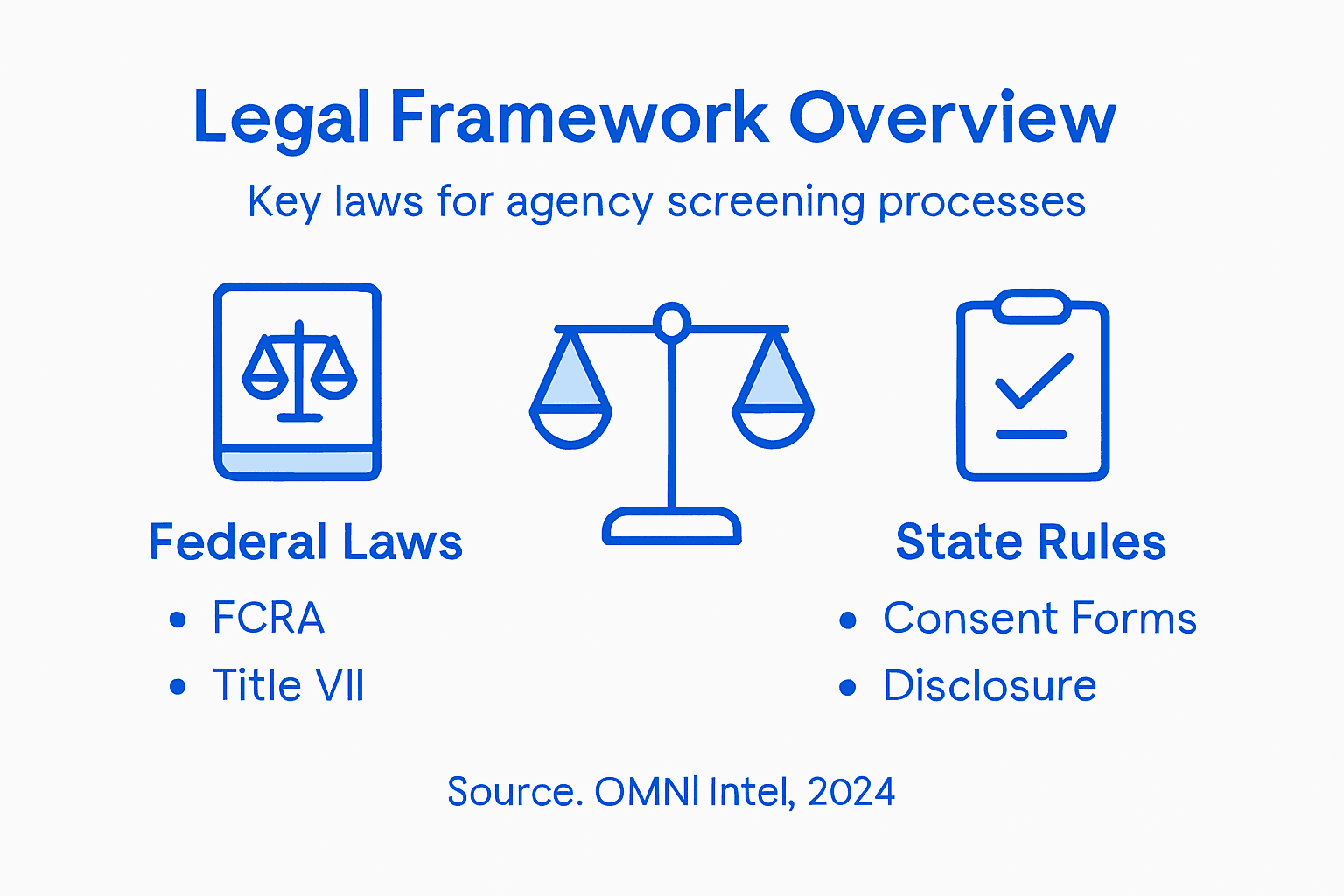
The legal framework surrounding background checks requires strict adherence to federal guidelines. According to federal employment screening regulations, employers must obtain explicit consent from candidates and follow non-discrimination protocols that protect applicants’ rights.
Specifically for public safety agencies, background checks serve a critical risk mitigation function. Positions involving public trust demand rigorous screening to prevent potential misconduct and ensure community safety. The comprehensive nature of these investigations goes beyond standard employment screenings, often requiring deeper levels of personal and professional examination.
Pro tip: Develop a standardized background check protocol that balances thorough investigation with candidate privacy and legal compliance.
Federal Laws Shaping Background Screening
Background screening for public safety agencies is governed by a complex network of federal regulations designed to protect both employers and job candidates. Federal employment screening guidelines establish critical standards for conducting comprehensive and fair background investigations.
Three primary federal laws significantly impact background screening practices:
Here’s a summary comparing federal background screening laws and their core protections:
| Federal Law | Purpose | Key Protection |
|---|---|---|
| FCRA | Regulates consumer reporting | Ensures report accuracy and consent |
| Title VII | Prevents employment discrimination | Safeguards protected groups during hiring |
| ADA | Protects individuals with disabilities | Prohibits exclusion based solely on disability |
- Fair Credit Reporting Act (FCRA): Regulates how consumer reports are obtained and used
- Title VII of the Civil Rights Act: Prohibits employment discrimination
- Americans with Disabilities Act (ADA): Protects individuals with disabilities from discriminatory screening
The legal framework requires employers to follow strict protocols when conducting background checks. These regulations mandate that agencies must:
- Obtain written consent from candidates before screening
- Provide candidates with opportunities to dispute inaccurate information
- Maintain consistent screening standards across all applicants
- Protect sensitive personal information
Under federal nondiscrimination laws, public safety agencies cannot use background check information to discriminate against candidates based on protected characteristics such as race, color, national origin, sex, religion, disability, or age. This ensures a fair and equitable hiring process that focuses on job-related qualifications and potential risks.
Specifically for public safety roles, these laws balance the need for rigorous screening with protecting individual rights. Agencies must demonstrate that background check criteria directly relate to job performance and safety requirements, preventing arbitrary or discriminatory exclusions.
Pro tip: Develop a standardized background check policy that explicitly aligns with federal guidelines and consistently applies screening criteria across all candidates.
State-Specific Requirements and Variations
Background check regulations demonstrate significant complexity across different states, with each jurisdiction implementing unique requirements for public safety agencies. State-level background check variations create a challenging landscape for consistent nationwide screening practices.
Key variations in state background check requirements include:
- Criminal record lookback periods
- Restrictions on using older criminal history information
- Specific consent and disclosure protocols
- Additional protected characteristics beyond federal guidelines
- Different fingerprinting and identification verification processes
Some states have implemented more stringent background check regulations, particularly for roles involving vulnerable populations. Comprehensive background check requirements often mandate multiple layers of screening, including:
- National criminal database searches
- State-specific criminal history checks
- Child abuse and neglect registry screenings
- Sex offender registry verifications
- Interstate background investigation protocols
Public safety agencies must navigate these complex state-level requirements by developing flexible screening processes that can adapt to diverse regulatory environments. This approach requires continuous monitoring of changing state laws and maintaining comprehensive documentation of screening procedures.

Regional differences can significantly impact background check strategies. For instance, Western states often have more strict privacy protections, while Northeastern states might have more extensive criminal record disclosure requirements. Agencies must remain agile and well-informed about these nuanced regulatory landscapes.
Pro tip: Develop a comprehensive matrix tracking state-specific background check requirements to ensure consistent and compliant screening across different jurisdictions.
Obtaining Consent and Candidate Rights
Background checks in public safety agencies require a delicate balance between organizational security and individual privacy. Employer background check regulations establish critical guidelines for protecting candidate rights during the screening process.
Key consent and candidate rights include:
- Written permission before initiating background checks
- Right to receive a copy of background investigation reports
- Opportunity to dispute inaccurate information
- Protection against discriminatory screening practices
- Transparency in decision-making processes
The consent process involves several crucial steps:
- Provide clear, written disclosure about background check intent
- Obtain explicit written authorization from the candidate
- Inform candidates about potential adverse action possibilities
- Deliver copies of background reports if negative decisions are considered
- Allow candidates reasonable time to challenge report findings
Candidate rights under background check laws extend beyond simple notification. Public safety agencies must ensure comprehensive transparency, allowing individuals to understand how their personal information will be used and evaluated during the screening process.
Specifically for public safety roles, agencies must demonstrate a nuanced approach that respects individual privacy while maintaining rigorous screening standards. This means creating clear communication channels, providing detailed explanations of background check procedures, and establishing fair review mechanisms for candidates.
Pro tip: Develop a standardized candidate consent packet that clearly explains background check procedures, rights, and potential outcomes in plain, understandable language.
Common Pitfalls and Agency Compliance Risks
Background check processes in public safety agencies are fraught with potential legal and operational risks that demand meticulous attention. Background check compliance challenges represent complex legal terrain that agencies must carefully navigate.
Critical compliance risks include:
- Inconsistent screening procedures across candidates
- Failing to obtain explicit written consent
- Mishandling confidential background information
- Discriminatory application of background check results
- Inadequate documentation of screening processes
The most significant legal vulnerabilities emerge from several key areas:
- Improper use of background check information
- Incomplete or inaccurate record verification
- Lack of standardized review protocols
- Insufficient candidate notification processes
- Failure to provide opportunities to dispute findings
Criminal record discrepancies can create substantial legal risks, particularly when private screening reports conflict with official state records. These inconsistencies may lead to unfair employment decisions and potential litigation.
To visualize compliance risks, see how common pitfalls impact agency operations:
| Compliance Risk | Potential Impact | Preventive Action |
|---|---|---|
| Inconsistent screening | Unequal hiring outcomes | Standardized protocols |
| Confidential data misuse | Legal liability | Secure data handling |
| Discriminatory screening | Litigation risk | Bias-free review procedures |
Public safety agencies must develop robust internal mechanisms to mitigate these risks. This involves creating comprehensive training programs, establishing clear screening guidelines, and implementing rigorous verification processes that prioritize both organizational safety and individual rights.
Pro tip: Conduct regular internal audits of background screening processes to identify and proactively address potential compliance vulnerabilities.
Strengthen Your Agency’s Hiring Process with Reliable Background Screening
Navigating complex background check laws poses ongoing challenges for public safety agencies determined to make safe hires while staying fully compliant. The key hurdles include managing multi-layered federal and state regulations, ensuring candidate consent and rights, and avoiding costly compliance pitfalls. With rigorous demands for accuracy, consistency, and privacy, agencies need a background check solution that aligns with these legal frameworks and protects your organization’s reputation.
Hiring Best Practices | OMNI Intel offers in-depth insights on implementing screening protocols that reduce risk and support fair, transparent hiring decisions.

Choose OMNI Intel’s tailored background screening platform designed specifically for public safety agencies to:
- Conduct comprehensive, legally compliant investigations with ease
- Automate candidate consent and reporting to protect privacy and rights
- Use AI-driven tools to expedite hiring while maintaining integrity
- Monitor personnel post-hire for ongoing risk mitigation
Don’t wait for a compliance issue to challenge your agency’s integrity. Visit https://omniintel.co/get-started now to implement a screening process that upholds safety, fairness, and trust across your entire recruitment cycle.
Frequently Asked Questions about Background Check Laws for Agencies
What are the key components of a background check for agencies?
Background checks typically include criminal record searches, employment verification, education credential confirmation, professional license validation, credit history reviews, social media assessments, and reference checks.
What are the federal laws that govern background checks for agencies?
The main federal laws include the Fair Credit Reporting Act (FCRA), which regulates consumer reporting; Title VII of the Civil Rights Act, which prevents employment discrimination; and the Americans with Disabilities Act (ADA), which protects individuals with disabilities from discrimination during screenings.
How can agencies ensure compliance with background check laws?
Agencies can ensure compliance by developing standardized background check policies, obtaining written consent from candidates, maintaining consistent screening standards, and protecting sensitive personal information throughout the process.
What rights do candidates have in the background check process?
Candidates have the right to receive clear disclosure about the intent of background checks, to give explicit written consent, to receive copies of investigation reports, to dispute inaccuracies, and to be protected against discriminatory practices during hiring.