

How investigation principles enhance public safety hiring
Roughly 20% of officers receive a misconduct report within five years of hire, and research consistently shows those warning signs existed before the badge was ever issued. Yet most agencies still rely on conventional background checks that were never designed to surface the behavioral patterns investigators are trained to detect. The gap between what traditional HR screening captures and what a rigorous investigative process reveals is where misconduct takes root. This guide walks HR managers and hiring decision-makers through the practical application of investigation principles at every stage of public safety recruitment, from initial application review through final suitability determination.
Table of Contents
- Why apply investigation principles in hiring?
- The investigative mindset: From applicant to inquiry
- Key investigation methodologies for public safety hiring
- Legal and ethical guidelines in investigative hiring
- Integrating technology and analytics for improved vetting
- Applying investigative principles: Practical steps for HR
- Enhance your hiring process with expert screening solutions
- Frequently asked questions
Key Takeaways
| Point | Details |
|---|---|
| Misconduct prevention | Adopting investigative vetting reduces misconduct by spotlighting early warning signs. |
| Multi-source verification | Corroborating applicant details from several sources ensures higher integrity and transparency. |
| Legal and ethical compliance | Following federal guidelines and fairness standards is crucial for safe public safety hiring. |
| Technology advantage | Integrating software and validated analytics eliminates gaps missed by manual checks. |
| Practical application | A step-by-step investigative checklist empowers HR to make defensible, evidence-based hiring decisions. |
Why apply investigation principles in hiring?
Having established why misconduct persists despite conventional hiring methods, let’s unpack how investigation principles in hiring provide a superior vetting framework.
Traditional HR screening was built for corporate environments where the stakes of a bad hire are financial. In public safety, a flawed hire can cost lives, erode community trust, and expose an agency to significant legal liability. The investigative approach reframes the entire process.
“Background investigations for law enforcement must include thorough record verification, interviews with references, neighbors, and family members, polygraph and psychological evaluations, and credit and criminal checks — these are not optional enhancements but core requirements.”
— Background Investigation Manual, California POST
The core investigative tenets that translate directly into hiring are:
- Objectivity: Evaluating every applicant against the same documented criteria, without allowing familiarity or urgency to lower the bar.
- Thoroughness: Pursuing every lead, discrepancy, and gap in an applicant’s history rather than accepting surface-level answers.
- Multi-source verification: Corroborating claims through independent channels — records, interviews, databases — rather than relying on self-reported information alone.
- Documentation: Maintaining a clear, auditable record of every finding so that suitability decisions can be defended and reviewed.
When these principles replace checkbox-style screening, agencies stop asking “Did anything disqualifying appear?” and start asking “Does the totality of evidence support this hire?”
The investigative mindset: From applicant to inquiry
Understanding the need for objectivity and thoroughness, let’s look at what adopting an investigative mindset in hiring actually entails.
The most effective shift an HR team can make is treating each applicant file as an active investigation rather than a form to be processed. That means forming hypotheses early. When a Personal History Statement (PHS) shows a two-year employment gap, the investigator’s instinct is not to accept the explanation at face value but to corroborate it through records, references, and structured interviews.
Applying core investigative tenets to hiring means treating applicant vetting like a structured inquiry: hypothesize from the PHS, then corroborate through records, interviews, and polygraph where authorized. This approach catches inconsistencies that self-reported data routinely conceals.

The table below illustrates how standard HR practice compares to an investigative hiring model:
| Dimension | Standard HR approach | Investigative hiring model |
|---|---|---|
| Information source | Applicant self-report | Multi-source corroboration |
| Employment gaps | Accepted with explanation | Verified through records and references |
| Reference checks | Provided contacts only | Developed sources, neighbors, colleagues |
| Discrepancy handling | Noted, rarely pursued | Treated as investigative lead |
| Documentation | Application file | Auditable investigation record |
| Decision basis | Absence of disqualifiers | Totality of evidence |
Pro Tip: Build your pre-employment investigation process around the PHS as a living document. Every discrepancy between the PHS and a verified record is an investigative lead, not an administrative error to be corrected and forgotten. Agencies that treat PHS inconsistencies as red flags rather than paperwork problems catch far more integrity issues before hire. Review avoiding hiring risks for additional guidance on structuring this process.
Key investigation methodologies for public safety hiring
With an investigative approach in place, HR teams need concrete tools. Here are the leading methodologies and how to apply them.
Key methodologies for public safety background investigations include structured PHS review, database checks, employment and education verification, social media review, and neighborhood canvassing. Each serves a distinct evidentiary purpose.
- Structured Personal History Statement (PHS): Collect a detailed, signed PHS covering at minimum the prior ten years of residence, employment, education, and financial history. Inconsistencies become investigative leads.
- Database checks: Run NCIC, credit history, and driving records. Cross-reference against state and national decertification indexes to identify officers previously removed from other agencies.
- Employment verification methods: Contact prior employers directly, not just HR departments. Supervisors and colleagues often provide context that official records omit.
- Education and credential verification: Confirm degrees, certifications, and licenses through issuing institutions. Credential fraud is more common in public safety applications than most agencies expect.
- Social media review: Assess publicly available content for indicators of bias, dishonesty, or conduct incompatible with public trust. Document findings with screenshots and timestamps.
- Neighborhood canvassing: Interview neighbors at prior residences to surface behavioral patterns that references and records will not reveal.
All of these steps must align with federal hiring regulations and agency-specific policy. Reviewing background check best practices before deploying any new methodology ensures your process remains both thorough and legally defensible.
| Methodology | Primary purpose | Coverage period |
|---|---|---|
| PHS review | Baseline history and discrepancy detection | 10 years minimum |
| NCIC and criminal database | Criminal history and warrants | Full history |
| Credit check | Financial integrity and vulnerability | 7 years |
| Driving records | Behavioral risk indicators | 3 to 7 years |
| Social media review | Character and integrity assessment | Publicly available |
| Neighborhood canvassing | Behavioral pattern corroboration | Prior residences |
Legal and ethical guidelines in investigative hiring
Adopting cutting-edge methods means navigating complex legal and ethical terrain. Here’s how to stay compliant and fair.
Federal regulations under the Fair Chance Act and 5 CFR Part 920 prohibit criminal history inquiries before a conditional job offer, with explicit exemptions for public safety positions. Suitability criteria under 5 CFR Part 731 include prior misconduct, criminal conduct, and drug abuse, giving agencies a structured framework for disqualification decisions.
Key compliance requirements for investigative hiring include:
- Timing of criminal inquiries: For non-exempt positions, criminal history review must follow a conditional offer. Public safety roles carry statutory exemptions, but agencies should document the legal basis for each inquiry.
- Suitability standards: Apply the criteria in 5 CFR 731 consistently. Inconsistent application creates disparate impact liability.
- Privacy boundaries: Neighborhood canvassing and social media review must stay within publicly available information. Accessing private accounts or protected data without authorization violates federal privacy law.
- Bias mitigation: Vetting bias research shows that minority applicants receive lower approval rates in complex vetting scenarios, underscoring the need for structured, criteria-based decision-making rather than subjective judgment.
Reviewing law enforcement hiring best practices and verifying applicant credentials within a documented compliance framework protects both the agency and the applicant.
Integrating technology and analytics for improved vetting
With compliance and ethics secured, next-level hiring demands robust technology. Here’s how public safety agencies can deploy analytics and digital tools effectively.
Psychological testing is one of the most empirically grounded tools available. MMPI-2-RF and MPQ assessments predict POST-10 suitability dimensions and post-hire behavioral outcomes with validated accuracy. Notably, prior law enforcement experience does not automatically reduce risk; candidates with disciplinary history from previous agencies may actually present elevated misconduct risk.
Research on ethnic bias and software integration confirms that traditional manual processes miss red flags that integrated screening software would flag, and that ethnic bias affects approval rates in complex vetting scenarios. Technology does not eliminate bias, but structured, criteria-driven platforms reduce its influence significantly.
Pro Tip: When selecting screening software for your investigative workflow for law enforcement, prioritize platforms that generate auditable decision logs. If a suitability determination is ever challenged, a documented, criteria-based record is your strongest defense.
Key technology capabilities that strengthen public safety vetting:
- Automated cross-referencing of decertification indexes across multiple states
- Integrated psychological assessment scoring with validated benchmarks
- Social media monitoring with flagging algorithms for integrity-related content
- Continuous post-hire monitoring to detect emerging risk indicators
- Workflow integration with applicant tracking systems to reduce manual data entry errors
Review the step-by-step investigative hiring framework to see how these tools fit into a structured process.
Applying investigative principles: Practical steps for HR
Finally, HR teams need practical guidance. Here’s how to apply these investigative principles at every step of the hiring process.
“A thorough background investigation is not a bureaucratic formality — it is the agency’s last, best opportunity to identify a candidate whose history suggests they will not serve the public with integrity.”
The following checklist translates investigative principles into operational steps:
- Issue and review the PHS before any interview. Flag every gap, inconsistency, and unexplained transition as a potential investigative lead.
- Run database checks covering NCIC, credit, driving records, and state decertification indexes simultaneously to reduce processing time.
- Conduct structured reference interviews using a standardized question set. Develop additional sources beyond those the applicant provides.
- Perform neighborhood canvassing at all prior residences listed in the PHS, particularly for law enforcement and dispatch roles.
- Review social media systematically, documenting findings with timestamps. Apply the same criteria to every applicant.
- Administer validated psychological assessments such as the MMPI-2-RF before the final suitability determination.
- Compile a complete investigation record that documents every source contacted, every finding made, and the rationale for the final decision.
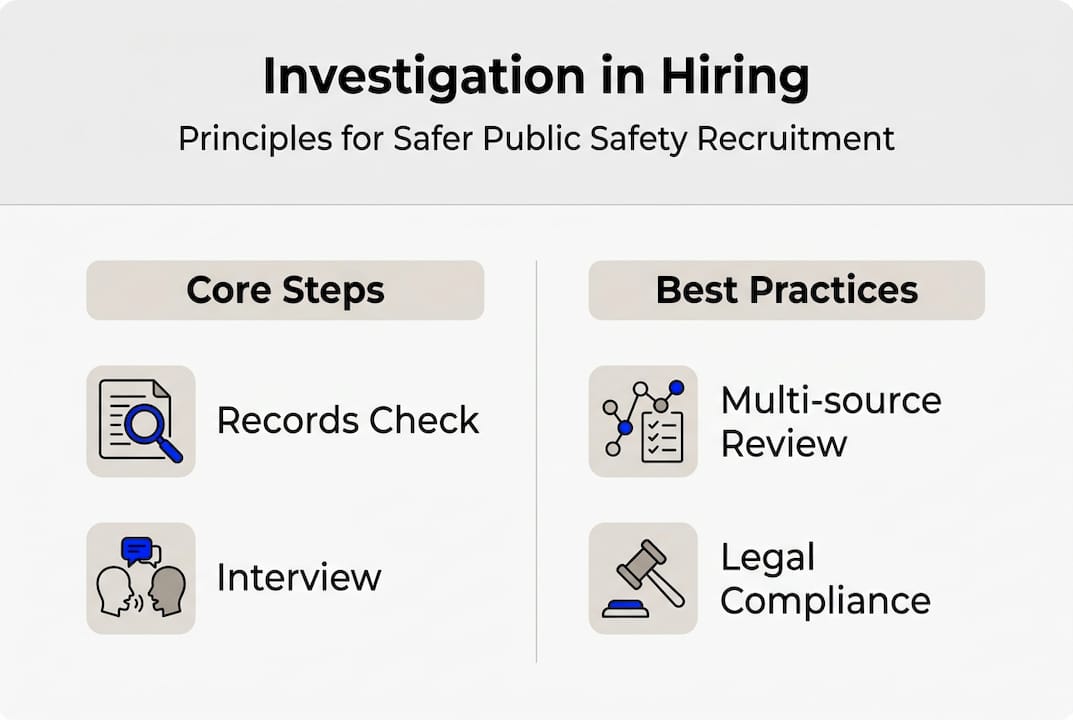
Key methodologies including structured PHS review, database checks, employment verification, social media review, and neighborhood canvassing form the evidentiary backbone of any defensible suitability decision. Agencies that follow public safety hiring best practices and document each step consistently are far better positioned to defend their decisions and protect their communities.
Enhance your hiring process with expert screening solutions
Ready to move from investigative theory to operational practice? OMNI Intel was built specifically for public safety agencies that need more than a generic background check vendor.

OMNI Intel’s pre-employment screening services apply the same investigative rigor outlined in this guide, combining database checks, credential verification, psychological assessment coordination, and social media review into a single, auditable workflow. Whether you oversee hiring for a law enforcement agency, a fire and EMS department, or a dispatch center, OMNI Intel’s background checks for agencies are tailored to the specific suitability standards your roles demand. Explore OMNI Intel’s public safety background investigations to see how investigative-grade screening can reduce your time-to-hire, lower misconduct risk, and produce defensible, evidence-based hiring decisions.
Frequently asked questions
What are the core investigation principles used in public safety hiring?
Thorough record verification, structured interviews, psychological testing, and multi-source corroboration are the core investigative principles applied to public safety hiring. These methods work together to surface behavioral patterns that self-reported data alone cannot reveal.
How do federal regulations shape background investigations for public safety jobs?
Federal law prohibits criminal history inquiries before a conditional offer except for public safety positions, and agencies must apply suitability criteria covering misconduct, criminal conduct, and drug abuse consistently across all candidates.
Which psychological assessments are most predictive for public safety suitability?
The MMPI-2-RF and MPQ are empirically validated tools for predicting suitability in public safety hiring, with demonstrated accuracy across POST-10 suitability dimensions and post-hire behavioral outcomes.
What are the risks of relying only on manual background checks?
Manual checks alone frequently miss red flags that integrated screening software would detect, and research shows that subjective manual review can introduce ethnic bias into approval decisions, particularly in complex vetting scenarios.
How can HR managers apply investigative principles to their screening process?
HR managers should document applicant history through a structured PHS, corroborate all claims from multiple independent sources, conduct standardized interviews, and integrate analytic tools to ensure every suitability determination is evidence-based and auditable.
Recommended
- Master investigation principles for safe public safety hiring
- Pre-Employment Investigations: Ensuring Safe Hires • OMNI Intel
- Enhancing integrity in public safety hiring: a guide
- Avoid Hiring Risks: Master Pre-Employment Background Investigations for Public Safety Professionals • OMNI Intel
- Drug Testing Cuts Workplace Accidents by 45% in 2026