

Tailored Screening Solutions Boost Public Safety Hiring
When the Larimer County Sheriff’s Office adopted a tailored digital screening platform, administrators reported better candidates and smarter workflows almost immediately. That outcome is not an accident. Generic background checks were built for retail and corporate hiring, not for agencies where a single bad hire can compromise community safety, trigger federal audits, or end careers. Public safety HR managers and decision-makers need screening solutions that match the complexity, urgency, and regulatory weight of their roles. This article explains what tailored screening solutions are, how they strengthen recruitment integrity, and how your agency can implement them with confidence.
Table of Contents
- What are tailored screening solutions?
- How tailored screening strengthens recruitment integrity
- Compliance advantages for public safety agencies
- Practical steps: Implementing tailored screening solutions
- Power your agency with OMNI Intel’s tailored solutions
- Frequently asked questions
Key Takeaways
| Point | Details |
|---|---|
| Boosted candidate quality | Tailored solutions directly improve candidate pool and completion rates for public safety hiring. |
| Faster, smarter workflows | Digital customization cuts screening time by up to 95 percent in some agencies. |
| Stronger compliance controls | Role-based security and audit tools help agencies consistently meet and document regulatory requirements. |
| Easy implementation steps | Adopting tailored platforms can be streamlined with proper assessment and leadership buy-in. |
What are tailored screening solutions?
Tailored screening solutions are background investigation platforms designed and configured specifically for the operational, legal, and security requirements of a particular sector. For public safety agencies, that means the platform understands the difference between vetting a patrol officer, a 911 dispatcher, a volunteer firefighter, and a private security contractor. Generic solutions treat all of these roles the same. Tailored solutions do not.
The distinction matters more than most HR managers initially realize. Consider what separates the two approaches:
- Process depth: Tailored platforms include investigator-driven checks, polygraph scheduling, psychological evaluation tracking, and decertification index queries. Generic platforms typically stop at criminal history and employment verification.
- Compliance alignment: Tailored solutions are built to reflect FCRA requirements, state-specific public safety statutes, and local data access thresholds. Generic tools often require manual workarounds to achieve the same result.
- Data security: Role-based access controls limit who sees sensitive applicant data at each stage of the investigation. Generic platforms rarely offer this level of granularity.
- Workflow integration: Tailored platforms connect directly with public safety hiring systems, applicant tracking tools, and scheduling software. Centralized digital platforms improve visibility and completion rates across the entire investigation pipeline.
For a deeper look at how these systems are structured, screening systems explained provides a useful framework for agencies evaluating their options.
Pro Tip: Before requesting a platform demo, map out every role your agency hires for and list the specific compliance requirements attached to each. This exercise reveals customization gaps that generic vendors cannot fill and gives you concrete criteria to evaluate tailored solutions against.
How tailored screening strengthens recruitment integrity
Recruitment integrity means every hiring decision is defensible, documented, and free from procedural shortcuts. Tailored screening solutions support that standard in ways that generic tools simply cannot replicate. Here are the key mechanisms:
- Real-time tracking: Investigators and HR managers can monitor exactly where each applicant stands in the background investigation process, eliminating the guesswork that delays conditional offers.
- Bottleneck identification: Dashboards surface which steps consistently slow down completion, whether that is reference interviews, medical clearances, or document submissions, so supervisors can intervene early.
- Role-based access: Data security in screening depends on limiting who can view, edit, or approve sensitive records. Tailored platforms enforce this automatically, reducing both internal risk and liability exposure.
- Audit trails: Every action taken within the platform is logged with a timestamp and user ID, creating a defensible record that protects the agency during legal challenges or regulatory reviews.
- Candidate experience: Applicants receive clear instructions, digital document submission options, and status updates, which reduces dropout rates among qualified candidates.
The performance gap between generic and tailored approaches is significant. The table below illustrates typical outcome differences:
| Metric | Generic screening | Tailored screening |
|---|---|---|
| Average turnaround time | 30 to 45 days | 10 to 18 days |
| Completion rate | 60 to 70% | 85 to 95% |
| Audit trail availability | Manual or partial | Automated and complete |
| Role-based access controls | Limited | Fully configurable |
| Regulatory update integration | Infrequent | Real-time or scheduled |
Statistic callout: Some public safety agencies using AI-enabled tailored platforms have reported 90 to 95% reductions in total screening time. That is not a marginal improvement. It is a structural shift in how agencies recruit.
For HR managers concerned about candidate privacy alongside these efficiency gains, privacy in public safety hiring outlines the legal framework agencies must navigate in 2026.
Compliance advantages for public safety agencies
Compliance in public safety hiring is not a checkbox exercise. It is a continuous obligation that touches federal law, state statutes, local ordinances, and agency-specific policy. The consequences of non-compliance range from costly litigation to decertification of officers and reputational damage that affects future recruitment for years.
The primary compliance challenges public safety HR managers face include:
- FCRA obligations: The Fair Credit Reporting Act governs how consumer reports, including background checks, are obtained, used, and disputed. Violations carry civil penalties and class-action exposure.
- State-specific statutes: Many states have enacted laws that restrict the use of certain criminal history data, impose waiting periods before adverse action, or require specific disclosure language.
- Data access thresholds: Not every investigator or HR staff member should have access to every record. Mismanaged access is one of the most common compliance failures in agency investigations.
- Audit and reporting requirements: Regulatory bodies increasingly require agencies to demonstrate documented, consistent screening processes. Informal or paper-based systems cannot meet this standard reliably.
Tailored platforms address these challenges through built-in features that generic tools lack:
- Automated role-based security that restricts record access by job function and clearance level
- Audit logging that captures every data interaction for regulatory review
- Real-time regulatory update modules that flag changes in state or federal law
- Configurable adverse action workflows that align with FCRA timelines
“Tailored solutions ensure role-based security and compliance, giving agencies the documentation infrastructure they need to withstand scrutiny at every level.”
Non-compliance does not just create legal risk. It erodes public trust. When an agency’s hiring process is questioned, the credibility of every officer, dispatcher, or contractor hired through that process comes under scrutiny. Explore how public safety recruitment technology is evolving to meet these demands, and review transparency in screening for guidance on building defensible, auditable processes.

Practical steps: Implementing tailored screening solutions
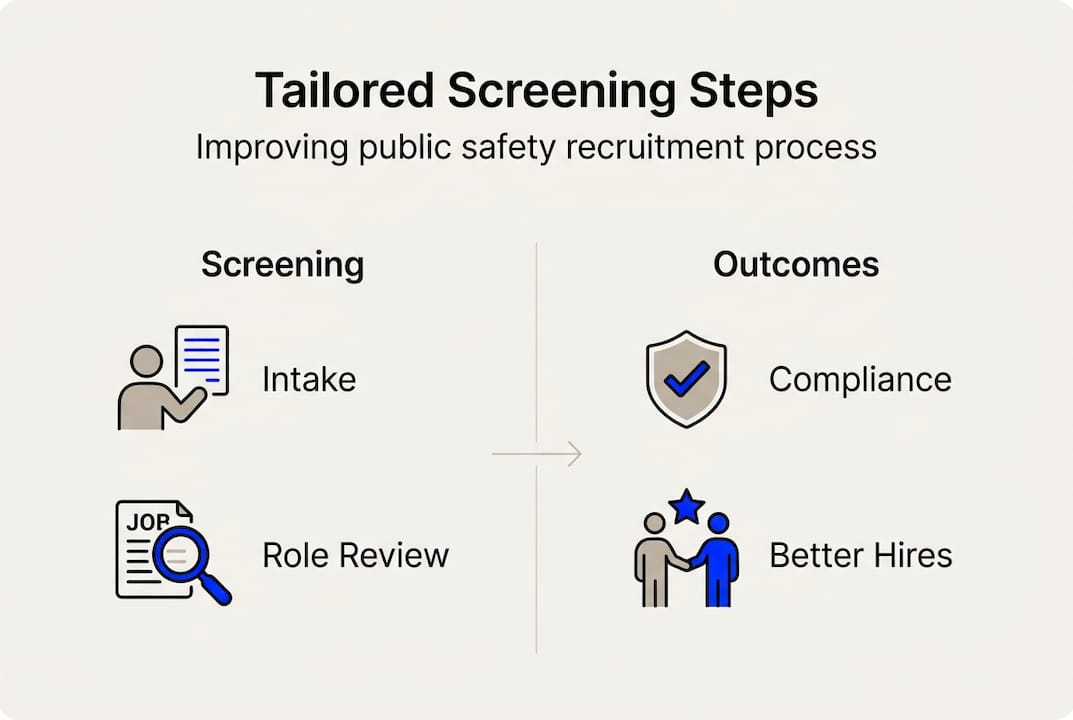
Knowing the benefits of tailored screening is one thing. Executing a successful transition is another. The following roadmap gives HR managers and agency decision-makers a structured path from evaluation to full deployment.
- Conduct a needs assessment: Identify every role your agency hires for, the specific background investigation requirements for each, and the compliance obligations attached to those roles. Document current pain points, including average turnaround times, dropout rates, and audit failures.
- Request targeted demos: Do not accept a generic product walkthrough. Ask vendors to demonstrate how their platform handles your specific role types, compliance requirements, and integration needs. Evaluate top screening tools against your documented criteria.
- Integrate with existing workflows: A tailored solution should connect with your applicant tracking system, scheduling software, and HR information system. Centralized, real-time digital platforms improve both applicant experience and internal workflow efficiency when integration is done correctly.
- Train your team: Investigators, HR coordinators, and supervisors all interact with the platform differently. Role-specific training ensures each user understands their permissions, responsibilities, and reporting obligations.
- Run a compliance audit post-launch: Within 60 to 90 days of going live, conduct an internal audit to verify that role-based access controls are functioning correctly, audit logs are complete, and adverse action workflows are aligned with current FCRA requirements.
Ongoing reporting is equally important. Monthly dashboard reviews help HR managers catch emerging bottlenecks before they affect hiring timelines. For a structured approach to building this process, the comprehensive screening guide offers agency-specific frameworks.
Pro Tip: When seeking leadership buy-in, frame tailored screening as a risk management investment, not a technology upgrade. Present the cost of a single bad hire, including litigation, retraining, and reputational damage, alongside the platform’s projected reduction in screening time and compliance failures. Decision-makers respond to numbers, not features.
Power your agency with OMNI Intel’s tailored solutions
The evidence is clear. Agencies that invest in tailored screening solutions hire better candidates, reduce compliance exposure, and build more defensible recruitment processes. OMNI Intel was built specifically for this challenge.

OMNI Intel’s pre-employment screening services are designed around the operational realities of law enforcement, fire and EMS, dispatch centers, and private security firms. From investigator-driven background checks for public safety to AI-assisted candidate tracking and continuous post-hire monitoring, every feature reflects the standards your agency is held to. Role-based access, real-time compliance updates, and seamless integration with existing hiring platforms are built in, not bolted on. Visit OMNI Intel to schedule a discovery call and see how a platform built for public safety performs when your agency’s reputation depends on it.
Frequently asked questions
How do tailored screening solutions improve candidate quality?
Tailored platforms give HR managers real-time oversight of every investigation stage, reducing completion bottlenecks and ensuring only thoroughly vetted candidates advance. Digital platforms improve candidate completion rates and overall investigation quality compared to manual or generic systems.
Are tailored solutions harder to implement than standard background checks?
Most agencies find the transition manageable because tailored platforms offer pre-built modules for common public safety roles and guided onboarding support. Centralized digital tools improve applicant experience and workflow efficiency from the first weeks of deployment.
What compliance risks do tailored screening solutions address?
They help agencies meet FCRA obligations, state-specific statutes, and role-based data access requirements that generic platforms cannot reliably enforce. Role-based access and centralized reporting ensure agencies maintain the documentation infrastructure required for regulatory audits.
How much faster are tailored screenings compared to traditional methods?
Some public safety agencies report 90 to 95% reductions in total screening time when using AI-enabled tailored platforms, a shift that directly accelerates conditional offers and reduces candidate dropout.