

Monitor post-hire activity: Step-by-step guide for public safety HR
Misconduct claims surged to 14.7 per 1,000 employees while 34% of public safety agencies faced enforcement actions, a reality that makes post-hire monitoring not a luxury but a core operational requirement. For HR managers and compliance officers in law enforcement, fire and EMS, and dispatch centers, the stakes are uniquely high: a single integrity failure can erode public trust, trigger regulatory scrutiny, and expose the agency to significant legal liability. This guide walks through the foundational principles, preparation steps, execution workflows, and verification methods that transform post-hire monitoring from a reactive measure into a proactive shield for organizational integrity.
Table of Contents
- Key principles of post-hire monitoring in public safety
- Preparation: Policies, consent, and legal compliance
- Step-by-step: Monitoring process and technology integration
- Troubleshooting: Common challenges and how to address them
- Verification: Proving compliance and measuring success
- How OMNI Intel supports effective post-hire monitoring
- Frequently asked questions
Key Takeaways
| Point | Details |
|---|---|
| Strong policies required | Clear, compliant policies are essential to ensure effective and lawful post-hire monitoring. |
| Role-based monitoring | Prioritize monitoring for high-risk and trust-sensitive roles while respecting privacy boundaries. |
| Technology integration | Use integrated platforms to automate alerts and streamline investigations for continuous oversight. |
| Legal compliance vital | Obtaining written consent, following FCRA/ECPA, and state notice laws safeguards agencies from regulatory penalties. |
| Continual verification | Regular audits and outcome measurements ensure compliance and demonstrate organizational integrity. |
Key principles of post-hire monitoring in public safety
Effective post-hire monitoring begins with a clear understanding of what you are watching, why you are watching it, and what authority you have to do so. The importance of monitoring in public safety cannot be overstated: personnel in these roles carry weapons, access sensitive data, and make decisions that directly affect community safety. That responsibility demands a structured, principled approach.
The scope of monitoring should be limited to job-relevant data. Criminal activity checks, social media reviews, and performance logs are the three primary categories that align with the trust and safety obligations of public safety roles. Monitoring personal communications unrelated to work, or surveilling employees in sensitive areas such as restrooms or medical spaces, is both legally prohibited and ethically indefensible.
Legal compliance is non-negotiable. As outlined in employee monitoring essentials, agencies must develop clear policies, obtain consent, use FCRA-compliant platforms, and limit monitoring to job-relevant data. State-level regulations add another layer: Maine, for example, requires written consent and disclosure, with fines of $100 to $500 per violation for non-compliance.
Key principles to anchor your monitoring program:
- Define monitoring scope in writing before implementation
- Obtain signed, role-specific consent from all employees
- Align policies with FCRA, ECPA, and applicable state notice laws
- Follow NLRB guidance to avoid interfering with protected concerted activity
- Prohibit monitoring in bathrooms, locker rooms, and personal devices
- Schedule annual policy reviews and maintain an adjudication matrix
| Monitoring type | Permitted scope | Legal framework |
|---|---|---|
| Criminal activity checks | Job-relevant offenses, arrests | FCRA, state law |
| Social media review | Public posts, conduct violations | ECPA, agency policy |
| Performance logs | Attendance, incident reports | Agency HR policy |
| Electronic communications | Agency-owned devices only | ECPA, NLRB rules |
| Physical surveillance | Common work areas only | State notice laws |
Pro Tip: Build your adjudication matrix before you launch any monitoring program. Defining in advance what actions trigger what responses eliminates inconsistency and protects the agency from claims of selective enforcement.
Preparation: Policies, consent, and legal compliance
With principles established, preparation involves translating them into actionable policies and processes. This phase is where most agencies either build a defensible program or create future liability.
Start by drafting a monitoring policy that covers three core elements: the scope of what is monitored, how employees are notified, and what response protocols are triggered when an issue is flagged. Post-hire monitoring tools are only as effective as the policies that govern their use. A technology platform without a clear policy framework is a compliance risk, not a solution.
Legal compliance is layered and jurisdiction-specific. Electronic monitoring compliance requires attention to FCRA for background checks, ECPA for electronic monitoring, state notice laws, and NLRB restrictions on monitoring that could chill protected activity. States including Maine, New York, Connecticut, and Delaware have enacted specific notice requirements, and California proposals signal further tightening ahead.
Public safety agencies carry a distinct obligation. As noted in LinkedIn guidance from OMNI Intel, agencies must monitor highly trusted roles and maintain transparent policies that employees understand and accept before they begin work.
Step-by-step preparation checklist:
- Draft a written monitoring policy covering scope, notification, and response
- Identify which roles require enhanced monitoring based on access and risk level
- Obtain signed consent forms tailored to each role category
- Review Maine regulations and all applicable state notice requirements
- Establish an appeals process for employees who dispute flagged activity
- Coordinate with legal counsel to confirm ECPA and NLRB alignment
- Document all policy decisions and consent records in a centralized system
“Transparency is not a weakness in a monitoring program. It is the foundation of its legal defensibility and employee trust.”
Review your privacy compliance posture annually, and update consent forms whenever monitoring scope changes. A signed consent form from three years ago may not cover new monitoring technologies deployed today.
Pro Tip: Use role-based consent tiers. A patrol officer with access to sensitive databases warrants a different consent scope than an administrative employee. Tailoring consent to job function strengthens both legal compliance and employee buy-in.
Step-by-step: Monitoring process and technology integration
Once policies and legal requirements are in place, executing ongoing monitoring at scale requires a combination of human oversight and technology-driven workflows. Manual monitoring alone is neither scalable nor consistent enough for agencies managing dozens or hundreds of personnel.
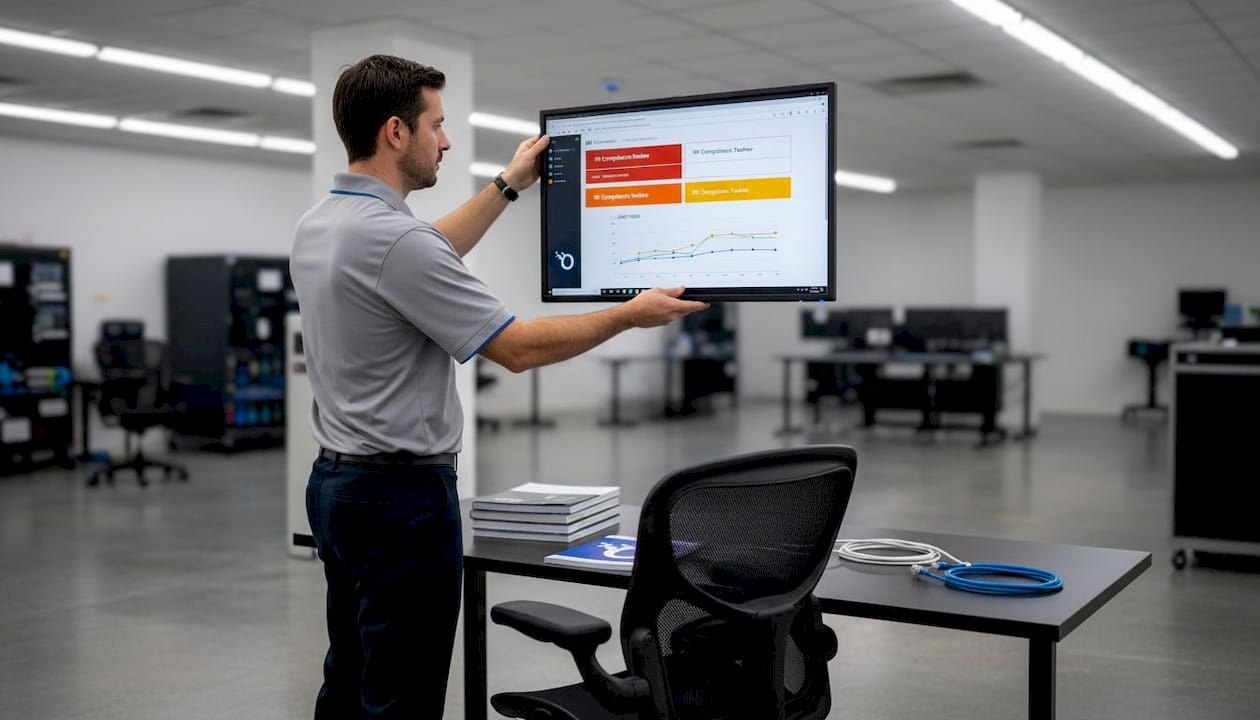
Integrated platforms that pull criminal record updates, social media flags, and performance data into a single dashboard give HR managers a unified view of workforce risk. The employee monitoring checklist recommends using integrated tech platforms for alerts and an adjudication matrix for responsive actions, ensuring that flagged events move through a defined review process rather than sitting unaddressed.
Monitoring workflow: Step by step
- Configure your platform to monitor criminal records, public social media, and performance logs
- Set automated alert thresholds based on your adjudication matrix
- Assign a designated reviewer for each alert category
- Document every alert, review decision, and outcome in the case management system
- Conduct quarterly audits of alert volume and resolution times
- Perform annual calibration of alert thresholds to reduce false positives
- Communicate monitoring scope updates to employees in writing
Role-based prioritization matters. High-risk positions, including those with access to weapons, sensitive data, or vulnerable populations, should receive more frequent and thorough monitoring cycles. Structured investigations reduce risk amid rising misconduct claims, and automating alerts for high-risk roles ensures that critical issues surface quickly rather than being buried in manual review queues.
What effective monitoring platforms should deliver:
- Real-time criminal record update alerts
- Social media monitoring limited to public, job-relevant content
- Integration with HR performance management systems
- Audit trails for every alert and adjudication decision
- Role-based access controls for reviewer permissions
Review your monitoring best practices annually and update your monitoring workflows whenever new technology or regulatory changes require it.
Pro Tip: Set a 48-hour maximum response window for all flagged alerts. Unresolved flags that sit for weeks create both legal exposure and operational blind spots. Speed and documentation are equally important.
Troubleshooting: Common challenges and how to address them
Effective workflows are only as strong as their ability to adapt. HR managers in public safety agencies consistently encounter a predictable set of obstacles when implementing or scaling post-hire monitoring programs.
Privacy objections are the most common friction point. Employees, particularly those represented by unions, may view monitoring as an intrusion. The NLRB guidance on electronic monitoring makes clear that surveillance cannot be used to interfere with protected concerted activity, and agencies must design their programs with that boundary firmly in place.
Union concerns require proactive engagement, not reactive defense. Bring union representatives into the policy development process early. When employees understand that monitoring is scoped to job-relevant conduct and governed by transparent rules, resistance typically decreases.
Common challenges and targeted responses:
- Privacy objections: Limit scope to job-relevant data, communicate clearly, and document consent
- Union pushback: Engage representatives early, align with NLRB limits, and avoid monitoring protected activity
- State restriction gaps: Audit compliance with all applicable state notice laws annually
- Flagged event disputes: Maintain a formal appeals process with defined timelines
- Technology gaps: Avoid monitoring personal devices; restrict surveillance to agency-owned equipment
- Emerging tech risks: Review body camera and AI-driven monitoring policies against current legal standards
“The tension between safety and privacy is real, but it is manageable. Agencies that invest in transparent, well-documented programs face far fewer legal challenges than those that monitor informally.”
The post-hire screening overview at OMNI Intel addresses many of these edge cases directly, including guidance on avoiding prohibited monitoring areas and establishing appeal processes that satisfy both legal and operational requirements.
Pro Tip: When a flagged event is disputed, treat the appeal as a data point. Patterns in disputes often reveal gaps in your adjudication matrix or alert thresholds that need recalibration.
Verification: Proving compliance and measuring success
Troubleshooting leads directly into verification. A monitoring program that cannot demonstrate its own effectiveness is difficult to defend to regulators, stakeholders, or legal counsel.
Documentation is the foundation of verification. Every consent form, alert, review decision, and audit record must be stored in a system that allows retrieval on demand. Agencies that cannot produce these records during an investigation or audit face compounded liability.
Benchmarking against industry data reveals where your program stands. 68% of agencies lack tracking on issue-per-case metrics, while misconduct claims hit 14.7 per 1,000 employees across the sector. If your agency cannot measure its own misconduct rate or case resolution time, you are operating without the data needed to improve.
Verification checklist for compliance officers:
- Maintain signed consent records for all monitored employees
- Log every alert, reviewer action, and resolution outcome
- Conduct annual audits comparing your metrics to industry benchmarks
- Use structured investigation protocols to reduce legal exposure
- Report monitoring outcomes to agency leadership and relevant regulators
- Review and update policies whenever regulations or technology change
| Metric | Why it matters | Target benchmark |
|---|---|---|
| Misconduct claims per 1,000 employees | Measures program effectiveness | Below sector average |
| Alert resolution time | Indicates operational responsiveness | Under 48 hours |
| Consent form completion rate | Confirms legal compliance | 100% |
| Annual audit completion | Demonstrates due diligence | Once per year minimum |
| Appeals filed vs. resolved | Tracks fairness and process integrity | 100% resolved |
Review your law enforcement monitoring resources to align your verification process with the standards expected of public safety agencies. Continuous improvement cycles, not one-time audits, are what separate compliant agencies from vulnerable ones.
How OMNI Intel supports effective post-hire monitoring
With verification in place, agencies can streamline their processes further by leveraging purpose-built tools and resources designed specifically for public safety environments.

OMNI Intel’s platform is built for the operational realities of law enforcement, fire and EMS, dispatch centers, and government entities. From automated alert systems and FCRA-compliant documentation workflows to role-based monitoring configurations, OMNI Intel gives HR managers and compliance officers the infrastructure to run defensible, effective monitoring programs at scale. The public safety monitoring guide and monitoring checklist provide ready-to-use frameworks that reduce setup time and eliminate guesswork. Whether you are building a program from scratch or auditing an existing one, OMNI Intel’s pre-employment screening and post-hire monitoring tools work together to protect your agency’s integrity from day one through the full employment lifecycle.
Frequently asked questions
What types of employee activities should agencies monitor post-hire?
Public safety agencies should monitor criminal activity, social media, and job performance logs, focusing only on data relevant to trust and safety responsibilities. Monitoring must be limited to job-relevant conduct and exclude personal devices or protected activity.
How can agencies ensure post-hire monitoring is legally compliant?
Agencies must follow FCRA, ECPA, and state notice laws, obtain written consent, and avoid interfering with protected employee rights under NLRB rules. Legal review of monitoring policies before deployment is essential, not optional.
What are the most common challenges HR managers face with post-hire monitoring?
Common challenges include privacy objections, union pushback, and the fact that 68% lack issue-per-case tracking, leaving agencies without the data needed to measure or defend their programs. Adapting to emerging technology and evolving state regulations adds further complexity.
How often should policies and monitoring be reviewed?
Annual reviews are best practice, with structured investigations and policy updates triggered whenever regulations change, new technology is deployed, or monitoring gaps are identified through audits. Waiting for an incident to prompt a review is a reactive posture that increases risk.
Recommended
- OMNIView™ | Post Hire Employee Monitoring for Public Safety Agencies
- What Is Post-Hire Screening for Public Safety?
- Step-by-Step Hiring Workflow Guide for Public Safety
- Employee monitoring best practices for public safety 2026
- Utvärdera arbetsmiljöinsatser guide för företag och HR – DISTANSUTBILDNING