

Top 7 ways to improve volunteer screening for public safety
Volunteer screening in public safety is not a formality. When a volunteer has unsupervised access to vulnerable populations, sensitive data, or emergency operations, a single screening failure can compromise community trust, expose your agency to liability, and put lives at risk. Risk-tiered screening balances thoroughness with efficiency, which is crucial for resource-limited agencies. This article walks you through seven proven, actionable ways to strengthen your volunteer screening process from the ground up.
Table of Contents
- Understand and categorize volunteer role risks
- Establish clear and fair disqualifying criteria
- Obtain consent and deliver clear, FCRA-compliant disclosures
- Leverage technology for automation and tracking
- Implement regular and risk-based re-screening
- Use structured background investigations for public safety volunteers
- Evaluate and upgrade your volunteer screening program regularly
- Take your volunteer screening to the next level
- Frequently asked questions
Key Takeaways
| Point | Details |
|---|---|
| Tailor screening by role | Risk-level assessment ensures the right depth of volunteer checks for public safety. |
| Maintain legal compliance | Secure clear consent and follow disclosure requirements to avoid regulatory issues. |
| Automate and track | Technology keeps screening on schedule and improves overall integrity. |
| Reassess regularly | Periodic re-screening and ongoing reviews catch new risks early. |
| Balance fairness and safety | Use individualized, documented criteria for more equitable volunteer screening. |
Understand and categorize volunteer role risks
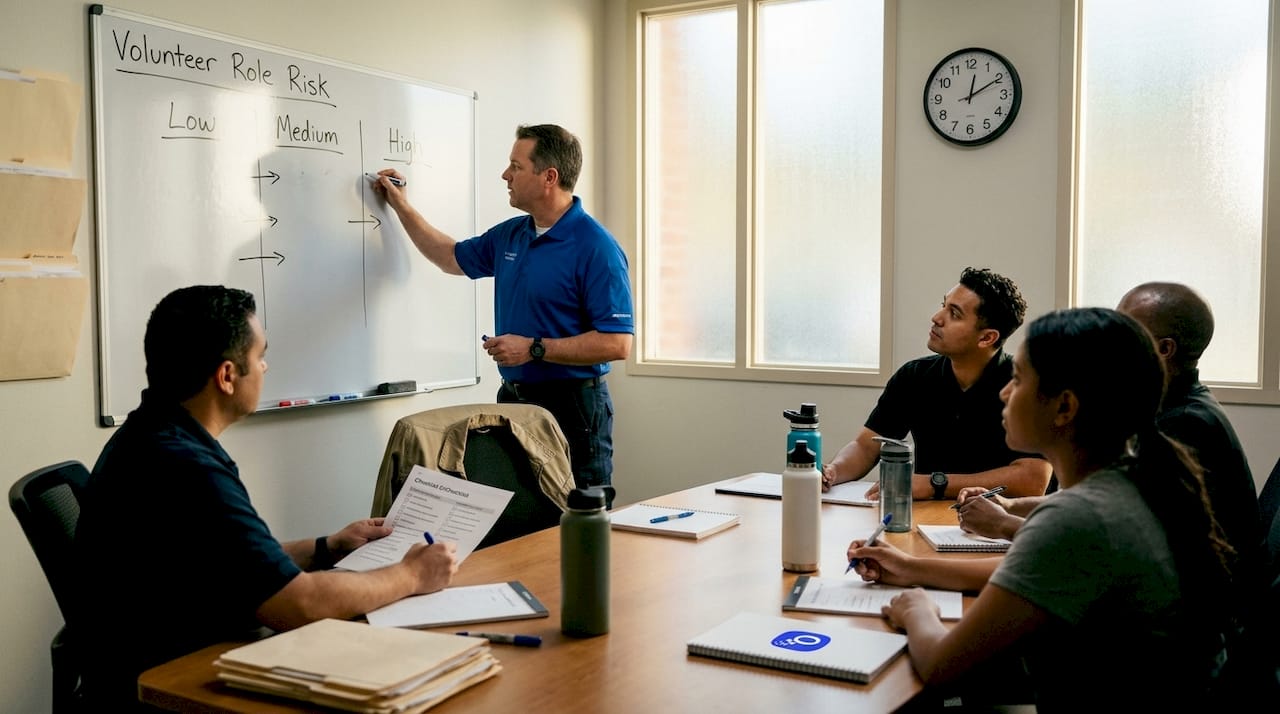
Not every volunteer role carries the same level of risk. A person handing out water at a community event poses a very different risk profile than a volunteer EMT with direct patient contact or a dispatcher with access to sensitive law enforcement data. Mapping risk tiers to roles is the foundation of any effective screening program.
Use these three tiers as a starting point:
- Low risk: No unsupervised contact with vulnerable populations, no access to sensitive systems or data, limited operational involvement.
- Medium risk: Occasional supervised contact with the public or sensitive information, some operational responsibilities.
- High risk: Unsupervised contact with vulnerable individuals, access to confidential records, direct involvement in emergency response or law enforcement support.
Risk-based screening tailored to volunteer roles categorizes positions by access level and responsibilities to determine the appropriate depth of background checks. This means a high-risk volunteer may require a full criminal history check, reference interviews, and even a polygraph, while a low-risk role may only need a basic identity and sex offender registry check. Following background screening best practices helps agencies align check depth with actual exposure.
Pro Tip: Review your risk categorizations at least once a year. Roles evolve, threats change, and a position that was low-risk two years ago may now involve access to sensitive systems or vulnerable populations.
Establish clear and fair disqualifying criteria
Once you have mapped risks to roles, you need documented, transparent criteria for what disqualifies a candidate. Vague or inconsistent standards create legal exposure and undermine trust with volunteers and the community alike.
Build a criteria matrix that ties each disqualifier directly to the role’s risk level and specific duties. For example, a prior conviction for financial fraud may be disqualifying for a volunteer managing agency funds but irrelevant for a volunteer doing grounds maintenance. This approach reflects fair chance hiring principles and helps avoid systemic bias.
Common disqualifying factors to consider by risk tier:
- Prior convictions directly related to role duties (e.g., violence, fraud, sexual offenses)
- Documented history of misconduct in similar roles
- Failed or refused reference checks
- Falsification of application materials
- Active restraining orders or protective orders relevant to the role
Avoid blanket bans on anyone with any criminal record. Fair chance considerations must be weighed against safety, and individualized assessments with documented reasoning protect your agency legally and ethically. Your vetting process for safety should reflect both community values and operational requirements.
“A well-designed criteria matrix does more than protect your agency. It signals to volunteers and the community that your standards are principled, not arbitrary.”
Obtain consent and deliver clear, FCRA-compliant disclosures
This step is non-negotiable. The Fair Credit Reporting Act (FCRA) is the federal law governing how third-party background checks are conducted. Skipping or shortcutting this process exposes your agency to lawsuits, regulatory fines, and reputational damage.
Here is a step-by-step consent and disclosure workflow every agency should follow:
- Provide a standalone disclosure document to the volunteer applicant before any background check is initiated. This must be a separate document, not buried in an application form.
- Obtain written authorization from the applicant. This can be a physical signature or a compliant electronic signature.
- Notify the applicant of the scope of the check, including what types of records will be reviewed.
- Follow adverse action procedures if a check returns disqualifying information. This includes a pre-adverse action notice, a copy of the report, and a reasonable waiting period before a final decision.
- Retain all consent and disclosure records for the duration required by your state and federal guidelines.
Written consent and clear disclosure per FCRA requirements must be obtained before any third-party checks are run. Transparency here does more than satisfy legal requirements. It builds trust with volunteers and signals that your agency operates with integrity. Review your FCRA compliance overview to make sure your current workflow meets all requirements.
Leverage technology for automation and tracking
A well-designed screening policy only works if it is executed consistently every single time. Manual processes introduce human error, missed deadlines, and incomplete records. Technology closes those gaps.
Key digital tools that strengthen volunteer screening programs include:
- Automated application checklists that flag incomplete submissions before they move forward
- Reminder systems for expiring background checks and re-screening deadlines
- Centralized record-keeping that stores consent forms, check results, and adverse action documentation in one auditable location
- Continuous monitoring tools that alert HR when a current volunteer has a new criminal record or flag
Technology integration reduces administrative burden and ensures timely renewals, which is vital for maintaining integrity in high-stakes roles. For agencies managing dozens or hundreds of volunteers, automated volunteer screening platforms make it possible to maintain rigorous standards without overwhelming your HR team. Tech-enabled screening also creates a defensible audit trail if your process is ever questioned.
Pro Tip: When evaluating screening technology, prioritize platforms with SOC 2 certification or equivalent data security standards. Public safety data is sensitive, and your vendor’s security posture matters as much as their features.
Implement regular and risk-based re-screening
A background check at onboarding is a snapshot, not a guarantee. People’s circumstances change. A volunteer who passed a clean check three years ago may have a new arrest, a restraining order, or a financial judgment that changes their suitability for a sensitive role.
Re-screening volunteers every 1 to 2 years, or continuously for high-risk roles with automated tracking, is the standard for maintaining program integrity. Here is a recommended re-screening schedule by risk tier:
| Risk tier | Recommended re-screening interval | Monitoring type |
|---|---|---|
| Low risk | Every 3 years | Periodic |
| Medium risk | Every 1 to 2 years | Periodic |
| High risk | Annually or continuously | Continuous automated monitoring |
Benefits of regular re-screening go beyond catching new issues:
- Cost savings: Catching a problem early is far less expensive than managing an incident after the fact.
- Compliance: Some grants and accreditation bodies require documented re-screening intervals.
- Volunteer morale: Consistent standards applied to everyone signal fairness and professionalism.
For a deeper look at what these checks actually cover, the background checks explained resource breaks down each component clearly.
Use structured background investigations for public safety volunteers
For your highest-risk volunteer roles, a standard criminal background check is not enough. Structured background investigations add layers of verification that surface issues a database check will never catch.
Core elements of a structured investigation include:
- Reference interviews: Structured conversations with former supervisors, colleagues, or community members who can speak to the applicant’s character and reliability.
- Employment and credential verification: Confirming that claimed experience, certifications, and licenses are accurate.
- Polygraph screening: Where agency policy and local law permit, polygraph examinations can surface deception that other methods miss.
- Social media and open-source review: Reviewing publicly available information for conduct inconsistent with public safety values.
Here is a quick comparison of advanced screening methods:
| Method | Strengths | Weaknesses |
|---|---|---|
| Reference checks | Reveals character and work history | Dependent on reference quality |
| Polygraph screening | Surfaces deception, deters dishonesty | Legally restricted in some states |
| Digital-only background check | Fast, scalable, cost-effective | Misses unreported or expunged records |
Public safety agencies are increasingly investing in structured investigations. According to POST background investigation standards, structured investigations including polygraph screening are recommended for public safety roles where allowed by policy. Agencies working with background investigations for volunteers in sensitive capacities should treat these tools as standard, not optional.
Evaluate and upgrade your volunteer screening program regularly
Even a well-built screening program can become outdated. Regulations change, new screening technologies emerge, and the nature of volunteer roles shifts over time. Building a culture of continuous improvement into your program is what separates reactive agencies from proactive ones.
Here are practical ways to keep your program sharp:
- Collect feedback from staff and volunteers through annual surveys or debrief sessions after onboarding cycles.
- Track key performance indicators (KPIs) such as issue detection rate, time-to-clear, incident rate among screened volunteers, and adverse action appeal outcomes.
- Audit your criteria matrix annually to ensure disqualifiers remain relevant and legally defensible.
- Monitor regulatory updates from EEOC, FCRA, and state-level fair chance hiring laws that may affect your process.
- Benchmark against peer agencies to identify gaps or opportunities in your current approach.
Risk-tiered screening balances thoroughness with efficiency, which is especially critical for resource-limited agencies that cannot afford to over-screen low-risk roles or under-screen high-risk ones. Reviewing the full range of types of background checks available helps you make informed decisions about where to invest your screening resources.
Take your volunteer screening to the next level
Building a rigorous volunteer screening program takes the right framework and the right tools. Manual processes, inconsistent criteria, and outdated technology leave gaps that put your agency and community at risk.

OMNI Intel is built specifically for public safety agencies managing exactly these challenges. From pre-employment screening services to continuous post-hire monitoring, our platform gives HR leaders the automation, compliance support, and audit-ready documentation they need. Explore our background checks for agencies or see how OMNIScreen for agencies can replace fragmented manual workflows with a single, secure, and scalable solution. Schedule a consultation today and see how we can help you screen smarter.
Frequently asked questions
How often should public safety agencies re-screen volunteers?
High-risk volunteer roles should be re-screened every 1 to 2 years or continuously using automated monitoring tools. Lower-risk roles can follow a 3-year cycle with periodic checks.
What is risk-based screening and why is it important?
Risk-based screening tailors the depth of background checks to each role’s level of access and responsibility. Categorizing positions by risk helps agencies allocate resources where they matter most without over-burdening low-risk onboarding.
Are polygraph screenings allowed for volunteer background checks?
Polygraph use depends on state law and agency policy. Structured investigations including polygraphs are recommended for high-risk public safety roles where legally permitted.
How can agencies ensure volunteer screening is fair and unbiased?
Tie every disqualifying criterion to the specific duties and risk level of the role. Role-relevant disqualifying criteria that account for fair chance hiring principles and systemic bias reduce legal exposure and promote equitable outcomes.
What technology can help manage volunteer screening programs?
Applicant tracking systems and automated re-screening platforms reduce administrative burden and ensure no renewal deadlines are missed. Technology integration is especially valuable for agencies managing large or rotating volunteer pools.
Recommended
- 7 Essential Background Screening Best Practices for HR
- Volunteer Background Checks for Fire and Rescue Organizations: Best Practices 2026 • OMNI Intel
- 7 Public Safety Recruitment Best Practices for Agencies
- 7 Best Hiring Process Practices for Public Safety Agencies
- 911 replies before killing faulted | The Public Safety Consulting Group