

Master investigation principles for safe public safety hiring
Many public safety agencies underestimate thorough investigation principles, risking unsafe hires and costly compliance failures. Without standardized methodologies, screening processes become inconsistent, leaving agencies vulnerable to liability and community harm. This article explains core investigation principles and their role in pre-employment screenings, equipping you with practical frameworks to improve compliance and hire integrity. You will learn how to apply these principles systematically, reduce hiring risks, and build safer teams that uphold public trust.
Table of Contents
- Key takeaways
- Understanding key investigation principles in public safety hiring
- Core components of effective pre-employment background screenings
- Comparing traditional and modern investigation frameworks
- Applying investigation principles for compliance and effective hiring
- Enhance your pre-employment screening with OMNI Intel
- Frequently asked questions about investigation principles in public safety hiring
Key Takeaways
| Point | Details |
|---|---|
| Standardized investigation principles | Investigation principles standardize how candidates are evaluated to ensure consistency and defensible hiring decisions. |
| Comprehensive pre employment screenings | Thorough pre employment screenings should cover criminal, employment, financial, and personal history to reveal multiple risk factors. |
| POST FPV alignment | Following POST and FPV guidelines helps ensure compliance and structured risk assessment across candidates. |
| Documentation for audit trails | Always document sources and verification methods to create an audit trail that protects the agency in reviews or challenges. |
| Continuous vetting and trust | Combining continuous vetting with these principles improves long term reliability and strengthens public trust. |
Understanding key investigation principles in public safety hiring
Investigation principles in pre-employment background screenings emphasize thorough verification using standardized methodologies like those in POST and federal FPV guidelines. These principles serve as the backbone of quality hiring decisions, ensuring every candidate undergoes consistent, evidence-based evaluation before joining your team. Without them, agencies risk inconsistent screening outcomes, legal challenges, and safety incidents that damage community trust.
At their core, investigation principles are standardized procedures designed to verify candidate history and assess suitability for public safety roles. They transform subjective gut feelings into objective, defensible hiring decisions. These principles guide investigators through systematic verification of criminal records, employment timelines, financial responsibility, and personal character references. Each element reveals different risk factors: criminal history exposes legal issues, employment verification uncovers dishonesty or performance problems, financial checks highlight vulnerability to corruption, and personal references provide character insights.
POST and federal FPV guidelines structure these investigations around integrity, risk assessment, and standardized methodologies. Integrity means every piece of information gets verified independently, not just accepted at face value. Risk assessment involves evaluating how past behaviors predict future performance in high-stakes public safety environments. Standardized methodologies ensure every candidate faces the same rigorous scrutiny, eliminating bias and creating defensible documentation.
Common procedural steps in quality public safety investigations include:
- Comprehensive criminal history searches across multiple jurisdictions and databases
- Direct contact with previous employers to verify dates, roles, and performance
- Credit checks and financial record reviews to assess fiscal responsibility
- Personal reference interviews conducted by trained investigators
- Education and credential verification through issuing institutions
- Social media and online presence reviews for red flags
- Polygraph examinations where legally permitted and role-appropriate
Pro Tip: Always document the specific sources and methods used for each verification step. This creates an audit trail that protects your agency if a hiring decision gets challenged legally or during internal reviews.
These principles connect directly to verifying applicant credentials and broader background screening best practices for HR teams. When applied consistently, they transform hiring from a gamble into a calculated, evidence-based process. The POST background investigation manual provides detailed frameworks that agencies can adapt to their specific needs and jurisdictional requirements.
Core components of effective pre-employment background screenings
POST guidelines require thorough verification of criminal, employment, financial, and personal history to assess candidate suitability and risk. Each component evaluates different dimensions of trustworthiness and reliability, creating a complete picture of who you are hiring. Missing even one element can leave critical blind spots that surface only after costly hiring mistakes.
Criminal history checks reveal past illegal behavior and patterns of poor judgment. They search local, state, and federal databases for arrests, convictions, and pending charges. For public safety roles, this component carries extra weight because criminal backgrounds directly contradict the integrity required to enforce laws or protect communities. These checks must cover all jurisdictions where candidates lived, worked, or attended school, not just their current address.
Employment verification confirms work history accuracy and uncovers performance issues. Direct contact with previous supervisors reveals whether candidates were reliable, honest, and competent in past roles. This step catches resume fraud, unexplained gaps, and terminations for cause that candidates omit from applications. Employment history verification prevents agencies from hiring individuals who misrepresent their qualifications or have patterns of workplace misconduct.

Financial checks assess fiscal responsibility and vulnerability to corruption. Credit reports and financial records show whether candidates manage money responsibly or face pressures that could lead to bribery, theft, or other integrity violations. Public safety personnel often handle evidence, cash, or have access to sensitive information, making financial stability a legitimate screening concern. Severe debt, bankruptcies, or patterns of financial irresponsibility raise red flags about judgment and susceptibility to compromise.
Personal references provide character insights from people who know candidates outside work contexts. Trained investigators conduct structured interviews with neighbors, friends, and associates to assess honesty, temperament, and community reputation. These conversations often reveal behavioral patterns that do not appear in official records but matter enormously for public safety roles.
| Screening component | Primary purpose | Verification method | Risk factors identified |
|---|---|---|---|
| Criminal history | Identify illegal behavior and judgment issues | Multi-jurisdictional database searches, court records | Arrests, convictions, pending charges, patterns of misconduct |
| Employment verification | Confirm work history accuracy and performance | Direct supervisor contact, HR records review | Resume fraud, terminations, performance problems, gaps |
| Financial checks | Assess fiscal responsibility and corruption risk | Credit reports, bankruptcy records, liens | Severe debt, bankruptcies, financial irresponsibility |
| Personal references | Evaluate character and community reputation | Structured interviews with associates | Behavioral issues, dishonesty, temperament problems |
| Education credentials | Verify qualifications and detect fraud | Direct contact with issuing institutions | Fake degrees, misrepresented qualifications |
Pro Tip: Do not rely solely on candidate-provided references. Independent source development through neighborhood canvassing and social network analysis often uncovers more candid perspectives than prepared reference lists.
Procedural standards must align with applicant credential verification requirements and various types of background checks appropriate for different public safety roles. The POST manual guidelines provide detailed protocols that ensure legal compliance while maximizing investigative thoroughness. Following these standards protects agencies from discrimination claims while ensuring no critical risk factor gets overlooked.
Comparing traditional and modern investigation frameworks
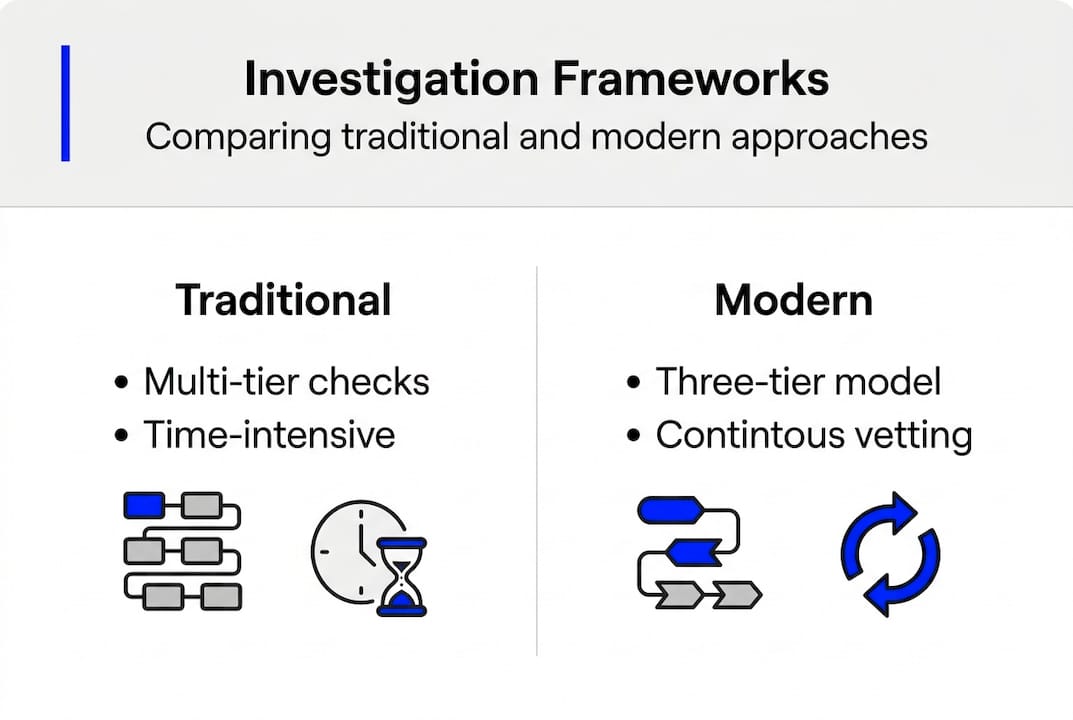
Traditional multi-tier background investigations evolved during the Cold War era, creating complex, time-intensive processes that often took months to complete. These systems divided investigations into numerous tiers based on security clearance levels, with each tier requiring progressively more extensive checks. While thorough, traditional approaches struggled with inefficiency, redundancy, and difficulty adapting to modern threats like cyber risks or continuous monitoring needs.
TW 2.0 framework reduces background check tiers to three with continuous vetting enhancing post-hire monitoring. This streamlined model maintains investigative rigor while eliminating unnecessary complexity and delays. TW 2.0 recognizes that initial screenings, no matter how thorough, provide only a snapshot in time. Continuous vetting addresses this limitation by monitoring employees throughout their careers, catching emerging issues before they escalate into incidents.
The three-tier TW 2.0 structure includes Tier 1 for low-risk positions requiring basic checks, Tier 3 for moderate-risk roles needing more extensive verification, and Tier 5 for high-risk positions demanding comprehensive investigations similar to traditional top-secret clearances. This simplified framework reduces confusion, speeds processing, and allows agencies to allocate investigative resources more strategically based on actual risk levels.
| Feature | Traditional multi-tier system | TW 2.0 framework |
|---|---|---|
| Number of tiers | 5+ distinct levels | 3 streamlined tiers |
| Processing time | 6-18 months for higher tiers | 3-6 months for equivalent checks |
| Continuous monitoring | Limited or absent | Built-in continuous vetting |
| Adaptability to modern threats | Slow to incorporate new risk factors | Designed for evolving threat landscape |
| Resource efficiency | High redundancy and duplication | Streamlined, focused investigations |
| Post-hire oversight | Periodic reinvestigations only | Ongoing automated monitoring |
Continuous vetting offers several advantages for long-term compliance and safety:
- Automated monitoring catches criminal activity, financial problems, or other issues as they occur
- Agencies can intervene early when employees show warning signs instead of waiting for periodic reinvestigations
- Continuous data feeds reduce the burden and cost of manual reinvestigations every 5-10 years
- Real-time alerts enable immediate risk mitigation when serious issues surface
- Employees understand they remain accountable throughout their careers, not just during initial hiring
Pro Tip: When implementing continuous vetting, clearly communicate the policy to employees during onboarding. Transparency about ongoing monitoring reduces privacy concerns and reinforces the culture of accountability your agency needs.
Challenges in adopting modern frameworks include technology infrastructure costs, legal considerations around continuous monitoring, and organizational change management. Some jurisdictions face statutory limitations on what can be monitored post-hire without renewed consent. Union contracts may require negotiation before implementing continuous vetting programs. Despite these hurdles, the safety and compliance benefits typically outweigh implementation challenges for public safety agencies.
Understanding these frameworks helps agencies evaluate their current screening process steps and public safety vetting process against modern standards. The CDSE student screening guide offers detailed implementation guidance for agencies transitioning from traditional to contemporary investigation models.
Applying investigation principles for compliance and effective hiring
Using standardized methodologies from POST and FPV ensures compliance and integrity in pre-employment investigations. Implementing these principles systematically transforms your hiring process from reactive to proactive, reducing risk while accelerating qualified candidate placement. The following steps embed investigation principles into daily recruitment and compliance practice:
-
Establish written policies documenting your investigation standards and procedures. Clear policies create consistency across all hiring decisions and provide legal protection if decisions get challenged. Include specific timelines, required verification steps, and decision criteria for each position type.
-
Train all personnel involved in hiring on investigation principles and legal requirements. HR staff, hiring managers, and investigators must understand what they can legally ask, how to document findings, and how to evaluate results objectively. Regular training updates keep teams current on evolving legal standards.
-
Create standardized documentation templates for each investigation component. Templates ensure investigators collect the same information for every candidate, making comparisons fair and defensible. They also speed processing by eliminating guesswork about what needs verification.
-
Implement quality control reviews before finalizing hiring recommendations. Have a second trained investigator review all findings and documentation for completeness, accuracy, and compliance. This catches errors and oversights before they result in bad hires or legal problems.
-
Develop clear adverse action procedures for handling disqualifying information. Candidates have legal rights to dispute inaccurate information and understand why they were rejected. Proper adverse action processes protect your agency while treating candidates fairly.
-
Integrate continuous monitoring systems for post-hire oversight. Set up automated alerts for criminal activity, financial problems, or other red flags that surface after employment begins. Early intervention prevents small issues from becoming major incidents.
-
Conduct periodic audits of your investigation program to ensure ongoing compliance and effectiveness. Review random samples of completed investigations, check for documentation gaps, and verify that procedures match written policies. Regular audits identify problems before they escalate.
Standardized investigation methodologies provide the foundation for defensible hiring decisions that protect both agency interests and candidate rights. Without consistent procedures applied equally to all applicants, agencies risk discrimination claims, bad hires, and loss of community trust.
Best practices for documentation require investigators to record not just what they found, but how they found it and why it matters. Every verification step needs source attribution, contact information, and dates. When disqualifying candidates, document the specific facts that led to the decision and how those facts relate to job requirements. This level of detail proves invaluable during legal challenges or internal reviews.
Verification best practices demand independent confirmation of every claim through original sources. Never accept copies of documents without verifying them with issuing authorities. Contact employers directly rather than relying on candidate-provided letters. Check credentials with schools, licensing boards, and certification bodies rather than trusting certificates candidates present.
Collaboration between HR and agency leaders ensures consistent adherence to investigation principles. HR brings expertise in legal compliance and documentation, while operational leaders understand the specific integrity requirements for different public safety roles. Regular meetings between these groups align screening standards with operational needs and legal obligations.
These practices integrate seamlessly with comprehensive pre-employment background check guide frameworks and public safety recruitment best practices. Agencies can streamline employee vetting workflow without sacrificing thoroughness by following POST manual compliance guidelines systematically.
Enhance your pre-employment screening with OMNI Intel
Applying investigation principles consistently across your hiring process requires specialized tools and expertise. OMNI Intel delivers public safety pre-employment screening services specifically designed for law enforcement, fire and EMS, dispatch centers, and other agencies where integrity is non-negotiable. Our platform enforces investigation principles automatically, ensuring every candidate undergoes the same rigorous, compliant evaluation.

Our comprehensive background checks for public safety agencies cover criminal history, employment verification, financial records, and personal references using POST-aligned methodologies. AI-driven tools accelerate processing without sacrificing thoroughness, helping you fill critical positions faster while maintaining the highest standards. Continuous monitoring capabilities catch post-hire issues early, protecting your agency reputation and community safety. Explore our tailored public safety vetting process solutions to see how we help agencies make safer, more defensible hiring decisions.
Frequently asked questions about investigation principles in public safety hiring
What are investigation principles in background checks?
Investigation principles are standardized procedures that ensure thorough, consistent verification of candidate history through systematic checks of criminal, employment, financial, and personal records. They transform subjective hiring into objective, evidence-based decisions that comply with POST and federal guidelines.
How do these principles improve safety in hiring?
These principles identify hidden risks by verifying every claim independently and evaluating multiple dimensions of trustworthiness. They prevent unsafe hires by catching dishonesty, criminal history, financial vulnerability, and character issues that candidates conceal on applications.
What laws impact investigation procedures in public safety?
Federal laws like the Fair Credit Reporting Act regulate how agencies obtain and use background information, while state POST standards define minimum investigation requirements for law enforcement roles. Title VII prohibits discrimination, requiring agencies to apply screening standards equally to all candidates regardless of protected characteristics.
Why is continuous vetting important post-hire?
Continuous vetting catches emerging issues like criminal activity, financial problems, or policy violations as they occur rather than waiting for periodic reinvestigations. Early detection enables intervention before small problems escalate into major incidents that harm agency reputation or public safety.
How can agencies ensure compliance with investigation standards?
Agencies ensure compliance by establishing written policies aligned with POST guidelines, training all hiring personnel on legal requirements, using standardized documentation templates, implementing quality control reviews, and conducting regular audits. Clear adverse action procedures and consistent application of standards across all candidates protect against legal challenges.
Recommended
- Enhancing integrity in public safety hiring: a guide
- Avoid Hiring Risks: Master Pre-Employment Background Investigations for Public Safety Professionals • OMNI Intel
- Pre-Employment Background Check Guide for Public Safety Hiring
- Step by Step Screening Process for Public Safety Hiring
- 7 Steps to a Secure Background Check Checklist | Security Jobs Board