
What is Responsibility Screening: A Guide for Public Safety HR
Many HR professionals in public safety assume responsibility screening is just another term for criminal background checks. It’s not. Responsibility screening specifically evaluates a candidate’s financial history to assess their suitability for roles involving fiduciary duties, cash handling, or access to sensitive assets. For agencies hiring law enforcement officers, dispatchers, or administrative personnel with financial responsibilities, understanding this distinction is critical. This guide clarifies what responsibility screening entails, explains the legal framework governing its use, and provides actionable strategies for integrating it into your hiring process while maintaining compliance with federal and state regulations.
Table of Contents
- Key takeaways
- Understanding responsibility screening in public safety hiring
- How responsibility screening works: process, compliance, and legal considerations
- Integrating responsibility screening into public safety hiring workflows
- Challenges and best practices for responsibility screening in public safety
- Enhance your public safety hiring with trusted screening solutions
- Frequently asked questions
Key Takeaways
| Point | Details |
|---|---|
| Financial responsibility screening | Responsibility screening assesses a candidate’s financial history to gauge integrity for roles handling cash assets or sensitive information in public safety. |
| Consent and compliance | The screening requires written candidate consent and must comply with the Fair Credit Reporting Act and applicable state regulations. |
| Job relevance limits | Use is restricted to positions with fiduciary duties and must be clearly justified with documented job duties to avoid discrimination claims. |
| Layered vetting | When combined with criminal history checks and polygraphs, responsibility screening contributes to a comprehensive credible assessment of candidate trustworthiness. |
Understanding responsibility screening in public safety hiring
Responsibility screening refers to financial responsibility checks in pre-employment screening, assessing a candidate’s financial history such as credit reports, outstanding debts, bankruptcies, and payment patterns to determine suitability for roles involving fiduciary duties. Unlike criminal background checks that focus on past offenses, responsibility screening examines financial behavior as a proxy for integrity and reliability.
For public safety agencies, this type of screening becomes particularly relevant when hiring for positions that involve handling evidence, managing departmental budgets, processing cash bonds, or accessing sensitive financial information. A dispatcher who processes fees, a property room supervisor managing seized assets, or an administrative officer with purchasing authority all represent roles where financial integrity directly impacts public trust and agency reputation.
The screening serves multiple purposes beyond simple risk mitigation. It helps agencies identify candidates who may be vulnerable to bribery or corruption due to severe financial distress. It protects against internal theft or fraud by flagging patterns of financial irresponsibility. Most importantly, it demonstrates due diligence in hiring decisions, which can be critical in defending against negligent hiring claims if an employee later commits financial misconduct.
Responsibility screening forms part of a broader integrity assessment strategy. When combined with pre-employment screening that includes criminal history checks, polygraph examinations, and thorough background investigations, it creates a comprehensive picture of candidate trustworthiness. Public safety agencies operate under heightened scrutiny, making this layered approach essential for maintaining community confidence.
Pro Tip: Document the specific job duties that justify financial screening for each position. This documentation becomes your defense if a candidate challenges the screening as discriminatory or irrelevant.
Key elements evaluated in responsibility screening include:
- Credit score and payment history patterns
- Outstanding debts and debt-to-income ratios
- Bankruptcy filings within the past seven to ten years
- Tax liens, judgments, and collection accounts
- Foreclosures or repossessions indicating severe financial distress
The goal is not to discriminate against candidates facing financial challenges, but to identify risk factors relevant to job performance and integrity in positions of trust.

How responsibility screening works: process, compliance, and legal considerations
The mechanics of responsibility screening begin after extending a conditional job offer, requiring the candidate’s written consent to access their credit information in compliance with the Fair Credit Reporting Act. This timing is critical because conducting financial checks before a conditional offer can expose agencies to discrimination claims.
Credit checks focus only on job-relevant financial indicators obtained through consumer reporting agencies. The process excludes information unrelated to financial responsibility, such as age, marital status, or medical history. Agencies typically receive a summary report highlighting red flags like recent bankruptcies, significant outstanding debts, or patterns of late payments rather than full credit scores.
FCRA compliance requires agencies to provide candidates with pre-adverse action notices if financial information may lead to disqualification. This notice must include a copy of the credit report and a summary of rights, giving candidates opportunity to dispute inaccuracies before final decisions. Failure to follow these procedures can result in costly litigation and regulatory penalties.
EEOC guidelines add another compliance layer by requiring agencies to demonstrate business necessity for financial screening. You must show that the financial information directly relates to job duties and that the screening does not create disparate impact on protected classes. State restrictions on credit checks vary significantly, with California, Illinois, and New York City banning general use unless the position is directly job-related.
Medical debt presents special considerations. Many states now prohibit considering medical debt in hiring decisions, recognizing that healthcare costs can create financial hardship unrelated to integrity or job fitness. Agencies must ensure their screening vendors exclude medical collections from reports.
Pro Tip: Create a matrix mapping each position to specific financial screening criteria. This standardized approach ensures consistency and provides clear documentation of business necessity.
The integration process typically follows these steps:
- Identify positions requiring financial screening based on documented fiduciary duties or financial access
- Obtain written candidate consent after extending conditional offer, clearly explaining scope and purpose
- Request credit report from FCRA-compliant consumer reporting agency with instructions to exclude non-relevant information
- Review results using standardized criteria focused on patterns rather than isolated incidents
- Provide pre-adverse action notice and opportunity to respond if negative information emerges
- Make final hiring decision based on totality of information, documenting rationale for defensibility
AI-powered screening tools can flag potential concerns, but human review remains essential. Automated systems may generate false positives or fail to account for extenuating circumstances like identity theft or divorce-related financial disruption. Expert review ensures fair, contextualized interpretation of financial data.
Agencies should integrate responsibility screening into their screening process for public safety hiring alongside other background checks. This integration allows for comprehensive evaluation while maintaining compliance with background screening best practices and EEOC financial screening guidelines.
Integrating responsibility screening into public safety hiring workflows
Responsibility screening functions most effectively as one component of layered vetting that includes criminal checks, polygraphs, and background investigations per POST standards. Public safety agencies cannot rely on financial screening alone to assess candidate integrity. The most robust hiring processes combine multiple evaluation methods to build a complete picture.
Positions involving evidence handling, cash processing, or access to seized assets require enhanced financial scrutiny. A patrol officer with evidence room duties faces different temptations than a dispatcher who never handles physical assets. Your screening intensity should match the specific risks associated with each role.

Screening tiers create efficiency while maintaining thoroughness. Entry-level positions with minimal financial access might require only basic credit checks focusing on recent bankruptcies or significant delinquencies. Mid-level supervisory roles could warrant comprehensive credit reports including payment histories and debt patterns. High-trust positions like financial managers or property supervisors might justify expanded screening including asset verification and lifestyle consistency analysis.
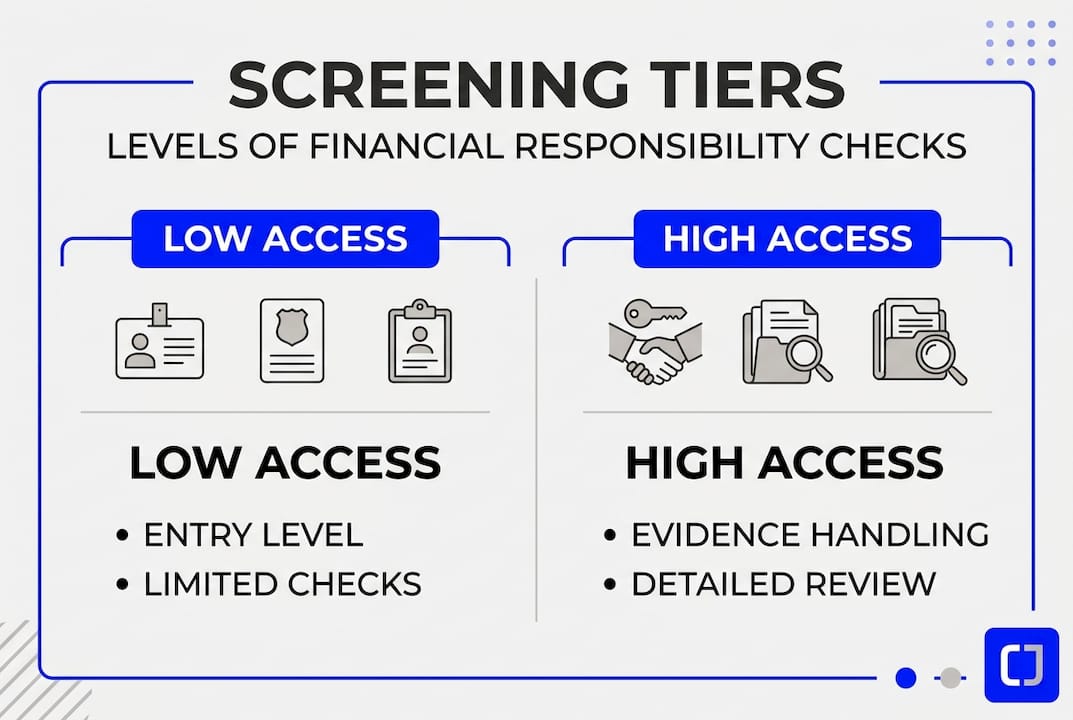
| Position Type | Financial Access Level | Screening Tier | Key Focus Areas |
|---|---|---|---|
| Entry patrol officer | Minimal (occasional evidence) | Basic | Recent bankruptcies, major delinquencies |
| Dispatcher | Moderate (fee processing) | Standard | Payment patterns, outstanding judgments |
| Evidence supervisor | High (asset custody) | Comprehensive | Full credit history, lifestyle analysis |
| Financial administrator | Critical (budget authority) | Enhanced | Asset verification, debt-to-income ratios |
Collaboration across background investigation units, financial screening specialists, and polygraph examiners strengthens overall assessment. When a candidate shows financial red flags, polygraph examiners can ask targeted questions about gambling, undisclosed debts, or financial pressures. Background investigators can verify explanations for bankruptcies or payment issues. This coordination prevents candidates from compartmentalizing information across different screening components.
Clear policies and candidate transparency build trust throughout the process. Applicants who understand why financial screening matters for their specific role and how their information will be evaluated are less likely to view the process as invasive or discriminatory. Pre-employment screening for public safety should include candidate education about screening rationale and procedures.
Pro Tip: Develop position-specific screening profiles that outline exactly which financial factors matter for each role. Share these profiles with candidates during the application process to set clear expectations.
Practical integration strategies include:
- Conducting financial screening concurrently with other background checks to avoid delays
- Training hiring managers to interpret financial information in context rather than applying rigid cutoffs
- Creating appeal processes for candidates to explain extenuating circumstances
- Reviewing screening criteria annually to ensure continued job relevance and legal compliance
- Documenting decision rationale for every candidate who fails financial screening
The goal is not to exclude candidates with any financial blemishes, but to identify patterns suggesting integrity risks relevant to job duties. A candidate who experienced bankruptcy five years ago due to medical bills presents different concerns than one with ongoing gambling debts and recent theft of employer property. Context matters enormously in responsible screening.
Agencies should leverage comprehensive screening for safer hiring that integrates financial, criminal, and behavioral assessments into unified candidate evaluation workflows. This integration ensures no single factor dominates hiring decisions while maintaining focus on job-relevant integrity indicators.
Challenges and best practices for responsibility screening in public safety
Responsibility screening raises legitimate privacy and discrimination concerns when misapplied. Contrasting viewpoints exist: proponents emphasize risk mitigation for safety and integrity, while critics highlight privacy invasion and potential discrimination if screening is not job-related. AI screening tools are particularly prone to false positives without human review, flagging candidates based on algorithmic patterns that lack real-world context.
Strict adherence to job relevance and EEOC business necessity standards is non-negotiable. You must demonstrate that financial screening directly relates to essential job functions and does not create disparate impact on protected classes. Courts have ruled against employers who applied financial screening broadly without documenting specific job relevance.
Automated screening tools require supplementation with expert human review. A credit report might show multiple late payments, but human review could reveal these resulted from identity theft or clerical errors rather than financial irresponsibility. Algorithms cannot assess extenuating circumstances or evaluate candidate explanations. Your screening process must include qualified personnel who can interpret financial data contextually.
Clear communication prevents candidate mistrust and disputes. When applicants understand the specific job duties that justify financial screening and the criteria you will apply, they are more likely to view the process as fair. Transparency also encourages candidates to proactively explain financial issues rather than hoping they go unnoticed.
“The key to defensible financial screening is documentation of job relevance and consistent application of criteria. Agencies that can demonstrate why financial integrity matters for specific positions and how they evaluate information fairly will withstand legal challenges. Those applying screening arbitrarily or without clear business justification face significant liability.” – Employment law perspective on screening defensibility
Best practices for optimizing responsibility screening programs include:
- Limiting financial screening to positions with documented fiduciary duties or financial access
- Developing written policies that specify screening criteria and decision-making processes
- Training all personnel involved in screening on FCRA, EEOC, and state law requirements
- Creating standardized evaluation forms that focus on job-relevant factors
- Maintaining detailed records of screening rationale for each candidate decision
- Regularly auditing screening outcomes for potential disparate impact on protected groups
State law compliance requires ongoing attention. Legislatures continue passing new restrictions on employment credit checks, often with exemptions for public safety positions. Your screening program must adapt to these changes, which may vary significantly across jurisdictions if you hire in multiple states.
False positives represent a significant operational challenge. Credit reports may contain errors, identity theft impacts, or outdated information. Your process must allow candidates to dispute inaccuracies and provide supporting documentation. Rushing to disqualify candidates based on preliminary credit information without verification invites wrongful rejection claims.
Agencies should implement transparency in screening for public safety by clearly communicating screening procedures, criteria, and candidate rights. This transparency protects both agency interests and candidate fairness. Consider providing candidates with resources about employee privacy rights to demonstrate your commitment to lawful, respectful screening practices.
Pro Tip: Conduct annual legal reviews of your financial screening program with employment counsel familiar with public safety hiring. Laws change frequently, and proactive compliance is far less costly than reactive litigation defense.
Enhance your public safety hiring with trusted screening solutions
Navigating the complexities of responsibility screening while maintaining legal compliance and operational efficiency requires specialized expertise. OMNI Intel offers public safety pre-employment screening services designed specifically for law enforcement, fire and EMS, dispatch centers, and government agencies. Our platform ensures FCRA and EEOC compliance through expert-managed financial and background checks for public safety that focus on job-relevant integrity indicators.

Integrate responsibility screening seamlessly into your hiring workflows with OMNIHire™, our applicant screening integration platform. We combine financial screening with criminal background checks, polygraph coordination, and comprehensive background investigations to provide the layered vetting public safety agencies require. Our team understands the unique challenges of hiring for positions of trust and can help you develop defensible screening criteria tailored to your specific roles. Partner with trusted specialists who understand public safety hiring to mitigate risk and hire with confidence.
Frequently asked questions
What exactly does responsibility screening evaluate?
Responsibility screening examines a candidate’s financial history including credit reports, outstanding debts, bankruptcies, payment patterns, tax liens, judgments, and collection accounts. It assesses financial behavior as an indicator of integrity and reliability for positions involving fiduciary duties, not general employment suitability.
Do I need candidate permission to run financial checks?
Yes, federal law requires written candidate consent before accessing credit information for employment purposes. You must provide clear disclosure about the screening, obtain signed authorization, and typically wait until after extending a conditional job offer to conduct financial checks.
Can I use responsibility screening for all public safety positions?
No, financial screening must be limited to positions where financial integrity directly relates to essential job functions. You must document specific duties like cash handling, evidence custody, or budget authority that justify screening. Broad application without job relevance violates EEOC guidelines and many state laws.
What if a candidate has past bankruptcy or financial problems?
Past financial difficulties do not automatically disqualify candidates. You must evaluate the circumstances, timing, and relevance to job duties. A bankruptcy from medical bills five years ago presents different concerns than ongoing gambling debts. Provide candidates opportunity to explain extenuating circumstances before making adverse decisions.
How do I ensure my financial screening program is legally defensible?
Document job relevance for each position, apply consistent criteria to all candidates, follow FCRA procedures including pre-adverse action notices, train staff on legal requirements, maintain detailed decision records, and regularly audit for disparate impact. Consult employment counsel familiar with public safety hiring to review your program annually.