
Guide to Enhancing Integrity in Public Safety Hiring
You might assume that integrity failures in public safety hiring are rare, but evidence suggests otherwise. When agencies hire personnel without rigorous integrity vetting, they expose themselves to corruption, misconduct, and erosion of public trust. The stakes are high: a single bad hire can undermine years of community relationship building and cost agencies hundreds of thousands of dollars in legal fees, retraining, and reputation repair. This guide equips human resources professionals and hiring managers with proven strategies to embed integrity into every stage of the hiring process, from initial screening through post-hire monitoring, ensuring your agency attracts and retains trustworthy personnel who uphold your mission.
Table of Contents
- Key takeaways
- Why integrity matters in public safety hiring
- Key integrity screening strategies in the hiring process
- Balancing integrity evaluation with legal compliance and fairness
- Sustaining integrity through ongoing employee monitoring and development
- Enhance your public safety hiring with OMNI Intel solutions
- Frequently asked questions
Key Takeaways
| Point | Details |
|---|---|
| Integrity foundation for trust | Integrity in hiring underpins public trust, community safety, and agency credibility. |
| Comprehensive screening essential | Rigorous background investigations beyond basic checks are critical to identify ethical risk before a hire. |
| Costs of bad hires | A single improper hire can trigger legal costs, retraining, and reputational damage that drain resources. |
| Transparent and consistent processes | Transparent and consistent hiring processes reduce risks and reinforce public confidence in the agency. |
| Ongoing monitoring after hire | Ongoing integrity monitoring after hire helps sustain ethical behavior and safety over time. |
Why integrity matters in public safety hiring
Integrity is not a nice-to-have quality in public safety personnel. It is the bedrock of every interaction with the community, every decision made under pressure, and every action taken in the line of duty. When hiring managers overlook integrity during recruitment, they invite catastrophic consequences. Integrity lapses in hiring can lead to significant public safety risks and damage to agency credibility, including corruption, abuse of authority, and breaches of confidential information. A single officer or firefighter who lacks ethical grounding can compromise investigations, endanger colleagues, and spark public outcry that takes years to repair.
Public trust depends entirely on transparent, honest hiring practices. Citizens expect that the people sworn to protect them have been thoroughly vetted and held to the highest standards. When agencies cut corners or rush through background checks, they signal that convenience matters more than community safety. This perception erodes confidence and makes it harder to recruit quality candidates in the future. Financial and legal costs compound the problem: wrongful termination lawsuits, settlement payments, and the expense of rehiring and retraining can drain agency budgets and divert resources from essential services.
Consider these critical risks of integrity failures:
- Corruption and misconduct that compromise investigations and public safety operations
- Loss of community trust and damaged agency reputation that takes years to rebuild
- Legal liability from negligent hiring claims and civil rights violations
- Decreased morale among honest employees who see unethical behavior tolerated
- Increased turnover and difficulty attracting quality candidates
Hiring managers must recognize that prioritizing integrity is not about being overly cautious or judgmental. It is about protecting the agency mission, safeguarding the community, and ensuring that every team member can be trusted in life-or-death situations. As one veteran chief put it:
“We can teach skills and tactics, but we cannot teach character. Integrity must be present from day one, or it will never be there when it counts.”
The bottom line is clear: integrity screening is not optional. It is the first line of defense against the risks that threaten public safety agencies every day.
Key integrity screening strategies in the hiring process
Once you understand why integrity matters, the next step is implementing practical screening methods that identify candidates with strong ethical foundations. Pre-employment background investigations are central to validating applicant integrity and mitigating hiring risks, but they are just one piece of a comprehensive strategy. Effective integrity screening combines multiple tools and techniques to create a complete picture of each candidate’s character and judgment.
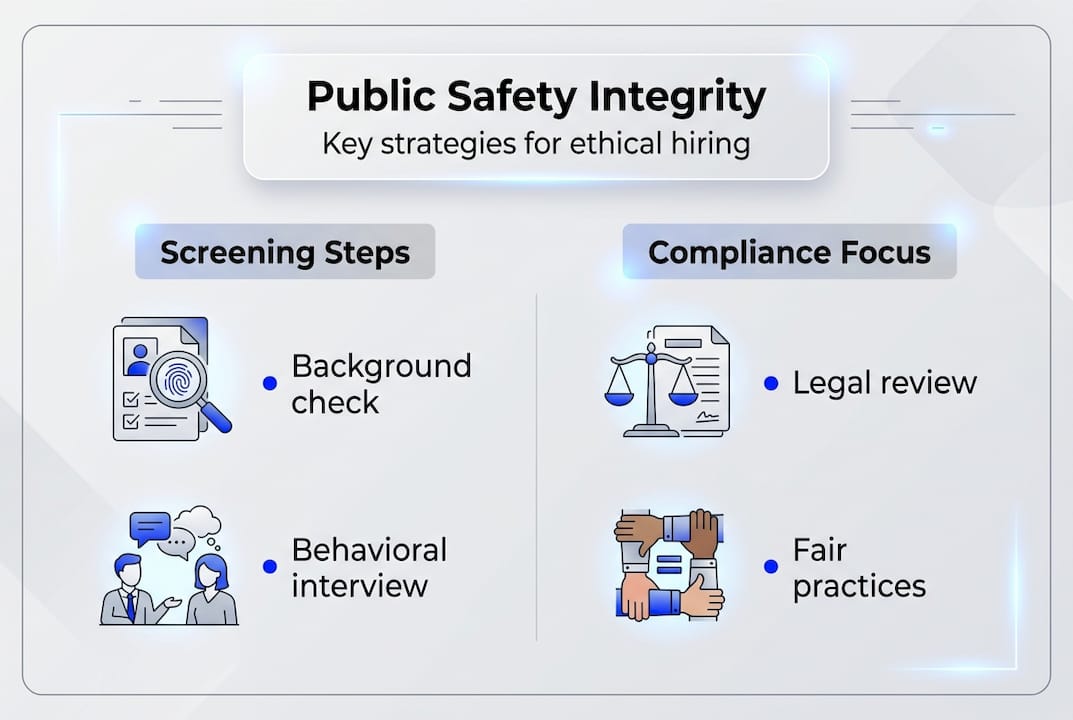
Start with comprehensive background investigations that go beyond basic criminal record checks. Your screening should cover:
- Criminal history at local, state, and federal levels, including sealed or expunged records where legally permissible
- Financial history and credit reports to identify potential vulnerabilities to corruption or bribery
- Employment verification with detailed reference checks from former supervisors and colleagues
- Education and credential verification to catch resume fraud and misrepresentation
- Social media and online presence review to uncover behavior inconsistent with agency values
- Driving records and traffic violations for positions requiring vehicle operation
Structured behavioral interviewing is another powerful integrity assessment tool. Instead of asking generic questions like “Are you honest?”, design scenarios that reveal how candidates make ethical decisions under pressure. Use these steps to conduct effective integrity interviews:
- Prepare situational questions based on real dilemmas your agency has faced, such as witnessing a colleague’s misconduct or discovering conflicting information in a case file.
- Ask candidates to walk through their decision-making process, not just state what they would do.
- Listen for signs of ethical reasoning, accountability, and willingness to report wrongdoing even when it is uncomfortable.
- Follow up with probing questions that test consistency and depth of their responses.
- Document responses thoroughly for comparison across candidates and legal protection.
Integrity testing and psychological assessments add another layer of screening depth. Validated instruments can measure honesty, responsibility, and resistance to unethical behavior. Reference checks should go beyond verifying dates and titles. Ask former supervisors specific questions about the candidate’s trustworthiness, handling of sensitive information, and response to ethical challenges. Request examples rather than general impressions.

Pro Tip: Always verify applicant disclosures against your investigation findings. Discrepancies between what candidates report and what you uncover often reveal more about integrity than the underlying issues themselves. A candidate who admits a past mistake and demonstrates growth shows stronger character than one who conceals or minimizes problems.
Consistency and documentation are critical throughout pre-employment screening. Use standardized evaluation criteria and scoring rubrics so every candidate is assessed fairly. Keep detailed records of all screening activities, findings, and decisions. This protects your agency legally and ensures that integrity standards are applied uniformly across all hires.
| Screening method | Primary integrity indicators | Implementation tips |
|---|---|---|
| Background checks | Criminal history, financial stability, employment gaps | Use specialized public safety screening services for depth |
| Behavioral interviews | Ethical reasoning, accountability, transparency | Develop scenario bank based on real agency situations |
| Integrity testing | Honesty, responsibility, rule-following tendencies | Select validated instruments appropriate for public safety |
| Reference checks | Trustworthiness, handling of sensitive info, peer respect | Ask specific behavioral examples, not general opinions |
By combining these strategies, you create multiple checkpoints that significantly reduce the risk of hiring personnel who lack the integrity your agency demands.
Balancing integrity evaluation with legal compliance and fairness
Rigorous integrity screening must operate within legal and ethical boundaries. Hiring managers face a complex landscape of employment laws, privacy regulations, and anti-discrimination requirements that shape how you can evaluate candidates. Hiring agencies must navigate legal frameworks while maintaining rigorous integrity assessments to avoid discrimination or liability, which requires careful policy development and consistent application.
Understand the applicable laws governing your hiring process. Federal regulations like Title VII of the Civil Rights Act, the Fair Credit Reporting Act, and the Americans with Disabilities Act set baseline requirements. State and local laws may impose additional restrictions on what you can ask, how you can use background information, and when you must provide candidates with notices or opportunities to respond. Public safety agencies often have more latitude than private employers in conducting thorough investigations, but this does not eliminate legal obligations.
Implement nondiscriminatory screening practices that focus on job-related criteria. Your integrity standards must connect directly to the essential functions and responsibilities of the position. Blanket policies that automatically disqualify candidates based on certain background elements, without individualized assessment, can create disparate impact and legal vulnerability. Instead, evaluate each case based on the nature of the issue, how long ago it occurred, evidence of rehabilitation, and relevance to the specific role.
Maintain transparency throughout the hiring process. Candidates should understand what screening will occur, how information will be used, and their rights to review and dispute findings. Provide clear written notices before conducting background checks and obtain proper authorization. When you make adverse decisions based on background information, follow required procedures for notification and opportunity to respond. This transparency not only fulfills legal requirements but also demonstrates the integrity you expect from candidates.
Balance thoroughness with respect for candidate rights and privacy. While background checks public safety agencies conduct are necessarily comprehensive, avoid overreach into areas unrelated to job performance. Focus your investigation on factors that genuinely predict integrity and suitability for public safety work. Document your rationale for each screening element so you can demonstrate its job relevance if challenged.
Pro Tip: Regularly review and update your screening policies to reflect changes in employment law and emerging best practices. What was legally sound five years ago may no longer provide adequate protection today. Consult with legal counsel who specializes in public sector employment to ensure your integrity screening program remains compliant and defensible.
Consider these key compliance principles:
- Apply the same screening standards and processes to all candidates for the same position
- Make individualized assessments rather than automatic disqualifications based on background elements
- Document the job-related rationale for each screening component and decision
- Provide candidates with required notices, authorizations, and opportunities to respond
- Protect confidential information and limit access to screening results
| Compliance area | Key requirements | Risk mitigation strategies |
|---|---|---|
| Anti-discrimination | Job-related criteria, individualized assessment | Document business necessity for each screening element |
| Privacy and data protection | Proper notices, consent, secure storage | Limit access to need-to-know personnel, encrypt records |
| Fair Credit Reporting Act | Pre-adverse and adverse action notices | Follow strict timeline and content requirements |
| State/local regulations | Varies by jurisdiction | Audit policies against all applicable laws regularly |
By building legal compliance into your integrity screening program from the start, you protect your agency while maintaining the rigorous standards public safety demands.

Sustaining integrity through ongoing employee monitoring and development
Hiring with integrity is essential, but it is only the beginning. Public safety personnel face constant ethical challenges throughout their careers, from handling evidence and confidential information to making split-second decisions with life-altering consequences. Ongoing monitoring and development programs help agencies detect and address integrity issues early among employees, reducing long-term risk and reinforcing the culture of accountability you established during hiring.
Regular integrity audits and lifestyle checks provide early warning of potential problems. These reviews might include periodic credit checks to identify financial stress that could create vulnerability to corruption, social media monitoring for concerning behavior or associations, and review of use-of-force reports or citizen complaints for patterns suggesting ethical drift. The goal is not to invade privacy but to identify red flags before they escalate into serious misconduct. Establish clear policies about what will be monitored, how often, and under what circumstances, ensuring employees understand expectations from day one.
Training and ethics reinforcement programs keep integrity front and center throughout careers. Annual ethics training should go beyond checkbox compliance to engage employees in realistic scenario discussions and case studies. Bring in examples from your own agency and the broader public safety community to illustrate how small integrity lapses can snowball into career-ending or agency-damaging incidents. Create opportunities for employees to ask questions and work through ethical dilemmas in a safe environment where they can learn from mistakes without fear of punishment.
Clear policies and whistleblower protections create the infrastructure for a culture of integrity. Your employee monitoring process guide should spell out expectations for reporting misconduct, protections for those who come forward, and consequences for violations. Make it easy and safe for employees to report concerns through multiple channels, including anonymous hotlines and third-party reporting systems. Investigate all allegations promptly and thoroughly, and communicate outcomes appropriately to demonstrate that integrity matters more than protecting individuals or avoiding embarrassment.
Pro Tip: Foster a culture where integrity is recognized and rewarded, not just where violations are punished. Publicly acknowledge employees who demonstrate ethical courage, such as reporting misconduct or returning found property. Make integrity a factor in promotion decisions and performance evaluations. When employees see that doing the right thing advances their careers rather than making them targets, they are more likely to maintain high standards even when it is difficult.
Post-hire integrity maintenance should include:
- Scheduled integrity audits at regular intervals or triggered by specific events
- Continuous ethics training that evolves with emerging challenges
- Clear reporting mechanisms and whistleblower protections
- Consistent investigation and discipline processes
- Recognition programs that celebrate ethical behavior
- Leadership modeling of integrity in all decisions and communications
By sustaining integrity focus beyond the hiring process, you create a self-reinforcing culture where ethical behavior is the norm and lapses are quickly identified and addressed. This protects your agency, your employees, and the community you serve.
Enhance your public safety hiring with OMNI Intel solutions
Implementing the integrity screening strategies outlined in this guide requires specialized tools and expertise. OMNI Intel provides public safety pre-employment screening services designed specifically for law enforcement, fire and EMS, dispatch centers, and other public safety agencies. Our platform combines comprehensive background checks for public safety with AI-driven investigation tools that uncover the information you need to make confident hiring decisions. From criminal history and financial records to employment verification and reference checks, we deliver thorough public safety background investigations that meet the rigorous standards your agency demands.

Our services go beyond basic screening to support integrity throughout the employee lifecycle, including post-hire monitoring and continuous activity tracking. With OMNI Intel, you gain a partner who understands the unique challenges of public safety hiring and provides the technology and expertise to protect your agency reputation while reducing hiring-related costs and speeding up recruitment cycles. Contact us today to learn how we can strengthen your integrity screening program.
Frequently asked questions
What is the role of integrity in public safety hiring?
Integrity serves as the foundation for all public safety work, ensuring personnel can be trusted with authority, sensitive information, and life-or-death decisions. Agencies that prioritize integrity during hiring protect community trust, reduce legal liability, and build teams capable of upholding their mission under pressure.
How can background checks identify integrity issues in candidates?
Comprehensive background investigations reveal patterns of dishonesty, financial instability, criminal behavior, and employment problems that indicate integrity risks. When combined with verification of candidate disclosures, background checks expose attempts to conceal or misrepresent information, which often signals deeper character concerns.
What legal considerations apply to integrity screening in public safety hiring?
Agencies must comply with anti-discrimination laws, privacy regulations, and fair credit reporting requirements while conducting integrity assessments. Screening criteria must be job-related, applied consistently, and documented thoroughly to withstand legal scrutiny and avoid disparate impact claims.
How do behavioral interviews assess candidate integrity?
Structured behavioral interviews use realistic ethical dilemmas to evaluate how candidates reason through difficult decisions, take accountability, and respond to pressure. Listening for consistency, depth of ethical reasoning, and willingness to report wrongdoing reveals more about integrity than direct questions about honesty.
Why is ongoing integrity monitoring important after hiring?
Post-hire monitoring detects emerging integrity issues before they escalate into serious misconduct or safety risks. Regular audits, ethics training, and clear reporting mechanisms sustain the culture of accountability established during hiring and protect the agency long-term.
What role does agency culture play in maintaining employee integrity?
A strong integrity culture reinforces ethical behavior through leadership modeling, recognition of ethical courage, and consistent consequences for violations. When employees see that integrity is valued and rewarded, they are more likely to maintain high standards throughout their careers.
Recommended
- What is integrity screening: A public safety hiring guide
- Why maintain transparency in hiring? 30% more qualified candidates
- 7 Best Hiring Process Practices for Public Safety Agencies
- Public Safety Vetting Process: Ensuring Trustworthy Hires
- How to Enhance Office Security for Better Workplace Safety – Safes and Security Direct