

Guide to Risk Mitigation for Public Safety Agencies
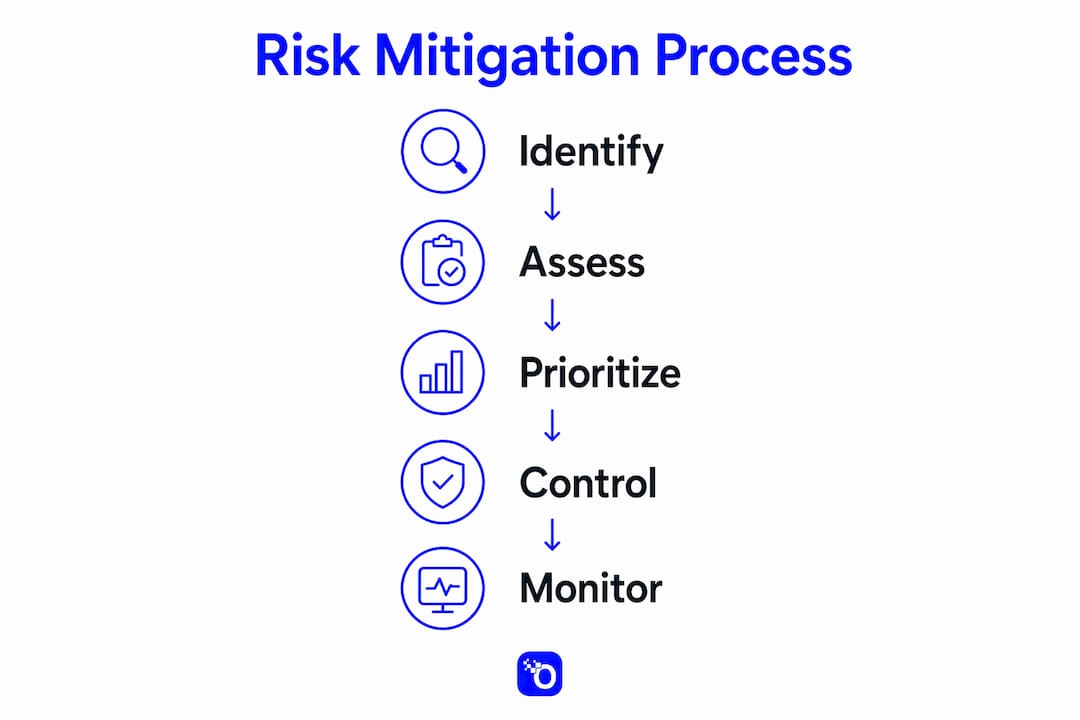
Risk mitigation is the structured process of identifying, analyzing, prioritizing, and controlling threats to reduce their impact on public safety operations, personnel, and community trust. For agency leaders, this is not a theoretical exercise. Compliance, IT, and risk awareness together explain 26.3% of effective operational risk management variance in public safety agencies, based on a study of 328 police personnel. That finding means the three most controllable factors in your agency’s risk posture are organizational, not circumstantial. Whether you lead a law enforcement department, a fire and EMS service, or a dispatch center, a disciplined guide to risk mitigation gives you a repeatable framework to protect personnel, reduce liability, and maintain the public’s confidence.
What are the essential components of a risk mitigation strategy?
Effective risk mitigation in public safety rests on four foundational components: risk identification, risk assessment, compliance monitoring, and technology infrastructure. Each component serves a distinct function. Together, they form the operational backbone of any public safety risk framework.
The four core components
- Risk identification: Systematically cataloging threats across personnel, operations, facilities, and data. This includes physical hazards, behavioral risks, and regulatory exposures.
- Risk assessment: Evaluating each identified risk by frequency, severity, and likelihood to determine which threats demand immediate action.
- Compliance monitoring: Tracking adherence to applicable standards such as NFPA 1660, FEMA preparedness guidelines, and state-level law enforcement regulations. Compliance gaps are risk events waiting to happen.
- Technology infrastructure: Deploying digital tools for audit trails, incident tracking, background screening, and real-time monitoring. Technology converts risk awareness from intention into practice.
Research confirms that governance alone is insufficient without operationalized compliance, technological tools, and audit processes. Leadership rhetoric does not reduce risk. Documented systems do.
| Component | Primary Function | Key Standard or Tool |
|---|---|---|
| Risk identification | Catalog all threat categories | NFPA 1660, FEMA hazard guides |
| Risk assessment | Score threats by impact and likelihood | Risk matrices, frequency-severity models |
| Compliance monitoring | Track regulatory adherence | PRIMA frameworks, internal audit cycles |
| Technology infrastructure | Automate tracking and reporting | Background screening platforms, KRI dashboards |
| Personnel vetting | Screen candidates and monitor employees | Pre-employment investigations, continuous monitoring |

Pro Tip: Assign a named owner to each risk component. Unowned risks are unmanaged risks. A compliance officer who also owns technology infrastructure creates accountability gaps.
How do you identify, assess, and prioritize risks in public safety?
Risk identification in public safety is most effective when it is structured, participatory, and tied to recognized standards. The Public Risk Management Association (PRIMA) recognizes facilitated hazard identification exercises as highly effective for aligning agency preparedness with NFPA 1660 and FEMA guidance. These exercises ask staff at all levels to list the top hazards they observe in their daily operations. The result is a ground-level risk inventory that no executive-only assessment can replicate.
Step-by-step risk assessment process
- Convene a cross-functional team. Include patrol supervisors, HR leaders, IT staff, legal counsel, and frontline personnel. Each group sees different risk categories.
- Conduct facilitated hazard identification. Use structured workshops where participants list the top threats in their operational area. Categorize results by domain: personnel, operational, reputational, and regulatory.
- Score each risk. Apply a frequency-severity matrix. Rate likelihood on a 1–5 scale and potential impact on a 1–5 scale. Multiply scores to produce a risk priority number.
- Map risks to your agency’s risk appetite. Some agencies accept higher operational risk in exchange for faster response times. Define what level of residual risk leadership is willing to carry before selecting controls.
- Rank and document. Produce a formal risk register that lists each threat, its score, the responsible owner, and the proposed control. Update this register at least annually.
- Validate with external benchmarks. Compare your risk register against FEMA’s Threat and Hazard Identification and Risk Assessment (THIRA) methodology to confirm you have not missed a category.
What makes public safety risk assessment different
Public safety agencies carry risks that private organizations rarely face. Use-of-force incidents, officer wellness, data breach exposure under criminal justice information systems, and community relations failures all require specific assessment criteria. A generic enterprise risk framework misses these categories entirely.
- Personnel risks: turnover, misconduct, inadequate training, and fitness-for-duty gaps
- Operational risks: equipment failure, mutual aid coordination breakdowns, and dispatch errors
- Reputational risks: public complaints, media scrutiny, and social media incidents
- Regulatory risks: decertification exposure, FCRA compliance in hiring, and records management failures
Pro Tip: Run your hazard identification exercise annually, not just when a crisis forces the conversation. Agencies that treat risk identification as a standing agenda item build institutional memory that survives leadership transitions.
What are the most effective strategies to control identified risks?
Risk treatment is the deliberate selection of controls to reduce a risk to an acceptable level. Public safety agencies have five treatment options available, and the right choice depends on the risk’s severity, cost of control, and operational context.
The five risk treatment options
- Avoid: Eliminate the activity that creates the risk. An agency that discontinues a high-liability training exercise it cannot safely supervise is avoiding risk.
- Accept: Acknowledge the risk and carry it without additional controls. Acceptance is appropriate only for low-severity, low-likelihood risks where the cost of control exceeds the cost of the risk itself.
- Reduce: Implement preventive or detective controls to lower the likelihood or impact of the risk. This is the most common treatment in public safety. Examples include mandatory body camera policies, regular use-of-force training, and pre-employment background investigations.
- Share: Distribute the risk across multiple parties. Joint task forces and mutual aid agreements share operational risk between agencies.
- Transfer: Shift financial exposure to a third party through insurance or indemnification agreements.
Risk transfer deserves specific attention because agencies frequently overestimate its protective value. Insurance reduces financial exposure but leaves operational and reputational risks entirely unaddressed. An agency that insures against use-of-force claims but does not invest in de-escalation training has transferred the bill while retaining the underlying threat. Preventive controls are the only treatment that reduces the probability of the event occurring in the first place.
| Treatment Option | Best Used When | Key Limitation |
|---|---|---|
| Avoid | Risk exceeds agency’s tolerance and activity is non-essential | May limit operational capability |
| Accept | Risk is low-severity and cost of control is disproportionate | Requires documented justification |
| Reduce | Risk is controllable through training, policy, or screening | Requires sustained investment |
| Share | Risk spans multiple agencies or jurisdictions | Requires formal agreements |
| Transfer | Financial exposure is the primary concern | Does not reduce operational or reputational risk |
Building organizational buy-in
Agency-wide buy-in is a prerequisite for successful risk mitigation, not an optional enhancement. Risk management fails when it is perceived as an administrative burden imposed from above. Leaders who communicate the direct connection between risk controls and officer safety, community trust, and budget stability generate the participation that makes controls effective.
Preventive controls work best when they are embedded in daily operations rather than reserved for audits. Detective controls, such as supervisory review of use-of-force reports, catch failures before they escalate. Corrective controls, such as retraining following a policy violation, close the loop and reduce recurrence. All three categories belong in a complete risk reduction program.
For agencies managing HR-related risk exposure, the personnel dimension of risk treatment is particularly consequential. Hiring decisions made without thorough vetting create risks that no subsequent policy can fully correct.
How do you implement continuous monitoring for sustainable risk mitigation?
Continuous monitoring transforms risk mitigation from a one-time project into an ongoing management discipline. The most effective monitoring programs use Key Risk Indicators (KRIs) as their primary measurement tool. KRIs such as staffing turnover, training hours, and policy violations serve as predictive signals, identifying conditions that precede incidents rather than simply recording them after the fact. This distinction matters because lagging indicators like claims frequency tell you what went wrong. KRIs tell you what is about to go wrong.
Steps to establish a monitoring cycle
- Define your KRI set. Select 8–12 indicators that reflect your agency’s highest-priority risks. Staffing vacancy rates, use-of-force frequency, training completion rates, and complaint volumes are standard starting points.
- Set thresholds. Establish a green, amber, and red threshold for each KRI. When an indicator crosses into amber, it triggers a review. Red triggers an immediate response.
- Assign reporting owners. Each KRI needs a named owner who collects data and reports on a defined schedule, typically monthly for operational indicators and quarterly for strategic ones.
- Conduct structured self-assessments. Annual self-assessment questionnaires between major external reviews create continuous accountability and have been shown to produce substantial premium savings for law enforcement agencies. Industry best practice calls for formal best-practice assessments every three years with mandatory annual self-assessments in between.
- Apply the Three Lines of Defense model. This governance structure assigns distinct roles: operational management owns and manages risk daily, the risk management function advises and monitors, and internal audit provides independent assurance. The Three Lines of Defense model prevents risk-blindness by separating the people who create risk from the people who evaluate it.
- Review and update the risk register. At the close of each monitoring cycle, update risk scores based on new data, close resolved risks, and add newly identified threats.
Pro Tip: Use your background screening and employee monitoring platform to generate automated audit trails. Manual tracking creates gaps. Automated systems produce the timestamped records that satisfy both internal governance requirements and external audits.
For agencies assessing their cyber and operational risk posture, a structured gap analysis methodology, such as the approach outlined in CMMC gap analysis guidance, provides a transferable model for identifying control deficiencies before they become incidents.
Key Takeaways
Effective risk mitigation in public safety requires compliance, technology, and agency-wide participation working together, not governance declarations alone.
| Point | Details |
|---|---|
| Compliance drives outcomes | Compliance, IT, and risk awareness explain 26.3% of operational risk management variance in public safety agencies. |
| KRIs predict, not just record | Key Risk Indicators like turnover and training hours signal future failures before incidents occur. |
| Insurance is not enough | Risk transfer covers financial exposure but leaves operational and reputational risks unaddressed. |
| Annual self-assessments matter | Structured internal reviews between triennial external assessments create accountability and reduce liability costs. |
| Personnel vetting is a control | Pre-employment background investigations and continuous employee monitoring are risk reduction tools, not administrative steps. |
Why risk culture matters more than risk policy
I have reviewed risk management programs across law enforcement, fire, and EMS agencies for years, and the pattern is consistent. Agencies with detailed risk policies but weak risk cultures fail at the implementation stage. The policy sits in a binder. The culture determines what actually happens on shift.
The research confirms what experience shows. Leadership effectiveness depends on operationalizing compliance through digital tools and audit processes, not on governance rhetoric. A chief who announces a commitment to risk management in a department-wide memo but does not fund training, screening, or monitoring technology has not reduced a single risk. The memo is not a control.
The agencies that build genuine risk resilience treat risk awareness as a daily operational habit. Supervisors review KRI dashboards the same way they review staffing rosters. HR leaders treat compliance in public safety hiring as a mission-critical function, not a legal formality. Background investigators apply the same rigor to a lateral hire as to a recruit. That consistency is what separates agencies that manage risk from agencies that merely document it.
The uncomfortable truth is that most agencies underinvest in the personnel dimension of risk. They build strong operational controls and then hire without adequate vetting, creating a vulnerability that no policy can close. The most durable risk mitigation programs treat every hire as a risk decision, because that is exactly what it is.
— Matt
How OMNI Intel supports your agency’s risk mitigation program
Public safety agencies that take risk mitigation seriously eventually reach the same conclusion: personnel risk is the hardest to control and the most consequential when it fails.

OMNI Intel’s pre-employment screening services are built specifically for law enforcement, fire and EMS, dispatch centers, and private security firms. The platform delivers investigator-driven background investigations, FCRA-compliant screening workflows, and continuous post-hire employee monitoring, all designed to reduce hiring-related risk and support your agency’s compliance posture. OMNI Intel also integrates with existing recruiting platforms, so screening becomes part of your hiring process rather than a separate administrative step. For agencies building a complete risk reduction program, thorough personnel vetting is not optional. It is a foundational control.
FAQ
What is risk mitigation in public safety?
Risk mitigation in public safety is the process of identifying, assessing, and controlling threats to personnel, operations, and community trust. It includes preventive controls like background screening, detective controls like KRI monitoring, and corrective controls like retraining after policy violations.
What are the steps for risk reduction in a public safety agency?
The core steps are: identify risks through facilitated hazard exercises, assess each risk using a frequency-severity matrix, select a treatment option (avoid, accept, reduce, share, or transfer), implement controls, and monitor outcomes using Key Risk Indicators and annual self-assessments.
How do Key Risk Indicators improve risk management?
Key Risk Indicators like staffing turnover, training completion rates, and policy violations predict future failures before incidents occur, giving agency leaders time to intervene rather than respond after the fact.
Why is insurance alone insufficient as a risk mitigation strategy?
Insurance transfers financial exposure but does not reduce the likelihood of an operational or reputational failure. Agencies that rely solely on insurance retain the underlying risk and the community trust damage that follows a preventable incident.
How often should public safety agencies conduct risk assessments?
Best practice calls for a formal external best-practice assessment every three years, with mandatory annual self-assessments in between. This cycle creates continuous accountability and supports premium savings through demonstrated risk governance.