

How to Maintain Data Privacy: A Practical Guide
Data privacy maintenance is defined as the continuous process of identifying, controlling, and protecting personal and sensitive information to prevent unauthorized access, misuse, or breach. Whether you manage a public safety agency or protect your own personal records, the challenge is the same: privacy is not a one-time setup. The NIST Privacy Framework provides the most widely recognized structure for this work, organizing privacy management into five core functions that apply to organizations of any size. Understanding how to maintain data privacy means committing to ongoing assessment, strong technical controls, and scheduled reviews that catch threats before they become incidents.
What key steps are involved in maintaining data privacy effectively?
Effective data privacy protection starts with knowing exactly what data you hold. Without a complete data inventory, you cannot control access, apply retention limits, or respond to a breach with any accuracy. Every individual and organization should catalog what personal data exists, where it lives, who can reach it, and why it was collected.
Access control is the next critical layer. The zero trust model treats every access request as untrusted until verified, regardless of whether the request comes from inside or outside your network. This means granting the minimum privileges necessary for each role and revoking access immediately when it is no longer needed.
Encryption protects data both at rest and in transit. Files stored on a server, messages sent over a network, and backups saved to an external drive all require encryption to remain protected if a device is lost or a network is compromised. The FTC advises that strong authentication and secure backups are foundational controls that organizations of any budget can implement.
Data minimization is equally non-negotiable. Collecting only the data you need, setting clear retention periods, and disposing of data when its purpose is fulfilled reduces the total volume of information at risk. The NIST Privacy Framework’s CT.DM core function formalizes these collection limits into documented policy, making compliance auditable rather than assumed.
Multi-factor authentication (MFA) adds a critical verification layer, but not all MFA methods carry equal weight. SIM swapping attacks increased 400% between 2021 and 2024, making SMS-based MFA a known liability. Industry guidance now recommends hardware security keys or authenticator apps as the standard.
- Build a data inventory. List every data type, storage location, and access point across your systems or devices.
- Apply zero trust access controls. Grant minimum necessary privileges and verify every access request.
- Encrypt data at rest and in transit. Use full-disk encryption for devices and TLS for network communications.
- Enforce data minimization. Collect only what you need and set automated deletion timelines tied to data purpose.
- Replace SMS MFA. Switch to hardware keys or authenticator apps to eliminate SIM swap vulnerability.
Pro Tip: Audit your MFA methods across every account before doing anything else. One SMS-based login on a critical account can undermine every other control you have in place.
How can organizations use the NIST Privacy Framework to structure their privacy programs?

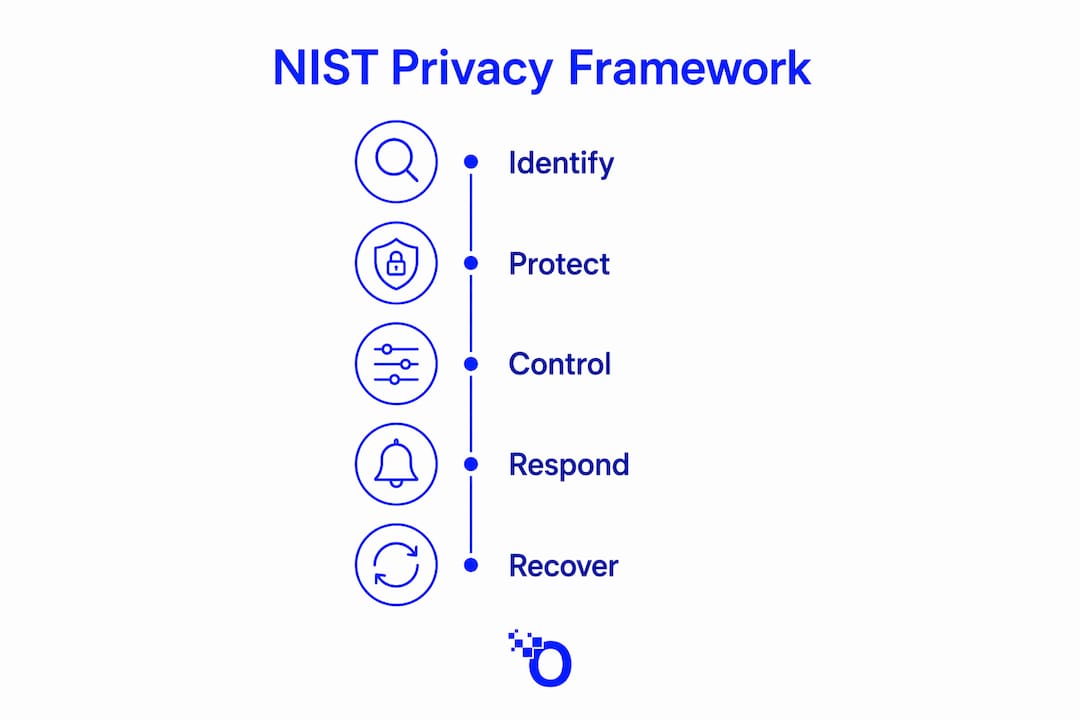
The NIST Privacy Framework gives organizations a structured path from ad hoc privacy practices to a documented, auditable program. It organizes privacy management into five core functions: Identify, Govern, Control, Communicate, and Protect. Each function addresses a distinct dimension of privacy risk, and together they form a complete operating model.
The five core functions work as follows:
- Identify: Catalog data assets, map data flows, and assess privacy risk across systems and third-party relationships.
- Govern: Assign named ownership for privacy functions, establish policies, and define accountability structures.
- Control: Implement data minimization, access restrictions, and consent management aligned with CT.DM practices.
- Communicate: Maintain transparency with individuals about how their data is used and provide mechanisms for rights requests.
- Protect: Apply technical safeguards including encryption, MFA, and monitoring to prevent unauthorized access.
Beyond the five functions, the NIST Privacy Framework introduces Profiles and Implementation Tiers. A Profile maps your current privacy practices against your target state, revealing gaps that need remediation. Implementation Tiers rate your program’s maturity from Tier 1 (ad hoc) to Tier 4 (adaptive). The difference in outcomes between tiers is significant.
| Maturity Level | Key Characteristic | Measured Outcome |
|---|---|---|
| Tier 1 (Ad Hoc) | No documented privacy processes | High incident frequency, reactive responses |
| Tier 2 (Risk Informed) | Policies exist but inconsistently applied | Moderate incident rate, partial audit readiness |
| Tier 3 (Repeatable) | Consistent processes with defined ownership | Lower incidents, improved audit performance |
| Tier 4 (Adaptive) | Continuous improvement and automation | 50% fewer privacy incidents annually |
Healthcare organizations that adopt NIST Target Profiles reduce audit timelines by up to 30% and report 25% fewer audit findings. That result reflects what structured privacy management delivers when it replaces informal practices.
Automation is a force multiplier within this framework. Automating data deletion based on retention rules, rather than relying on manual cleanup, achieves true data minimization compliance at scale. Manual processes drift. Automated workflows do not. Organizations that assign named ownership for privacy functions and conduct regular progress reviews respond faster to audits and adapt more effectively to changing risk environments.
Privacy experts consistently emphasize that intentional, documented privacy management using frameworks like NIST satisfies auditors and operationalizes risk management in ways that informal approaches cannot replicate. Understanding why data privacy matters is the foundation; the NIST framework is the architecture that turns that understanding into a functioning program.
What practical privacy routines should individuals adopt to protect their data?
Individual privacy protection requires the same discipline as organizational programs, applied at a personal scale. The most effective approach is a structured quarterly review cycle that covers every major exposure point. Performing a comprehensive privacy review every 90 days is the recognized standard, covering cloud storage terms, app permissions, passwords, and backup integrity.
The zero trust mindset applies directly to personal devices and accounts. Assuming all access is untrusted until verified means treating every app, browser extension, and connected service as a potential risk until you have confirmed it needs access. Minimizing privileges at the personal level means revoking permissions from apps that no longer need them and removing accounts you no longer use.
- Conduct a 90-day privacy review. Check cloud storage terms for AI training opt-out clauses, update compromised passwords, and verify that encrypted backups are current.
- Audit app permissions. Review every app on your phone and computer. Revoke camera, microphone, and location access for any app that does not require it to function.
- Enable hardware MFA. Replace SMS codes with an authenticator app or a physical hardware key on every critical account.
- Use a password manager. Generate and store unique, complex passwords for every account. Reused passwords are one of the most common breach vectors.
- Maintain encrypted offline backups. Store sensitive files on an encrypted external drive that is not permanently connected to the internet.
- Monitor for breaches. Use a breach notification service to receive alerts when your credentials appear in leaked databases.
Pro Tip: Your quarterly review should include checking cloud service terms of service for any new clauses that allow AI training on your stored data. These clauses are often added through routine terms updates and reviewing AI opt-out settings takes less than five minutes per service.
Cloud storage services, social media platforms, and productivity apps all accumulate permissions over time. Most people grant access once and never revisit it. A single dormant OAuth token connected to a compromised third-party app can expose an entire account. Periodic auditing and revocation of connected OAuth applications reduces unnecessary account access risks that most users never think to check.
How can organizations and individuals troubleshoot common data privacy pitfalls?
The most persistent privacy failures share a common root: they are not technical failures. They are process failures. Manual deletion policies drift. Token revocations get skipped. SMS MFA stays in place long after better options are available. Recognizing these patterns is the first step toward correcting them.
Common pitfalls and their corrections include:
- Manual deletion failures: Relying on staff to delete data on schedule creates gaps. Automate deletion workflows tied to data purpose and retention deadlines.
- Dormant OAuth tokens: Connected apps accumulate over time. Auditing and revoking dormant app tokens across all major providers is a critical maintenance task that most organizations perform too infrequently.
- SMS MFA persistence: Many organizations and individuals upgraded to MFA years ago but never revisited the method. SMS remains the default on many platforms despite its documented vulnerability to SIM swapping.
- Undocumented privacy posture: Without an audit trail showing what controls exist, when they were reviewed, and who owns them, an organization cannot demonstrate compliance. Documentation is not bureaucracy. It is evidence.
- No named privacy owner: Organizations that lack a designated privacy function owner experience drift. Responsibilities diffuse across teams, reviews get delayed, and incidents go undetected longer.
“Organizations often fail to assign clear privacy function owners, leading to drift and reactive responses. Named ownership is essential for sustained privacy management.”
NIST Privacy Framework: What It Is and How to Use It
Preparing for a breach before one occurs is as important as prevention. This means maintaining an incident response plan with defined roles, documented data inventories that allow rapid scope assessment, and communication templates ready for regulators and affected individuals. Organizations that handle data privacy in background checks and other sensitive processes face heightened obligations when a breach occurs, making pre-incident preparation a compliance requirement, not just a best practice.
Monitoring practices should include scheduled access reviews, automated alerts for unusual login activity, and regular checks of third-party vendor privacy posture. Vendors with access to your data extend your privacy perimeter. Their failures become your incidents. Reviewing vendor agreements and access rights on the same quarterly cycle as internal controls closes this gap. For organizations managing data security in public safety recruitment, these controls carry direct legal and reputational weight.
Key Takeaways
Maintaining data privacy requires a structured, continuous program built on documented controls, named ownership, and scheduled reviews rather than one-time technical fixes.
| Point | Details |
|---|---|
| Start with a data inventory | You cannot protect what you have not mapped; catalog all data assets before applying controls. |
| Replace SMS MFA immediately | SIM swapping attacks increased 400% between 2021 and 2024; switch to hardware keys or authenticator apps. |
| Apply the NIST Privacy Framework | Organizations at Tier 4 maturity report 50% fewer privacy incidents annually compared to less mature peers. |
| Conduct quarterly privacy reviews | Review cloud terms, app permissions, passwords, and encrypted backups every 90 days without exception. |
| Assign named privacy ownership | Unnamed responsibility leads to drift; designate a specific owner for each privacy function and hold regular progress reviews. |
Why privacy maintenance is a discipline, not a deployment
Working with public safety agencies and organizations that handle sensitive personnel data has made one thing clear: most privacy failures are not caused by missing technology. They are caused by missing discipline. The organizations that suffer the most damaging breaches are rarely the ones with the weakest tools. They are the ones that set up controls once, assumed the work was done, and never looked back.
The NIST Privacy Framework changed how I think about this. It reframes privacy not as a compliance checkbox but as a risk management discipline with measurable maturity levels. When an organization moves from Tier 1 to Tier 4, the reduction in incidents is not accidental. It reflects the compounding effect of documented processes, clear ownership, and regular review cycles that catch problems before they escalate.
Zero trust is the same kind of reframe. Most people think of it as a network architecture concept. I think of it as a mindset. The question is not “do I trust this app?” The question is “have I verified that this app still needs this access?” That shift in framing changes behavior in ways that no single tool can replicate.
The hardest part of privacy maintenance is not the first 90 days. It is the second year, when the initial urgency fades and quarterly reviews start getting pushed to “next month.” The organizations that sustain strong privacy posture are the ones that treat the review cycle as non-negotiable, the same way they treat payroll or compliance reporting. Privacy is not a project with an end date. It is an ongoing operational responsibility.
— Matt
How OMNI Intel supports privacy-conscious public safety organizations
Public safety agencies operate under some of the most demanding privacy and compliance requirements of any sector. Every background investigation, every personnel record, and every applicant file represents sensitive data that must be handled with documented controls and clear accountability.

OMNI Intel builds its pre-employment screening services on the same principles this article describes: data minimization, access control, documented audit trails, and named accountability for every step of the process. Agencies that need to demonstrate privacy compliance to regulators, oversight bodies, or the communities they serve can rely on OMNI Intel’s investigator-driven approach to deliver thorough, FCRA-compliant screening without sacrificing data security. For agencies ready to align their hiring process with modern privacy standards, OMNI Intel provides the structure and the expertise to make that possible.
FAQ
What is the NIST Privacy Framework?
The NIST Privacy Framework is a voluntary guidance document that organizes privacy risk management into five core functions: Identify, Govern, Control, Communicate, and Protect. Organizations use it to build structured, auditable privacy programs that satisfy regulators and reduce incidents.
How often should individuals review their privacy settings?
A comprehensive personal privacy review every 90 days is the recognized standard. Each review should cover cloud storage terms, app permissions, password integrity, MFA methods, and encrypted backup status.
Why is SMS-based MFA considered unsafe?
SIM swapping attacks, which redirect your phone number to an attacker’s device, increased 400% between 2021 and 2024. Hardware security keys and authenticator apps eliminate this vulnerability entirely.
What does data minimization mean in practice?
Data minimization means collecting only the personal data required for a specific, documented purpose and deleting it automatically when that purpose is fulfilled. The NIST Privacy Framework’s CT.DM function provides the policy structure to enforce this at an organizational level.
How does zero trust apply to personal privacy?
Zero trust for personal privacy means treating every app, device, and connected service as potentially untrusted until access is verified and confirmed necessary. This includes revoking dormant OAuth tokens, limiting app permissions, and authenticating strongly on every account.