

Why International Background Checks Matter for Global Hiring
International background checks are the process of verifying a candidate’s criminal, employment, and education history across multiple countries before making a hiring decision. For employers managing cross-border hiring, skipping this step is not a minor oversight. It exposes organizations to negligent hiring liability, regulatory penalties, and the very real risk of placing an unqualified or dangerous individual in a position of trust. Understanding why international background checks matter starts with recognizing that a domestic screening process, no matter how thorough, cannot capture what happened in another country’s jurisdiction.
Why international background checks matter for legal compliance
The legal stakes of inadequate global employment verification are significant and growing. GDPR violations alone can result in fines reaching 4% of a company’s global annual turnover. That figure is not a theoretical ceiling. It represents the actual exposure any employer faces when collecting or processing candidate data in the European Union without a proper legal basis.
The challenge is structural. HR teams must manage background screening across 195 countries, each operating under its own data privacy framework, record-keeping system, and employment law. A process that is fully compliant in the United States may be illegal in Germany, restricted in Japan, or unenforceable in Brazil. Treating global screening as an extension of domestic procedures is the most common and costly mistake employers make.
Consent is another area where employers frequently misjudge their legal footing. Under GDPR and similar frameworks, consent alone may not legitimize a background check due to the inherent power imbalance between employer and candidate. Legal bases such as “legitimate interest” or “contract necessity” are often more defensible. Employers who rely solely on a signed consent form in EU jurisdictions may find that form provides no legal protection at all.
The consequences extend beyond fines. Improper checks create negligent hiring liability when a candidate’s undisclosed history later causes harm. Reputational damage from a high-profile bad hire, particularly in public safety or financial services, can far outlast any regulatory penalty.
- Criminal record searches face the most restrictions globally and require country-specific authorization
- Education verification is widely permissible across most jurisdictions but must follow local data handling rules
- Drug testing regulations vary dramatically, with some countries prohibiting employer-mandated testing entirely
- Data retention limits differ by country, affecting how long screening results can be stored
- Failure to follow local consent and notification rules can invalidate the entire screening process
Pro Tip: Consult a local employment attorney or a compliance resource specific to each target country before launching a screening program there. Relying on a single global policy document to cover 195 jurisdictions is a compliance gap, not a solution. Resources like data privacy in hiring can help frame the right questions to ask.
How background check procedures vary by country
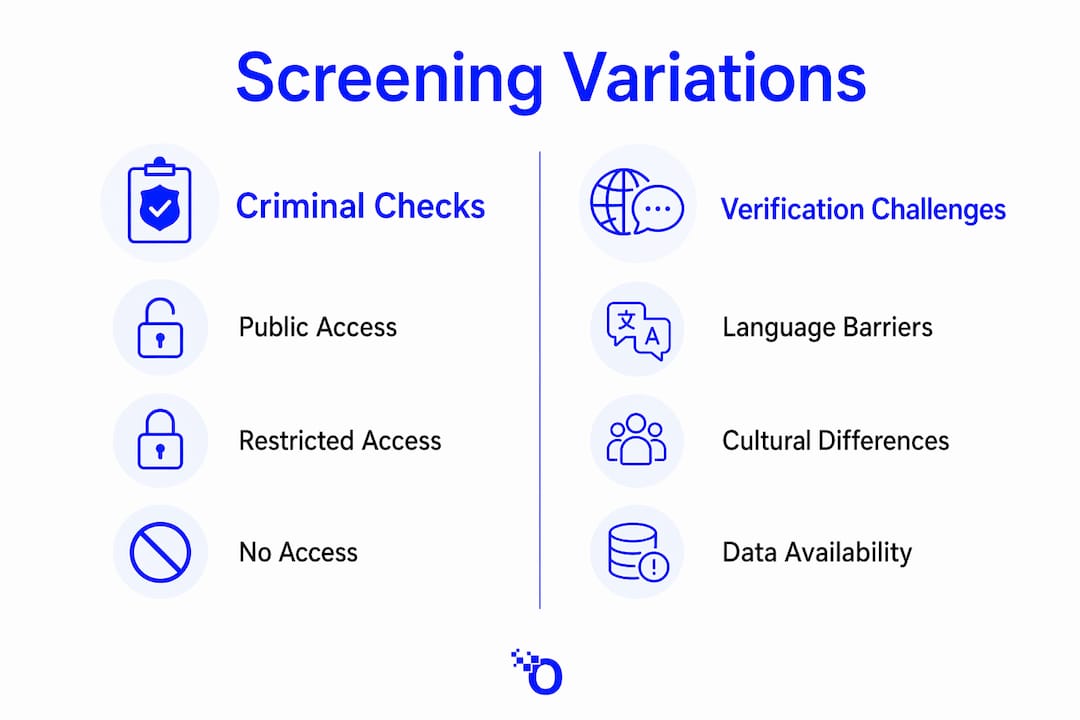
No universal criminal database exists. Global checks require in-country access to local records, which means an employer cannot simply run a single search and assume it covers a candidate’s full international history. This is the operational reality that many HR teams discover only after a problem surfaces.

Record availability differs sharply across regions. In the United States, criminal court records are largely public and accessible at the county level. In many European countries, criminal records are held by national police authorities and released only to the individual, not to employers. In parts of Southeast Asia and sub-Saharan Africa, records may exist only in paper form at local courthouses, with no centralized database at all.
Language barriers compound the problem. A background check result written in Mandarin, Arabic, or Portuguese requires accurate translation before it can be interpreted. A mistranslated credential or a misread date of conviction can produce a false clear or a false flag, either of which carries serious consequences.
Cultural context adds another layer of complexity. Written employment references vary culturally. A reference letter that reads as lukewarm in the United States may represent the highest possible praise in a country where effusive recommendations are considered unprofessional. Misreading that signal can lead to rejecting a strong candidate or, conversely, missing a warning sign embedded in culturally coded language.
The table below illustrates how background check procedures differ across selected countries.
| Country | Criminal check access | Education verification | Key challenge |
|---|---|---|---|
| United States | Public court records, county-level | Widely available | Volume and jurisdiction fragmentation |
| Germany | Candidate must self-obtain from federal registry | Permitted with consent | Employer cannot request directly |
| United Kingdom | Disclosure and Barring Service (DBS) for regulated roles | Permitted | Role-specific access tiers |
| India | State police records, inconsistent availability | Permitted | Record inconsistency across states |
| Brazil | Federal and state courts, partially digitized | Permitted | Language barrier, data gaps |
| Japan | Highly restricted; employer checks largely prohibited | Limited | Cultural resistance to formal screening |
Localized expertise is not optional in this environment. Effective global screening requires operational presence or partnerships in each relevant country to access local records and verify authenticity reliably. A vendor that claims global coverage without in-country capability is providing a surface-level check, not a genuine investigation.
Pro Tip: When evaluating a screening provider’s international capabilities, ask specifically which countries they have direct in-country access to versus which they rely on third-party aggregators. The distinction determines the reliability of what you receive.
Why a risk-based approach improves international screening
International background screening should be risk-based, aligned with the role’s access to sensitive data, financial systems, or security-related responsibilities. Applying the same depth of investigation to every candidate regardless of role is both operationally inefficient and legally unnecessary in many jurisdictions.
A tiered screening matrix allows employers to match the scope of a check to the actual risk profile of the position. A software engineer working remotely in a low-risk capacity does not require the same depth of investigation as a financial controller with access to corporate accounts or a security officer with access to restricted facilities. Calibrating the process to the role protects the organization without creating unnecessary friction for candidates.
Opaque or overly intensive screening processes often lead to significant candidate drop-off globally. This is particularly pronounced in regions where background checks are culturally unfamiliar or associated with distrust. Losing qualified candidates because the screening process felt invasive or unexplained is a preventable cost.
The following steps outline how to implement a risk-based international screening program.
- Classify roles by risk tier. Assign each position a risk level based on access to sensitive data, financial authority, physical security responsibilities, and public-facing duties.
- Map jurisdictions for each candidate. Identify every country where the candidate has lived or worked for a meaningful period, typically two years or more.
- Identify permissible checks per jurisdiction. Confirm which screening components are legally allowed in each relevant country before initiating any request.
- Align check depth to risk tier. High-risk roles warrant criminal, employment, education, and reference verification across all relevant jurisdictions. Lower-risk roles may require only employment and education confirmation.
- Document the rationale. Record why each check was selected for each role. This documentation supports compliance audits and demonstrates a defensible, non-discriminatory process.
- Communicate clearly with candidates. Explain what checks will be conducted, why, and how long the process will take. Transparency reduces drop-off and builds candidate trust.
Pro Tip: Build your screening matrix before you open a requisition, not after you have a finalist. Retroactively adjusting the scope of a check for a specific candidate creates legal exposure and the appearance of discriminatory treatment.
Best practices for compliant international background checks
Partnering with a screening provider that has genuine in-country expertise is the single most consequential decision an employer makes in building a global screening program. A provider with local knowledge understands which records are accessible, which require candidate self-disclosure, and which are legally off-limits. That expertise cannot be replicated by a domestic provider running database queries against aggregated international data.
Candidate communication is equally critical. Country-specific guidelines are essential to avoid uniform global processes that violate local law. Candidates must receive clear, localized notice of what is being checked, in a language they understand, and with an explanation of their rights under local law. A generic English-language consent form sent to a candidate in France or South Korea does not meet this standard.
Technology supports the process but cannot replace human judgment. Automated database searches are fast and cost-effective for initial screening. Authenticity verification, reference interpretation, and document review require experienced investigators who understand local context. The most effective programs combine both, using technology to flag and prioritize, and trained professionals to verify and interpret.
Staying current on jurisdictional changes requires a formal process. Employment law changes frequently, and a check that was permissible last year may be restricted today. Integrating HR, legal, and compliance stakeholders into a regular review cycle keeps the program aligned with current requirements. You can also review background screening best practices to build a structured review cadence into your HR calendar.
Key implementation recommendations for employers building or refining a global screening program:
- Select a screening provider with documented in-country access, not just claimed global coverage
- Develop a written screening policy that specifies which checks apply to which roles and why
- Train hiring managers on what they can and cannot ask candidates about their screening results
- Build candidate-facing communications in the local language for each target country
- Establish a process for candidates to dispute inaccurate results, as required in many jurisdictions
- Review the program annually against regulatory changes in each active hiring country
- Maintain records of all screening decisions and the legal basis for each check conducted
Understanding how to structure the pre-employment screening workflow from intake through decision is particularly valuable for agencies and organizations with recurring high-volume hiring needs.
Key Takeaways
International background checks are the only reliable method for verifying a global candidate’s full history, and no domestic screening process can substitute for in-country access and jurisdictional expertise.
| Point | Details |
|---|---|
| Legal exposure is real | GDPR violations can reach 4% of global annual turnover; consent alone may not provide legal protection in EU jurisdictions. |
| No universal database exists | Global screening requires in-country access or vetted local partnerships to retrieve accurate records. |
| Risk-based screening reduces friction | Matching check depth to role risk improves compliance and reduces candidate drop-off in unfamiliar screening markets. |
| Country procedures vary sharply | Criminal record access, education verification rules, and reference interpretation differ significantly across jurisdictions. |
| Documentation is a legal defense | Recording the rationale for each check and the legal basis used protects employers during audits and disputes. |
The uncomfortable truth about “global” background checks
The phrase “global background check” is one of the most misleading terms in HR. I have seen organizations sign contracts with screening vendors who promise global coverage, then discover months later that their “international check” was a database query against aggregated records with no in-country verification at all. That is not a background check. It is a false sense of security with a price tag attached.
The real problem is that most employers do not know what to ask. They assume that if a vendor operates in 50 countries, the checks conducted in those countries are equivalent in depth and reliability to what they receive domestically. They are not. The quality of a background investigation is determined by what records are actually accessible in each jurisdiction, who is retrieving them, and whether the person interpreting the results understands the local legal and cultural context.
What I find most underappreciated is the candidate experience dimension. Employers in public safety and security roles often apply the most intensive screening processes to candidates who are already skeptical of institutional scrutiny. When that process is opaque, slow, or poorly communicated, qualified candidates withdraw. The organization then concludes that the talent pool is thin, when the actual problem is a screening process that drives people away.
The organizations that get this right treat international screening as a compliance function and a candidate experience function simultaneously. They invest in clear communication, localized processes, and providers with genuine in-country capability. They also build the legal review into the program design, not as an afterthought. That combination is what separates a defensible global hiring program from a liability waiting to surface.
— Matt
OMNI Intel’s approach to pre-employment screening for global hiring
Public safety agencies and security-focused organizations face a higher standard of scrutiny in hiring than most sectors. A single unvetted hire can compromise community trust, agency accreditation, and operational integrity.

OMNI Intel’s pre-employment screening services are built on investigator-driven principles, combining thorough background investigations with compliance-aware processes tailored to the specific demands of public safety hiring. Whether your agency is vetting candidates with international history or building a repeatable screening program for high-volume recruiting, OMNI Intel provides the depth of investigation that generic screening platforms cannot match. Connect with OMNI Intel to build a screening program that holds up under audit and protects the people you serve.
FAQ
What is an international background check?
An international background check verifies a candidate’s criminal, employment, and education history across the countries where they have lived or worked. It differs from a domestic check because it requires in-country access to local records and compliance with each jurisdiction’s data privacy laws.
Why do international background checks matter for public safety hiring?
Public safety roles require the highest level of candidate integrity, and a domestic check cannot reveal history from other countries. Hiring an individual with a disqualifying record abroad without detecting it creates direct liability for the agency and risk to the community it serves.
What legal risks come with skipping international checks?
GDPR violations can reach 4% of a company’s global annual turnover, and improper data collection in any jurisdiction can expose employers to regulatory penalties and negligent hiring claims. Consent alone may not provide a valid legal basis for screening in EU countries.
How do background check procedures differ by country?
Criminal record access, education verification rules, and employer permissions vary significantly across jurisdictions. Germany requires candidates to self-obtain their criminal record, while Japan largely prohibits employer-initiated checks. No single process applies universally.
How should employers choose an international screening provider?
Employers should ask specifically which countries the provider has direct in-country access to, as opposed to relying on aggregated databases. A provider with genuine local partnerships delivers more accurate and legally defensible results than one offering broad but shallow global coverage.