

Essential Background Check Trends for HR Leaders in 2026
TL;DR:
- Background and identity fraud are now routine challenges requiring advanced screening tools.
- Role-based and risk-based screening models improve safety and efficiency in public safety hiring.
- AI, biometrics, and continuous monitoring are transforming background check accuracy, speed, and fraud prevention.
Identity and credential fraud have reached record levels, and the pressure on HR and recruitment managers at public safety agencies has never been greater. 76% of job seekers falsified employment history, while 45% misrepresented their identity in 2026, according to the First Advantage Global Trends Report. These numbers are not abstract statistics. They represent real risk to your agency, your community, and the people you serve. At the same time, background check technologies are evolving faster than most hiring frameworks can absorb. New tools, new regulations, and new fraud tactics are arriving simultaneously. This guide cuts through the noise to explain the most important background check trends shaping public safety hiring right now, and what each one means for your recruitment decisions.
Table of Contents
- Why background check trends are shifting in 2026
- AI and automation: Game changers for screening
- Rise of biometrics and digital identity checks
- Role-based and risk-based screening: The new normal
- What most guides miss: Real-world lessons in background checks
- Next steps: Upgrade your agency’s background checks
- Frequently asked questions
Key Takeaways
| Point | Details |
|---|---|
| AI transforms screening | AI tools accelerate and improve background checks but require human oversight to avoid bias. |
| Biometrics fight fraud | Digital identity verification and biometrics are vital for combatting rising identity and credential fraud. |
| Role-based models win | Tailored, risk-sensitive background checks improve agency safety and meet new compliance standards. |
| Privacy remains critical | Adopting advanced screening must be balanced with strict privacy and data security practices. |
Why background check trends are shifting in 2026
The landscape of pre-employment screening has changed more in the past two years than in the previous decade. Several forces are converging at once, and agencies that fail to recognize them are operating on outdated assumptions.
First, document falsification and identity fraud are no longer edge cases. They are routine challenges that screening programs must be built around from the start. Fraudulent credentials, fabricated work histories, and synthetic identities are being submitted through increasingly sophisticated means, including AI-generated documents that can fool visual inspection.
Second, regulatory pressure is intensifying. Regulatory shifts in background screening are pushing agencies to demonstrate not just that they ran a check, but that the check was appropriate for the role, documented correctly, and conducted in compliance with applicable law. Understanding background check legal requirements is no longer optional for HR leaders. It is a core operational responsibility.
Third, the operational pressures facing public safety agencies are unique. Hiring cycles must be fast because vacancies in law enforcement, fire, EMS, and dispatch carry direct public safety consequences. But speed cannot come at the cost of accuracy. This tension is driving the adoption of smarter, more targeted screening models.
Key stat: Agencies in high-risk sectors are moving away from generic screening packages toward structured, role-sensitive processes that match investigation depth to actual job risk.
The most significant structural shift is the replacement of one-size-fits-all background checks with role-based and risk-based screening models, particularly in sectors like public safety, healthcare, and transportation. These models allocate investigative resources based on the sensitivity of the position, rather than applying the same checklist to every applicant regardless of role.
Here is what this shift looks like in practice for public safety agencies:
- Higher scrutiny for sworn roles: Law enforcement officers, armed security personnel, and emergency dispatchers require deeper criminal history searches, expanded reference interviews, and psychological evaluations.
- Tiered screening for support roles: Administrative staff, volunteers, and civilian contractors may require a narrower but still rigorous set of checks appropriate to their access level.
- Continuous monitoring post-hire: Background checks are no longer a one-time event. Agencies are implementing ongoing monitoring to catch issues that emerge after hiring.
- Faster turnaround requirements: Technology is being deployed specifically to reduce time-to-hire without sacrificing investigative depth.
Now that we see why these trends matter, let us break down the biggest innovations shaping background checks.
AI and automation: Game changers for screening
Artificial intelligence is reshaping the mechanics of background investigations in ways that were not practical even three years ago. AI and automation are driving efficiency across the screening lifecycle, from initial records retrieval to risk scoring and anomaly detection. For agencies under pressure to hire faster, this is a significant operational advantage.
The practical benefits are real. Automated systems can search across multiple criminal record databases, court systems, and public records simultaneously, compressing a process that once took days into hours. Risk scoring algorithms can flag inconsistencies in application data, such as gaps in employment history or addresses that do not match stated locations, before a human investigator even opens the file.
AI in public safety background checks is also improving the consistency of screening outcomes. Human reviewers are subject to fatigue, unconscious bias, and inconsistent application of criteria. Automated systems apply the same rules every time, which supports both fairness and defensibility.
However, automation is not a replacement for investigative judgment. It is a force multiplier. AI-driven hiring speed gains mean nothing if the underlying data sources are incomplete or if the algorithm is not calibrated for the specific risk profile of public safety roles.
Comparison: AI-assisted vs. traditional background checks
| Factor | Traditional checks | AI-assisted checks |
|---|---|---|
| Time to complete | 5 to 10 business days | 1 to 3 business days |
| Records coverage | Manual, jurisdiction-limited | Multi-source, automated |
| Consistency | Varies by reviewer | Standardized across cases |
| Bias monitoring | Dependent on reviewer training | Algorithmic flagging available |
| Human oversight | Primary review method | Required as final decision layer |
| Cost per hire | Higher due to labor intensity | Lower at scale |
The ethical dimension of AI in screening is also receiving serious attention. Bias in training data can produce discriminatory outcomes, particularly in criminal history searches where certain populations are statistically overrepresented. Responsible deployment of AI in screening requires ongoing bias auditing, transparent criteria, and clear documentation of how automated decisions are made.
“The goal of AI in background screening is not to remove human judgment. It is to ensure that human judgment is applied where it matters most.”
Pro Tip: Before adopting any AI-assisted screening platform, ask the vendor for documentation of their bias monitoring protocols and how their system handles FCRA-compliant adverse action workflows. If they cannot provide it, that is a red flag.
With AI and automation accelerating hiring, let us see how identity verification technologies are evolving to keep up.
Rise of biometrics and digital identity checks
Biometric verification has moved from a specialized security tool to a mainstream component of pre-employment screening, particularly for public safety roles where identity certainty is non-negotiable. The expansion of biometric-based identity fraud prevention is a direct response to fraud rates that now affect nearly half of all applicants in some sectors.
The core technologies in use today include:
- Facial matching: Compares a live photo or video capture against a government-issued ID document to confirm the applicant is who they claim to be.
- Liveness detection: Prevents spoofing by verifying that the biometric sample comes from a live person, not a photograph or video replay.
- Fingerprint verification: Cross-references applicant fingerprints against criminal databases, including FBI records, to confirm identity and surface criminal history.
- Document authentication: Uses optical character recognition and forensic analysis to detect altered or counterfeit identity documents.
These tools are not just faster. They are fundamentally more reliable than traditional document review. A trained HR professional can be deceived by a high-quality fake ID. A properly configured biometric system operating with liveness detection and document authentication is far more resistant to that kind of fraud.

Biometric verification: Impact on fraud detection
| Fraud type | Traditional detection rate | Biometric-assisted detection rate |
|---|---|---|
| Fake ID documents | Moderate | High |
| Credential misrepresentation | Low | Moderate to high |
| Identity substitution | Low | High |
| Synthetic identity fraud | Very low | Moderate |
The legal and privacy dimensions of biometric screening require careful management. Several states have enacted biometric privacy laws that govern how biometric data is collected, stored, and deleted. Background check privacy with biometrics is an area where non-compliance carries significant legal exposure.
Agencies must also address credential verification in hiring as a parallel process. Biometrics confirm who someone is. Credential verification confirms what they claim to have done and earned. Both are necessary.
Pro Tip: Ensure your biometric screening vendor provides a clear data retention and deletion policy. Applicants must provide informed consent, and data must be handled in accordance with applicable state biometric privacy laws. Review privacy in digital identity checks before deploying any new biometric system.
Beyond technology, agencies are rethinking screening strategies entirely. Here is how tailored models are reshaping hiring.
Role-based and risk-based screening: The new normal
The era of the generic background check package is ending. Role-based and risk-based models are now the standard for agencies hiring in public safety, healthcare, and transportation, and for good reason. Applying the same screening depth to a sworn law enforcement officer as to a part-time administrative assistant is both inefficient and strategically unsound.
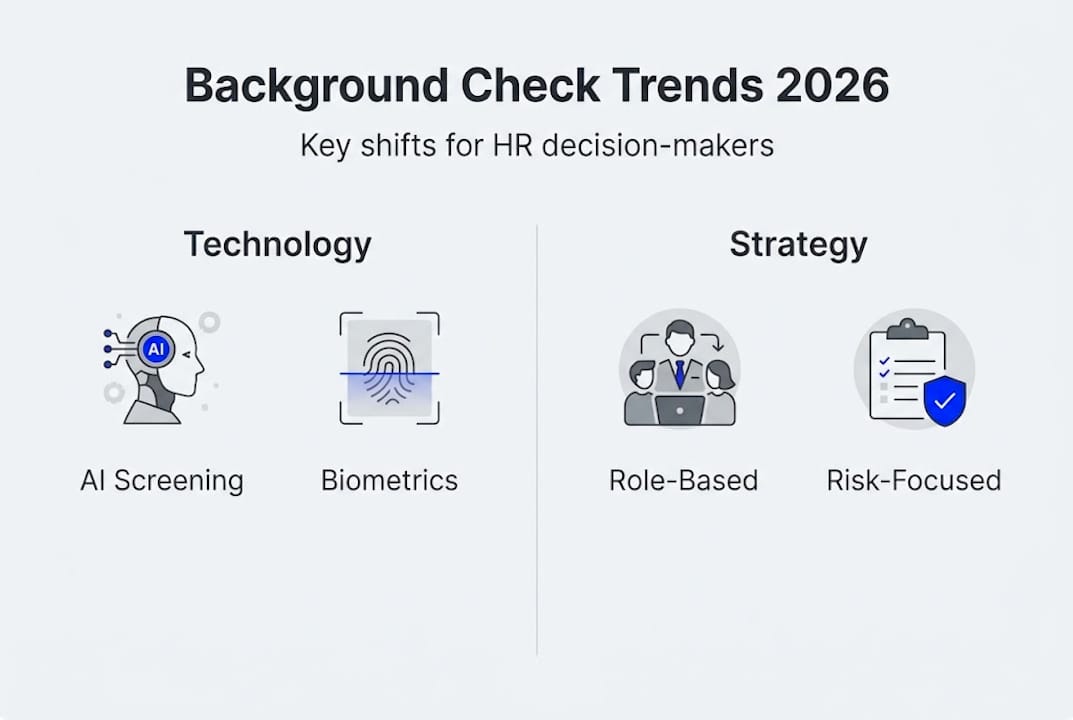
Role-based screening means defining the specific checks required for each position category based on the access, authority, and risk that role carries. Risk-based screening adds a dynamic layer, adjusting the depth of investigation based on factors like the applicant’s history, the sensitivity of the role, and the agency’s current risk environment.
Here is how to implement this model effectively:
- Map every role to a risk tier. Sworn officers, armed security, and dispatch personnel belong in the highest tier. Civilian support staff and volunteers occupy lower tiers, though still requiring meaningful vetting.
- Define the required checks for each tier. High-tier roles should include criminal history, credit checks where legally permitted, reference interviews, social media review, psychological evaluation, and driving record checks. Lower tiers may require a subset of these.
- Document your rationale. Every screening decision must be defensible. If you apply a deeper check to one role than another, your policy documentation should explain why.
- Avoid over-screening lower-risk roles. Excessive screening for positions that do not warrant it creates unnecessary delays, increases costs, and can deter qualified candidates.
- Avoid under-screening high-risk roles. This is the more dangerous error. Comprehensive role-based screening for sworn and armed roles is not optional. The consequences of a bad hire in these positions extend far beyond the agency.
One area where agencies frequently underestimate risk is in EMS hiring. EMS background check results consistently show that inadequate screening in this sector contributes to negligent hiring exposure that agencies did not anticipate.
Pro Tip: Build your role-based screening matrix before you need it. Waiting until a vacancy opens to decide what checks apply to that role introduces delay and inconsistency. A pre-built matrix makes every hire faster and more defensible.
Now, let us reflect on what these trends really mean and what most guides will not tell you about adopting new background check approaches.
What most guides miss: Real-world lessons in background checks
Most articles on background check trends focus on what technologies exist and what regulations say. Far fewer address the harder question: why do agencies still make bad hires even when they follow best practices?
The honest answer is that automation and checklists create a false sense of security. A background check platform can tell you that an applicant has no criminal record in the jurisdictions searched. It cannot tell you that the applicant has a pattern of behavior that signals future risk, or that the references provided are personal contacts rather than supervisors. These gaps require human judgment, and specifically, the kind of investigative instinct that comes from experience in law enforcement and public safety vetting.
Another lesson that rarely appears in trend guides: most agencies underestimate how quickly the threat environment changes. A fraud technique that your screening process catches today may be obsolete in six months, replaced by a more sophisticated variant. Agencies that treat their screening framework as a fixed policy rather than a living process are always one step behind.
The most resilient hiring programs we have seen share one characteristic. They invest in training their HR staff to recognize behavioral and documentary red flags, not just to execute a checklist. Understanding investigation principles for hiring is what separates a screening program that catches problems from one that merely documents compliance.
Technology is a tool. Judgment is the skill. The agencies that combine both are the ones that consistently make better hires.
Next steps: Upgrade your agency’s background checks
The trends covered in this article represent both a challenge and an opportunity. Agencies that act on them will hire more reliably, reduce legal exposure, and build stronger teams. Those that delay will face growing fraud risk and compliance gaps.

OMNI Intel is built specifically for this environment. Our pre-employment screening services are designed around the unique demands of public safety hiring, combining investigator-driven methodology with modern technology to deliver accurate, FCRA-compliant results. Whether you need background checks for agencies or full public safety background investigations, our platform adapts to your role-based requirements. We help you move faster without cutting corners. Contact our team today to schedule a consultation and see how OMNI Intel can strengthen your hiring process from the ground up.
Frequently asked questions
How does AI reduce bias in background checks?
AI helps flag bias patterns and automates repetitive tasks, but human review must remain the final decision layer to ensure fairness and legal compliance.
What biometric methods are most common in background checks in 2026?
Facial matching, fingerprint verification, and liveness detection are now widely deployed, driven by the expansion of digital identity verification to combat credential fraud affecting nearly half of all applicants.
Why are role-based screening models replacing traditional checks?
Role-based models focus resources on high-risk positions, improving both safety outcomes and compliance compared to generic packages that apply the same depth to every role regardless of risk.
How can agencies protect privacy when using new screening technologies?
Agencies should use secure, consent-based platforms, maintain clear data retention policies, and ensure full compliance with applicable state biometric and data privacy laws before deploying any new screening technology.
What is the biggest risk if agencies ignore 2026 trends?
Agencies that fail to adapt face record-high fraud rates, negligent hiring liability, and compliance failures that can damage both agency reputation and community trust.