

What Is a Background Investigator Role in Public Safety?
A background investigator is defined as a professional who independently gathers, verifies, and analyzes sensitive personal and professional information to determine whether a candidate meets the legal, ethical, and departmental standards required for public safety employment. This role sits at the center of every responsible hiring decision in law enforcement, fire and EMS, dispatch centers, and government agencies. Standards from bodies like POST (Peace Officer Standards and Training) and TCOLE (Texas Commission on Law Enforcement) govern how these investigations must be conducted. The background check investigator role is not a clerical function. It is a disciplined, fact-finding process that directly shapes who serves and protects the public.
What are the main responsibilities of a background investigator?
A background investigator gathers and verifies criminal history, education, employment records, credit history, and driving records using databases such as NCIC and direct interviews with references, neighbors, and former employers. The scope of this work is broad by design. A single candidate file may require contact with dozens of sources before an investigator can render a complete picture.
The background investigator job description typically includes the following core duties:
- Document review: Examine the candidate’s Personal History Questionnaire (PHQ) and all submitted documents for completeness, accuracy, and internal consistency.
- Record verification: Cross-check claims against NCIC, TLO, state criminal repositories, motor vehicle records, credit bureaus, and educational institutions.
- Interviews: Conduct structured interviews with applicants, personal references, former supervisors, neighbors, and coworkers to corroborate or challenge submitted information.
- Discrepancy resolution: Identify gaps, omissions, or contradictions in the PHQ and address them directly with the applicant during a formal discrepancy interview.
- Report preparation: Compile all findings into a neutral, factual, and legally defensible investigation report that avoids personal opinion.
- Case management: Maintain organized case records and comply with departmental standards, retention schedules, and chain-of-custody requirements.
Pro Tip: Document both positive and negative findings with equal rigor. POST regulations require investigators to present a balanced record, not a case for or against a candidate.
The responsibilities of a background investigator extend beyond paperwork. Investigators also perform fieldwork, which may include traveling up to 50 miles for neighborhood checks and in-person interviews. That physical presence matters because neighbors and former colleagues often share information in person that they would never put in writing.

What qualifications and skills do background investigators need?
Entry-level background investigator positions typically require an associate’s degree plus three years of investigative or law enforcement experience, along with certifications such as VCIN Operator Level B. Preferred qualifications often include hands-on experience with NCIC, TLO, and open-source intelligence tools. Agencies set these bars deliberately because the consequences of a flawed investigation can reach far beyond a single bad hire.
Core qualifications for the role
- Education: An associate’s or bachelor’s degree in criminal justice, public administration, or a related field.
- Experience: Prior work in law enforcement, military intelligence, or investigative services.
- Certifications: POST certification, VCIN Operator credentials, or completion of National Training Standards programs.
- Technology proficiency: Demonstrated ability to navigate NCIC, TLO, LexisNexis, and open-source intelligence platforms.
Skills that separate effective investigators
Emotional intelligence is one of the most critical skills for background investigators, particularly during discrepancy interviews and sensitive conversations with references. An investigator who cannot build rapport will rarely get the candid responses needed to assess a candidate’s true character. Technical skills open doors; interpersonal skills determine what walks through them.
Discretion is equally non-negotiable. Investigators handle sealed records, mental health history, financial data, and personal disclosures. Mishandling any of these can expose an agency to legal liability and destroy a candidate’s reputation without cause. Strong written communication rounds out the skill set, since every finding must translate into a clear, defensible report that a hiring board, attorney, or court could read and understand.
Investigators who pursue continuing education through programs aligned with POST or TCOLE standards consistently produce more thorough and legally sound reports. The field rewards those who treat learning as a career-long commitment, not a box checked at hire.
How does the background investigation process unfold?
The background investigation process follows a structured sequence designed to build an accurate, verifiable record of each candidate. Skipping steps or rushing the timeline creates gaps that can expose agencies to negligent hiring claims. Here is how a thorough investigation typically progresses:
- Initial document review: The investigator receives the candidate’s completed PHQ and supporting documents. Every entry is reviewed for completeness before any external verification begins.
- Records verification: The investigator queries NCIC, state criminal databases, motor vehicle records, credit bureaus, and educational institutions to confirm or challenge the candidate’s stated history.
- Discrepancy identification: Experienced investigators detect inconsistencies in the PHQ by comparing submitted information against database results and social media activity. These inconsistencies become the focus of the next phase.
- Discrepancy interview: The investigator meets with the candidate to address specific gaps or contradictions. This interview tests honesty and serves as an early integrity indicator. A candidate who minimizes or denies clear evidence raises a serious flag.
- Fieldwork: The investigator conducts in-person interviews with neighbors, former employers, personal references, and coworkers. These conversations often surface information that records alone cannot reveal.
- Report compilation: All verified findings are organized into a formal investigation report. The report is factual, descriptive, and free of personal opinion, following POST or agency-specific standards.
The table below shows the primary data types verified during each phase and the sources investigators typically use.
| Investigation phase | Data type verified | Common sources |
|---|---|---|
| Document review | PHQ accuracy and completeness | Candidate submission |
| Records verification | Criminal, credit, driving, education | NCIC, TLO, DMV, institutions |
| Discrepancy identification | PHQ vs. database conflicts | NCIC, social media, open-source |
| Discrepancy interview | Candidate honesty and integrity | Direct applicant interview |
| Fieldwork | Character and conduct | Neighbors, employers, references |
| Report compilation | Full investigative record | All gathered sources |
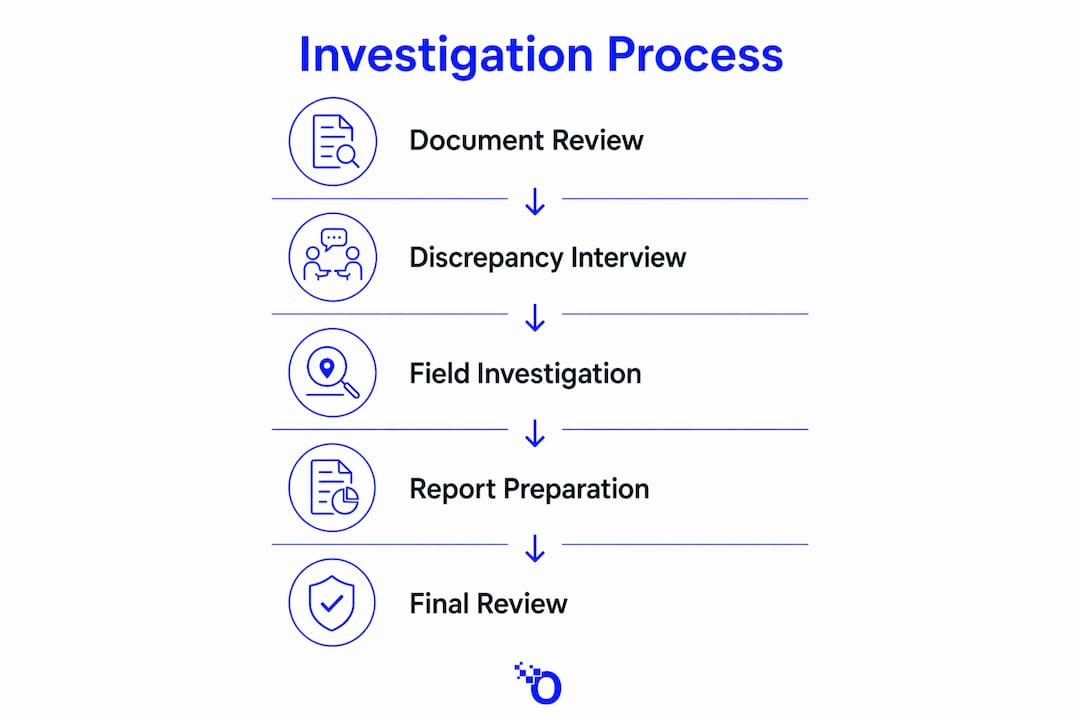
The importance of background checks at each phase cannot be overstated. A gap in step two can invalidate findings in step five. Agencies that treat the process as a checklist rather than a connected investigation consistently produce reports that fail legal scrutiny.
What legal and ethical standards must background investigators follow?
Background investigators must maintain strict confidentiality and follow fair employment laws at the local, state, and federal levels, including employment and privacy regulations that govern how candidate data is collected, stored, and used. Failing to comply does not just expose a candidate to harm. It exposes the agency to significant legal liability.
The core legal and ethical obligations include:
- Bias prevention: Investigators must guard against personal bias and apply equal rigor when documenting both favorable and unfavorable information. A report that selectively emphasizes negatives is not legally defensible.
- Factual reporting: POST regulations require that reports avoid personal opinions and focus exclusively on documented, verifiable evidence. Phrases like “I believe” or “it seems” have no place in an investigation report.
- Privacy compliance: Investigators must balance deep investigative access with candidate privacy rights. Accessing records beyond the scope of the investigation, or sharing findings with unauthorized parties, violates both ethics and law.
- Consistency: Every candidate must be investigated using the same standards and procedures. Inconsistent application of criteria creates disparate impact claims and undermines the agency’s legal defense.
- Legal defensibility: Investigators support legal defensibility by applying consistent standards and documenting every step thoroughly. This reduces agency liability from negligent hiring and protects the public safety mission.
Pro Tip: Review your agency’s background check laws and applicable legal frameworks before opening any new case file. State-specific rules on credit checks, arrest records, and social media review vary significantly and can invalidate findings if ignored.
The Texas Police Chiefs Association’s background investigation manual reinforces that balancing investigative access with candidate privacy is not optional. It is a core professional obligation that protects both the agency’s reputation and the candidate’s rights. Investigators who internalize this balance produce reports that hold up under legal challenge and reflect well on their agencies.
Understanding investigative procedures used in formal legal contexts also helps background investigators appreciate why documentation standards and interview techniques must meet a high bar. The same principles that make an investigation useful in court make it defensible in a hiring dispute.
Key Takeaways
A background investigator’s primary function is to produce factual, bias-free reports that give public safety agencies a legally defensible basis for every hiring decision they make.
| Point | Details |
|---|---|
| Core function | Background investigators verify criminal, employment, education, credit, and driving records using NCIC and direct interviews. |
| Minimum qualifications | Most agencies require an associate’s degree and three years of investigative or law enforcement experience. |
| Process structure | The investigation follows six phases, from PHQ review through fieldwork to formal report compilation. |
| Legal obligation | Investigators must apply consistent standards, avoid personal bias, and comply with federal, state, and local employment laws. |
| Key skill | Emotional intelligence drives effective discrepancy interviews and is as critical as technical database proficiency. |
Why the background investigator role defines agency integrity
The background investigator role is the most consequential position in the public safety hiring pipeline. I have seen agencies treat it as a formality, a box to check before an academy start date. That approach produces officers, dispatchers, and paramedics who should never have been hired, and it produces them consistently.
What most career guides miss is that this role demands two seemingly opposite qualities at the same time. You need the analytical detachment of an auditor and the interpersonal warmth of a skilled counselor. A candidate sitting across from you in a discrepancy interview is nervous, often defensive, and sometimes dishonest. Your job is to make them comfortable enough to tell the truth while remaining clear-eyed enough to recognize when they are not.
The other underappreciated reality is that the background investigator is also protecting the candidate. A thorough, fair investigation that clears a qualified person is just as important as one that disqualifies an unsuitable one. Agencies that rush the process or apply standards unevenly end up in court, and they deserve to be there.
Career growth in this field is real. Investigators who build expertise in FCRA-compliant reporting, POST standards, and interview methodology move into supervisory roles, training positions, and consulting work with agencies that need to rebuild their vetting programs. The learning curve is steep, but the professional ceiling is high for those who take the work seriously.
— Matt
How OMNI Intel supports agencies with background investigations
Public safety agencies face mounting pressure to hire qualified candidates faster without sacrificing the depth of investigation that protects communities and limits liability.

OMNI Intel’s pre-employment screening services are built specifically for law enforcement, fire and EMS, dispatch centers, and government entities. The platform supports every phase of the background investigation process, from initial PHQ review through final report compilation, using investigator-driven workflows that meet POST and FCRA compliance standards. Agencies gain access to structured investigation tools, legally defensible report formats, and AI-assisted recruiting features that reduce time-to-hire without cutting corners. Whether you are building a background investigation program from the ground up or strengthening an existing one, OMNI Intel provides the infrastructure to do it right.
FAQ
What is a background investigator role in public safety?
A background investigator independently gathers and verifies criminal, employment, education, credit, and driving records to assess whether a candidate meets the legal and ethical standards for public safety employment. The role requires producing factual, bias-free reports that support legally defensible hiring decisions.
What does a background investigator do during a discrepancy interview?
A background investigator uses the discrepancy interview to address specific gaps or contradictions between the candidate’s PHQ and verified database records. This interview tests honesty and serves as an early indicator of the candidate’s integrity.
What qualifications are needed to become a background investigator?
Most agencies require an associate’s degree and at least three years of investigative or law enforcement experience, along with certifications such as VCIN Operator Level B or POST credentials. Proficiency with NCIC, TLO, and open-source intelligence tools is typically preferred.
Why are background checks important for public safety agencies?
Background checks protect agencies from negligent hiring liability and protect communities from personnel who do not meet the integrity standards required for public safety roles. Consistent, thorough investigations also create a legally defensible hiring record that holds up under legal challenge.
How long does a public safety background investigation take?
The timeline varies by agency and candidate complexity, but a thorough investigation covering all six phases, from document review through report compilation, typically requires several weeks. Agencies that skip phases to accelerate hiring risk producing reports that fail legal scrutiny.